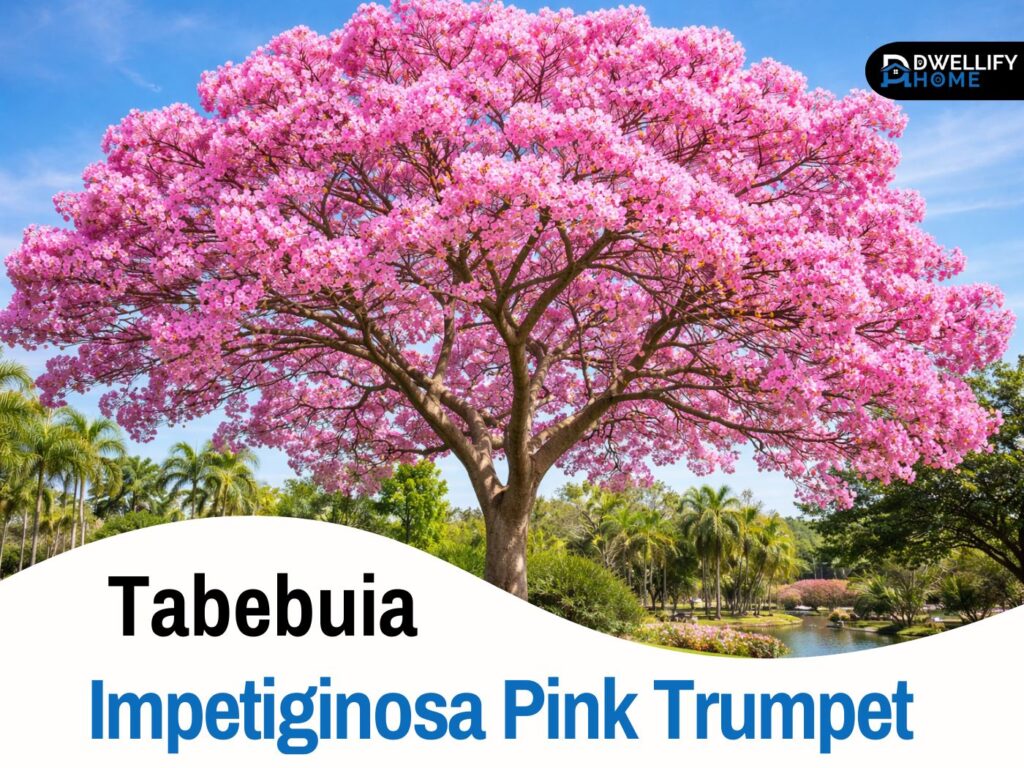
There are flowering trees that look nice, and then there are flowering trees that stop people in their tracks. The Pink Trumpet Tree is in that second group. When it blooms on bare branches, it doesn’t just add color, it creates a full-on “wow” moment that can make a plain yard feel like a postcard.
In my own work, I’ve seen homeowners fall in love with this tree the first time they watch it bloom. Then a few weeks later, they panic because leaves drop, petals litter the driveway, or the tree looks “empty” before flowering. Don’t worry, most of that is normal behavior for this type of tree. Once you understand its rhythm, it’s actually a very satisfying tree to grow.
This guide walks you through the real-world care of the Pink Trumpet Tree: where it performs best, what it needs to flower heavily, how big it gets, how fast it grows, and the honest pros and cons. I’ll share the practical details I give clients when we’re standing in the yard deciding where it should go.
Snippet-Ready Definition:
Tabebuia impetiginosa Pink Trumpet is a warm-climate flowering tree known for its bright pink trumpet-shaped blooms, leaf drop before flowering, moderate growth, and strong performance in sunny, well-drained landscapes.
Mission Statement:
At Dwellify Home, our mission is to provide clear, experience-based guidance that helps homeowners make confident decisions about their homes, landscapes, and outdoor spaces — without confusion or hype.
Quick profile (at-a-glance facts for homeowners)
The Pink Trumpet Tree is a warm-climate ornamental known for dramatic pink trumpet-shaped blooms that often arrive before the leaves. It’s a popular choice for front yards, courtyards, and along streets because it gives strong seasonal color without needing constant attention once it’s established.
A few quick notes that matter in real life. It likes sun. It hates soggy soil. And it doesn’t love cold snaps. If you live in a warm region and you can give it good drainage, you’ll get the best performance with the least fuss.
If you want the “quick decision” version, here it is:
- Best in full sun with well-drained soil
- Moderate to fast growth when happy
- Can reach medium-to-large shade-tree size
- Drops leaves before bloom in many climates
- Drought tolerant once established, but not indestructible
Quick Guide Table: Pink Trumpet Tree at a Glance
| Feature | Details |
| Botanical Name | Tabebuia impetiginosa (also Handroanthus impetiginosus) |
| Common Name | Pink Trumpet Tree |
| Mature Height | 25–50 feet |
| Growth Rate | Moderate to fast in warm climates |
| Sun Requirement | Full sun |
| Water Needs | Moderate; drought tolerant once established |
| Soil Type | Well-drained soil only |
| Climate | Warm climates (Zones 9–11) |
| Flower Color | Pink to magenta |
| Bloom Time | Late winter to early spring |
| Special Note | Drops leaves before blooming |
Step-by-Step Care Basics (Simple & Practical)
- Choose full sun — at least 6–8 hours daily for strong flowering
- Plant in well-drained soil — avoid low or soggy areas
- Water regularly during establishment — then reduce gradually
- Fertilize lightly after leaf-out — avoid winter feeding
- Prune only after flowering — focus on structure, not heavy shaping
Identification & correct naming (Tabebuia vs Handroanthus)
The naming confusion explained
You’ll see two different names used for the same tree: Tabebuia impetiginosa and Handroanthus impetiginosus. That’s not you being confused, that’s botany doing what it does. In practical terms, nurseries, older labels, and many landscape references still use “Tabebuia” because it’s familiar. More updated references may list it under “Handroanthus.”
When you’re buying, the best move is to treat both names as connected and focus on the plant’s actual features and the seller’s photos. If a listing only says “pink trumpet tree” with no botanical name, be extra careful because several trumpet trees get marketed under similar names.
How to confirm you’re buying the right pink trumpet tree
When I’m helping a client choose one, I look at structure and identity at the same time. You want the right species, but you also want a tree that will hold together for years.
A simple checklist before you purchase:
- The tag should say Tabebuia impetiginosa or Handroanthus impetiginosus
- Leaves are usually palmately compound, meaning several leaflets radiate from one point
- Bloom photos should show pink trumpets in clusters, often before leaves appear
- Avoid trees with tight V-shaped branch unions low on the trunk, those can split later
If you’re shopping online for a tabebuia impetiginosa pink trumpet for sale, ask for clear photos of the trunk, the base of the plant, and the soil surface in the pot. That tells you more than a flower photo ever will.
Key characteristics (flowers, leaves, habit, mature size)
Flowers (the main event)
The flowers are the reason most people plant this tree. You get large clusters of rosy-pink to magenta trumpet-shaped blooms, and they can appear when the branches are mostly bare. That contrast is what makes the canopy look painted.
One of my favorite client moments is the first bloom season after planting. They’ll text a photo saying, “It finally did it.” And yes, it’s worth the wait. The bloom show tends to be stronger when the tree is in full sun and not being overfed with nitrogen-heavy fertilizer.
Foliage + seasonal behavior
After flowering, leaves usually come in and the tree shifts into its “green season.” The leaves are often dark green and divided like a hand shape, which gives the canopy a lighter, airy texture than many broadleaf trees. In warmer areas it can behave semi-evergreen, while in cooler or drier cycles it may drop more.
That leaf drop before bloom is what scares people the first time. They think something is wrong because the tree looks thin, then suddenly it explodes with color. That’s just its normal timing. It’s one reason it photographs so well.
Tabebuia impetiginosa pink trumpet height & canopy shape
Let’s talk size in a way that actually helps you plan. The tabebuia impetiginosa pink trumpet height is commonly in the medium-to-large tree range, and in good conditions it can become a real shade tree. Think roughly 25 to 50 feet tall over time, with a rounded canopy.
In a small yard, that matters. I’ve seen people plant it six feet from a wall because it came in a 15-gallon pot and looked “small.” A few years later, it’s pushing branches into rooflines. Give it room from the start and you’ll enjoy it instead of fighting it.
Tabebuia impetiginosa pink trumpet growth rate (realistic expectations)
The tabebuia impetiginosa pink trumpet growth rate is best described as moderate to fast when conditions are right. In warm weather, full sun, and well-drained soil, it can put on noticeable growth each season. In marginal conditions, especially with cold stress or heavy clay soil, it slows down.
Here’s a real-world pattern I’ve observed: many trees focus on roots first after planting. The top growth may look modest in year one, then it picks up in years two and three once the root system settles in. That’s a good sign, not a problem.
Best growing conditions (where it thrives)
Sun requirements (for maximum flowering)
If you take only one tip from me, make it this: give it full sun. This tree uses sunlight like fuel for flowers. In partial shade, you’ll still get growth, but flowering often becomes weak and uneven. It might bloom on one side and skip the side that’s shaded by a building or larger tree.
In front yards, I like an open spot where it gets sun from late morning through afternoon. That’s usually enough to drive strong bloom production and keep branches sturdier.
Soil & drainage (the non-negotiable)
Good drainage isn’t just a preference here, it’s a survival issue. The Pink Trumpet Tree can handle dry periods once established, but it doesn’t handle wet feet for long. Soggy soil leads to stressed roots, thin canopies, and a tree that never looks truly happy.
A quick, practical test: dig a small hole about a foot deep, fill it with water, and see how fast it drains. If water is still sitting there hours later, plan for drainage improvements or choose a different planting spot. Raised planting, slight mounding, or improving the soil structure can make a huge difference.
Climate, zones, and frost protection
This is a warm-climate tree at heart. In regions similar to USDA Zones 9 to 11, it tends to perform best. If you get frost, it may still survive, but it can take damage and lose its bloom potential for that season.
If you’re right on the edge of its comfort range, plant it in the warmest microclimate you have. Near a south-facing wall, away from low spots where cold air settles, and sheltered from harsh winds. Those small location choices can be the difference between thriving and struggling.
Planting the right way (setup that prevents future problems)
Planting is where most long-term problems get locked in, so it’s worth doing carefully. I like planting when the soil is warming up and the risk of cold snaps is lower. That gives the tree time to root out before facing stress.
Spacing is another big one. Give it room for a rounded canopy. Keep it away from tight corners, overhead wires, and rooflines. If you want it near a patio, place it where the canopy can shade the space without branches scraping the roof later.
A few planting habits I recommend in real landscapes:
- Plant at the same depth it was in the pot, or slightly higher if drainage is questionable
- Mulch in a wide ring, but keep mulch off the trunk
- Stake only if the tree truly wobbles, and remove staking once it’s stable
Watering (simple schedule, not confusing)
Establishment watering (first 8–12 weeks)
Newly planted trees don’t need constant water, they need consistent water. I usually tell clients to water deeply, then let the top few inches of soil dry slightly before the next watering. That encourages roots to move outward instead of sitting near the trunk.
A simple rhythm that often works is deep watering a couple of times per week at first, then adjusting based on heat, wind, and soil type. Sandy soil dries faster. Clay holds water longer. Your goal is steady moisture, not swampy soil.
Once established: drought tolerance, but not “no water ever”
Once established, it becomes much more forgiving. That’s where the reputation for drought tolerance comes from. Still, during long hot stretches, an occasional deep soak helps keep bloom potential strong and prevents stress that can lead to weak branch growth.
Think of it like this: drought tolerance means it can survive without perfect watering. It doesn’t mean it looks its best with zero help.
Overwatering warning signs (common reason for decline)
Overwatering is sneaky because it looks like “care.” You water more, the tree looks worse, so you water even more. I’ve seen that cycle many times.
Watch for:
- Yellowing leaves when the soil is still wet
- Limp, weak-looking new growth
- A musty smell or constantly damp soil around the root zone
If those show up, pause watering and focus on drainage. Most of the time, the fix is less water, not more.
Fertilizing & pruning (expert-style care without overdoing it)
Fertilizing timing (when to feed, when to stop)
If the tree is planted in decent soil, it doesn’t need heavy feeding. Overfeeding, especially with high-nitrogen products, can push leafy growth at the expense of blooms. That’s the opposite of what most homeowners want.
I prefer a balanced, slow-release fertilizer after new leaves emerge. Avoid winter feeding. In cooler seasons the tree isn’t actively growing, and fertilizer at the wrong time can encourage soft growth that gets damaged.
Pruning after flowering (light and strategic)
Pruning is best kept light and purposeful. Right after flowering is a good window to remove dead tips, crossing branches, and any awkward growth. Heavy pruning can reduce the next bloom cycle because you may remove flowering wood or stress the tree.
In most yards, you’re aiming for a clean structure, not a sculpted shape. Let it look like a tree.
Structural training early (important safety + longevity)
This is a professional tip that saves headaches later. Pink trumpet trees can develop weak branch unions, especially if they form tight angles. Those unions sometimes split as the tree gains weight, especially during wind or heavy rain.
Early on, pick a strong central leader when possible, and encourage wide branch angles. If you’re not comfortable doing structural pruning, this is one area where hiring a qualified arborist for one visit can pay off for years.
Bloom cycle & what to expect each year
This tree has a rhythm. In many warm climates, it drops foliage, then blooms, then leafs out again. The bare-branch bloom is normal and part of the appeal.
Bloom timing can vary based on local weather and microclimate. A warmer winter can shift the bloom earlier. A cold snap can shorten the show. A stressed tree may bloom lightly, then rebound the next year once conditions improve.
After bloom, you may see seed pods form. They can be a little messy if the tree is over a driveway or pool area. That’s why placement matters. If you plant it where fallen petals and pods don’t bother you, you’ll enjoy it much more.
Common problems (and fixes that actually work)
The most common complaint I hear is, “It’s not flowering.” In most cases, it comes down to light, feeding, or patience. Too much shade is the number one culprit. Too much nitrogen is another. And sometimes the tree is simply not mature enough yet.
Cold damage is another issue in borderline climates. If frost nips the tips, don’t rush to prune everything immediately. Give it time to show what’s truly dead once warmer growth starts. Then prune carefully back to healthy tissue.
Branch splitting is the one problem that can become serious. If you see a crack forming at a branch union, that’s not something to ignore. Light corrective pruning may help when it’s early. If a large limb is involved, get a pro to evaluate it before a storm does the decision for you.
Pink trumpet tree pros and cons (honest homeowner section)
Let’s keep this straight and useful.
Pros:
- Huge seasonal impact with spectacular blooms
- Handles heat well in warm regions
- Drought tolerant once established
- Works as a focal-point ornamental or a street tree
Cons:
- Frost sensitivity can reduce blooms or cause damage
- Leaf and flower drop can feel messy in the wrong spot
- Can develop weak branch unions without early structure care
- Needs full sun to perform at its best
If you’re choosing between this and another flowering tree, the deciding factors are usually climate and placement. In the right spot, it’s a showstopper. In the wrong spot, it’s a constant compromise.
Landscape uses & design ideas (practical placement)
As a design tree, this one shines as a specimen. I like it where it can be seen from windows or the street, because its bloom show is a seasonal event. Courtyards are great too, as long as there’s enough sun and drainage.
For patios, place it so it gives shade later without dropping flowers directly onto outdoor furniture during peak bloom. Along streets, give it enough soil volume and avoid planting where roots will be trapped by hardscape on all sides.
For underplanting, keep it simple. Choose drought-tolerant groundcovers or low perennials that won’t need constant irrigation. Constant wet soil under a pink trumpet tree is a recipe for long-term stress.
Buying guide
Where to buy tabebuia impetiginosa pink trumpet (smart options)
If you’re wondering where to buy tabebuia impetiginosa pink trumpet, start with local nurseries that actually grow trees for your climate. Local stock is often better acclimated and easier to establish. On top of that, you can inspect structure and root health in person.
Online sources can work too, especially when local availability is limited. If you’re considering a pink trumpet tree for sale online, focus on sellers who provide real photos, clear sizes, and a straightforward shipping and replacement policy.
Tabebuia impetiginosa pink trumpet for sale: what to check before you pay
This is where my arborist brain kicks in. Flowers are fun, but structure is forever.
Check for:
- A trunk that’s straight and sturdy, not thin and whippy
- Branches that attach with wider angles, not tight V shapes
- No obvious trunk wounds
- Roots that aren’t circling heavily at the pot edge
If you can, lift the pot slightly and look at drainage. If water stays pooled on top after watering, that tells you the mix may be too heavy or compacted.
Pink trumpet tree for sale: avoid common purchasing mistakes
The biggest mistake is buying the tallest tree because it feels like a shortcut. A slightly smaller tree with great structure often outperforms a taller, poorly structured one within a couple of seasons. It also adapts better after planting.
Also, avoid planting a stressed tree immediately into a difficult site. If your soil drains poorly, fix that first. Otherwise you’ll blame the tree for a site problem.
Safety & confusion with “lapacho/pau d’arco” (quick clarity)
You might come across the words lapacho or pau d’arco in conversations about this species group. Those terms are often tied to herbal products and bark, while this guide is strictly about the ornamental landscape tree.
In practical yard terms, your focus should stay on the tree’s growing needs: sun, drainage, and smart early pruning. Keeping that simple approach will help you avoid the rabbit holes that don’t affect landscape success.
FAQs: Real Questions People Ask
Where do pink tabebuia trees grow best?
Pink tabebuia trees grow best in warm, sunny climates with well-drained soil. They perform especially well in tropical and subtropical regions where frost is rare.
Are tabebuia tree roots invasive?
No, tabebuia tree roots are not considered invasive. However, like any medium-to-large tree, they need adequate space away from foundations and hard surfaces.
Do Tabebuia trees like sun or shade?
Tabebuia trees strongly prefer full sun. While they may survive in partial shade, flowering will be reduced and growth may become uneven.
How big do pink Tabebuia trees get?
Most pink Tabebuia trees grow between 25 and 50 feet tall with a rounded canopy, depending on climate, soil, and available space.
How long does it take for a pink trumpet tree to flower?
In good conditions, flowering may begin within 3–5 years after planting, though bloom strength improves as the tree matures.
Conclusion:
If you want a flowering tree that looks like a celebration when it blooms, the Pink Trumpet Tree is hard to beat. The best part is that it doesn’t need complicated care. It just needs the right setup: full sun, well-drained soil, and a sensible watering routine while it gets established.
Once it’s settled in, treat it like a mature landscape tree. Water deeply during extreme dry spells, feed lightly after leaf-out if needed, and prune with a light hand after flowering. Most importantly, pay attention to structure early so you don’t deal with branch problems later.
Plant it in a spot where you can enjoy the bloom show and where a little petal drop won’t annoy you. Do that, and you’ll have one of those trees that makes neighbors slow down, look up, and smile every spring.
Disclaimer
This article is for general informational purposes only and is based on professional landscape and arboriculture experience. Local climate, soil, and site conditions may vary. Always consult a qualified arborist or local nursery for site-specific advice.

I’m Bilal, the founder of Dwellify Home. With 6 years of practical experience in home remodeling, interior design, and décor consulting, I help people transform their spaces with simple, effective, and affordable ideas. I specialize in offering real-world tips, step-by-step guides, and product recommendations that make home improvement easier and more enjoyable. My mission is to empower homeowners and renters to create functional, beautiful spaces—one thoughtful update at a time.