Picking a living room rug sounds simple until you’re standing in the store thinking, “Is this too small, too big, or just… weird?” Here’s the thing. A rug isn’t just a decoration. It’s a planning tool. It anchors your seating area, controls the visual scale of the room, and makes the space feel finished.
In real homes, the wrong rug size is one of the fastest ways to make a living room feel smaller and less comfortable, even if the furniture is beautiful. So let’s make this easy. I’ll walk you through designer-proven sizing rules, standard dimensions, and layout tips that actually work in day-to-day living.
Snippet-Ready Definition:
Rug sizes for living room refer to choosing the right rug dimensions that anchor furniture, balance the space, and improve comfort, using proper placement rules based on room size and seating layout.
Mission Statement:
Our mission is to help homeowners make confident, practical design decisions by explaining home planning concepts in a simple, experience-based way that works for real daily living.
Quick Answer First: The best rug size rules for living rooms
If you only remember three things, remember these:
- Anchor the seating area, not just the coffee table.
- Front legs on the rug is the safest, most practical rule for most rooms.
- Leave a border of exposed floor around the rug so it doesn’t feel wall-to-wall.
A rug that’s too small tends to “float” in the middle of the room. It makes furniture look disconnected, like each piece is doing its own thing. On top of that, it can make your living room feel less welcoming because your feet keep stepping off the rug as you move around.
A better approach is to decide where your “conversation zone” starts and ends, then choose a rug that supports that zone. Think of the rug as the stage where your living room life happens.
The fastest method: painter’s tape test (real-home sizing)
Guess what works better than measuring once and hoping for the best? Painter’s tape.
Before you buy anything, tape out a few common rug sizes on your floor. Try 8×10, 9×12, and if you have a big space, 10×14. Then:
- Walk through the room like you normally do
- Sit down and stand up like you’re hosting someone
- Check door swings and pathways
- Look at how the rug relates to the sofa and chairs
The best part is you’ll immediately see if the room feels anchored or awkward. I’ve seen people change their mind in five minutes once the tape is down.
Quick Comparison Table: Living Room Rug Size Guide
| Living Room Type | Recommended Rug Size | Best Placement Style |
| Small apartment living room | 6×9 ft | Front legs on |
| Medium living room | 8×10 ft | Front legs on |
| Large living room | 9×12 ft | All legs on |
| Extra-large or open concept | 10×14 ft | All legs on |
| Living room with sectional | 9×12 or 10×14 ft | Extend under seating |
Step-by-Step: How to Choose the Right Rug Size
- Measure your seating area, not the full room
- Decide your layout style (front legs on or all legs on)
- Leave visible floor space around the rug edges
- Use painter’s tape to test sizes on the floor
- Choose the larger size if you’re between two options
This method works in real homes and prevents expensive mistakes.
Quick Rules List (Easy to Remember)
- Never place a rug only under the coffee table
- Front legs of the sofa should touch the rug at minimum
- Bigger rugs usually make rooms feel larger
- Keep walkways clear and comfortable
- Sectionals almost always need larger rugs
Standard rug sizes for living room (most common options)
Most living rooms look best when you stick with classic area rug sizes. These are the ones you’ll see again and again because they fit real furniture groupings.
Common choices include:
- 5×7: small seating setups, layered rugs, or tight apartments
- 6×9: compact rooms where you still want a proper seating zone
- 8×10: the most common “safe” choice for many homes
- 9×12: ideal for larger seating groups or open layouts
- 10×14: great rooms, large sectionals, and wide spaces that need scale
Here’s the practical rule. If you’re between sizes, go bigger unless it breaks your walkways or hits the walls. A slightly larger rug usually makes the room feel more generous. A slightly smaller one almost always looks like a compromise.
Rug sizes for living room in feet, inches, and standard rug sizes in cm
If you shop across brands, you’ll see measurements shown in different units. Here’s a simple reference that helps when you’re comparing listings.
- 5×7 ft equals 60×84 inches and about 152×213 cm
- 6×9 ft equals 72×108 inches and about 183×274 cm
- 8×10 ft equals 96×120 inches and about 244×305 cm
- 9×12 ft equals 108×144 inches and about 274×366 cm
- 10×14 ft equals 120×168 inches and about 305×427 cm
If you want a quick way to remember it, think like this. A rug listed in centimeters near 200×300 cm is roughly a 6.5×10 ft feel, and 274×366 cm is the classic 9×12 scale.
How to measure your living room the right way (so you don’t waste money)
A lot of people measure the room walls and pick a rug based on that. It’s not wrong, but it’s not the best way either.
A living room rug should be sized to your seating arrangement, not the empty space around it.
Start with these steps:
- Measure your sofa length
- Measure the distance from sofa to TV wall or focal point
- Measure chair placement if you have accent chairs
- Decide how much of the furniture will sit on the rug
Now check your circulation. In well-planned rooms, you want clear walkways, usually around 30 to 36 inches for major paths. If your rug choice starts squeezing those paths, it’s a sign you should adjust layout, not force the rug.
A tip from real homes: if you have kids, pets, or frequent guests, don’t design for a showroom. Design for how the room is actually used. A rug that supports movement and seating will always feel better than one that looks perfect but trips people up.
Rug sizes for living room by room size
Room size matters, but not in the way most people think. A smaller room doesn’t always need a small rug. In fact, a slightly larger rug can make a small room feel bigger because it creates one cohesive zone.
Small living rooms
For small spaces, 6×9 often works well, and 8×10 can still work if the furniture grouping is tight and the pathways stay clear.
A practical setup is front legs on, with the rug extending beyond the sofa edges by a little. That extra width makes the room feel more balanced.
If you’re choosing rugs for living room in feet for a smaller layout, focus on whether you can fit:
- Sofa front legs on the rug
- Chair front legs on the rug
- Coffee table comfortably centered
Medium living rooms
This is where 8×10 and 9×12 shine. If you have a standard sofa plus two chairs, an 8×10 often lands in that sweet spot.
If the seating group feels wide, or you have a larger coffee table, 9×12 is usually the better long-term decision. It gives you flexibility if you change furniture later.
Large living rooms and great rooms
Larger rooms need rugs with presence. This is where 9×12 and 10×14 feel right. Many people try to save money with an 8×10 in a big room, and it almost always looks undersized.
Large rug sizes for living room (when 9×12 or 10×14 is the right call)
Go with a larger rug when:
- Your sofa is long, or you have multiple seating pieces
- There’s a wide gap between seating and the focal wall
- The room is open concept and needs zoning
- You want all legs on the rug for a cohesive feel
The best part is a larger rug often makes your furniture look more expensive because the proportions finally make sense.
Rug placement layouts that designers use (pick your look)
You can choose a rug size that fits and still place it in a way that looks off. Placement matters as much as dimensions.
Here are the three layouts I rely on when planning rooms.
All legs on
This is the most “finished” look. Every major seating piece sits fully on the rug. It’s great for large rooms, formal living rooms, or anyone who loves that pulled-together feel.
Front legs on
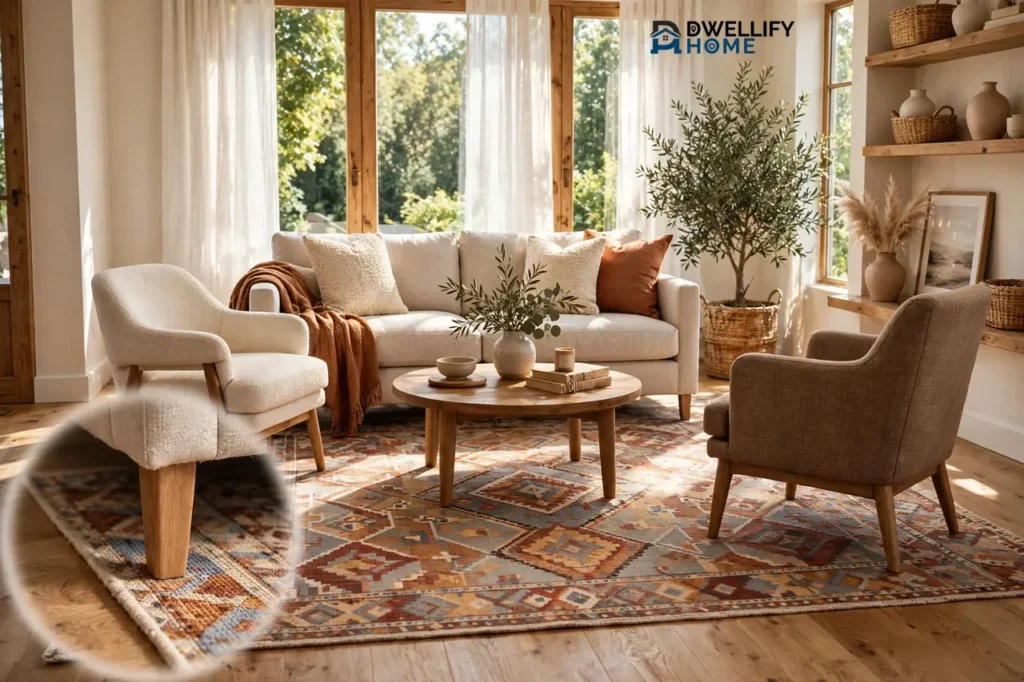
This is the best everyday layout. The sofa and chairs place their front legs on the rug, while back legs stay off. It anchors the group without requiring a giant rug.
Floating
This means no furniture legs touch the rug. It can work in a very small room, but it’s also the easiest way to make a room feel disconnected. If you go this route, make sure the rug is still large enough to visually connect the coffee table and the seating zone.
Rug size for living room with sectional (L-shape, chaise, corner sectional)
Sectionals change the game because they cover a lot of floor area. If the rug is too small, the sectional will dominate and the rug will look like a mat in front of it.
A good rule is this: the rug should extend beyond the sectional’s key edges so the seating zone feels intentional, not accidental.
For many sectionals, these are common outcomes:
- Medium sectional: often needs 8×10 or 9×12
- Large sectional: often needs 9×12 or 10×14
If you have a chaise, don’t force the rug to stop short of it. Let the rug either include the chaise front legs or extend far enough that the chaise doesn’t look like it’s hovering off the side.
In open concept spaces, a sectional rug also acts like zoning tape. It tells the eye, “This is the living room area.” That’s why large rug sizes for living room setups are so popular in modern homes with combined kitchen and living areas.
What size rug for living room apartment (small-space rules that actually work)
Apartment living rooms often have tight circulation, awkward corners, and limited wall-to-wall space. But you can still make it look polished.
A reliable approach is:
- Choose 6×9 if your seating is compact
- Choose 8×10 if you can fit front legs on without blocking walkways
If the room is narrow, a rectangular rug placed correctly can make it feel wider. Keep a clean border and avoid pushing the rug into the walls. That little frame of exposed floor helps your room breathe.
Another real-life tip: if you can’t afford a larger rug right now, don’t go tiny. Instead, go with a well-sized 6×9 and use the front-legs-on placement. It looks intentional and avoids that “I bought the smallest option” vibe.
Where the rug should sit under the sofa and coffee table
This is where the room either feels designed or improvised.
For most living rooms, aim for the rug to sit under the front legs of the sofa and extend far enough to hold the coffee table comfortably. Your coffee table should not feel like it’s balancing on the edge.
Try these spacing guidelines:
- Leave a little breathing space between the coffee table and seating for legs and movement
- Keep the coffee table centered on the rug
- Avoid placing the rug only under the coffee table without touching seating
If you’re dealing with rug sizes for living room in inches on a product listing, focus on the usable area. A fringe edge looks nice, but the flat portion is what supports furniture placement.
Rug shapes for living rooms (rectangle vs round vs runner)
Rectangles dominate living rooms for a reason. They match the geometry of sofas and room walls.
Rectangular rugs
Best for most setups, especially sofa plus chairs arrangements.
Round rugs
They can work beautifully in a small seating cluster, under a round coffee table, or in rooms with curved furniture. But round rugs can look odd under long sofas unless the room layout supports it.
Runner rugs
These aren’t usually the main living room rug, but they’re great for connecting spaces. For example, a runner can soften an entry path into the living room or add comfort along a walkway behind a sofa.
Material, pile height, and rug pad basics (comfort plus safety plus long life)
Size is the headline, but comfort and performance matter too.
If you have a busy household, consider:
- Low to medium pile for easier cleaning
- Durable fibers that handle foot traffic
- A rug pad for safety and stability
A rug pad does three big jobs:
- Reduces slipping
- Protects the rug backing and your floor
- Adds comfort underfoot
A simple rule is to choose a pad slightly smaller than the rug so it doesn’t peek out. This matters a lot in real homes, especially with kids running through the room.
Common mistakes that make a living room rug look “wrong”
I’ve walked into many living rooms where everything was nice, but the rug made the space feel off. These are the usual culprits.
- Rug too small so the seating area looks disconnected
- Rug pushed to the wall with no border of exposed floor
- Wrong shape that fights the furniture layout
- Overly busy pattern in a small room, making it feel crowded
- No rug pad, causing bunching, curling edges, and slipping
Here’s the thing. A rug doesn’t need to be expensive to look right. It just needs to be sized and placed correctly.
Room-to-room sizing comparison (for readers shopping more than one rug)
If you’re buying rugs for multiple rooms, it helps to know that each space has its own rules.
For rug sizes for bedroom, people often choose rugs that extend beyond the bed sides so your feet land on something soft when you get up. Common options include 6×9 and 8×10 depending on bed size and layout.
For rug sizes for dining room, sizing is all about chair movement. You want the chairs to stay on the rug even when pulled out.
Dining room sizing rule (the chair test)
A practical way to test it is:
- Pull a dining chair out like someone is sitting down
- Make sure all chair legs still stay on the rug
If chairs catch on the rug edge, it becomes annoying fast. Dining rooms benefit from larger rugs for that reason.
Quick rug size chart (simple decision guide)
Here’s a clean way to decide without overthinking it:
- Small living room or apartment: 6×9 or 8×10 if walkways allow
- Medium living room: 8×10 or 9×12 depending on seating width
- Large living room or open concept: 9×12 or 10×14 to avoid the “floating” look
- Sectional: usually 8×10 minimum, often 9×12 or 10×14 for larger sectionals
- Best general placement: front legs on, with a comfortable border around the rug
If you’re unsure between two sizes, the safest bet is the larger one, as long as you keep your pathways clear.
FAQs about rug sizes for living room
What is the perfect size for a living room rug?
The perfect size allows at least the front legs of all seating to sit on the rug, creating a connected and balanced seating area without blocking walkways.
Is a 9×12 rug good for a living room?
Yes. A 9×12 rug works very well in medium to large living rooms, especially when you want all furniture legs on the rug or have a wide seating layout.
Is a 5 by 7 rug big enough for a living room?
Usually no. A 5×7 rug is often too small for a full living room and works better as a layering rug or in very compact spaces.
What are the rules for rugs in living rooms?
Rugs should anchor furniture, avoid touching walls, support seating layouts, and feel proportional to the room. Front legs on the rug is the safest rule.
Should a living room rug go under the couch?
Yes. At least the front legs of the couch should sit on the rug to prevent a floating look and to visually connect the furniture.
Conclusion
Choosing the right rug size isn’t about guessing or copying a showroom. It’s about planning your living room like a real, livable space. Start by anchoring your seating zone, then decide whether you want all legs on or front legs on. From there, use tape to visualize, keep walkways comfortable, and don’t be afraid to size up when the room needs it.
Once you dial it in, everything feels easier. Furniture looks more balanced, the room feels warmer, and the space finally looks like it was meant to be that way. And if you ever get stuck, remember the simplest rule: anchor the seating first, then choose the rug size that supports how you actually live.
Disclaimer
This article is for general guidance only. Rug sizing and placement may vary based on room layout, furniture dimensions, and personal preferences. Always measure your space carefully before purchasing.