You know that moment when the sofa looks perfect, the rug is centered, the chairs are in place, but the room still feels unfinished? Here’s the thing, nine times out of ten, it’s the table in the middle. The right cocktail table makes the whole living room feel balanced, usable, and welcoming.
I’ve planned and styled living rooms for years, and I can tell you this with confidence: the best table isn’t the fanciest one. It’s the one that fits your layout, supports your daily habits, and doesn’t fight the traffic flow. Let’s walk through it like we’re standing in your living room together.
Snippet-ready definition:
A living room cocktail table is the low table that anchors your seating area. It keeps drinks and essentials within reach, balances the layout, and can add storage and style without blocking traffic.
Mission Statement:
Dwellify Home helps you choose living room furniture that fits real life, with simple measurements, layout guidance, and designer-level tips that make your space comfortable, practical, and beautiful.
What Are Living Room Cocktail Tables? (And Are They Different From Coffee Tables?)
In modern homes, cocktail table and coffee table usually mean the same thing: the low table in front of the sofa where drinks, books, remotes, and everyday life land. Some people use “cocktail table” to describe a slightly more decorative or entertaining-friendly style, but functionally, it’s that central anchor piece.
If you’ve ever felt confused by the wording, you’re not alone. Retailers, designers, and homeowners often use both terms interchangeably. So don’t get stuck on the label. Focus on the role it plays in your room: it should feel easy to reach, safe to walk around, and visually proportional to your seating.
One more designer truth: a cocktail table is not just a surface. It’s a spacing tool. It creates a comfortable “conversation distance” between seats, and it keeps the middle of the room from feeling empty.
Quick Guide Table (Fast Comparison)
| What you need most | Best pick | Why it works | Watch-outs |
| Easy walking flow | Round living room cocktail tables | No sharp corners, smoother traffic | Less surface than a rectangle |
| Classic fit with a sofa | Rectangular living room cocktail tables | Balanced proportions, lots of usable space | Can feel tight in narrow rooms |
| Small space flexibility | Nesting tables | Expand when needed, tuck away after | Less “anchor” feel if too small |
| Clutter control | Living room cocktail tables with storage | Hides remotes, chargers, toys, books | Avoid bulky bases in tight rooms |
| Light, airy look | Glass living room cocktail tables | Makes a room feel more open | Shows fingerprints and clutter faster |
| Warm, forgiving surface | Wood living room cocktail tables | Durable, hides wear well | Use coasters to prevent rings |
| Character and charm | Vintage living room cocktail tables | Unique details, often great build quality | Check stability and top damage |
| Collector-style option | Vintage Bassett coffee tables | Popular proportions, classic designs | Inspect veneer edges and drawer glide |
Step-by-step: Pick the Right Table in 7 Minutes
- Measure your sofa length
Aim for a table about half to two-thirds of the sofa length for a balanced look. - Check the sofa-to-table gap
Leave roughly 16 to 18 inches so it’s easy to reach, but you can still move comfortably. - Match the height to real comfort
Most homes do best with a table about seat-height or slightly lower, so it feels natural to use. - Choose the shape based on traffic
Busy walkway or kids, go round or oval. Long sofa and open space, go rectangular. - Decide on storage
If you’re always clearing the top, pick a cocktail table with storage (drawers for hidden clutter, shelf for baskets). - Pick the material for your lifestyle
Wood for everyday durability, glass for a lighter look, mixed materials for modern strength. - Plan a simple styling set
Keep one tray or bowl, one taller item, and one personal touch. Leave open space for daily use.
Quick Pick Guide (If You Want the Right Table in 2 Minutes)
If you want a fast answer before we go deeper, this is the shortcut I use during real consultations.
Choose based on room size and traffic flow
If the room is tight, pick a shape that’s easier to walk around, often a round table or nesting tables. If the room is long or your sofa is large, a rectangular living room cocktail table usually looks best and feels natural.
Choose based on daily life
If you have kids, pets, or a lot of movement, avoid sharp corners and delicate materials. If you love hosting, you’ll want enough surface area for drinks and snacks without crowding.
Choose based on what you need most
If clutter is the constant enemy, go for living room cocktail tables with storage. If you want a lighter visual look in a small space, consider a glass living room cocktail table, just be realistic about fingerprints.
Measure First: The Key Dimensions That Prevent Regret
I’ve seen beautiful tables returned for one simple reason: they didn’t fit real life. Measuring sounds boring, but it’s the quickest way to avoid a table that feels awkward every single day.
Distance from sofa: the comfort gap that keeps walkways clear
A good rule is leaving roughly a forearm’s length between the sofa and the table. In many living rooms, that lands around 16 to 18 inches. Close enough to reach your mug comfortably, far enough that your knees aren’t constantly bumping.
If you have a narrow walkway, give yourself a little more breathing room. I’d rather you reach slightly forward than feel like you’re squeezing through your own furniture.
Height: what looks right and feels comfortable
Most cocktail tables look best when they’re about the same height as the sofa seat cushion, or just a bit lower. Too high and it feels like a barrier. Too low and it becomes annoying to use, especially for drinks.
Here’s a quick way to check: sit on your sofa like you normally do and rest your hand where you’d naturally place a cup. That’s your comfort zone.
Length and proportion: how to match your sofa and seating layout
Visually, a table that’s about half to two-thirds the length of your sofa tends to look right. If it’s much shorter, the center can feel “lost.” If it’s almost as long as the sofa, it can start to look heavy and make the room feel tight.
If you’re using a sectional, think of the longest seating side as your reference point, not the whole L shape.
Best Shapes for Real Living Rooms
Shape isn’t just a style choice. It changes how people move and how the room functions. I always choose shape based on layout first, then aesthetics.
Rectangular living room cocktail tables
These are the easiest to place and the most common. They work especially well with a standard sofa, a long rug, and a classic living room layout. They also give you generous surface space, which is great for families and entertaining.
If your sofa faces two chairs, a rectangle helps define that “conversation lane” in the center.
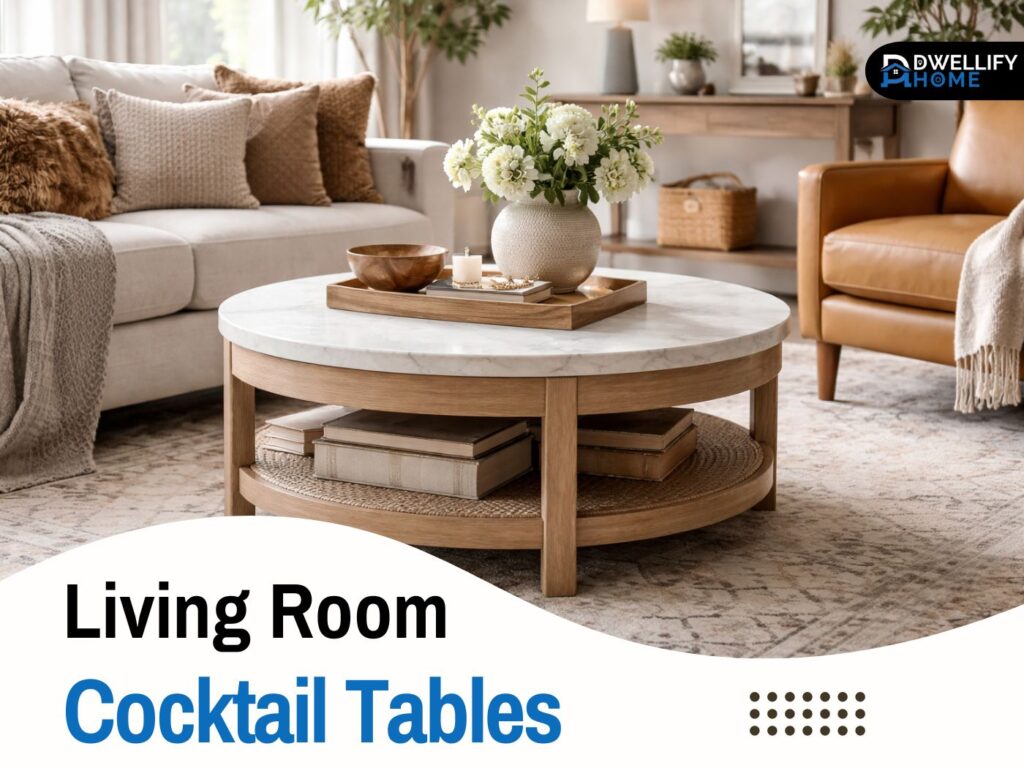
Round living room cocktail tables
Round tables are my go-to for tighter rooms and busy walkways. No corners means fewer bruised hips and less visual bulk. They’re also fantastic if you have a sectional with a curved traffic path around it.
If you’ve got kids, a round table can be a quiet upgrade that makes daily life smoother.
When square, oval, or nesting tables make more sense
Square tables are great when seating is symmetrical, like a sofa facing a loveseat, or a deep sectional where you want equal reach from multiple sides.
Oval tables give you the best of both worlds: the flow of a round shape with a bit more length.
Nesting tables are a lifesaver in small spaces. You can pull the smaller one out when guests come over, then tuck it back in when you want the room to breathe.
Storage That Actually Helps (Not Just “Nice to Have”)
Let’s be honest. Most living rooms collect stuff. Chargers, remotes, coasters, kids’ toys, mail, candles, that one pen that never has a cap. This is where cocktail table with storage options earn their keep.
Shelves vs drawers vs cubbies
A shelf is great if you like baskets or neatly stacked books. It’s quick access and keeps the top from getting crowded.
Drawers are better if you want the room to look calm, even when life is messy. They hide the chaos fast.
Cubbies are a middle ground. They work well for households that need quick grab-and-go storage, like board games or blankets.
Hidden storage and lift-top designs
Lift-tops are surprisingly practical if you eat on the sofa or work from the living room. You can bring the surface closer to you and keep the rest tucked away.
Hidden compartments are perfect for small items like remotes, matches, or spare cables. If you like a clean tabletop, you’ll love this style.
Small-room solutions that don’t feel bulky
If your living room is compact, I often suggest nesting tables or a storage ottoman as a “soft table” option. You can add a sturdy tray on top, and it still feels cozy.
That said, if you want a true table, pick living room cocktail tables with storage that have slim legs and an open base. They feel lighter and less crowded.
Materials Breakdown: What Looks Good and Holds Up Best
This is where real life matters. In a showroom, everything looks perfect. In your home, it meets coffee, kids, sunlight, and the occasional dropped phone.
Wood living room cocktail tables
Wood is warm, forgiving, and easy to live with. It hides fingerprints, it doesn’t feel cold, and it adds texture to almost any style.
For daily use, I like finishes that aren’t ultra glossy. They tend to show fewer scratches and smudges. And if you’re worried about water rings, coasters plus a durable top finish makes a big difference.
Glass living room cocktail tables
Glass looks airy and can make a small room feel more open. It’s also great when you don’t want the table to visually compete with a bold rug.
But here’s the trade-off: glass shows fingerprints and clutter faster. If you’re the type who leaves the remote out and a mug on the corner, glass will highlight it. Tempered glass is the safer choice, especially with kids.
Mixed materials and stone-look tops
Wood and metal combinations are popular because they feel sturdy but not heavy. Metal frames are also great if you like a more modern or industrial vibe.
Stone-look tops, like marble or travertine style finishes, can be beautiful. Just remember they can show etching or stains depending on the material. I usually recommend using coasters and wiping spills quickly, especially with acidic drinks.
Style Match: Pick a Cocktail Table That Fits Your Home
Style should feel natural in your space, not like you copied a staged photo. The goal is harmony with your sofa, rug, and overall vibe.
Vintage living room cocktail tables
Vintage pieces have character you can’t fake. Solid wood, interesting legs, unique hardware, and real craftsmanship.
When you’re choosing vintage, check stability first. Give it a gentle shake. Look underneath. If the joints feel solid and the top isn’t warped, it’s usually a good sign.
Vintage Bassett coffee tables
Vintage Bassett coffee tables are popular because many of them were built with solid materials and classic proportions. You’ll see a lot of mid-century influence, clean lines, and practical sizing.
If you’re buying one secondhand, inspect the veneer edges, drawer function if it has drawers, and any water damage on the top. Most cosmetic wear is fixable, but structural problems can be frustrating.
Modern favorites that work in real homes
Mid-century modern tables pair beautifully with simple sofas and warm rugs. Farmhouse styles tend to look best with textured fabrics and cozy layers. Coastal looks light and relaxed, often with softer tones.
If your room already has a bold rug or statement chairs, keep the table calmer. If your room is neutral and quiet, a more interesting table base can add personality.
Choosing the Right Table for Your Layout
This is where I slow down with clients, because layout makes or breaks comfort.
For a sectional, I often choose an oval, round, or a large rectangle depending on the open side. The key is making sure the people on the chaise side can still reach comfortably.
If you have two sofas facing each other, a rectangle or a large oval usually looks best. It creates a clear center and supports entertaining.
For narrow apartments, nesting tables or a smaller round table can keep the walkway open. You want space for knees and feet, not just a pretty centerpiece.
For open-plan living rooms, pick a table that visually anchors the seating area. A table with a strong base or a warm wood tone can help define the space without adding walls.
Quality and Safety Checklist Before You Buy
A cocktail table gets used constantly, so quality matters more than people expect.
Stability and construction
Give the table a gentle push. If it wobbles in a store, it’ll wobble more at home. Look for solid joinery, sturdy legs, and a base that feels balanced.
Surface durability
If you’re a “coffee and snacks” household, choose a surface that can handle real use. Scratch resistance, water resistance, and easy cleaning are worth prioritizing.
Safety for kids and pets
Rounded corners help more than you think. If you’re choosing glass, make sure it’s tempered. Avoid sharp metal edges or bases that stick out where people walk.
Styling Tips That Look Finished (Not Overdecorated)
Styling should make the room feel welcoming, not delicate. The best part is, you don’t need a lot of pieces.
A simple formula that works in almost every living room:
- One anchor item: a tray or a shallow bowl
- One vertical piece: a small vase or a candle
- One personal touch: a book stack, a small plant, or something meaningful
Leave space on the tabletop for actual living. I always tell homeowners to keep about a third of the surface open. That way, drinks have a home and you’re not constantly moving decor around.
If you like seasonal updates, swap one element only. Change the flowers, switch the candle, or replace the book stack. Small changes keep it fresh without creating clutter.
Care and Maintenance (So It Stays Beautiful)
A table that looks great on day one should still look great next year. A few habits make a big difference.
For wood, use felt pads under decor, wipe spills quickly, and avoid harsh cleaners. A slightly damp cloth and gentle soap usually does the job.
For glass, a microfiber cloth keeps it streak-free. If scratches are a concern, avoid dragging heavy objects and use coasters with a soft bottom.
For mixed materials, keep metal bases dry and dusted. For stone-look tops, coasters and quick wipe-downs prevent most stains.
Trends People Are Shopping Right Now (Without Chasing Fads)
Trends are fun, but comfort and function always win long-term.
Right now, multifunctional designs are everywhere, especially tables that include storage. Sculptural bases are also popular, but I always check if they still allow good knee space and easy walking paths.
Natural textures are also having a moment. Warm woods, soft matte finishes, and subtle stone looks pair nicely with modern sofas and cozy rugs.
If you want a trend that’s truly practical, choose a table that looks lighter on its legs. Open bases and slimmer profiles make a room feel bigger.
FAQs About Living Room Cocktail Tables
What size table works best for a small living room?
Go smaller in footprint, not in usefulness. A round table or nesting tables often give you enough surface without blocking traffic.
How far should the table be from the sofa?
Far enough to walk comfortably, close enough to reach without leaning forward too much. Aim for that comfortable “arm reach” gap.
Should the table be lower or higher than the sofa seat?
Usually the same height or slightly lower looks best and feels easiest to use.
Round vs rectangular, which is better for tight spaces?
Round tends to win for tight spaces because it’s easier to walk around and has no corners.
Are glass tables a bad idea with kids and pets?
Not always. Tempered glass is safer, but you’ll want to stay on top of smudges and keep the surface clear.
Are lift-top tables worth it?
If you eat in the living room or work from the sofa, yes. They can be surprisingly helpful.
How do I style it without clutter?
Keep it simple, vary heights, and leave open space for real use. One tray plus a couple of pieces is plenty.
Conclusion
A great cocktail table doesn’t just look good, it makes the whole living room feel easier to live in. Start with measurements, then pick a shape that matches your traffic flow. Choose materials that fit your habits, not just your taste. And if clutter shows up daily, storage is your best friend.
If you’re stuck between two options, choose the one that feels more comfortable when you sit down and reach for it. That small moment tells you what will work long-term. In the end, the right living room cocktail tables choice is the one that supports your routines while making the room feel complete.
Disclaimer:
This article provides general interior design guidance. Measurements and product suitability can vary by room layout, furniture dimensions, and household needs. Always measure your space and confirm material care instructions before purchasing.