If you’re planning an accessible bathroom upgrade in Raleigh, you’re probably juggling a few concerns at once. You want the bathroom to feel safe and easy to use, you don’t want to waste money on a redo, and you definitely don’t want to hire someone who says “sure, I can do ADA” but doesn’t actually understand what makes a bathroom truly accessible.
ADA-style plumbing is not just about adding a grab bar and calling it a day. The plumbing choices, fixture placement, clearance under a sink, and even the type of faucet handle can be the difference between a bathroom that looks nice and one that works comfortably every single day.
In this guide, I’ll walk you through the real-world checklist, planning tips, common mistakes, and a straightforward way to vet plumbers in Raleigh. I’ll also show you how to compare reviews and prices without getting pulled into hype.
Snippet-ready definition:
ADA-compliant bathroom plumbing in Raleigh means installing sinks, faucets, toilets, and shower controls that are easier and safer to use, with proper clearances, operable handles, and protected piping for accessible, code-aware bathrooms.
Mission Statement:
At Dwellify Home, our mission is to make home upgrades simple, safe, and practical, so you can build spaces that work for real life, including comfort, accessibility, and long-term peace of mind.
What ADA-Compliant Bathroom Plumbing Means (and when it matters in Raleigh)
ADA stands for the Americans with Disabilities Act. In simple terms, it’s a set of accessibility rules designed to make spaces usable for people with disabilities. In public-facing buildings, ADA compliance isn’t optional, it’s part of doing things properly.
For homes, it’s a little different. A lot of homeowners in Raleigh use ADA guidelines as a smart “aging-in-place” plan. That means you’re building a bathroom that stays comfortable if mobility changes later, or if a family member uses a walker or wheelchair, or even if you just want safer footing and easier controls.
On top of that, accessibility upgrades are not only for wheelchair users. Arthritis, shoulder injuries, balance issues, and recovery after surgery can all make a standard bathroom feel harder than it should.
Quick Guide Table (fast checklist for an ADA-style bathroom upgrade)
| Bathroom item | What “ADA-friendly” usually means | Why it matters |
| Sink/vanity | Counter height within accessible range and knee/toe clearance plan | Allows wheelchair approach and comfortable use |
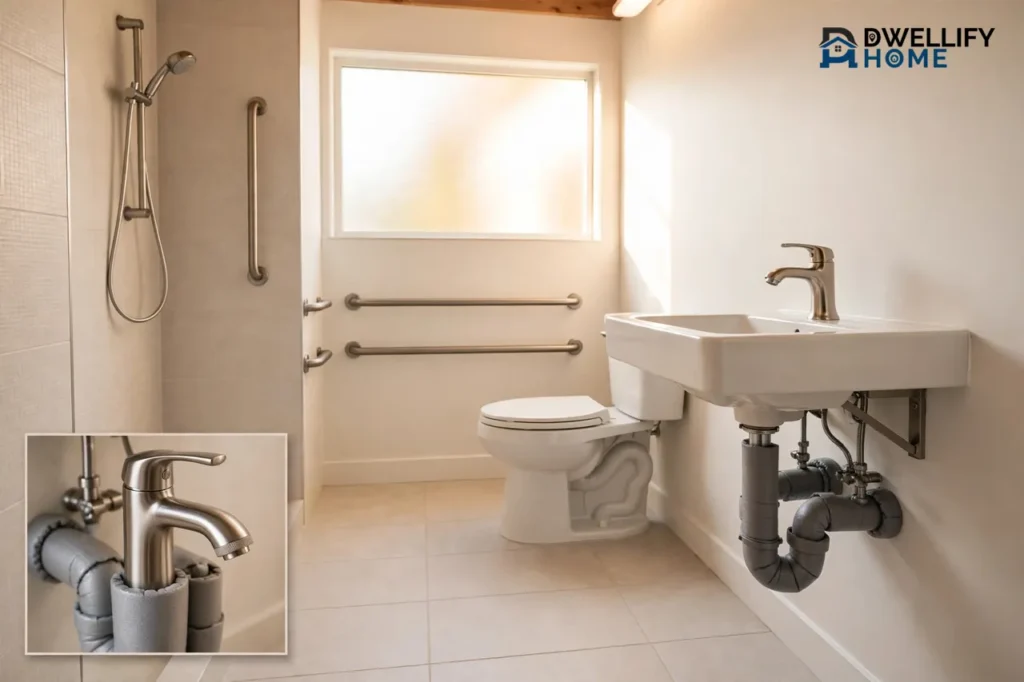
| Under-sink pipes | Exposed supply and drain pipes protected (insulated or covered) | Prevents burns and scrapes on legs |
| Faucet | One-hand operation, no tight grasping or twisting, low-force feel | Easier for arthritis, limited grip strength |
| Toilet | Comfort height option and usable clear space for transfers | Safer sitting/standing and side transfer setups |
| Shower | Handheld showerhead, reachable controls, anti-scald valve setup | Safer bathing, less slip risk, easier reach |
| Grab bars | Correct height range and mounted into solid backing | Real support, not just “decor on tile” |
Step-by-step mini guide (how to hire the right Raleigh plumber)
- Describe the exact accessibility need (wheelchair clearance, arthritis-friendly controls, aging-in-place).
- Ask 3 questions on the phone: sink clearance experience, lever/touchless faucet installs, pipe protection under sinks.
- Request photos of similar jobs (not just a generic bathroom remodel gallery).
- Get an itemized estimate (fixture models, what’s included, what’s excluded).
- Confirm permits for bigger work (moving drains, vents, replacing systems) and don’t assume “DIY is fine.” Local rules often exempt only minor repairs.
Bullet list: what you can usually DIY vs when to hire a licensed plumber in NC
Often considered “minor repairs” (commonly allowed without a license):
- Replacing a faucet or minor fixture parts
- Unclogging a simple drain
- Replacing a trap under a sink without changing the system layout
Usually needs a licensed plumber (and often permits):
- Moving supply or drain lines inside walls
- Altering vents, sewer connections, or gas piping
- System replacements that go beyond minor fixture swaps
Helpful detail: NC rules also include specific cases like water heater replacement, where a property owner may be allowed in limited situations, but it’s still not “minor repair” for most scenarios.
The ADA Rules That Affect Plumbing (the ones that actually change the install)
This is where projects go right or wrong. A bathroom can look updated, but still fail the usability test if the plumbing and fixtures don’t match real accessibility needs.
Knee and toe clearance and sink access (why vanity choice matters)
One of the biggest “hidden” ADA issues is the sink area. Many modern vanities look great, but they block knee space underneath. If someone needs to roll up close, a cabinet base can stop them short.
In practical terms, that means the vanity style matters as much as the faucet or sink bowl. Wall-mounted sinks, open-bottom vanities, or specially designed accessible vanities often work better. And the drain and water lines below the sink need to be planned so they aren’t sitting right where knees and legs go.
Faucet operability (one-hand use, no twisting gripping)
A lot of bathrooms fail accessibility because of the faucet choice. Twist knobs can be tough if someone has limited grip strength. Lever handles are usually easier, and touchless options can be a great fit too, as long as they’re installed and adjusted properly.
The best part is this is one of the easiest upgrades to get right. It’s also one of the first things people notice day-to-day.
ADA Bathroom Plumbing Checklist (fixtures plumbers install or modify)
This section is your “bring it to the appointment” checklist. You don’t need to memorize rules. You just need to know what to ask for and what to watch.
Sink and plumbing under the sink (safety and clearance together)
Under-sink plumbing is often exposed in accessible setups. That’s normal. But exposed doesn’t mean unsafe.
A good accessible install usually includes protection from hot pipes and sharp edges. That can mean insulation covers, protective panels, or thoughtful routing so legs aren’t touching hot surfaces. It also means keeping the trap and supply lines positioned in a way that doesn’t steal the clearance you need.
Quick practical tip: If your contractor suggests a deep cabinet vanity for an “ADA sink,” pause and double check the clearance plan. Cabinets and accessibility often fight each other unless the vanity is made for it.
Faucets and controls (lever, touchless, easy reach)
For most Raleigh homes and small commercial spaces, the simplest reliable choice is a quality lever handle faucet installed at a comfortable reach. Touchless is also popular, especially in clinics and offices, but it should be installed with stable water pressure and sensible sensor settings so it doesn’t act up.
If you’re outfitting a bathroom for someone with limited hand strength, ask about:
- Lever handle models with smooth movement
- Single-handle controls that adjust temperature without being stiff
- Touchless faucets that still allow manual override if needed
Toilets (comfort height, positioning, and transfer-friendly setup)
Toilets are a major part of accessibility, and this is where “ADA-compliant toilet” conversations usually start. Many people are really asking for comfort height and a layout that makes sitting and standing easier.
When toilet replacement is part of the job, a plumber should look at more than the bowl. They should check rough-in positioning, shutoff valve location, clearance around the toilet, and whether grab bars or support features will be installed nearby.
Real-world note: Some comfort height models flush differently than older toilets. If you’ve had clog issues before, talk about flush performance and drain condition at the same time.
Showers and tubs (handheld showerheads, valves, safer bathing)
Accessible shower upgrades are one of the most life-improving changes you can make. Handheld showerheads, a stable mounting bar, and controls that are easy to reach can turn a stressful routine into something safe and comfortable.
If you’re converting a tub to a shower, the plumbing details matter a lot:
- Valve placement that’s reachable without stepping into the spray
- Anti-scald protection through modern mixing valves
- A handheld option that can be used seated or standing
Guess what, a beautiful shower can still be unsafe if the controls are awkward. Placement matters more than fancy finishes.
Grab bars (mounted correctly, not just “stuck on tile”)
Grab bars aren’t plumbing, but plumbers often get asked about them during bathroom projects. The key is how they’re mounted.
A safe grab bar install usually requires solid backing behind the wall surface. Mounting into tile alone is not a reliable long-term plan. This is why coordination between plumber, remodeler, and installer matters.
Planning Before You Call a Plumber (saves money and redo)
The easiest way to cut your costs is to plan before demolition. Moving drain lines, vents, and supply lines can raise the scope fast. Sometimes it’s worth it. Sometimes it’s not.
Before you schedule an on-site visit, measure a few basics:
- Door swing and clearance path into the bathroom
- Where the toilet sits relative to walls and nearby fixtures
- The vanity width and whether you want knee space
- Shower entry style and whether a threshold needs changing
If you have a small bathroom, be upfront about it. Tight spaces can still be accessible, but they often require smarter layout decisions, not random fixture swaps.
Hiring ADA-Compliant Bathroom Plumbing Plumbers in Raleigh (how to vet fast)
This is the part most people skip, and then regret later.
The phone call script (what to ask in 2 minutes)
If you’re calling around for ada compliant bathroom plumbing plumbers raleigh, keep the conversation simple and specific. You’re not trying to test them, you’re trying to confirm experience.
Ask questions like:
- Have you installed accessible sinks that require knee clearance and protected under-sink plumbing?
- Do you regularly install comfort height or ADA-style toilets and adjust shutoff locations if needed?
- Are you comfortable coordinating with a remodeler for wall backing for grab bars?
- Can you work from a plan or accessibility checklist?
If they can’t answer clearly, that’s a signal. A good pro doesn’t need to overexplain, but they should sound confident in the basics.
Proof that matters more than generic claims
Reviews are helpful, but proof is better. Ask for:
- Photos of past accessible bathroom installs
- The fixture models they recommend and why
- A written scope that includes what’s included and what’s not
If the job is commercial, also ask how they handle inspections and documentation. You don’t want to discover late that nobody planned for the compliance details.
Raleigh Plumbers Mentioning ADA or Accessibility Work (and how to compare fairly)
People often ask about specific names, so let’s handle this carefully and fairly.
You may see companies like Schwartz Plumbing Raleigh or Thermo Direct mentioned in discussions about accessible bathroom upgrades, including items like grab bars, accessible fixtures, or ADA-style toilets. You might also come across Raleigh Plumbing Company LLC in listings and local directories.
Here’s the thing. The company name alone doesn’t guarantee the right technician or the right approach for your project. Use the name as a starting point, not the final decision.
A simple way to compare companies is to ask:
- Do they do accessibility work often, or only occasionally?
- Can they describe sink clearance and faucet operability in practical terms?
- Will they provide an itemized estimate?
If you’re trying to find the best ada compliant bathroom plumbing plumbers raleigh for your situation, match the provider to the job type. A basic toilet swap is not the same as a full layout change with accessible sink clearance and shower valve relocation.
ADA-Compliant Bathroom Plumbing Prices in Raleigh (what drives cost)
Pricing can vary a lot, and it’s not just about the fixture itself.
In real projects, the biggest cost drivers are usually:
- Moving drains or venting inside walls
- Opening and repairing tile or drywall
- Changing vanity style to create knee space
- Shower conversions and valve relocation
- Upgrading shutoffs and supply lines for safer placement
So when someone asks about ada compliant bathroom plumbing plumbers raleigh prices, the most honest answer is: it depends on how much you’re changing behind the wall.
How to compare quotes without getting tricked
You’ll get the cleanest comparison if each estimate includes:
- Fixture model numbers (or at least the exact type and quality level)
- Whether plumbing will be moved or only swapped
- Any wall repair or access work included or excluded
- Timeline and warranty on labor
If one estimate is dramatically cheaper, don’t assume you found a deal. Sometimes it means they’re not including the hidden parts like wall patching, reinforcement coordination, or proper under-sink protection.
Reviews and Reputation (how to read “Raleigh NC reviews” the smart way)
It’s totally normal to look up ada compliant bathroom plumbing plumbers raleigh nc reviews and see a sea of five-star ratings. But not all reviews are equally useful.
Here’s what actually matters in accessibility projects:
- Reviews that mention specific work: grab bars, comfort height toilet, lever faucet, accessible sink setup
- Photos that show the finished space and layout
- Notes about communication and cleanup, since remodel plumbing can be messy
Red flags include vague praise with no details, sudden review spikes, and reviewers who seem to leave the same wording for multiple businesses.
If you’re checking ada compliant bathroom plumbing plumbers raleigh reviews, try to focus on comments that describe the process and the outcome, not just “great service.”
Common ADA Bathroom Plumbing Mistakes (and how pros prevent them)
Most compliance issues don’t happen because people don’t care. They happen because nobody slowed down to think through the day-to-day use.
Common mistakes include:
- Choosing a vanity that blocks knee space, then trying to “make it work” later
- Installing a stylish faucet that requires twisting or a strong grip
- Leaving hot pipes exposed under an accessible sink
- Placing shower controls where you can’t reach them safely
- Mounting grab bars without proper backing support
A good installer prevents these by planning the fixture layout and the in-wall work together. In other words, they don’t treat accessibility as an afterthought.
Who Does What in an Accessible Bathroom Remodel (plumber vs contractor vs designer)
For small upgrades like a lever faucet swap or a comfort height toilet replacement, you may only need a plumber.
For larger changes, you’ll usually need coordination:
- Plumber handles supply, drains, valves, shutoffs, fixture install
- Contractor or remodeler handles wall opening, reinforcement, tile, and finish repairs
- Designer can help with layout in tight bathrooms, especially when clearance and turning space matter
The best part is, when everyone is clear on responsibilities, the job moves faster and you avoid the “I thought you were doing that” problem.
How to Find More ADA and Accessibility Plumbing Options in Raleigh
If you want more local options beyond the big names, use straightforward phrases like:
- Raleigh plumbing accessibility
- age-in-place bathroom plumber Raleigh
- accessible bathroom remodel Raleigh
You can also ask local aging-in-place networks or disability advocacy groups if they have contractor recommendations. Those referrals can be more useful than random directory listings because they’re based on real outcomes.
And yes, when you call, ask for the ada compliant bathroom plumbing plumbers raleigh phone number and speak to someone who can confirm accessibility experience, not just booking availability.
Maintenance Tips for Accessible Fixtures (keep them easy to use)
Accessible fixtures are only helpful if they stay smooth and reliable.
A few simple habits go a long way:
- Check lever faucet handles for looseness every few months
- Replace cartridges early if the handle starts sticking
- For touchless faucets, keep batteries fresh and sensors clean
- Inspect grab bars for any movement and tighten hardware if needed
- Keep shower drains flowing well to reduce slip risk from standing water
If you’re caring for an older family member, this maintenance routine can prevent sudden problems that turn into emergencies.
FAQs
1) What plumbing can I do without a license in NC?
In many cases, you can handle minor repairs like replacing a faucet, clearing a clog, or swapping a sink trap, as long as you’re not altering the plumbing system, venting, or supply lines. Rules and permit expectations can vary by local inspection offices.
2) Can a plumber make $100,000 a year?
Yes, some plumbers do. Six-figure income is more common for experienced plumbers, specialty roles, leadership positions, or business owners, and can also depend on overtime and local demand.
3) What are the three types of plumbing?
A simple way to group it is:
- Residential (homes, apartments)
- Commercial (restaurants, offices, multi-user restrooms)
- Industrial (plants, high-volume systems)
4) What certification should I get for plumbing?
If you’re building a career, start with your state license path (technician or contractor track). A strong add-on credential is backflow tester certification, because it’s useful for compliance and water safety work.
5) Do I need a permit for bathroom plumbing work in the Raleigh area?
For many jurisdictions, minor repairs may not require a permit, but installing, relocating, or replacing parts of a plumbing system often does. When in doubt, check with your local inspections office before opening walls or moving drains.
Conclusion
ADA-style bathroom plumbing is really about one thing: making the bathroom usable, safe, and comfortable for real life. When it’s done well, it doesn’t feel “special” or clinical. It just feels easy.
If you remember only a few things, make them these: plan clearances before you buy fixtures, choose controls that work with one hand, protect under-sink plumbing when knee space is needed, and don’t treat grab bars like a decoration.
If you’re comparing ada-compliant bathroom plumbing plumbers raleigh, use a simple checklist and a short phone script. Get itemized estimates. Read reviews for accessibility details, not just star counts. Do that, and you’ll end up with a bathroom that works the way it should, today and years from now.
Disclaimer:
This guide is for general information only and isn’t legal or code advice. ADA requirements, permits, and inspection rules can vary by project type and location. For your specific bathroom, consult a licensed plumber and local inspection office.