If you’ve ever wished your morning routine felt a bit more “hotel spa” and a bit less “rush-hour chaos,” a bathroom mirror TV can do that. It’s basically a real mirror that quietly hides a display behind the glass—so when it’s off, it looks like a normal mirror, and when it’s on, your favorite show appears right where you’re already looking.
This isn’t the kind of upgrade you want to buy on impulse. Bathrooms are tough environments—steam, splashes, humidity, and tight spaces can punish electronics fast. So in this guide, I’ll walk you through what works in real life: where it makes sense, what to check before you buy, and how to avoid the common “I wish I knew that” mistakes.
Snippet-Ready Definition:
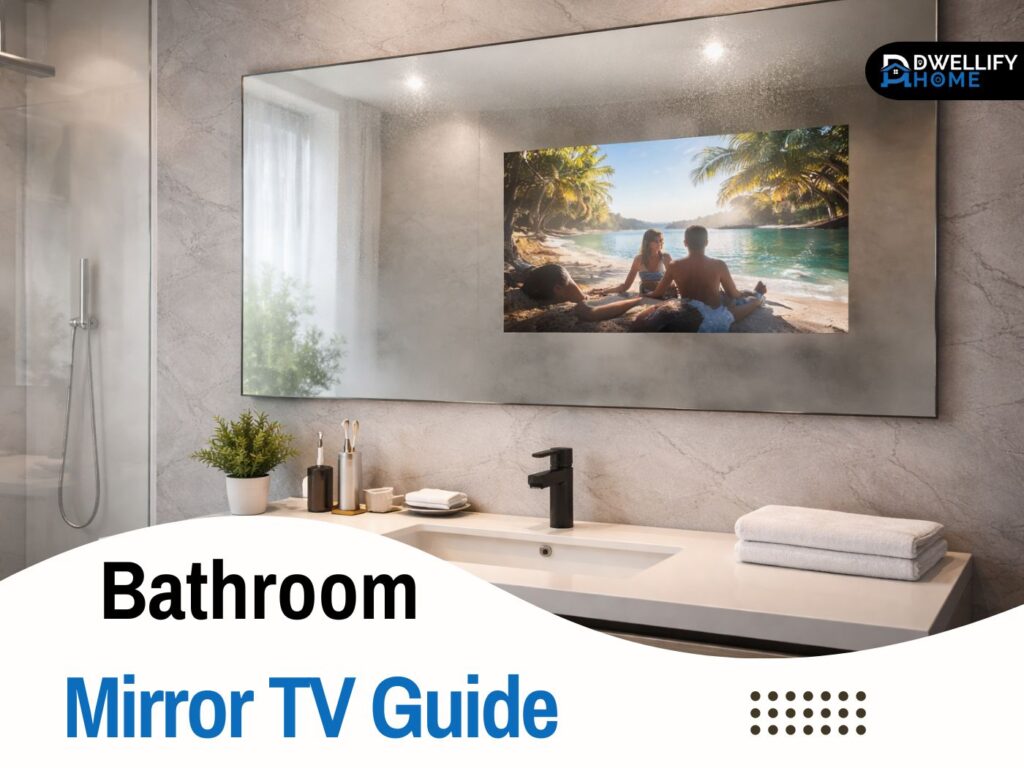
A bathroom mirror TV is a waterproof display hidden behind mirror glass. When off, it looks like a normal mirror; when on, the screen appears through the mirror—often with smart streaming and anti-fog options.
Mission Statement:
At Dwellify Home, our mission is to help homeowners make smart, stylish home upgrades with clear, experience-based guidance—so every choice feels confident, safe, and worth it.
What Is a Bathroom Mirror TV (And How the “Vanishing Mirror” Works)
A bathroom mirror TV is a waterproof TV built behind mirror glass. The “vanishing” effect comes from special mirror glass that lets light pass through from the display when it’s on, but still behaves like a mirror when it’s off. In the right lighting, it’s honestly impressive—your mirror looks clean and normal, then suddenly you’ve got a screen for news, music videos, or a quick YouTube tutorial while you get ready.
One thing I always explain to homeowners: a mirror TV isn’t just “a TV in a bathroom.” A standard waterproof bathroom TV is visible all the time, like a normal screen mounted on a wall. A mirror version is about aesthetics and space—it keeps the bathroom looking uncluttered, especially in modern or luxury designs where you don’t want a black rectangle taking over the wall.
You’ll see different names for the same idea—mirror television, vanity mirror TV, smart mirror TV—and most models these days come with smart features like streaming apps, Wi-Fi, and Bluetooth. The experience can be great, but only if you choose the right waterproof rating and install it properly.
Quick Guide Table (Comparison)
| What to Compare | Best Choice For | What to Watch Out For |
| IP Rating (IP65 vs IP66) | Splash-prone bathrooms, steamy spaces | Vague “water-resistant” listings with no IP number |
| Wall mounted bathroom mirror tv | Fast installs, easier servicing | Visible cables if not planned well |
| Recessed/flush mount | Luxury “built-in” look | Needs wall depth + planning before tiling |
| 1080p vs 4K | 4K is nicer for larger mirrors/tub viewing | Brightness matters more than resolution behind mirror glass |
| Anti-fog / heated screen | Small bathrooms, frequent hot showers | Anti-fog helps, but doesn’t replace ventilation |
| Smart features (Wi-Fi/Apps) | Netflix/YouTube users | Weak bathroom Wi-Fi = buffering and frustration |
| Bluetooth audio | Better sound without remodeling | Bathrooms echo—built-in speakers can feel thin |
Step-by-Step Buying Checklist (Simple & Practical)
- Pick your location first (vanity vs tub vs near shower).
- Match the IP rating to exposure (higher protection near frequent splashes).
- Choose mounting style: wall mount for simplicity, recessed for premium look.
- Select size by viewing distance (tub viewing usually needs bigger).
- Confirm brightness + viewing angle (mirror glass reduces visibility).
- Decide your streaming setup (built-in apps vs HDMI stick).
- Don’t ignore sound (Bluetooth support helps a lot).
- Check warranty + return policy—especially on marketplace listings.
Useful Bullet List: “Must-Have Specs” (No Fluff)
- Clear IP rating (not just “waterproof”)
- Anti-fog/heated option if your bathroom gets steamy
- Strong brightness (for visibility through mirror glass)
- Wi-Fi + Bluetooth (for streaming + better sound)
- Enough ports (HDMI/USB) if you’ll use external devices
- A warranty that’s easy to understand and claim
Where to Install a Bathroom Mirror TV (Best Spots + Real-Life Use Cases)
The most common (and usually the best) place is above the vanity. That’s where you naturally spend time—brushing, shaving, skincare, hair, getting dressed. If you’re standing there anyway, having the screen inside the mirror feels effortless. In small bathrooms, this placement also keeps things tidy because you don’t need another wall dedicated to a TV.
Tub-facing installs are the “luxury move.” If you have a freestanding tub or a soaking tub and there’s a clear line of sight, it’s a relaxing setup. The key is making sure the viewing angle works when you’re leaning back, and that the screen is bright enough to be visible through the mirror glass in your lighting.
Shower-adjacent installs can work, but this is where you have to be disciplined. People see “waterproof” and assume anything goes. Guess what—waterproof doesn’t mean “install it anywhere with no planning.” If it’s near direct spray, you need a rating and placement that truly matches that exposure, and you need smart electrical planning. If you’re unsure, treat shower zones as “specialist territory” and plan it with an experienced installer.
Safety & Waterproofing First: IP Ratings, Moisture, and Bathroom Basics
If you remember one thing from this guide, let it be this: pick your waterproof rating first, not the screen size. Many bathroom models advertise IP ratings (Ingress Protection). The second number is the important one for water exposure. In practical terms, you’ll commonly see IP65 and IP66 in this category.
A simple way to think about it:
- IP65 is generally aimed at protection from water jets (good for high humidity and splashes).
- IP66 is typically a stronger level against powerful water jets (better for harsher splash zones).
That doesn’t automatically mean “IP66 belongs inside the shower.” Bathrooms vary, and placement matters. But if you’re mounting near a tub where splashes are frequent, or you have a very steamy bathroom with poor ventilation, the higher protection level can give you more margin.
Now, about electrical safety: I’m not going to turn this into a scary lecture, but I will be honest—this is not a “random handyman and hope” project if you’re doing anything beyond a basic wall mount. Good installs plan the cable path, keep connections protected, and make sure the unit is supported properly. The best part is, when it’s done right, you don’t see wires, and you don’t worry every time someone takes a hot shower.
Quick homeowner checklist before you buy:
- Is the IP rating clearly stated (not just “water-resistant”)?
- Does the listing mention bathroom use and high humidity support?
- Is there a real warranty and clear support channel?
- Do you have a realistic plan for power and cable routing?
Anti-Fog Options: What Works and When You Actually Need It
Steam is the daily reality test for these setups. Some units include anti-fog or a heated screen function. In real bathrooms, that can make the difference between “this feels premium” and “why is my screen hazy every morning?”
Here’s the thing: anti-fog isn’t magic, and it doesn’t replace ventilation. If your bathroom gets so steamy that your mirror turns white after every shower, you’ll still want decent airflow. But anti-fog helps keep the visible area usable, especially during long hot showers or in bathrooms without strong exhaust fans.
If you’re on a tight budget, you can also reduce fog issues with simple habits:
- Run the exhaust fan early, not after the bathroom is already filled with steam.
- Keep the mirror away from direct steam paths when possible.
- Use lighting that reduces glare—fog plus glare is a double hit.
Choosing the Right Size, Layout, and Placement (So It’s Comfortable to Watch)
People often ask me, “What size should I get?” And my answer is usually, “Tell me where you’ll watch from.” A vanity setup doesn’t need a massive screen because you’re relatively close. A tub-facing install might need a bigger size to feel comfortable from farther away.
Also, mirror TVs often have a “TV window” inside the mirror. That window can be centered, lower, or corner-positioned depending on the design. For example, if you want the mirror to still feel like a mirror during grooming, you might prefer the screen area slightly lower or off to one side—so your face isn’t always in the TV section.
Placement tips I’ve learned from real installs:
- Don’t mount it too high just because “it’s a TV.” Vanity viewing is different.
- Watch out for glare from vanity lights and ceiling spots. A mirror is reflective, so lighting matters more than you think.
- If you’re tub-viewing, test the angle from the tub. A small change in height can improve comfort a lot.
Wall Mounted Bathroom Mirror TV vs Recessed/Flush Mount
A wall mounted bathroom mirror TV is the practical option. It’s easier to install, easier to service later, and it doesn’t require you to open up the wall as much. For most homeowners, especially in existing bathrooms, wall mounting is the safer and cleaner path.
A recessed or flush-mounted install looks amazing when done right. It gives that “built-in” feel, like the mirror is part of the architecture. On top of that, it can help the mirror sit perfectly aligned with tile lines or wall panels—something designers love.
But recessed installs need planning. You’re thinking about cavity depth, cable routing, and future access if something needs service. If you’re renovating, it’s a great time to do it. If your bathroom is already finished, a flush mount might be more work than it’s worth unless you’re already redoing the wall.
Picture Quality That Matters Behind Mirror Glass
A mirror TV can be 1080p or 4K, but the real-world factor isn’t only resolution. What matters most is how visible the screen is through the mirror glass in your lighting. Bathrooms are bright, reflective spaces. If the screen isn’t bright enough, the image can look muted, especially during daylight.
So yes, 4K can be worth it—especially on larger sizes and for tub viewing. But don’t ignore brightness and viewing angles. If you’ll watch while standing at the vanity, side-angle visibility matters. If you’ll watch from a tub, you want it to look good when you’re leaning back and not perfectly centered.
A tip I give clients: imagine the worst-case lighting—morning sun through a window, vanity lights on, steam in the air. That’s when you’ll notice whether your screen has enough punch to stay enjoyable.
Smart Features & Connectivity (Streaming Without Hassle)
Most modern models are smart, meaning they can run apps like Netflix and YouTube, and connect to Wi-Fi. That’s great, but it’s only smooth if your bathroom actually has stable Wi-Fi. Bathrooms can be Wi-Fi dead zones because of tile, plumbing, and distance from the router.
If streaming matters to you, plan for it:
- Check your Wi-Fi signal in the bathroom before buying.
- Consider a mesh node nearby if the signal is weak.
- If you prefer a simpler setup, using HDMI devices (like a streaming stick) can be easier for some people.
Bluetooth is another underrated feature. I’ve seen homeowners pair the mirror TV to a small bathroom-safe speaker or a soundbar placed outside the wet zone. It can instantly improve the experience without blasting volume on tiny built-in speakers.
Sound in Bathrooms (The Feature People Regret Ignoring)
Bathrooms are echo chambers. Tile, glass, and hard walls bounce sound around, so small speakers can sound thin or harsh. Built-in speakers are fine for news or background content, but if you really want to enjoy a show, sound becomes the “make or break” detail.
A practical approach is to treat the built-in speakers as baseline, then improve if needed:
- If your model supports Bluetooth, pair it to a better speaker in a dry-safe position.
- If you can route sound to a soundbar (again, safely placed), voices become clearer and less “tinny.”
- Keep volume moderate—bathrooms amplify odd frequencies.
The best part is, you don’t need a complex audio system. Even a small quality speaker can make it feel 10x better.
Controls & Everyday Usability
Most people want a simple remote that works when your hands are damp or you’re moving around. Touch controls can look sleek, but they’re not always practical if your mirror is wet or if fingerprints bother you.
Voice control can be useful, but I don’t treat it as essential. In real life, the biggest usability win is a clean setup that connects quickly, doesn’t lag, and has a remote that feels straightforward.
My “daily life” advice: choose convenience over gimmicks. If it turns on fast, stays connected, and the image is clear, you’ll actually use it. If it’s fussy, it becomes an expensive mirror.
Design & Customization: Frameless, Framed, LED, and Made-to-Order
Design is where mirror TVs shine. Frameless styles work beautifully in modern bathrooms. Framed styles can match classic vanities or bring warmth into minimalist spaces. Some setups add LED lighting around the mirror, which can be both functional (grooming) and decorative (mood lighting).
Customization matters more than people expect. You may want the screen section positioned so it doesn’t interfere with your face while you’re brushing or shaving. Or you might want a larger mirror with a smaller hidden screen area so it still feels like a “real mirror” first.
If you’re going for a premium look, focus on:
- Mirror clarity when the TV is off
- How well the screen disappears in your lighting
- How the edges and mounting look against tile
How to Choose the Best Bathroom Mirror TV (Simple Comparison Criteria)
When people search “best bathroom mirror tv,” they often end up comparing specs that don’t matter as much as they think. Here’s what actually matters in installs I’ve seen succeed:
1) Waterproof rating and bathroom suitability
Make sure the protection level matches your placement and your bathroom’s humidity habits.
2) Brightness and visibility
A beautiful 4K panel isn’t helpful if it looks dim behind mirror glass.
3) Smart stability
Does it connect reliably? Does it feel smooth? Is it compatible with your preferred streaming method?
4) Service access
If something needs attention later, can it be accessed without tearing up the wall?
5) Warranty and support
A good warranty isn’t glamorous, but it’s part of a smart, low-stress buy.
Bathroom Mirror TV Amazon Checklist (Avoid Bad Listings)
Shopping on marketplaces like Amazon can be convenient, but you have to filter aggressively. Some listings are vague, and bathrooms aren’t forgiving.
Here’s what I check before recommending a bathroom mirror tv amazon listing to a homeowner:
- The IP rating is clearly stated (not “water-resistant” with no number)
- Warranty terms are visible and realistic
- Ports are listed (HDMI, USB, etc.) if you need external devices
- Anti-fog/heated screen claims are specific
- Reviews mention real issues like brightness, fogging, or weak Wi-Fi performance
If a listing hides key details, it’s usually a sign the product isn’t built for serious bathroom use.
Installation Planning Checklist (Clean Finish, No Surprises)
Good installs look simple because the planning happened earlier. If you’re renovating, plan before tiling. If you’re adding it to an existing bathroom, plan cable routing and mounting carefully.
Before tiling (best case for recessed installs):
- Decide exact mirror position and TV window location
- Plan power and cable path inside the wall
- Ensure you’ll still have access if service is needed
For wall mounting (common and practical):
- Confirm solid mounting support (studs or proper anchors)
- Plan cable management so it doesn’t look messy
- Keep connections protected from moisture paths
If you’re installing near high-splash zones, this is the point where I strongly recommend involving a qualified installer. It’s not about making it complicated—it’s about making it safe and reliable for years.
Cleaning, Care, and Long-Term Maintenance
Mirror TVs need gentle cleaning. Avoid abrasive pads or harsh chemicals that can damage coatings. I usually tell people: treat it like a premium mirror, not like a kitchen countertop.
Also, remember that humidity management is maintenance. If your bathroom stays damp for hours after every shower, everything ages faster—paint, cabinets, and electronics. A decent exhaust fan and a habit of running it early can extend the life of the setup.
If you ever notice strange behavior—like dim spots, connectivity drops, or fog that never clears—don’t ignore it. Small issues are easier to solve early than after moisture has had months to work on it.
Common Mistakes to Avoid (Quick Expert Tips)
This is the part I wish every buyer read first.
- Buying too dim: The mirror layer reduces visibility. Brightness matters.
- Wrong size for the space: Vanity viewing and tub viewing need different planning.
- Ignoring IP rating: “Waterproof” without a clear rating is a red flag.
- Bad cable planning: Exposed wires ruin the luxury look.
- Overpaying for features you won’t use: Smooth basics beat fancy extras.
FAQs
Can I install one near the shower?
Sometimes, yes—but only with the right rating and careful placement. “Near” is different from “inside direct spray.” Plan this one properly.
IP65 or IP66—what should I choose?
If your bathroom is very steamy or the mirror is near frequent splashes, the higher protection level can be safer. For a standard vanity area with good ventilation, IP65 may be enough. Match it to exposure.
Does anti-fog really work?
It helps, especially in small steamy bathrooms, but it’s best when paired with decent ventilation.
Can I connect a Fire Stick or Apple TV?
Many models support HDMI, so external streaming devices can work well. Just confirm ports before buying.
Is it really a normal mirror when it’s off?
The better models look like a normal mirror at a glance, but lighting can affect how “perfect” it looks. Mirror clarity and finish quality matter.
What’s the best size for a vanity setup?
Most vanity installs work well with smaller sizes because you’re close. If you’re planning tub viewing, go larger so it doesn’t feel tiny from a distance.
Conclusion
A bathroom mirror TV can be one of the most satisfying upgrades in a modern bathroom—when it’s chosen and installed with real-world logic. Start with the environment: moisture, steam, and splash exposure. Then decide on placement and size based on how you’ll actually watch—vanity routine or tub relaxation.
From there, pick your install style. A wall-mounted bathroom mirror TV is often the most practical and service-friendly choice. Recessed/flush installs look incredible, but they’re best done during renovations when you can plan properly.
And here’s my final, experience-based advice: don’t chase specs first. Chase reliability and daily usability. If the mirror looks great when off, the screen is bright enough when on, and the installation is clean and safe, you’ll enjoy it every single day—and that’s what makes it worth it.
Disclaimer:
This article is for general informational purposes only and doesn’t replace professional advice. Bathroom electrical and wet-area installations can be hazardous—always follow local codes and consult a qualified electrician/installer for your specific space.

I’m Bilal, the founder of Dwellify Home. With 6 years of practical experience in home remodeling, interior design, and décor consulting, I help people transform their spaces with simple, effective, and affordable ideas. I specialize in offering real-world tips, step-by-step guides, and product recommendations that make home improvement easier and more enjoyable. My mission is to empower homeowners and renters to create functional, beautiful spaces—one thoughtful update at a time.