Walk into any busy flower shop early in the morning and you’ll see the same thing: buckets everywhere, deliveries coming in, wedding orders waiting, and a tight window to get everything conditioned and looking perfect. That’s exactly where a good floral cooler earns its keep.
Here’s the thing—flowers don’t just need “cold.” They need the right kind of cold: steady temperature, high humidity, and gentle airflow. That combination is what keeps stems hydrated, petals crisp, and colors looking sale-ready instead of tired. Industry guidance commonly points to around 34–38°F (1–3°C) for many cut flowers and 80–95% humidity, with airflow designed to be gentle so flowers don’t dehydrate.
In this guide, I’m going to walk you through how to pick the right unit for your shop, how to set it up so it actually works, and how to avoid the mistakes that quietly wreck inventory (even in an expensive cooler).
Snippet-ready definition:
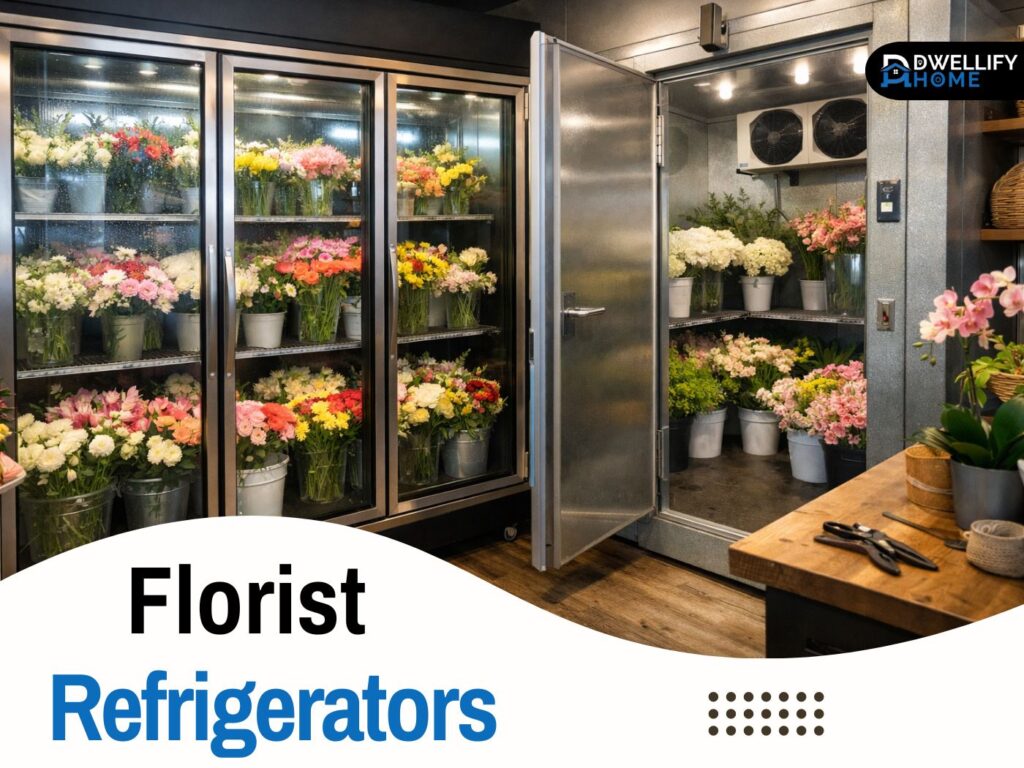
Florist refrigerators (floral coolers) are specialty units that store cut flowers at steady cold temps with high humidity and gentle airflow, helping blooms stay hydrated, crisp, and sale-ready longer than a regular fridge.
Mission Statement:
At Dwellify Home, our mission is to turn complicated home-and-business decisions into clear, practical guidance—so you can choose equipment and setups that save time, reduce waste, and keep your space running smoothly.
What Is a Florist Refrigerator and Why It’s Different From a Regular Fridge?
A florist refrigerator is built for one job: protecting delicate plant tissue. Food refrigeration is the opposite in a key way—many food fridges run drier and push air harder, because that helps food stay safe and reduces moisture problems. Flowers hate that.
A proper flower cooler focuses on three things at once:
- High humidity (so petals and leaves don’t shrivel)
- Low-velocity airflow (so the cooler doesn’t “windburn” your blooms)
- Stable temperature control (so you don’t get freezing edges or warm swings)
If you’ve ever tried using a standard commercial fridge as a “flower fridge,” you probably noticed the same pattern: heads start drooping sooner, petals look papery, and greenery gets crispy. That’s exactly what higher airflow and lower humidity tend to do.
Quick Guide: Which Flower Cooler Should You Buy?
| Option | Best for | Why florists like it | Watch-outs |
| Glass-door display cooler | Retail “grab & go” sales | Customers can see product; good lighting + merchandising | Doors open a lot—needs stable temp/humidity to avoid swings |
| Reach-in floral cooler | Backroom conditioning + storage | Easier rotation (FIFO), less door-opening chaos | Don’t cram it—blocked airflow dries edges faster |
| Walk-in floral cooler | Weddings, bulk deliveries, wholesale volume | Zoning (deliveries / events / ready-to-sell) + serious capacity | Needs proper insulation + planning to avoid hot spots |
| DIY walk-in with CoolBot | Tight budgets, seasonal scaling | Can work well when insulated correctly | Build quality matters; temperature stability depends on setup |
Fast “pick the right size” rule (simple, real-world)
- Plan for your busiest week, not an average week.
- Count inventory in buckets, not just cubic feet.
- Add breathing room (airflow lanes) so flowers don’t dry out.
A practical “settings cheat sheet” (what to aim for)
- Most cut flowers: around 34–38°F (1–3°C)
- Humidity target: roughly 80–95% RH (this is a big reason floral coolers outperform standard fridges)
- Airflow: gentle / low-velocity, not blasting air like a beverage cooler
- Tropicals: often need warmer storage (many guides cite ~55°F/13°C+ for tropicals)
Ideal Settings for Storing Flowers (Temperature, Humidity, Airflow)
You don’t need perfection—you need consistency. Flowers respond more to swings than to small differences.
Recommended temperature range (and when tropicals need warmer storage)
For most cut flowers, many florist-focused resources recommend keeping storage around 34–38°F (1–3°C).
But tropicals are the “don’t get cute” category. Orchids, anthuriums, some gingers—these can get cold damage if you treat them like roses. Many guides recommend warmer storage (often ~55°F / 13°C and up) for tropical blooms.
A practical shop tip: if you routinely carry tropicals, plan for a warm zone (even a small separate unit) instead of trying to force one cooler to do everything.
Humidity targets and how to prevent dehydration
Floral cooling units are often described as running 80–95% relative humidity—much higher than typical food refrigeration. That moisture slows dehydration and helps arrangements hold up longer.
If your cooler can’t keep humidity up, you’ll see it fast:
- Petal edges look dry or curled
- Greenery turns brittle
- Hydrangeas collapse like they’re “suddenly thirsty”
One small habit that helps: keep bucket water topped up and clean, and don’t let fans blast directly on flower faces. Humidity isn’t just a machine setting—it’s the whole environment.
Low-velocity airflow—why strong fans can bruise/dry flowers
Guess what causes a lot of “mystery shrink”? Air that’s too aggressive.
Floral coolers are designed to gently circulate cooled air. That’s a consistent theme in florist refrigeration guidance, because hard air movement dries petals and can physically damage delicate varieties.
If you ever stand in front of a beverage cooler and feel that strong cold jet—that’s exactly the vibe you don’t want pointed at your flowers.
Types of Florist Refrigerators (Choose What Fits Your Shop)
This is where most buyers get stuck, so let’s keep it simple: choose based on how you sell and how you process.
Glass-door display floral coolers (retail merchandising)
Display units (often 1-, 2-, or 3-door glass front) are for shops that want customers to see product and buy quickly. They’re perfect for:
- Grab-and-go bouquets
- Everyday stems
- Front-of-house merchandising
The best part is… when the cooler is doing its job, your display looks fuller longer, and you’re not constantly “refreshing” the floor just to keep it presentable.
Reach-in floral coolers (backroom storage and prep)
Reach-ins are your workhorses. They’re built for:
- Conditioning after delivery
- Holding buckets by variety
- Storing prepped greens and event product
If your shop does any volume at all, you’ll usually appreciate a reach-in even if you also have a display case.
Walk-in floral coolers (bulk storage, weddings, wholesale volume)
A walk-in floral cooler becomes worth it when:
- You’re doing weddings every week
- Your stem count jumps at holidays
- You’re buying more wholesale to protect margins
Walk-ins give you space to separate zones: conditioned stock, event builds, and sensitive varieties. If you’re searching “walk-in floral coolers for sale,” you’re probably already feeling the squeeze of not having enough cold, clean space during peak weeks.
Benefits of Using a Flower Cooler (Freshness, Sales, Less Waste)
A proper flower cooler isn’t about being fancy. It’s about buying time—and time is money in floral.
You usually see benefits in three places:
- Quality control: flowers stay hydrated and presentable longer
- Speed: staff can find and rotate inventory faster
- Shrink reduction: fewer stems end up discounted or tossed
And there’s a subtle one: when your cooler holds steady, you can confidently prep in advance for events without that “are these going to hold?” anxiety.
Key Features to Look For Before Buying a Floral Cooler
I’m going to save you from the feature overload. Here’s what truly matters in real shops:
- Stable temperature control (not just “cold,” but consistent)
- Humidity-friendly design (flowers need moisture, not dry air)
- Gentle airflow / low-velocity circulation
- Solid door seals (bad gaskets = temperature swings + higher power bills)
- Bucket-friendly shelving (adjustable heights and practical spacing)
- Lighting that shows color accurately without adding heat (especially for display)
If you’re comparing the best flower cooler options, don’t get distracted by bells and whistles. Ask one question: Will this unit keep my flowers hydrated and stable during real-world chaos?
Choosing the Right Size (Capacity Planning Without Guessing)
Most sizing mistakes come from planning for “average weeks.” You need to size for busy weeks, because that’s when the cooler either saves you—or fails you.
Here’s a simple way to estimate:
- Think in buckets, not cubic feet.
- Count your peak-week bucket needs, not your normal Tuesday.
- Add breathing room so you don’t block airflow.
If you’re deciding between 1-, 2-, or 3-door:
- 1-door: tiny shops, low stem variety, tight inventory
- 2-door: most small-to-mid retail shops (good balance)
- 3-door: high variety, high walk-in sales, heavier deliveries
For walk-ins, plan zones:
- Conditioning zone (fresh deliveries)
- Sales stock zone (ready-to-sell)
- Event zone (weddings / sympathy / large builds)
One practical tip I’ve seen save a lot of headaches: leave aisle space inside the walk-in that lets you rotate buckets without dragging them across product. Less bruising, less mess, faster work.
Display vs Storage Strategy (Merchandising That Doesn’t Hurt Freshness)
A common trap is treating the display cooler like your only cooler. Display coolers get opened a lot, and customers linger with doors open. That can create warm swings.
If your budget allows, the smoothest setup is:
- Backroom reach-in (or walk-in) for conditioning + storage
- Front display for curated product
On top of that, you can keep your display looking abundant without overstuffing it. When display coolers are overloaded, airflow gets blocked and the “front row” looks sad first.
Day-to-Day Best Practices (How Pros Keep Flowers Fresh in a Flower Fridge)
This is the part that actually moves the needle—even with an older cooler.
Receiving + conditioning routine (simple, repeatable steps)
When a delivery arrives, don’t just shove it into the cooler and hope. A simple routine works:
- Unpack quickly (heat buildup during unpacking is real)
- Recut stems cleanly
- Get flowers into fresh water with appropriate food
- Let them drink before heavy handling
Your cooler is your recovery room. Conditioning well means fewer surprises later.
Rotation system (FIFO) to reduce waste
FIFO sounds boring, but it’s a profit strategy. Oldest product gets used first, and you stop “discovering” tired stems too late.
A simple shop habit:
- Put new buckets behind existing buckets
- Label event product clearly (date + job name)
- Do a quick “what’s aging?” scan daily
Where to place buckets to avoid airflow damage / freezing edges
Avoid putting sensitive blooms right where cold air dumps in. If you see:
- brown edges
- translucent petals
- “wet-looking” cold damage
…that’s often placement or temperature stability, not “bad flowers.”
One “real shop” trick: place a thermometer probe where the flowers actually live—near bucket height—not just at the top of the cooler.
Ethylene, Cross-Contamination, and What NOT to Store With Flowers
Ethylene is one of those invisible problems that makes florists feel cursed.
Ethylene is a plant hormone gas that accelerates aging in many cut flowers—leading to faster wilting, petal drop, and reduced quality. This is well documented in postharvest research and industry guidance.
So what do you do in practice?
- Don’t store produce, ripening fruit, or anything “food-ish” in your floral space
- Keep the cooler clean (decaying plant material can contribute)
- Isolate ethylene-sensitive flowers when possible
If you’ve ever had carnations or lilies act “fine yesterday, awful today,” ethylene exposure is one place to look.
Maintenance Checklist (Daily / Weekly / Monthly)
Maintenance doesn’t need to be complicated. It needs to be consistent.
Daily
- Quick temperature check
- Bucket water cleanup (spills become smells fast)
- Door seal glance (is it closing cleanly?)
Weekly
- Wipe shelves and floor
- Remove debris and dead leaves
- Sanitize high-touch areas (handles, edges)
Monthly
- Check coils/filters (restricted airflow = poor performance)
- Inspect for ice buildup or condensation issues
- Confirm the thermostat is holding steady
If your cooler suddenly can’t hold temperature, don’t just crank it colder. That usually makes the swing worse and risks freezing product.
Florist Refrigerator Price Guide (What Floral Coolers Cost and Why)
Let’s talk money without the hype.
A floral cooler price can vary widely because you’re paying for:
- Size and capacity
- Door count (glass doors cost more)
- Build quality and insulation
- Humidity/airflow design that’s flower-friendly
- Installation needs (especially for walk-ins)
You’ll often see a spread between DIY-style builds and commercial units (some guides cite ranges from lower-cost DIY approaches to higher-end commercial builds).
If you’re comparing “cheap vs expensive,” here’s the honest tradeoff:
- Lower-cost can work if you manage it carefully
- Higher-quality usually buys stability, lower shrink, and fewer emergency repairs
And yes, used can be a smart move—if you inspect it properly.
Buying Options: New, Used, Wholesale, or Walk-In Builds
When you’re searching “floral cooler for sale,” it helps to know your main paths.
New units
- Best for reliability and warranty
- Easier to match your exact needs
Used units
- Great value if the compressor and seals are solid
- Risky if you can’t verify history
Used-buyer checklist:
- Doors close tightly (no gaps)
- No persistent condensation or ice issues
- Compressor cycles normally (not constantly running)
- Temperature holds steady over time, not just right after startup
Wholesale / multi-unit purchases
If you’re buying multiple units (or expanding locations), floral coolers wholesale pricing can make sense. But only if your maintenance plan and service coverage are ready too.
Walk-in builds
Walk-ins are amazing when done right. They’re also expensive mistakes when airflow and insulation aren’t planned well. If you go walk-in, prioritize experienced installation and proper airflow design.
Quick Decision Checklist (Pick the Best Flower Cooler for Your Shop)
If we were standing in your shop right now, here’s what I’d ask you:
- Are you display-first (walk-in sales) or storage-first (events, prep)?
- What’s your peak week stem volume (not average)?
- Do you carry tropicals that need warmer storage?
- Do you need one unit now—or a setup that can scale in 12 months?
- Are you trying to reduce shrink or improve merchandising (or both)?
If you can answer those clearly, choosing the right cooler gets much easier.
Common Mistakes Florists Make With Refrigeration (And Easy Fixes)
Let’s save you from the most expensive “learning moments.”
Mistake 1: Going too cold to “make it last longer.”
Fix: stable is better than extreme. Too cold can cause damage, especially for sensitive varieties.
Mistake 2: Overstuffing the cooler.
Fix: leave airflow lanes. Crowding creates warm pockets and uneven performance.
Mistake 3: Using a standard fridge and blaming suppliers.
Fix: if you must use a standard unit short-term, reduce fan impact and watch humidity symptoms closely.
Mistake 4: Ignoring ethylene sources.
Fix: keep fruit/produce out, clean religiously, and isolate sensitive flowers when you can.
Mistake 5: Skipping basic maintenance.
Fix: clean coils/filters monthly and check door seals—small tasks prevent big failures.
FAQs About Florist Refrigerators
1) What kind of fridge do you need for flowers?
Ideally, a floral cooler / flower cooler designed for high humidity (about 80–95%) and gentle airflow. Standard fridges are often too dry and can dehydrate flowers fast.
2) Can I use a regular refrigerator for flowers?
You can in a pinch, but it’s not ideal. Regular refrigerators are built for food storage and typically run lower humidity, which can dry petals and greenery quickly.
3) What is the difference between a floral cooler and a refrigerator?
A floral cooler is engineered to keep flowers fresh by maintaining higher humidity and low-velocity airflow, while many standard refrigerators prioritize a drier environment that helps food stay safe and reduces moisture issues.
4) How do florists store flowers in the fridge?
Most florists store flowers upright in clean buckets, rotate stock (FIFO), and avoid anything that produces ethylene (like fruit) in the same cold space. They also limit unnecessary door opening to reduce temperature swings and condensation risk.
5) What temperature should a flower cooler be set to?
For many cut flowers, industry guidance commonly recommends 34–38°F (1–3°C), while tropicals often need warmer storage to avoid chill damage.
Conclusion
A well-chosen cooler doesn’t just “store flowers.” It supports your whole business—freshness, speed, presentation, and peace of mind during busy weeks.
If you remember only one thing, make it this: flowers need stable temperature, high humidity, and gentle airflow, not just cold air. When those three are right, your product looks better, lasts longer, and sells with less discounting.
So take a breath, measure your real peak-week needs, and pick the setup that matches how you work—display-first, storage-first, or a hybrid. And when you’re ready, tell me your shop size, daily stem volume, and whether you do weddings weekly—I can help you narrow it down to the most practical options without overbuying a system you don’t need.
Disclaimer:
This article is for general informational guidance only. Refrigeration design, electrical work, and food/flower storage safety can vary by location and building code—consult a qualified refrigeration technician or contractor for sizing, installation, and compliance decisions.

I’m Bilal, the founder of Dwellify Home. With 6 years of practical experience in home remodeling, interior design, and décor consulting, I help people transform their spaces with simple, effective, and affordable ideas. I specialize in offering real-world tips, step-by-step guides, and product recommendations that make home improvement easier and more enjoyable. My mission is to empower homeowners and renters to create functional, beautiful spaces—one thoughtful update at a time.