
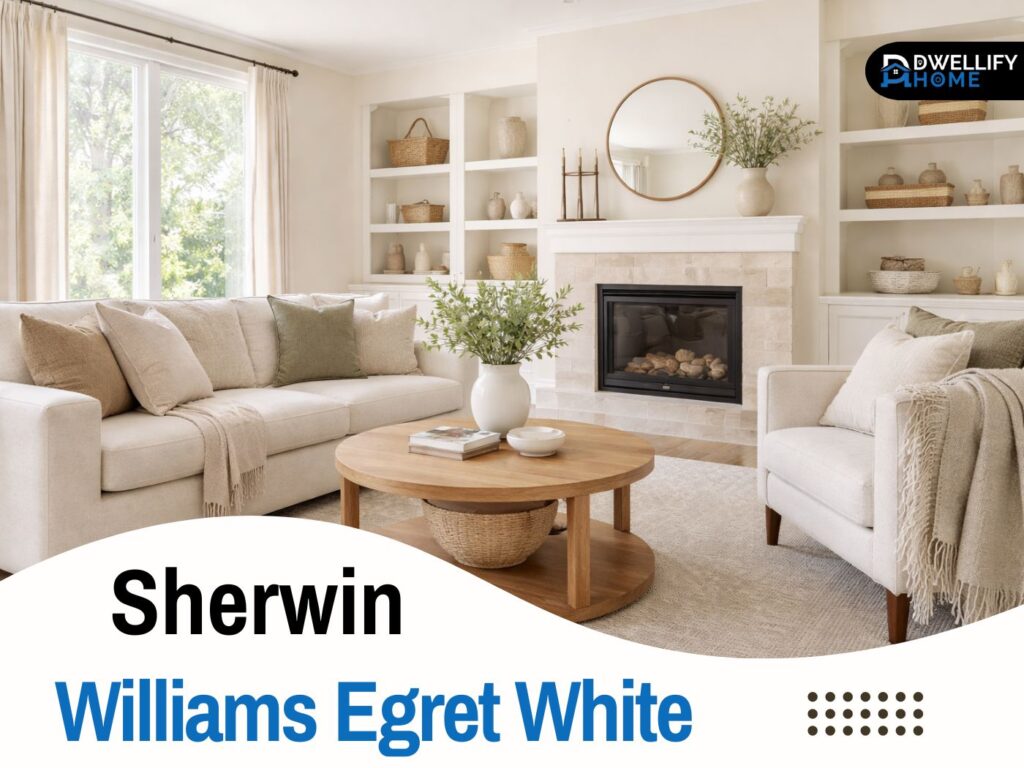
If you’ve been eyeing Sherwin Williams Egret White for your home, you’re not alone. It’s one of those colors that people expect to behave like a simple off-white, but it doesn’t. In the best way, and sometimes in a frustrating way.
I’ve used this color in lived-in spaces, not just pretty photos. I’ve seen it on walls, cabinets, trim, and even tested it for whole-home flow. If you want a calm, warm neutral that can bridge beige and gray without feeling icy, this one can be a great fit. But you do need to know how it behaves before you commit.
Snippet-ready definition:
Sherwin Williams Egret White (SW 7570) is a light, warm neutral that often reads like a soft greige. Its taupe-leaning undertones shift with lighting, so sampling near your finishes matters.
Mission Statement:
At Dwellify Home, our mission is to help homeowners choose calm, livable paint colors with confidence, using real-room guidance, honest comparisons, and practical steps that prevent expensive repainting mistakes.
Sherwin Williams Egret White (SW 7570) at a Glance
Egret White, also labeled SW 7570 Egret White, sits in that “in-between” zone. It’s often called an off-white, but in many homes it reads more like a very light greige with a soft taupe pull.
That’s why it works so well when you’re trying to warm up a space without going full beige, or soften a gray-leaning interior without making it feel cold. It has more body than a crisp white, so it can look grounded and relaxed rather than bright and sharp.
If you’re planning a cohesive look, this is the type of shade that can play nicely across rooms. It can work as a wall color, a cabinet color, or a gentle backdrop for layered neutrals and natural materials.
Quick Guide Table (fast decisions)
| Topic | Quick answer |
| Color family | Light warm neutral (off-white that often reads greige) |
| Undertones | Soft taupe/stone base, can show faint pink-purple in some lighting |
| LRV | Around 70 (light, but not a crisp bright white) |
| Best interior use | Open-concept walls, bedrooms, warmer kitchens, hallways |
| Use with caution | North-facing rooms, very low light spaces, strong yellow finishes |
| Trim approach | Either clean bright white for contrast or soft warm white for tone-on-tone |
| Exterior use | Can work as body or trim; often looks lighter in sun |
Comparison Table (Egret White vs popular alternatives)
| Feature | Egret White (SW 7570) | Alabaster | Shoji White | Agreeable Gray |
| Overall vibe | Soft greige-leaning off-white | Creamier warm white | Warm off-white with more depth | True greige, noticeably deeper |
| Undertone feel | Taupe/stone, sometimes faint pink-purple | Warm, creamy | Warm, slightly muted | Greige balance (more “color” on walls) |
| Best for | Warm neutrals, stone, wood tones | Classic warm white interiors | Soft warm interiors, gentle contrast | Walls where you want more depth |
| Common mistake | Expecting it to look like a crisp white | Using where you want zero warmth | Pairing with very cool whites | Mixing next to warm off-whites without transition |
Step-by-step sampling checklist (simple and reliable)
- Paint a large sample board (or use a large removable sample).
- Check it in morning, mid-day, and evening.
- Hold it next to your fixed finishes: floors, counters, tile, stone.
- Turn on your regular bulbs at night and look again.
- If it ever looks “muddy” or “pink,” test one alternate shade beside it for context.
Egret White Undertones (What You’ll Actually See on Your Walls)
The core undertone profile (warm greige taupe stone feel)
Egret White undertones are the reason people either love it or feel unsure about it. On a paint chip, it can look like a straightforward warm off-white. On your wall, it usually shows a light greige base with a slightly taupey, stone-like warmth.
In plain terms, it’s not creamy like a traditional warm white. It’s more like a softened neutral that picks up hints of what’s around it. If your home has warm wood floors, beige tile, or natural stone, Egret White often looks calm and intentional.
When it can shift (subtle pink purple moments) and why that happens
Here’s the honest part. In certain settings, Egret White can flash a faint pink or violet cast. It’s not loud, but if you’re sensitive to those tones, you’ll notice it.
This usually happens in north-facing rooms, in low daylight, or next to finishes that have pink in them already, like some warm beige carpets, rosy tiles, or certain quartz with mauve veining. I’ve also seen it happen when warm bulbs and reflective surfaces team up in the evening.
Egret White LRV + Lighting Behavior (Why It Looks Different in Every Home)
Egret White LRV explained in plain English (what it means for brightness)
Egret White LRV is around the low 70s. That means it reflects a good amount of light, but it’s not a bright, crisp white that bounces light like a mirror. It has enough depth to feel substantial, which is great for cozy interiors.
In real homes, that LRV range means Egret White will usually look “light” but not “white-white.” If you’re expecting a clean gallery wall look, you may feel disappointed. If you want warmth and softness, it’s often just right.
North vs south vs east west rooms (real-life effect)
Lighting direction matters a lot here.
- North-facing rooms often make Egret White look cooler and slightly grayer, sometimes with that faint pinkish cast.
- South-facing rooms usually bring out its warmth and make it feel more neutral and creamy-beige, but still not yellow.
- East-facing rooms can look fresh in the morning, then slightly flatter later.
- West-facing rooms may look neutral during the day and warmer at sunset.
If your home has a mix of exposures, Egret White can still work, but sampling becomes non-negotiable.
Artificial lighting tips (warm vs cool bulbs + how they change the read)
At night, bulbs can change everything. Very warm bulbs can exaggerate taupe and bring out a warmer, slightly rosy look. Very cool bulbs can push it grayer.
I like a balanced, soft white bulb for most rooms. Also, check how the color looks near lampshades, since warm fabric shades can shift wall color more than people expect.
Best Places to Use Egret White Indoors
Egret White paint tends to shine in homes where you want the walls to feel soft and cohesive, not stark.
It’s especially good in:
- Living rooms and open-concept areas where you want one color to connect spaces
- Bedrooms where you want calm, warm-neutral walls
- Hallways and entryways where you want a welcoming tone that won’t look too bright
- Bathrooms with stone, warm tile, or softer whites rather than icy, blue-white fixtures
A quick real-world example. I used Egret White in a home with medium oak floors and warm white trim. In daytime it felt airy. In the evening it felt cozy, not beige, not gray, just settled.
Egret White on Kitchen Cabinets and Built-Ins
Egret White can look beautiful on cabinets, but only when the surrounding finishes support it. On cabinetry, undertones show more because you see the color up close and often under mixed lighting.
It tends to work best when:
- Your counters lean warm or neutral, not icy blue-white
- Your backsplash isn’t extremely bright white
- Your hardware and lighting lean warm metals or soft black, rather than shiny chrome everywhere
For cabinets, finish matters. A satin or similar durable finish usually looks cleaner and more wipeable than flat. If you go too glossy, you may highlight undertone shifts and reflections, especially near windows.
When to Avoid Egret White (And Better Alternatives)
Red flags (very low light, strong yellow finishes, pink-sensitive spaces)
I’m cautious with Egret White in rooms that are consistently dim, especially north-facing rooms with little window area. It can look heavier than expected and sometimes reads a touch muddy.
I’m also careful when a home has strong yellow-beige elements like golden granite, honey oak cabinets, or yellow-heavy travertine. Those finishes can pull Egret White warmer and make it feel less neutral.
If you want cleaner brighter, what direction to go (crisper whites)
If your goal is a brighter, cleaner white look, Egret White may feel too grounded. In that case, you’d usually move toward a whiter trim and wall strategy where the wall color has fewer taupe notes and a cleaner base.
That doesn’t mean Egret White is wrong, it just means it’s not trying to be a crisp white. It’s trying to be a soft neutral.
If you want deeper warmer, what direction to go (warmer greiges)
If you love the idea of Egret White but want more depth, you’ll likely prefer a warmer greige that still feels neutral, but has enough pigment to hold up in low light.
This is a common move in open-concept homes where you want one color that feels warm all day and doesn’t wash out.
Sherwin Williams Egret White Coordinating Colors
Coordinating color families that almost always work
Sherwin Williams Egret White coordinating colors usually fall into a few reliable families. The goal is to pair it with colors that respect its warm greige base rather than fight it.
These are the most dependable directions:
- Muted greens like sage or olive
- Deep blues and blue-greens that feel slightly gray
- Charcoal and soft black accents
- Warm beiges, tan leathers, and natural woods
3–5 ready-to-use mini palettes (body + trim + accent)
Here are a few simple Egret White color palette ideas that work in a lot of homes:
- Warm neutral home: Egret White walls, soft warm white trim, charcoal doors
- Organic cozy: Egret White walls, sage green accents, medium oak and linen textures
- Modern classic: Egret White walls, soft black accents, brass hardware and warm lighting
- Exterior friendly: Egret White body, deeper charcoal shutters, warm stone and greenery
Trim, Ceiling, and Door Colors That Pair Beautifully With Egret White
How to choose trim: crisp contrast vs soft tone-on-tone
Trim choice is where many people get stuck. You can go two ways.
If you want contrast, choose a cleaner, brighter trim white so the walls look richer. If you want a softer, blended look, choose a warmer white trim that doesn’t feel stark.
The best choice depends on your fixed elements. Bright white tile and countertops usually look best with a cleaner trim. Warm woods and creamy stone often look best with softer trim.
Ceiling guidance (avoid harsh mismatch)
For ceilings, I like keeping things simple. A ceiling that’s too bright and icy can make Egret White look darker and more taupey. A ceiling that’s too creamy can make it look grayer by comparison.
If you’re unsure, test your ceiling white next to Egret White on a large sample. That one step prevents a lot of second guessing later.
Egret White vs Alabaster
Egret White vs Alabaster is a common comparison, and it’s a helpful one. Alabaster tends to feel creamier and more traditional. It’s a warm white that often reads softer and more “white” on the wall.
Egret White has more of that greige stone base. If you want warmth but don’t want a creamy look, Egret White is usually the better match. If you want a gentle, classic warm white, Alabaster often wins.
Egret White vs Shoji White
Egret White vs Shoji White comes down to how you want the neutral to read in the space. Shoji White usually feels warmer and more obviously off-white, especially in rooms with warm light.
Egret White often reads a little more grounded and slightly more greige. In homes with a lot of stone, brick, or warm neutrals, that can be a plus. In very bright white modern spaces, Shoji White can feel more natural.
Egret White vs Agreeable Gray
Egret White vs Agreeable Gray is less about “which is better” and more about depth. Agreeable Gray is a fuller greige, deeper and more obvious as a wall color. Egret White is lighter and closer to an off-white.
They can work together in an open floor plan if you’re careful. I like Egret White in connecting spaces like halls and common areas, and Agreeable Gray in a room where you want a bit more depth. What I avoid is placing them side-by-side with no transition, because the undertones can highlight each other in an unflattering way.
Sherwin Williams Egret White Exterior House Use
Egret White as exterior body color (how sunlight changes it)
Sherwin Williams Egret White exterior house use can be really attractive, but it changes in full sun. Outdoors, this color often looks lighter and more “true neutral” because sunlight washes out undertones.
That’s usually a good thing. It can give you a soft, timeless exterior that doesn’t look stark. But if your home has a very cool roof color or blue-toned stone, you’ll want to check for harmony.
Egret White as trim color (where it looks brightest)
As trim, Egret White can be a softer alternative to a bright white. It works well when you want trim that doesn’t shout, especially on homes with warm siding, warm brick, or natural stone.
If your body color is already light, Egret White trim may not stand out much. In that case, a crisper trim white gives more definition.
Pairing tips: brick, stone, roof color, and landscaping greens
Exterior pairing is all about fixed materials. I like Egret White with warm red brick, tan stone, and black or dark bronze accents. It also looks great with green landscaping because that warm greige base feels natural next to plants.
If your roof is a cooler gray, test first. Sometimes it’s fine, but sometimes it makes Egret White look slightly warmer than you planned.
How to Sample Egret White Like a Pro (Designer Method)
The 3-time-of-day test (morning / afternoon / evening)
This is the sampling method I trust most. Look at your sample in the morning, mid-day, and at night. Egret White often looks most neutral mid-day and shows its personality in early morning and evening.
Don’t decide in five minutes. Give yourself at least a full day.
Test near fixed elements (floors, counters, tile, upholstery)
Paint doesn’t live alone. Tape your sample next to flooring, countertops, tile, and large upholstered pieces. Those elements influence undertones more than wall art or small decor.
If you’re testing for cabinets, sample near your countertop and backsplash. That’s where people get surprised.
Peel-and-stick vs painted sample (when each is better)
Peel-and-stick samples are great for quick testing and moving around the room. Painted samples are better if you want to see sheen and texture effects.
If you can only do one, I’d rather you paint a large board and move it around. It shows you more truth.
Common Mistakes People Make With Egret White
Most regrets with Egret White come from expectations, not from the color itself.
Here are the biggest mistakes I see:
- Treating it like a crisp white when it’s really a light greige
- Skipping sampling in low-light rooms
- Ignoring nearby finishes that pull undertones, especially tile and countertops
- Using very warm bulbs at night and wondering why it looks different
- Pairing it with overly bright, icy whites that make it look darker
Quick FAQ
1) What undertones does Sherwin-Williams Egret White have?
Egret White typically shows a warm greige base with a soft taupe, stone-like undertone. In some spaces, a faint pink-purple cast can appear, especially in cooler light.
2) When not to use Egret White?
Skip it in consistently low-light rooms (like some basements or north-heavy spaces) if you want a fresh, bright look. It can feel a bit dull or heavier without enough light.
3) What is the difference between Sherwin-Williams Egret White and Alabaster?
Alabaster reads creamier and more traditionally warm-white. Egret White is more greige-leaning with a “stone” feel, so it often looks less creamy and more grounded.
4) Does Egret White look pink?
It can, but usually only under certain conditions, like cool north light, mixed lighting at night, or when nearby finishes pull rosy tones forward.
5) Is Egret White okay for exterior use?
Yes, it’s commonly used for both interior and exterior projects. Outdoors it often appears lighter in full sun, so always sample against brick, stone, and roof tones first.
Conclusion
If you want one calm neutral that sits between white and greige, Sherwin Williams Egret White can be a smart choice. It’s especially good in homes with warm woods, natural textures, and finishes that don’t lean icy or overly yellow.
The key is treating it like the nuanced color it is. Sample it properly, check it next to your fixed materials, and look at it under your evening bulbs. If it stays balanced through those tests, you’ll feel confident using it on walls, cabinets, or even as part of an exterior plan.
If you’d like, share your room direction (north, south, east, west) and your main fixed finishes, and I’ll tell you whether Egret White is likely to read neutral, warm, or slightly gray in your specific space.
Disclaimer:
Paint colors can shift with lighting, sheen, surrounding materials, and screen settings. Always test Egret White in your own space before committing. This guide is educational and not affiliated with Sherwin-Williams.

I’m Bilal, the founder of Dwellify Home. With 6 years of practical experience in home remodeling, interior design, and décor consulting, I help people transform their spaces with simple, effective, and affordable ideas. I specialize in offering real-world tips, step-by-step guides, and product recommendations that make home improvement easier and more enjoyable. My mission is to empower homeowners and renters to create functional, beautiful spaces—one thoughtful update at a time.