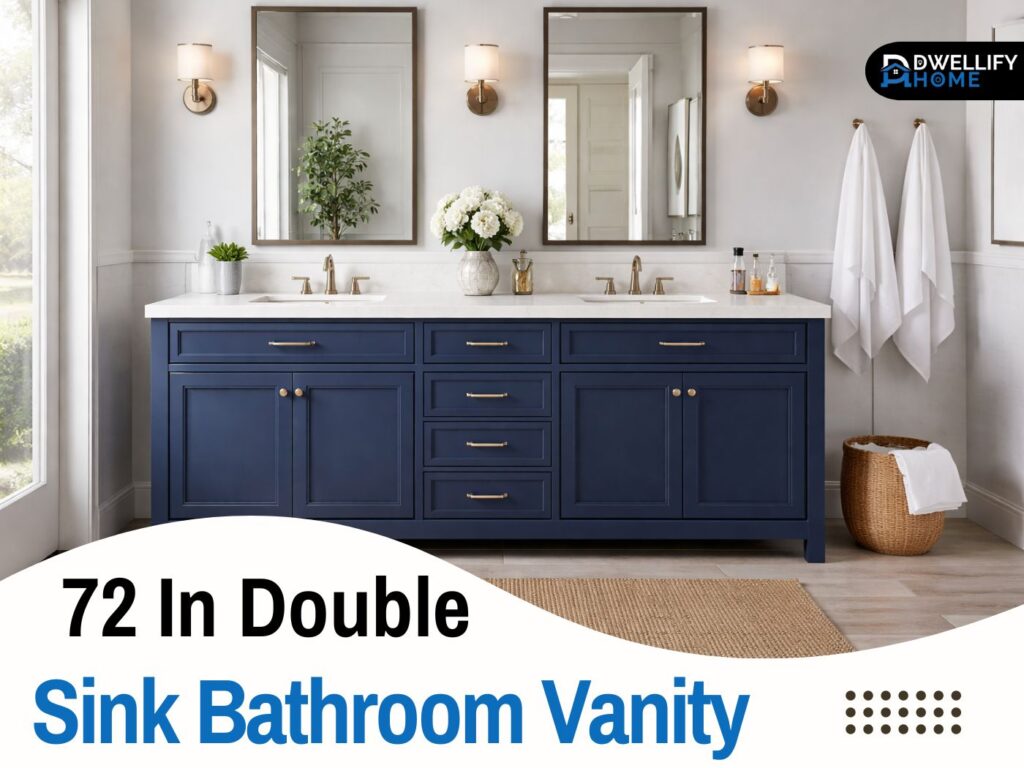
If you’re remodeling a master bathroom or a large shared bath, a 72 in double sink bathroom vanity can feel like the moment the room finally “makes sense.” You get two sinks, a wide counter, and enough storage that toiletries stop living on every flat surface.
Here’s the thing, though. At 72 inches, small mistakes turn into expensive ones. I’ve seen beautiful vanities look awkward because the mirrors were wrong, the faucet holes didn’t match, or the depth stole walking space in front of the shower. This guide walks you through the practical stuff that matters in real homes, not just in product photos.
Snippet-ready definition:
A 72-inch double sink bathroom vanity is a wide cabinet-and-counter unit designed for two users, offering dual sinks, generous counter space, and strong storage, ideal for roomy master or shared bathrooms.
Mission Statement:
At Dwellify Home, our mission is to help homeowners make confident, long-term remodeling decisions with practical guidance, clear planning tips, and honest trade-offs that work in real bathrooms.
Quick Snapshot (The “Before You Buy” Checklist)
Before you fall in love with a finish color, make sure the basics are right. I use this quick checklist with homeowners because it prevents 90 percent of “why doesn’t this work” moments.
- Confirm your usable wall length (not just the vanity width). Trim, door casing, and towel bars count.
- Check depth and walkway clearance so the room doesn’t feel tight.
- Decide set vs cabinet-only: a 72 inch bathroom vanity with top can simplify things, but cabinet-only gives you more freedom.
- Plan plumbing and electrical early: double setups don’t forgive last-minute changes.
- Match mirrors and lighting to the vanity layout so it feels balanced.
The best part is once these pieces are locked in, choosing style becomes fun instead of stressful.
Quick Guide Table (Comparison)
| What you’re deciding | Best choice for most remodels | Why it works in real life | Quick check before buying |
| Double sinks vs single sink | Double sinks if two users share mornings | Less conflict, two “stations” | Confirm enough counter between bowls |
| Freestanding vs floating | Freestanding for simplest install | More forgiving walls and floors | Check toe-kick space and leveling |
| Quartz vs marble top | Quartz | Low maintenance, stain resistance | Confirm thickness and edge profile |
| Vanity set vs cabinet-only | Vanity set (includes top/sinks) | Fewer compatibility surprises | Verify what’s included: backsplash, drains, mirrors |
| Drawers vs cabinets | Drawer-heavy layout | Easier daily organization | Look for U-shaped plumbing drawers and full-extension slides |
| Mirror setup | Two mirrors or one oversized mirror | Better balance at 72 inches | Align mirror width with sink centers and lighting |
| Faucet drilling | Match your faucet type | Prevents “doesn’t fit” headaches | Single-hole vs 8-inch widespread holes |
Step-by-step “Buy Without Regret” Checklist
- Measure wall space and obstacles: trim, door casing, towel bars, light switches.
- Confirm depth clearance: leave a comfortable walkway in front of the vanity.
- Choose sink layout: double sinks or a 72-inch single sink if you want max counter space.
- Decide on the top: quartz for easy living, marble look if you’re okay with extra care.
- Lock faucet compatibility: hole count and spacing must match your faucet choice.
- Pick the storage layout: prioritize drawers if you hate countertop clutter.
- Plan mirrors and lighting together: don’t treat them as afterthoughts.
- Verify what’s in the box: top, sinks, backsplash, hardware, and any missing essentials.
- Installation plan: confirm plumbing access and wall support (especially for floating).
Standard Dimensions and Fit Planning (Avoid Expensive Returns)
A “72-inch vanity” refers to width, but depth and height are where real-life comfort happens. Most 72-inch double vanities land around 21 to 26 inches deep and roughly 34 to 35 inches tall. That sounds standard until you put one into a bathroom with a tight passageway.
A tip from jobs I’ve overseen: always measure from the finished wall to the nearest obstacle, usually the shower curb, tub edge, or a door swing. Then subtract a comfortable walkway. In most master bathrooms, you’ll want a clear path that doesn’t feel like you’re squeezing sideways.
Typical 72-inch double vanity dimensions and why depth matters
Depth is the silent troublemaker. A deeper cabinet can give you a more generous counter, but it can also steal the “breathing room” in front of the vanity. In one remodel, a couple chose a deep vanity because they loved the storage. After installation, the bathroom felt cramped every morning, even though the measurements technically fit.
If your bathroom is long and narrow, lean toward the slimmer depth when possible. If the room is wide and open, you can enjoy a deeper top without compromising movement.
Minimum wall space and walkway clearance (doors, shower swing, traffic flow)
Don’t measure the vanity wall in isolation. Check door swings, especially if the bathroom door opens inward. I’ve had to reverse a door swing on a project because the new vanity made the door smack the drawer pulls.
Also watch out for shower doors. Hinged glass doors need clearance, and a big vanity can turn that door into an annoying daily obstacle.
Double-sink comfort: how much space each person realistically needs
Two sinks are great, but only if there’s enough elbow room. On a 72-inch vanity, you’re usually in a sweet spot where two people can use it at the same time without bumping shoulders, as long as the sinks aren’t oversized and the faucets don’t crowd the center area.
If you’re a couple who keeps grooming tools on the counter, prioritize a layout with generous landing zones beside each sink. That counter space is what keeps mornings calm.
Double Sink vs Single Sink at 72 Inches (Which Is Actually Better?)
A lot of homeowners assume double sinks are the automatic choice at 72 inches. Sometimes they are. Other times, a 72 inch bathroom vanity with single sink is the smarter long-term move.
Two sinks shine when two people truly use the vanity at the same time. Couples with early work schedules, families with teens, or anyone sharing a morning routine usually appreciates the separation.
But here’s the thing. A single-sink 72-inch setup gives you a huge uninterrupted counter. That can be a game changer if you prefer to spread out makeup, shaving tools, or hair appliances without juggling space around two basins.
When two sinks are worth it (shared schedules, grooming space)
If both users need their own sink space, double is worth it. In one master bath I remodeled, the couple initially debated saving money with a single sink. After living with two sinks for a few months, they told me it was the best daily-life upgrade they made.
The key is choosing the right basin size and placement so you still have some counter between sinks. That shared center zone is where soap, a tray, or a small plant can live without taking over.
When a 72-inch single sink makes more sense (more counter and simpler plumbing)
If the bathroom has only one plumbing stack in a difficult location, forcing two sinks can mean extra labor and extra risk. In that case, a single sink can save money and keep the remodel cleaner.
You also reduce future maintenance. Two faucets, two drains, and two traps means twice the chance of a small leak down the road. It’s not scary, just reality.
Freestanding vs Floating (Wall-Mounted) — What Pros Prefer and Why
This is where style meets structure. Freestanding units are the classic choice, and they’re easier to install in most homes. Floating vanities look modern and make floors easier to clean, but they demand stronger wall support and more careful planning.
If you want the “hotel bathroom” feel, floating is a strong option. If you want maximum practicality and less installation complexity, freestanding is usually the safer bet.
Freestanding: easiest install, most forgiving for older homes
Older homes often have walls that aren’t perfectly straight, floors that slope slightly, or plumbing that sits in odd positions. Freestanding cabinets hide those quirks better. They also tend to offer more enclosed storage, which matters in busy households.
Floating: modern look and easier floor cleaning (but needs strong wall support)
A floating 72-inch unit can be stunning. But at this size, it’s heavy, especially with a stone top and two sinks. You need solid blocking in the wall, reliable studs, and careful leveling. I’ve walked away from “floating” requests when the wall conditions weren’t right, or when the homeowner didn’t want the extra construction work.
Storage That Works in Real Life (Not Just “2 Cabinets”)
Storage is where homeowners feel the difference every day. The goal isn’t just more space. It’s useful space.
A 72 in double sink bathroom vanity with drawers is often the most practical layout because drawers organize smaller items better than deep cabinets. You can see everything without digging.
Best layouts for drawers
Look for these real-world friendly features:
- U-shaped drawers that wrap around plumbing
- Full-extension drawer glides so nothing gets lost in the back
- A balanced split: drawers for daily items, cabinets for tall bottles and backups
If you have kids, drawers also make it easier to assign each person their own zone. That small boundary reduces clutter fast.
Soft-close drawers and hardware quality
Soft-close is more than a luxury. It protects the cabinet frame over time and keeps the vanity quieter in the morning. I also pay attention to drawer boxes. Solid, well-joined drawer boxes hold up better than thin panels that wobble after a year.
Materials and Build Quality
This is where I get blunt with clients. A vanity can look identical online but perform completely differently in a humid bathroom.
Solid wood frames are great, but don’t obsess over “all solid wood.” High-quality plywood boxes with a good finish often hold up better than cheaper solid wood that swells or cracks.
Solid wood vs plywood vs MDF (humidity, warping, lifespan)
- Solid wood: strong, but can move with humidity if the finish is poor
- Plywood: stable and durable, often my favorite for cabinet boxes
- MDF: can be fine in the right build, but edges and seams must be sealed well
If you’re in a household where hot showers happen daily, moisture resistance matters more than marketing labels.
Finish quality, joinery, and warranty
Open a drawer, look underneath, and check the back. A well-made unit feels solid, closes smoothly, and has consistent finish coverage. Warranty length isn’t everything, but it’s a useful signal. Companies that stand behind their build tend to be more consistent.
Vanity Tops and Countertops (Quartz, Marble, Engineered Stone)
The countertop is where looks and maintenance meet. If you want something that stays low-stress for years, quartz is hard to beat.
A 72 inch double sink vanity top quartz gives you strong stain resistance and easy cleaning. That matters when toothpaste, makeup, and hair products are part of daily life.
Quartz: low maintenance and stain resistance
Quartz is a practical “set it and forget it” material. Wipe it down with mild soap and water, and you’re done. For busy households, I recommend quartz more often than anything else, especially for double sink setups where the counter sees more traffic.
Marble and Carrara look: beauty vs care reality
Marble is gorgeous. It also demands more care. It can etch from acidic products and may need sealing. If you love marble, just go in with open eyes and accept that a little patina may happen over time.
Buying a vanity with top vs choosing your own top (true cost difference)
A 72 inch bathroom vanity with top usually simplifies decisions. The holes are drilled, the sinks are matched, and installation moves faster.
Cabinet-only can still be a smart choice if you want a specific stone or a custom sink style. Just remember to budget for the top, sinks, backsplash, and possible fabrication.
Sink Types and Faucet Compatibility (Where Most People Mess Up)
This is one of the most common mistakes I see. Someone orders a vanity and then discovers their faucet doesn’t fit, or the sink style doesn’t match the counter cutout.
Undermount vs integrated sinks
- Undermount sinks look clean and are easy to wipe around, but installation has to be done correctly.
- Integrated tops are simple and often more budget-friendly, but replacement options are limited later.
If you want long-term flexibility, undermount tends to win.
Faucet hole spacing and what listings usually include
Pay attention to whether the top is drilled for single-hole faucets or for widespread setups. If you’re choosing an 8-inch widespread faucet, confirm the drilling supports it. This is especially important when comparing sets from different retailers.
Mirror and Lighting Pairing (Make the Vanity Look “High-End”)
A vanity can be perfect, then the mirrors make it look off. I treat mirror planning as part of the vanity selection, not an afterthought.
For a 72 in double sink bathroom vanity with mirror, you usually have two good routes: two separate mirrors or one large mirror.
Two mirrors vs one large mirror
Two mirrors feel symmetrical and are great when each person wants their own space. One large mirror can make the bathroom feel bigger and more modern, especially with a floating vanity.
The trick is proportion. Mirrors that are too small make a 72-inch vanity look oversized. Mirrors that are too large can crowd light fixtures.
Lighting placement tips for shadow-free grooming
Side sconces at face height give the best light for grooming. A top light bar can work too, but it sometimes creates shadows under the eyes. If you’re doing a serious remodel, I recommend planning lighting with the mirror size so everything lines up cleanly.
Plumbing and Installation Notes (What Installers Check First)
A 72-inch double setup isn’t hard to install, but it needs planning. The plumbing rough-in should align with the cabinet layout, especially if you’re using deep drawers.
Rough-in basics: drain and shutoff placement
Before ordering, confirm where your drains and shutoffs are located. Some vanities have tight plumbing bays, and you don’t want to lose your best drawer space because pipes sit where the drawer needs to be.
If you’re moving plumbing, do it early in the project, before tile and paint. It keeps costs and stress under control.
Weight, leveling, and securing a 72-inch vanity
Stone tops and double sinks add serious weight. Leveling matters because doors and drawers won’t operate smoothly on a cabinet that’s twisted. Floating units must be anchored properly into solid blocking. This isn’t a place to cut corners.
Cost, Budget Tiers and What Changes at Each Price Point
I like to set expectations early so the budget doesn’t get ambushed.
Lower-priced options often compromise on hardware, finish quality, or drawer construction. Mid-range tends to offer better glides and stronger cabinet boxes. Premium options may add better materials, thicker tops, and more refined details.
Hidden costs that surprise homeowners
Even a great deal can creep up if you don’t plan for:
- Faucets and drains for two sinks
- Delivery and handling for heavy vanities
- Plumbing changes, especially for double setups
- Mirrors, lighting, and electrical updates
If you’re watching for a 72 inch bathroom vanity clearance deal, factor in the risk of missing parts or cosmetic damage.
Where to Buy (Including Costco Intent) and How to Compare Listings Fast
Different retailers bundle items differently, which is why side-by-side comparison matters.
Big-box stores often offer broad choices and easier returns. Specialty brands may offer better build consistency and clearer specs. Marketplace listings can be a mixed bag, so read the details closely.
Costco-style bundle shopping
People often compare options like a 72 inch bathroom vanity costco listing because bundles can include a top, sinks, and sometimes backsplash pieces. It can be convenient, especially if you don’t want to coordinate separate parts.
If you’re specifically considering a 72 inch vanity top double sink costco option, double-check:
- Faucet hole drilling
- Sink type and material
- What’s included versus what’s not (mirror, drain assemblies, faucets)
Clearance shopping without regret
Clearance can be smart, but inspect carefully. Confirm the top and sinks are included if you need them, and make sure replacement parts are available. Returns on clearance items can be stricter, so read the policy before committing.
Style Options That Rank (Match What People Actually Choose)
At 72 inches, style is very visible. The vanity becomes a focal point, so choose something that fits the home, not just the trend.
Modern floating looks great in contemporary remodels. Traditional raised-panel cabinets suit classic homes. Rustic or farmhouse styles can work beautifully, but only if the rest of the room supports it.
Finish color matters too. White stays timeless. Gray is flexible. Navy and deep green can look custom when paired with the right hardware. If you like bold finishes, keep the countertops and walls calmer so the room doesn’t feel busy.
Maintenance and Longevity (Keep It Looking New)
Maintenance is mostly about habits and ventilation. A good vanity still needs a bathroom that’s not constantly damp.
For quartz and engineered stone, mild soap and water is usually enough. For marble-style tops, wipe spills sooner and avoid harsh cleaners. Use a tray for daily items to reduce water rings and product stains.
Also, don’t ignore humidity control. A properly sized exhaust fan, run during showers and for a bit afterward, protects cabinet finishes and keeps drawers operating smoothly.
Common Buyer Mistakes (And Quick Fixes)
I’ve seen the same mistakes repeat, even in high-end remodels. The good news is they’re preventable.
- Measuring width only: depth and door swings matter just as much.
- Assuming every set includes everything: mirrors and drains often aren’t included.
- Forgetting faucet compatibility: drilling and faucet type must match.
- Choosing deep drawers without checking plumbing: the best storage can get sacrificed.
If you take one lesson from this guide, let it be this: plan the vanity like a system, not a single purchase.
FAQs
What are standard dimensions for a 72-inch double sink vanity?
Most are 72 inches wide, around 21 to 26 inches deep, and about 34 to 35 inches tall, but always confirm the exact listing.
How much space do you need between two sinks?
Enough that two people can use the vanity comfortably without bumping elbows. Look for a layout that leaves practical counter space between basins.
Is quartz better than marble for a bathroom vanity top?
For low maintenance and stain resistance, quartz is usually easier to live with. Marble is beautiful, but it needs more care.
Should I buy cabinet-only or a vanity with top included?
If you want simplicity and fewer decisions, a vanity with top helps. If you want a specific stone or custom sink choice, cabinet-only can be worth it.
Can a 72-inch double vanity fit in a 7×10 bathroom?
It can, depending on layout and door swings. Depth and walkway clearance are the deciding factors, not just width.
What mirror size works best with a 72-inch double vanity?
Either two well-proportioned mirrors or one large mirror. The best choice depends on lighting placement and the style you want.
Conclusion
A 72-inch double vanity is one of the most practical upgrades you can make in a master or shared bathroom, but it pays to choose it like a pro. Start with fit and clearance, then decide whether double sinks truly match your routine. From there, focus on storage layout, countertop material, and faucet compatibility so the daily experience stays smooth.
If you want the most reliable “low stress” setup, I usually steer homeowners toward a well-built cabinet with soft-close drawers and a quartz top, paired with properly sized mirrors and face-friendly lighting. It’s a combination that looks great on day one and still works years later.
Measure carefully, plan plumbing early, and buy the vanity as a complete system. Do that, and your bathroom won’t just look renovated, it’ll feel easier to live in every single morning.
Disclaimer
This guide is for general educational purposes based on remodeling experience. Always verify measurements, product specs, and included components before purchase. For plumbing, electrical, and structural work, consult qualified local professionals and follow local codes.

I’m Bilal, the founder of Dwellify Home. With 6 years of practical experience in home remodeling, interior design, and décor consulting, I help people transform their spaces with simple, effective, and affordable ideas. I specialize in offering real-world tips, step-by-step guides, and product recommendations that make home improvement easier and more enjoyable. My mission is to empower homeowners and renters to create functional, beautiful spaces—one thoughtful update at a time.