A 2 bedroom, 2 bathroom home can feel like the perfect middle ground. It’s not too big to maintain, but it still gives you breathing room, privacy, and flexibility. I’ve worked with couples who wanted a guest suite that didn’t feel like an afterthought, roommates who needed real separation, and small families who wanted a practical layout that wouldn’t feel cramped after a year.
Here’s the thing. The “best” plan isn’t the prettiest drawing or the trendiest style. It’s the one that matches how you actually live day to day. Where you drop your keys, how you cook, whether you’re a light sleeper, and how often you have guests all matter more than most people expect.
In this guide, I’ll walk you through what works in real life, what tends to backfire, and what to check before you commit to a layout.
Snippet-ready definition:
2 bedroom 2 bathroom plans are home layouts with two bedrooms and two full baths, designed for privacy and everyday comfort. They’re popular for couples, roommates, small families, rentals, and downsizers because routines don’t collide.
Mission Statement:
Dwellify Home helps everyday homeowners choose smarter layouts and finishes through clear, practical guidance, so your space feels comfortable, functional, and easy to live in.
Quick Snapshot: Typical Sizes, What’s Popular, and Who These Plans Fit Best
Most 2 bedroom, 2 bathroom homes land somewhere in the 800 to 1,500 square foot range. That spread is wide because “2 bed 2 bath” can mean anything from a compact cottage to a roomy single-story with a garage, bigger closets, and wider circulation.
This format works well for:
- Couples who want one bedroom for sleeping and one as an office or guest room
- Roommates who want privacy and fewer shared spaces
- Downsizers who want single-level living without feeling boxed in
- Rentals where two bathrooms make the home more comfortable and easier to share
The best part is you can tune the layout to your lifestyle without needing a huge footprint. The trick is putting the space in the right places, not just adding more space.
Quick Guide Table: Which layout fits your life best?
| Plan style | Best for | Typical feel | Key thing to watch |
| Split-bedroom | Roommates, frequent guests | Most private | Longer plumbing runs can raise cost |
| Open-concept core | Entertaining, small homes | Bigger and brighter | Kitchen clutter stays visible |
| One-story ranch | Easy daily living | Calm, simple flow | Wider footprint may need a wider lot |
| Compact under 1200 sq ft | Budget, ADU, small lots | Efficient | Small mistakes feel big (tight baths, door swings) |
| Loft version | Home office, hobby space | Flexible bonus area | Noise and HVAC balance upstairs |
| Barndominium style | Workshop, storage needs | Utility-forward | Buffer bedrooms from shop or garage noise |
| Village or rural plan | Hot climates, outdoor living | Practical, ventilated | Utilities and service yard planning matter |
Step-by-step: Fast plan selection checklist (architect-style)
- Pick your privacy level
If you share the home, lean split-bedroom. If it’s mostly a couple, clustered bedrooms can work. - Choose bathroom access
Decide between primary ensuite + hall bath or dual ensuite (great for rentals and roommates). - Lock in your size band
Under 1200 sq ft needs smarter storage. Around 1200–1500 sq ft usually feels comfortable without waste. - Read dimensions like a real walkthrough
Check overall footprint, bedroom furniture fit, closet depth, door swings, and bathroom clearances. - Audit storage and utilities
Look for a linen closet, pantry, and laundry that doesn’t block circulation. Group wet areas to simplify plumbing. - Match the plan to your lot and climate
Narrow lot, rural utilities, cross-ventilation, shaded porch, these should shape the layout early.
Start Here: 7 Things to Decide Before You Pick a Floor Plan (Expert Checklist)
Before we get into styles, I want you to pause and answer a few questions. These save clients from expensive regret later.
- Privacy level
Do you need true separation between bedrooms, or is a nearby second bedroom fine? - One story or two story
A ranch-style plan is easier for daily life and long-term comfort. A loft or partial second level can add flexibility. - Lot shape and views
A narrow lot plan pushes you toward long, efficient layouts. A wider lot gives you more freedom with bedroom placement. - Kitchen habits
If you cook a lot, you’ll care about counter runs, pantry space, and clear paths around the island. - Storage expectations
Small homes feel big when storage is planned. They feel tiny when it’s forgotten. - Guest use
Do guests need a bathroom that feels private, or will a hall bath work? - Budget and build simplicity
Complicated corners, long plumbing runs, and fancy rooflines add cost. A simple footprint is often the smartest move.
Guess what. If you get these right, the rest gets easier. If you skip them, even a beautiful layout can feel annoying.
Common 2 Bedroom 2 Bathroom Layout Types (Most Searched + Most Practical)
1) Split-Bedroom Plan (privacy-first)
A split-bedroom layout places the two bedrooms on opposite sides of the home, usually with living space in the middle. In real life, it’s one of the most reliable options for roommates, frequent guests, or couples who want a quiet primary suite away from the second bedroom.
This design reduces noise transfer and awkward moments. One person can go to bed early while the other is still watching TV, and it doesn’t feel like you’re living on top of each other. If privacy is your top priority, this is often the cleanest solution.
2) Modern Open-Concept Plan (social + spacious feel)
An open-concept core combines the kitchen, dining, and living areas into one connected space. In smaller homes, this creates a sense of width and light that hallways can’t match. It’s also great if you like entertaining or keeping an eye on kids while cooking.
On top of that, open plans need a little discipline. You’ll want defined zones, smart furniture placement, and storage that hides clutter fast. If the kitchen is always visible, the mess is too.
3) Ranch-Style (One Story) Plan (easy access)
A one-story ranch-style layout is simple to live in. There are no stairs, no awkward level changes, and circulation is usually straightforward. It’s a strong choice for downsizers, small families, or anyone who wants long-term comfort without thinking about mobility later.
In my experience, ranch plans also make it easier to create a calm “bedroom wing” and a more active “living wing.” That separation keeps the home feeling balanced.
4) Small/Compact Footprint Plan (efficient planning)
Compact plans prioritize efficiency. You’ll see tighter room sizes, shorter hallways, and smarter storage. These are common in 2 bedroom 2 bathroom plans under 1200 sq ft, where every inch matters.
The upside is cost and simplicity. The downside is that small mistakes feel bigger, like a bathroom door that bumps into a vanity, or a laundry area that blocks a walkway. With compact layouts, details are everything.
Simple 2 Bedroom 2 Bathroom Plans (Easy, Buildable, Hard to Mess Up)
Simple 2 bedroom 2 bathroom plans tend to use clean shapes and predictable structure. A rectangle or slightly stepped footprint is often cheaper to build and easier to heat, cool, and maintain. It also makes furniture planning much easier.
Here’s the thing. Simple doesn’t mean boring. It means the plan is logical. Bedrooms have real closets, bathrooms have workable layouts, and you’re not wasting square footage on odd angles.
A hallway can be worth it when it protects privacy, especially if bedroom doors would otherwise open directly into the living room. The key is keeping it short and purposeful. A long hallway in a small home is like paying rent on empty space.
Modern 2 Bedroom 2 Bathroom Plans (2026 Features People Actually Want)
Modern 2 bedroom 2 bathroom plans usually focus on daily comfort more than formal rooms. Clients ask for kitchen-centric layouts, brighter living spaces, and storage that doesn’t eat the room alive.
A few features I see people genuinely appreciate:
- A pantry that’s more than a single cabinet
- A defined entry drop zone for shoes and bags
- A kitchen island that doesn’t block circulation
- Sliding doors to a patio or porch for indoor outdoor flow
- Laundry placed where it’s quiet but easy to reach
The best part is you don’t need a big house to get these. You need a plan that prioritizes the right things.
Best Size Ranges: What You Can Realistically Fit (Without Cramming)
Around 900 sq ft (compact and efficient)
At roughly 900 square feet, you can absolutely do a comfortable 2 bed 2 bath, but you’ll need to be intentional. Living space is usually open, storage must be planned, and bedrooms may be slightly smaller.
A good 900 sq ft layout often uses:
- An open living core
- Two modest bedrooms with efficient closets
- One ensuite and one hall bath or a near-guest bath
- A compact laundry nook
Around 1,200 sq ft (the comfortable standard)
Around 1,200 square feet is where things start to feel easy. You can fit a better pantry, more breathing room in the living area, and bathrooms that don’t feel tight.
This size is also great for split-bedroom plans. You can create real privacy without squeezing the common space.
1,500 plus sq ft (spacious 2/2)
At 1,500 square feet and above, you can add comfort features like a larger primary suite, bigger closets, a mudroom, or a garage with storage. The trick is staying disciplined so the plan doesn’t become a maze.
Bigger isn’t always better. A spacious plan is only enjoyable if circulation stays clean and rooms relate to each other logically.
2 Bedroom 2 Bath House Plans Under 1200 sq ft (Make Small Feel Big)
If you’re looking at 2 bedroom 2 bath house plans under 1200 sq ft, your plan should do three things well: flow, light, and storage. When those are handled, the home feels far larger than the number suggests.
Practical ways to make a smaller plan feel bigger:
- Keep the main living space open and bright
- Use fewer doors in the living core
- Put windows on two sides where possible for better daylight
- Plan at least one real linen closet, not just vanity storage
- Avoid oversized furniture layouts on the drawing
I’ve seen small homes feel surprisingly calm when circulation is clear. When people can move from entry to kitchen to living without weaving around corners, it changes everything.
2 Bedroom House Plans Under 1500 sq ft (Comfort Without Overspending)
2 bedroom house plans under 1500 sq ft are a sweet spot for many buyers. You can have comfortable room sizes, a practical kitchen, and storage that doesn’t require constant decluttering.
If you’re deciding where to spend the extra square footage, I usually recommend:
- A slightly larger kitchen with pantry space
- Better bedroom closets, especially in the primary
- A real laundry area with storage above or beside it
- A living room that can handle everyday seating plus a guest chair
Those upgrades improve daily life more than an oversized dining area that rarely gets used.
2 Bedroom 2 Bathroom Plans With Dimensions (How to Read Plans Like a Pro)
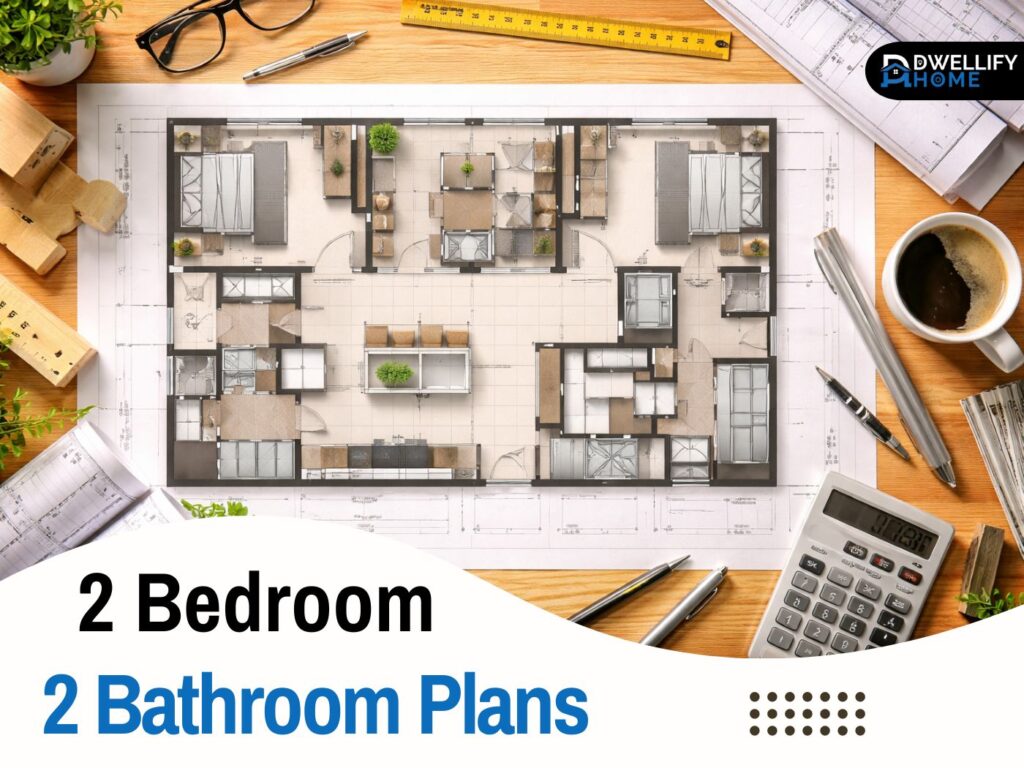
When you review 2 bedroom 2 bathroom plans with dimensions, don’t just look at the room labels. Look at how the rooms work with real furniture, real doors, and real movement.
Here are the dimensions and details that matter most:
- Overall footprint width and depth, so you know it fits your lot
- Bedroom sizes that allow a bed plus walking space on both sides
- Closet depth, because shallow closets feel useless fast
- Bathroom clearances, especially around toilets and shower doors
- Hall widths and door swings, so doors don’t collide
A quick tip from my own review process: trace your daily routes with your finger. Entry to kitchen, kitchen to laundry, bedroom to bathroom. If your finger keeps hitting tight turns or crossing through the living room for simple tasks, you’ll feel that friction every day.
Bathroom Planning That Works in Real Life (Not Just on Paper)
In a 2 bed 2 bath home, bathroom access can make or break comfort. The most common setups are:
- Primary ensuite plus a hall bath for guests
- Dual ensuite arrangement where each bedroom has its own bath access
Dual ensuite layouts are great for roommates and rentals. Everyone gets private access and fewer shared routines. The tradeoff is plumbing complexity and sometimes a slightly smaller common area.
If you go with one ensuite and one hall bath, pay attention to guest flow. Ideally, guests can use the second bathroom without walking past bedroom doors. It keeps the home feeling more private and comfortable.
Also, don’t underestimate ventilation. In smaller footprints, a good exhaust fan and smart moisture control matter a lot, especially if bathrooms sit near bedrooms.
Storage & Utility: The Difference Between Pretty and Livable
Storage is where small homes either shine or struggle. Many people focus on the living room size, then later realize there’s nowhere for coats, cleaning supplies, extra towels, or bulk groceries.
I like to see these basics covered:
- Bedroom closets that can actually hold seasonal clothes
- A linen closet near the bathrooms
- A pantry or tall kitchen storage zone
- A place for a vacuum, mop, and basic tools
One architect trick that saves money is wet-zone stacking. If the kitchen, bathrooms, and laundry sit near each other, plumbing runs are shorter and simpler. It’s not glamorous, but it often reduces build cost and future maintenance headaches.
Laundry placement matters too. A laundry closet near bedrooms is convenient, but it needs sound control and ventilation. A laundry near the kitchen can work well if it doesn’t block circulation.
2 Bedroom 2 Bathroom Plans With Loft (When a Loft Is Worth It)
2 bedroom 2 bathroom plans with loft space can be a smart way to add flexibility without expanding the footprint. A loft can become an office, a reading lounge, a hobby area, or even a guest overflow space.
The best lofts feel intentional, not like leftover space. They usually have good natural light, enough headroom, and a plan for where furniture will go.
A few watch-outs I always mention:
- Sound travels, so quiet work can be tricky
- HVAC balance can be harder with open upper spaces
- Privacy is limited unless the loft is separated
- Safety rails and stair comfort matter more than people expect
If you want a loft, make sure the downstairs still feels complete. The loft should be a bonus, not a patch.
Optional but Popular: Barndominium-Style 2 Bedroom 2 Bathroom Layouts
Barndominium-style layouts are popular because they pair living space with practical storage or workshop potential. They often use simpler exterior forms, larger spans, and flexible interiors.
What works best is clear separation between noisy and quiet zones. If the shop or garage shares a wall with a bedroom, sound and vibration become real issues. I like to buffer those spaces with a laundry room, storage room, or bathroom when possible.
This style is especially appealing for rural lots or anyone who wants a low-maintenance exterior and more utility space.
2 Bedroom House Plan in Village or Rural Areas (Practical Add-Ons)
A 2 bedroom house plan in village settings or rural areas often needs a different set of priorities. Climate, ventilation, outdoor living, and utility planning take center stage.
A few practical add-ons that help a lot:
- A shaded veranda or covered porch for outdoor seating
- Cross ventilation by placing windows on opposite walls
- A mudroom or secondary entry to handle dust and outdoor gear
- A service yard for water storage, washing, or maintenance access
Also, plan utilities honestly. If septic or water tanks are involved, you’ll want easy access and thoughtful placement. It’s not the most exciting part of the plan, but it prevents big headaches later.
Vastu Compliance (Optional): Simple Guidance Without Overcomplicating
If Vastu compliance matters for your household, you can usually align the plan without making it complicated. Common preferences include placing the master bedroom in the southwest, the kitchen in the southeast, and keeping the entry toward the north or east.
The key is not forcing it so hard that daily function suffers. I’ve seen layouts where people chase “perfect placement” and end up with awkward circulation or tiny rooms. A balanced approach works best.
If you want to follow Vastu, treat it like a guideline. Keep the plan practical and comfortable first.
Customization Options (What Most Plans Can Be Modified For)
Most plans can be adjusted to fit your needs, but not every change is equally simple. The easiest modifications usually include shifting door locations, resizing closets slightly, adjusting window placement, or tweaking the kitchen layout.
Common upgrades clients ask for:
- Adding a small powder room
- Enlarging a pantry or laundry area
- Turning a second bedroom into a home office flex room
- Adding a covered porch or extending a patio
Here’s a practical caution. Don’t move plumbing heavy areas early unless you have a good reason. Bathrooms and kitchens are expensive to relocate because they affect structure, mechanical runs, and sometimes the roof.
If your lot is sloped, a walkout basement can be an option, but it changes the project scope. It’s worth considering early, not after everything is finalized.
Budget & Cost-to-Build Considerations (Simple, Honest Guidance)
People often assume cost is mostly about square footage. Square footage matters, but plan complexity can matter just as much.
What commonly increases cost:
- Complicated roof shapes
- Lots of corners and jogs in the footprint
- Long plumbing runs between kitchen and baths
- Custom window sizes everywhere
- Oversized spans that need stronger beams
What commonly saves money:
- Simple footprints
- Standard room proportions
- Grouped utilities and shared plumbing walls
- A clean structural grid that doesn’t fight the layout
If you’re comparing options, ask yourself which plan is elegant in its simplicity. Those plans usually perform better over time.
Code & Safety Basics (Keep It Buildable)
Even if you’re just choosing a concept right now, it helps to keep basic safety and code ideas in mind. Bedrooms typically need proper emergency egress through a compliant window or door. Habitable rooms often have minimum size expectations depending on your local rules.
Local requirements vary, so always confirm with a licensed professional in your area. Still, checking early prevents you from falling in love with a plan that can’t be approved without major changes.
A simple mindset: safety first, then style. A beautiful plan that fails basic requirements becomes expensive fast.
2 Bedroom 2 Bathroom Plans Free: Where to Find Them (and What to Check)
You can find 2 bedroom 2 bathroom plans free online, but “free” often means partial. Sometimes you get a nice drawing without structural details, specifications, or site adaptation.
Before building from a free plan, I recommend a quick checklist:
- Does it match your local building rules and climate needs?
- Are dimensions and clearances realistic for furniture and doors?
- Is there enough detail for a contractor to price accurately?
- Has a professional reviewed structure, loads, and mechanical planning?
Free plans can be a good starting point. Just treat them like a concept, not a finished construction set.
FAQs
What’s a good size for a 2 bedroom, 2 bathroom home?
Many comfortable layouts fall between 1,000 and 1,300 sq ft, but great plans exist smaller and larger. The layout quality matters as much as the number.
What’s the most private 2/2 layout?
A split-bedroom plan is usually the top choice for privacy, especially for roommates or frequent guests.
Can a 2/2 work under 1200 sq ft?
Yes. The best small plans rely on open living space, smart storage, and efficient circulation. Avoid wasted hallway area.
Is a loft practical in a 2/2?
It can be, especially for a home office or hobby zone. Just plan for sound, heating and cooling, and safety.
Conclusion: The Best 2 Bedroom 2 Bathroom Plan Is the One That Fits Your Life
By now, you’ve probably noticed a pattern. The most successful 2 bedroom 2 bathroom plan isn’t defined by a trendy look. It’s defined by privacy that matches your routine, bathroom access that feels natural, and circulation that doesn’t create daily friction.
If you want a simple decision path, use this. Choose split-bedroom if privacy is your priority. Choose open concept if you want the home to feel larger and more social. Stay under 1200 sq ft if you want efficiency and lower build costs, but plan storage carefully. Add a loft only if it has a real purpose and doesn’t compromise the main floor.
And here’s my final architect-style tip. Print your favorite plan and imagine a full day inside it. Wake up, make coffee, do laundry, host a friend, and go to bed. If the flow feels calm in your mind, it’ll feel calm in real life too.
Disclaimer:
This article is for general information and planning ideas only. Building codes, structural requirements, and permits vary by location and site conditions. For safety and accuracy, consult a licensed architect, engineer, or local professional before finalizing or building any plan.

I’m Bilal, the founder of Dwellify Home. With 6 years of practical experience in home remodeling, interior design, and décor consulting, I help people transform their spaces with simple, effective, and affordable ideas. I specialize in offering real-world tips, step-by-step guides, and product recommendations that make home improvement easier and more enjoyable. My mission is to empower homeowners and renters to create functional, beautiful spaces—one thoughtful update at a time.