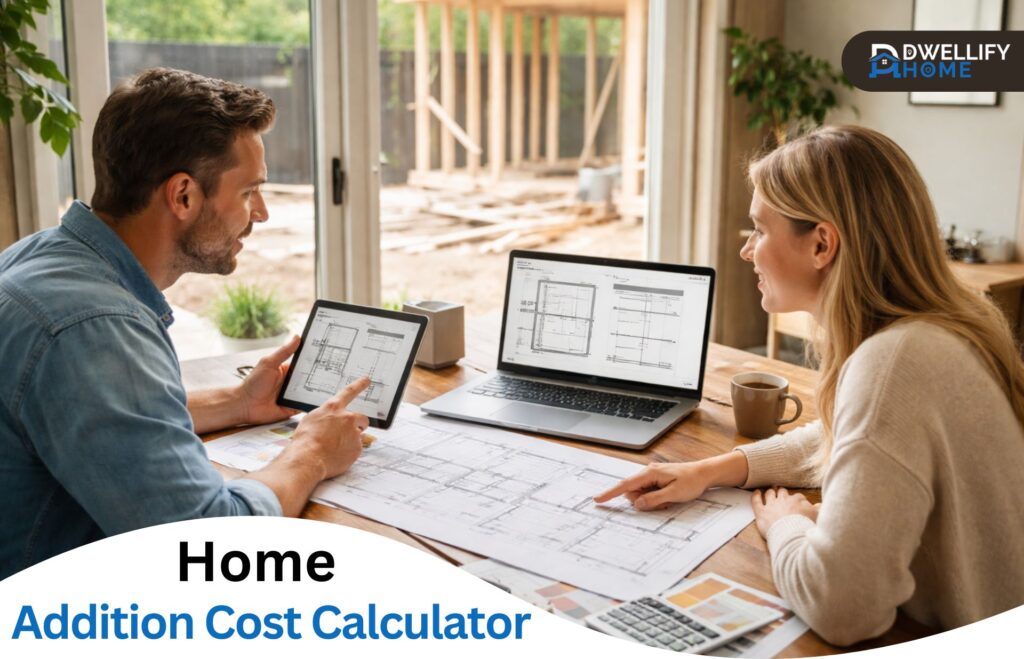
A rough number can save you from a very expensive misunderstanding.
That’s the real value of a home addition cost calculator. It gives you a starting point before you spend weeks talking to contractors, redrawing plans, or building your budget around a number that was never realistic in the first place.
I’ve seen the same mistake over and over: someone plugs in square footage, gets a neat estimate, and treats it like a quote. Then the real bids come in and they’re shocked by the gap. Most of the time, the calculator wasn’t wrong. It just wasn’t complete.
Snippet-Ready Definition
A home addition cost calculator is a budgeting tool that estimates renovation costs based on size, room type, finishes, and location. Homeowners use it to compare options and avoid unrealistic budget assumptions.Mission Statement
Dwellify Home helps homeowners make practical, stylish, and informed home improvement decisions with clear, trustworthy guidance.
What a Home Addition Cost Calculator Can and Cannot Tell You
A calculator is useful for early planning. It can help you estimate the base cost of adding space, compare project types, and get a feel for whether your idea fits your budget.
What it usually does well:
- Gives a ballpark cost based on size and room type
- Helps compare a bedroom addition with a bathroom or master suite
- Shows how finish level changes the price
What it usually misses:
- Permit fees
- Design and engineering work
- Site prep problems
- Utility upgrades
- Structural surprises once walls or roofing are opened up
That’s why the number on the screen should be treated as a planning range, not a final commitment.
Mini Guide: What to Check Before Trusting the Estimate
| Input | Why It Matters |
| Square footage | Sets the base cost range |
| Addition type | Bathrooms, kitchens, and suites cost more |
| Build out vs. build up | Second-story work usually costs more |
| Finish level | Materials and fixtures can shift the budget fast |
| Location | Labor, permits, and code requirements vary by area |
| Contingency | Helps cover the costs calculators often miss |
Key Benefits
- Gives you a fast starting budget before requesting bids
- Helps compare room types and project sizes
- Shows how finish level and location affect cost
- Makes it easier to spot unrealistic contractor quotes
- Helps you plan for permits, design fees, and contingency
Average Home Addition Cost Per Square Foot
For many projects, building out tends to fall somewhere around $80 to $200 per square foot. Building up is often much higher, sometimes reaching $300 to $500 per square foot, because second-story work usually involves structural reinforcement, stair construction, and roof changes.
The room type matters just as much as the size. A simple bedroom or bonus room is usually less expensive than a bathroom or kitchen because there’s less plumbing, fewer fixtures, and less specialized labor.
This is where a home addition cost per square foot calculator can be helpful, but only if you remember that square-foot pricing gets less reliable as complexity goes up.
Home Addition Cost by Project Type
Not all additions are priced the same, even when they’re the same size.
A basic bedroom or family room addition is often one of the simpler projects. It still needs framing, insulation, electrical work, flooring, and HVAC, but it doesn’t usually carry the plumbing and fixture costs of a wet room.
Bathroom additions are a different story. Once you add drainage, waterproofing, tile work, ventilation, and fixtures, the cost per square foot rises fast.
Kitchen additions also climb quickly because cabinets, appliances, plumbing lines, electrical circuits, ventilation, and finish details all add up.
Master suites tend to land in the higher range because they combine bedroom space with bathroom costs and often include closets, upgraded finishes, or custom layouts.
Sunrooms, garage additions, guest suites, and second-story additions each come with their own pricing logic. A garage may cost less per square foot than conditioned living space, while a second-story addition may cost far more than homeowners expect.
Home Addition Cost by Size
Size-based searches are common for a reason. People want real numbers they can picture.
A 12×24 addition cost calculator example gives you a useful look at a 288-square-foot project. That might work for a bedroom, office, or modest family room.
A 20×20 room addition cost calculator estimate covers 400 square feet, which often feels large enough to matter in day-to-day life. That size is also a good benchmark because many homeowners can imagine what fits into it.
A 400 sq ft master suite addition cost will usually land much higher than a 400-square-foot basic room because bathrooms and finish choices drive up pricing.
A 1,000 sq ft addition cost estimate can vary wildly. At that size, the project may involve major layout changes, more extensive HVAC work, larger foundation needs, and a different permit or engineering path.
One thing many people miss: bigger additions don’t always scale neatly. Some fixed costs spread out better on larger jobs, but structural and systems work can still push the final price up faster than expected.
The Main Factors That Change Your Home Addition Estimate
Square footage gets attention because it’s easy to measure. It’s not the whole story.
Layout complexity matters. A clean rectangular addition is usually more efficient to build than a design with multiple corners, roof transitions, or custom openings.
Foundation type matters too. Slab, crawl space, and full foundation work all carry different costs. Then there’s framing, roof tie-ins, siding matching, window quality, insulation, drywall, flooring, and trim.
Mechanical systems are another big factor. Extending plumbing, electrical, and HVAC sounds straightforward until the existing system can’t support the new load.
And then there’s site prep. Tight access, grading problems, drainage issues, tree removal, or demolition work can change the estimate before the addition even starts.
How to Use a Home Addition Cost Calculator the Right Way
Start with accurate square footage. Guessing usually leads to disappointment later.
Next, choose the right project type. Don’t price a master suite like a standard bedroom. Don’t price a second-story addition like a ground-floor bump-out.
Then adjust for finish level. Builder-grade, mid-range, and higher-end materials can move the budget more than people expect.
After that, add a contingency. For most additions, a reserve of 10% to 20% is a safer approach than assuming everything will go perfectly. Older homes especially tend to reveal surprises once work begins.
Build Out vs. Build Up: Which Option Makes More Financial Sense?
Building out is often cheaper on a per-square-foot basis, but only when the lot allows it. You need enough yard space, workable setbacks, and a practical way to connect the new structure to the old one.
Building up makes sense when land is tight or when preserving outdoor space matters. Still, it usually costs more because the house may need reinforcement, the roof has to be altered, and stairs consume both money and interior space.
Zoning rules can affect this choice as much as construction costs. A project that looks cheaper on paper may not be the easier one once local restrictions come into play.
Local Costs Can Change Your Estimate More Than You Think
National averages are useful, but local pricing is where budgets get real.
Labor rates, permit fees, inspection requirements, and material demand vary by region. A home addition cost calculator near Washington, DC may produce a very different outcome than a similar estimate near Virginia, even when the square footage looks the same on paper.
That’s why zip code-based estimates tend to be more useful than national averages. They won’t replace bids, but they usually get you closer.
Hidden Costs Many Homeowners Miss
This is where budgets usually go off track.
Permits and inspections are often left out of early estimates. So are architect fees, structural engineer review, utility service upgrades, drainage corrections, cleanup, and storage costs during the project.
Matching the existing home can also cost more than expected. A new roofline, siding transition, or flooring tie-in may require more labor than a calculator assumes.
Change orders are another common budget leak. Small layout adjustments during construction can snowball into real money.
How Accurate Is a Free Home Addition Calculator?
A free home addition calculator is useful for early planning, comparing options, and deciding whether a project is worth exploring.
It becomes less reliable when the project involves:
- Older homes
- Structural modifications
- Complex rooflines
- Plumbing-heavy rooms
- Tight sites
- Local code complications
A quick estimate is most helpful when you use it as a first pass, then tighten the numbers with local input.
A Smarter Way to Estimate Your Full Renovation Budget
The best way to budget is to separate the project into layers.
Start with base construction cost. Then add soft costs like plans, permits, and engineering. Add contingency after that. Finally, think about finishes, furnishings, and post-project touch-ups that often get ignored.
That difference matters. Construction-only budget and total project budget are not the same thing.
Sample Budget Ranges to Sanity-Check Your Numbers
A small addition may land somewhere around the lower end of the overall range, while a mid-size or large addition can move quickly into six figures depending on type and finish level.
The key is not memorizing one number. It’s learning when a number looks suspiciously low.
A bathroom addition priced like a simple bedroom should raise questions. A second-story estimate that barely exceeds a ground-floor build should also make you pause.
How to Compare Your Calculator Result With Contractor Quotes
Once quotes start coming in, compare line items, not just totals.
Look closely at what each bid includes for foundation, framing, roofing, insulation, windows, electrical, plumbing, and finish work. One quote may look lower simply because important costs were left vague or excluded.
The cheapest price often becomes the most expensive job when missing items show up later as extras.
When to Bring in an Architect, Designer, or Structural Engineer
Some projects need professional input early. Second-story additions, major wall changes, complicated roof modifications, and larger suites usually benefit from proper design and engineering before pricing gets serious.
That step costs money, but it often saves money by preventing bad assumptions, change orders, and layout mistakes that are hard to fix once work starts.
Is a Home Addition Worth the Cost?
That depends on what you’re trying to solve.
Some additions make daily life much easier. A new bedroom, family room, or proper suite can give a house years of added function. Other projects make less sense financially, especially if the budget gets close to what moving would cost.
The right question isn’t just “What will this addition cost?” It’s “What does this solve, and is that worth the spend?”
Frequently Asked Questions
How much does a 20×20 addition cost?
A 20×20 addition is 400 square feet, so the cost depends mostly on room type, finishes, and whether you’re building out or up. Wet rooms and second-story additions usually cost much more than a basic bedroom or family room.
How much would it cost to add 1,000 square feet to a home?
A 1,000-square-foot addition is a major project, and costs can vary widely depending on structure, layout changes, mechanical work, and local labor rates. The final number is usually driven more by complexity than size alone.
How much does it cost to build a 30×30 addition?
A 30×30 addition equals 900 square feet. That kind of project often moves beyond a simple room addition and may involve larger structural, HVAC, permit, and design costs, so the estimate should be treated as a planning range, not a fixed quote.
Is it cheaper to add an addition or build up?
Building out is often cheaper per square foot, but it depends on lot size, setbacks, and site conditions. Building up usually costs more because of structural reinforcement, roof changes, and stair construction.
Are free calculators accurate enough to use?
They’re useful for early budgeting, comparing options, and setting expectations. They’re less reliable for older homes, complex layouts, heavy plumbing work, or projects with local code and permit complications.
Conclusion
A home addition cost calculator is a helpful planning tool, but it works best when you use it with clear expectations.
Use it to compare ideas, test rough budgets, and understand what drives cost. Then bring in local pricing, realistic contingencies, and professional input before you commit. That approach gives you a budget you can actually work with, not just a number that looked good on a screen.
Disclaimer
Cost estimates are for planning purposes only and can vary based on location, design, permits, labor, and site conditions.

I’m Bilal Hassan, the founder of Dwellify Home. With 6 years of practical experience in home remodeling, interior design, and décor consulting, I help people transform their spaces with simple, effective, and affordable ideas. I specialize in offering real-world tips, step-by-step guides, and product recommendations that make home improvement easier and more enjoyable. My mission is to empower homeowners and renters to create functional, beautiful spaces—one thoughtful update at a time.