Wainscoting is one of those home-improvement words that looks like it should be obvious… until you say it out loud and everyone’s eyebrows go up. I’ve heard it in paint stores, in showrooms, and on job sites—smart, capable homeowners pausing mid-sentence because they’re not sure where the “coat” part lands.
Let’s clear it up in a way that actually sticks. You’ll walk away knowing how to say it comfortably, how to recognize acceptable variations, and how to avoid the few mispronunciations that tend to cause confusion.
Snippet-Ready Definition:
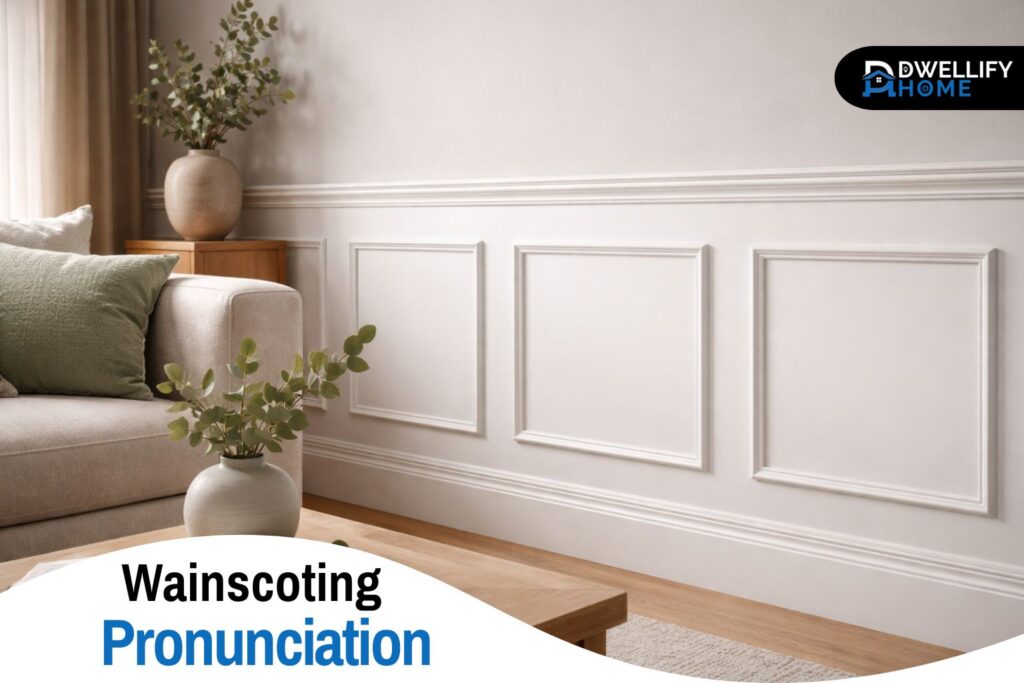
Wainscoting pronunciation is commonly said as “WAYN-skuh-ting.” The term refers to decorative wall paneling installed on the lower portion of interior walls, often used to protect surfaces and add architectural detail.
Mission Statement:
At Dwellify Home, our mission is to help homeowners make practical, stylish, and informed décor decisions with clear explanations and realistic guidance.
The Correct Wainscoting Pronunciation (Most Common)
The most common, natural way you’ll hear it said is:
WAYN-skuh-ting
Think: WAYN + skuh + ting
Said smoothly, it doesn’t sound like three separate chunks. It’s more like one flowing word with a clear stress at the start: WAYN-skuh-ting.
A quick syllable breakdown helps if you like structure:
- wains (rhymes loosely with “lanes”)
- cot (soft, quick—don’t over-pronounce it)
- ing (standard “-ing” ending)
The biggest thing is the middle sound. Most people get tripped up because they want “cot” to sound like a full, strong word. In real speech it’s lighter, almost tucked in.
Key Takeaways
- The most common pronunciation is WAYN-skuh-ting
- Stress is placed on the first syllable
- The middle syllable should sound soft, not like “coat”
- Both American and British pronunciations are acceptable
- The word refers to decorative lower wall paneling used in interior design
Wainscoting Pronunciation Cheat Sheet (Fast Answer)
When someone asks you in the aisle at the hardware store, here’s the fast version you can use without thinking:
- WAYN-skuh-ting (most common)
- Stress is on WAYN
- Keep the middle syllable quick and soft
A small trick that helps a lot: don’t try to “perform” the word. Say it like you’d say “painting” or “baseboarding”—one smooth motion.
Here’s a sentence you can copy out loud:
“We’re doing wainscoting in the dining room to protect the walls.”
Say it slowly once, then say it again at normal speed. That second one is usually the moment it clicks.
American vs British Pronunciation (Both Accepted)
You may hear slightly different vowel sounds depending on where the speaker is from, and that’s completely normal. In American English, the common sound is still the familiar WAYN-skuh-ting shape—clear first syllable, soft middle.
In British English, the vowel sounds can shift a bit, especially in the middle syllable. The overall rhythm stays similar, but the “cot” portion can sound a touch closer to “skoh” depending on accent and region.
Here’s the practical takeaway: both versions are accepted, and most people won’t blink either way. What people notice isn’t “US vs UK.” They notice when someone says it like it’s two words—especially when it turns into “wains-coating.”
Common Mispronunciations (And the Quick Fix)
I’ve heard every version of this word you can imagine. Most mispronunciations come from one understandable place: the spelling looks like it should behave like “coating.”
Here are the common ones, and the quick fixes:
- wains-COAT-ing
Fix: Don’t say “coat” like a full word. Make the middle syllable softer: WAYN-skuh-ting. - wayne-SCOTT-ing
Fix: Keep it as a gentle “skuh,” not “scott.” Think of it like you’re passing through the middle syllable. - wains-coating
Fix: This is the one that can cause real confusion in conversation. People might momentarily picture paint or a coating product. Return to the quick rhythm: WAYN-skuh-ting.
The #1 mistake is over-emphasizing the “coat” sound. If you avoid that, you’ll sound natural even if your accent is different from someone else’s.
How to Practice Saying Wainscoting (30-Second Method)
You don’t need to stand in front of a mirror practicing home-renovation vocabulary, but a simple method helps if this word keeps catching you mid-sentence.
Step 1: Say “wainscot.”
Say it as WAYN-skot (soft “skot”). Not “wains-coat.”
Step 2: Add “-ing.”
Now turn it into WAYN-skot-ing without changing the middle sound.
Step 3: Smooth it out.
Speed it up slightly so it becomes WAYN-skuh-ting. That “uh” sound often shows up when people speak naturally.
One easy self-test: record a quick voice memo saying the sentence from earlier. When it sounds like one word—not three pieces—you’re there.
Wainscoting vs Wainscot (Pronunciation + Meaning)
You’ll hear both terms in real projects, and that’s where confusion sneaks in. Wainscot is the base word. Wainscoting is the more common term people use today when they’re talking about the wall treatment.
Pronunciation-wise, they’re closely related:
- wainscot: WAYN-skot
- wainscoting: WAYN-skuh-ting
Meaning-wise, here’s how it plays out in everyday home talk:
- Someone might say, “We’re adding wainscoting in the hallway,” meaning the full paneling detail on the wall.
- A designer or trim carpenter might use wainscot in a more traditional or technical way, especially when referring to the paneling as a material or style element.
In normal homeowner conversation, “wainscoting” is the word you’ll use most, and everyone will understand it.
Wainscoting vs Wainscotting (Spelling Variant)
You’ll sometimes see wainscotting with a double “t.” It shows up in older writing and occasionally in certain regional usages or product descriptions.
Here’s what matters for you:
- Both spellings point to the same idea.
- The spelling variation doesn’t require a new pronunciation.
- In most modern home-improvement content and labeling, wainscoting is the more common spelling.
If you’re writing it in an email to a contractor or searching for product options, using wainscoting will usually match more results and look more familiar.
Dictionary-Accurate Pronunciation (For People Who Want Precision)
Some people like to see the dictionary form—especially if they’re writing professionally, teaching, or just want to be sure they’ve got it right.
Dictionaries often show pronunciation using IPA (International Phonetic Alphabet). IPA is simply a standardized way to show sounds, since spelling can be misleading. It’s useful, but you don’t need to memorize it to say the word correctly.
You may also notice dictionaries list more than one acceptable pronunciation. That’s not them being vague—it’s acknowledging that pronunciation can vary by region and still be correct. For everyday use, the practical goal is clarity and confidence, not chasing a single “perfect” sound.
Use “Wainscoting” in Real Sentences (So It Sticks)
Using the word in a sentence is the fastest way to make it feel normal. Here are a few short, home-focused examples:
- “We’re adding wainscoting in the entryway to protect the walls from scuffs.”
- “The dining room looks more finished with wainscoting and a matching chair rail.”
- “We chose a taller wainscoting height to make the ceilings feel higher.”
- “Painting the wainscoting semi-gloss makes it easier to wipe clean.”
- “The contractor asked whether we wanted flat panels or beadboard-style wainscoting.”
Mini drill that works: say each sentence once slowly, then once at your normal speaking speed. That second pass is the one that trains your mouth to do it without hesitation.
Pro Tip for Homeowners
In real conversations—especially in showrooms—confidence matters more than perfection. I’ve watched homeowners get flustered and switch to vague phrases like “that wall panel thing,” even though they know what they want. You don’t need to do that.
Most pros will say something close to WAYN-skuh-ting, and they’ll understand you even if your accent shifts the vowels a little. The only time you might get a “wait, what?” moment is if it turns into “wains-coating,” because that can sound like a paint product or a finishing step.
One simple way to be crystal clear when ordering materials or discussing scope is to pair the word with a quick description:
“Wainscoting—those lower wall panels, about waist height.”
That’s especially helpful when you’re talking to someone new on a crew, or you’re comparing options at a millwork shop where “paneling,” “beadboard,” and “wall trim” are all in the same conversation.
Related Terms People Also Search (Quick, Helpful One-Liners)
A few terms get mixed up with wainscoting all the time. Keeping these straight helps you communicate clearly during a project.
- Paneling vs wainscoting: Paneling can cover a full wall or large sections; wainscoting typically refers to paneling on the lower portion of a wall for protection and style.
- Chair rail / dado rail: These are horizontal trim pieces often used with wainscoting to cap the top edge; people sometimes use the rail name when they actually mean the whole wainscoting setup.
- Beadboard: A type of paneling with narrow vertical grooves; beadboard is often used as a wainscoting style, so the terms get swapped in casual conversation.
Knowing these terms isn’t about sounding fancy—it just makes it easier to get the exact look you want without back-and-forth.
FAQ: Wainscoting Pronunciation
Is it pronounced wainscotting or wainscoting?
Both spellings appear in writing, but wainscoting is the more common modern spelling. The pronunciation usually remains the same: WAYN-skuh-ting.
Is it wainscoting or coating?
The correct word is wainscoting, which refers to decorative wall paneling. Some people mistakenly pronounce it like “coating,” but the middle sound is softer.
What is the definition of wainscoting?
Wainscoting is a type of decorative wall treatment installed on the lower portion of a wall, often made from wood panels, beadboard, or trim molding.
What is the golden rule for wainscoting
A common design guideline is that wainscoting should cover about one-third of the wall height, though proportions may vary depending on ceiling height and room style.
Why is wainscoting pronunciation confusing?
The spelling suggests the word should sound like “coating,” but natural speech softens the middle syllable, creating the more familiar WAYN-skuh-ting sound.
Conclusion: Wainscoting Pronunciation (Say It With Confidence)
The most common way to say it is WAYN-skuh-ting, with the stress on WAYN and a soft middle syllable. You may hear slight US/UK variations, and that’s fine—both are accepted.
The easiest way to feel confident is to use it in a sentence once or twice. After that, it stops being “that tricky word” and starts being just another normal part of talking about your home.
Disclaimer:
Information provided is for general home and design education. Measurements, terminology, and recommendations may vary depending on project requirements and professional advice.

I’m Bilal, the founder of Dwellify Home. With 6 years of practical experience in home remodeling, interior design, and décor consulting, I help people transform their spaces with simple, effective, and affordable ideas. I specialize in offering real-world tips, step-by-step guides, and product recommendations that make home improvement easier and more enjoyable. My mission is to empower homeowners and renters to create functional, beautiful spaces—one thoughtful update at a time.