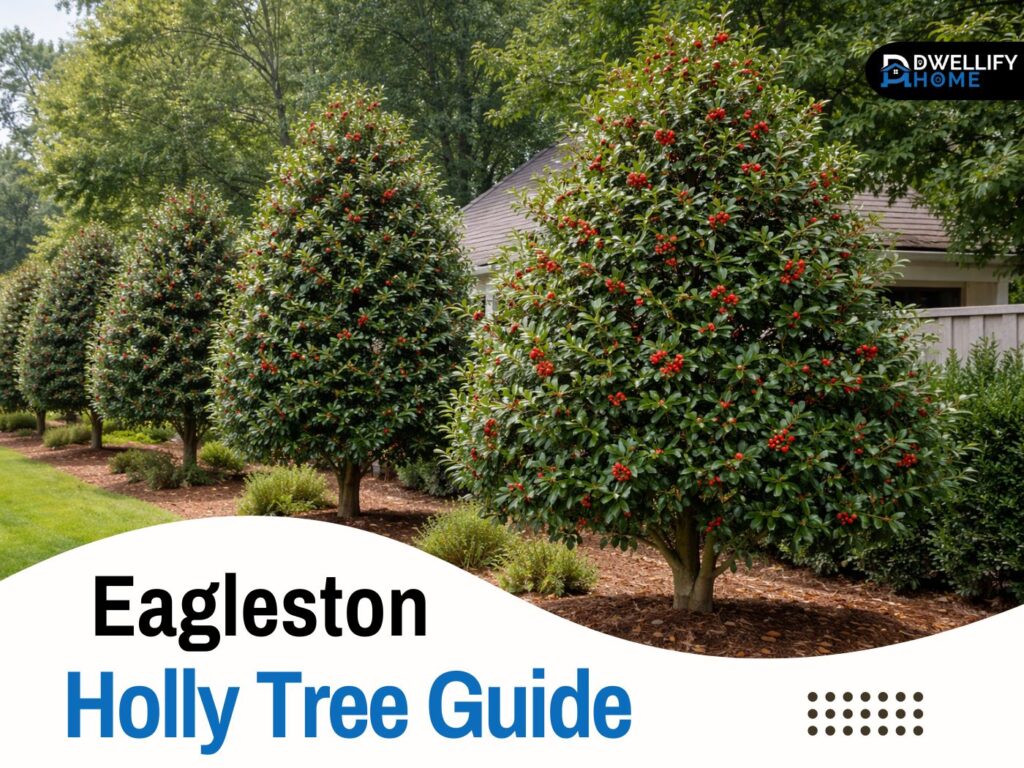
If you want a yard that looks put-together year round, an Eagleston holly can get you there without constant babysitting. It stays green, holds a naturally tidy shape, and can work as a privacy screen or a small ornamental tree.
Most “easy” evergreens still have one or two deal-breakers, usually waterlogged soil or wrong planting depth. Get those basics right and this plant tends to reward you with thick foliage and, with the right pollination setup, bright red berries in the cooler months.
Snippet-ready definition:
The eagleston holly tree is a dense, evergreen holly hybrid prized for year round privacy, glossy foliage, and winter berries on female plants when a male pollinator is nearby. It grows best in well-drained soil.
Mission Statement:
At Dwellify Home, our mission is to give homeowners practical, experience-based guidance that helps you choose, plant, and care for landscape plants with confidence, so your outdoor spaces stay healthy and beautiful year after year.
Eagleston holly at a glance (quick facts)
What it is (a Topel or Topal holly hybrid) and why that matters
This plant is a hybrid holly, Ilex × attenuata ‘Eagleston’. In plain language, it was selected because it performs well in landscapes and keeps its structure better than many fussier choices.
Hybrid hollies are popular because they usually combine good looks with practical toughness. That doesn’t mean they thrive anywhere, but it does mean they’re often more forgiving once established.
Mature size, shape, and common landscape uses (screen, hedge, small tree)
In most home landscapes, you can expect about 15 to 25 feet tall and 10 to 20 feet wide over time. It naturally grows in a pyramidal form, which is why it’s so useful when you want a clean look without weekly trimming.
Common uses include privacy screens, hedges along property lines, and single specimen plantings near entries or corners. It can also be trained into a tree form for a more formal look.
USDA zone + sunlight + soil must-haves (simple checklist)
If you like quick checklists, this is the one to remember.
- Eagleston holly tree zone range is typically USDA 6 to 9
- Full sun to partial shade
- Well-drained soil is essential
- Regular watering during the first growing season, then less once established
Quick Guide Table (comparison + fast decisions)
| Topic | Quick answer | Practical tip |
| Best use | Privacy screen, hedge, small ornamental tree | Decide form first: full-to-ground for privacy, tree form for entryways |
| Mature size | About 15–25 ft tall, 10–20 ft wide | Give it room so you are not forced into harsh pruning |
| Sun | Full sun to partial shade | More sun usually means denser growth and better berry potential |
| Soil | Well-drained, prefers slightly acidic | Poor drainage is the fastest way to cause decline and root rot |
| Common issues | Chlorosis (yellowing), leaf spots, scale, root rot in wet soil | |
| Berries | Female plants berry with a compatible male nearby | If you want berries, plan pollination before planting a full row |
| Pet safety | Leaves and berries are low toxicity but can upset pets |
Step-by-step mini guide
- Pick the right spot
Choose sun to partial shade and avoid any area where water sits after rain. Poor aeration and wet soil increase root-rot risk. - Plant at the right depth
Set the root ball level with the soil, or slightly high if drainage is questionable. Avoid burying the trunk flare. - Water smart in year one
Deep watering is better than daily sprinkling. Let the top few inches start drying between waterings. - Mulch correctly
Use 2–3 inches of mulch and keep it pulled back from the trunk so moisture does not stay trapped. - Prune with timing in mind
Shape in late winter or early spring, and avoid heavy pruning if you want berries.
What makes Eagleston holly different from other hollies?
Foliage, density, and year-round structure benefits
Some evergreens look great early on, then thin out and show bare stems as they age. This one tends to hold density well, especially when it gets enough light and isn’t overwatered.
Leaves are glossy and dark green, and new growth may start lighter before deepening in color. That fresh growth can make the plant look lively in spring without needing flowers to do the work.
Berries in fall and winter + wildlife value (birds)
When berries happen, they’re one of the best winter features you can add to a yard. They can hang on through cooler months and give you color when most plants are sleeping.
Birds also use hollies for shelter. In winter, that dense branching can become a little safe zone in the landscape, which is one reason people notice more bird activity around mature plantings.
Eagleston vs East Palatka (quick, practical comparison)
These two get compared a lot because both are widely used as screens.
A simple way to think about it is this. Eagleston often gets chosen when the goal is a thick, tidy screen with a more uniform shape. East Palatka can be a great option too, but depending on the site, it may feel a bit more vigorous or looser in habit.
If you care about a clean, “finished” look without heavy pruning, Eagleston is usually the safer bet.
Pros and cons (honest snapshot before you buy)
Pros (privacy, evergreen look, hardy hybrid, adaptable form)
Let’s start with what it does well.
It gives year-round privacy, stays evergreen without looking shaggy, and works in multiple forms. It’s also one of those plants that can look expensive even when the maintenance routine is simple.
Cons (soil pH issues, berry mess placement, drainage sensitivity)
Now the part that saves people money.
The most common headaches are not dramatic pests. They’re soil and water issues. In alkaline soils, you can see yellowing from nutrient availability problems. In wet soils, you can get decline and root rot.
And yes, berries can be messy in the wrong spot. If you hate sweeping, don’t plant a berrying holly right beside a narrow walkway or a light-colored driveway.
Tree form vs shrub form vs full-to-ground (choosing the right plant)
Best choice for a privacy screen/hedge vs a focal-point tree
Before you buy anything, decide what job the plant is doing.
For privacy, you want full-to-ground plants that keep foliage low. For a focal point, a tree form can look polished and architectural, especially when paired on each side of an entry.
What tree form means (and how it changes maintenance long-term)
Tree form is the same plant trained differently. Lower branches are removed to expose a trunk, and the canopy is maintained above.
The tradeoff is straightforward. Tree form looks cleaner, but it can need a little more shaping and a bit more attention while establishing. Full-to-ground screens are more forgiving visually and recover faster if a branch gets stressed.
Where it grows best (zones + climate notes, including Houston)
Eagleston holly tree zone: cold/heat expectations
In Zones 6 to 9, it usually performs reliably when the site conditions are right. Young plants can be stressed by sudden cold snaps, so the first winter is the one to watch.
A practical tip is to avoid heavy late-season fertilizing. You don’t want to push tender new growth right before cold weather.
Houston-specific note: drainage + alkaline soil = most common struggle
If you’re dealing with Houston-area conditions, the big issues are often heavy clay and higher soil pH. That combination can lead to chlorosis and slower growth if you don’t plan for it.
The good news is you can work around it with smarter planting and soil strategy. Raised planting, wider soil prep, and choosing the right fertilizer approach make a noticeable difference over time.
Ideal growing conditions (the success checklist)
Sun: full sun vs partial shade (what changes in density and berries)
More sun usually means a denser plant and faster fill-in. Full sun also supports better flowering, which matters if berries are a priority.
Partial shade can still work, especially in hotter climates, but you may see a slightly thinner habit over the years. If privacy is the goal, lean toward the brighter spot.
Soil + pH: why slightly acidic soil prevents yellow leaves (chlorosis)
Yellow leaves are often blamed on “lack of fertilizer,” but many times it’s really a pH issue. In alkaline soil, nutrients like iron can be present but harder for the plant to use.
That’s why the best fix is usually two-part. You handle the short-term symptoms, then you improve the soil environment slowly so the problem doesn’t keep returning.
Drainage: the number one avoidable mistake (root rot risk)
If there’s one deal-breaker, it’s poor drainage. Hollies can tolerate a lot, but staying wet around the roots for long periods is where trouble starts.
If your planting spot holds water after rain, adjust the location or improve the grade. It’s much easier to fix drainage before planting than after decline begins.
Planting the Eagleston holly tree (step-by-step)
When to plant + site placement tips
Fall and early spring are usually the smoothest times to plant. Mild temperatures let roots settle in without battling extreme heat.
Pick a spot with enough room for mature width and good air flow. Crowding a screen into a tight strip often leads to thinning and constant pruning battles.
How to plant correctly (depth, backfill, first watering)
Planting depth matters more than fancy soil additives.
Dig the hole as deep as the root ball and two to three times as wide. Set the plant so the top of the root ball is level with the surrounding soil, or slightly high if drainage is questionable.
Water thoroughly to settle soil, then add mulch. Don’t pack the soil down hard. Roots need oxygen.
Spacing guidelines: hedge/privacy screen vs single specimen
Spacing depends on how fast you want the screen to close in.
For a tighter hedge, many homeowners aim around 6 to 8 feet apart. For a more natural look with less future pruning, 8 to 12 feet can work well.
For a single specimen, give it room to show off its shape. Crowding it into a narrow bed almost guarantees awkward pruning later.
Watering routine (establishment year vs once established)
First year watering (how to build roots without drowning them)
The first growing season is when most success is decided.
Water deeply, then let the upper soil begin to dry before watering again. Shallow daily watering creates surface roots, and that makes the plant more heat-stressed long term.
A simple habit that helps is checking moisture a few inches down. If it’s still damp, wait.
After establishment: drought tolerance + when it still needs a drink
Once established, it can handle dry spells better than many broadleaf evergreens. That said, drought-tolerant doesn’t mean it never needs water.
During extreme heat, long drought, or windy winter dry periods, an occasional deep watering keeps foliage healthier and reduces tip burn.
Fertilizer + mulch (simple schedule that works)
Fertilizing basics (what acid-loving really means)
Acid-loving fertilizer is formulated to support plants that prefer slightly acidic soil and often helps reduce chlorosis symptoms in higher pH conditions.
A simple schedule is one feeding in early spring. If growth is weak, a second light feeding later may help, depending on your climate.
Avoid heavy fertilizing late in the season. It can encourage tender growth that doesn’t harden off in time.
Mulch done right (depth, trunk clearance, keeping roots cool)
Mulch is one of the easiest ways to help the root system.
Keep mulch about 2 to 3 inches deep and pull it back from the trunk. A wide mulch ring helps retain moisture and reduces competition from grass, which is a bigger deal than most people realize.
Pruning and shaping (keep it thick, neat, and berry-friendly)
Best time to prune (and what can reduce berries)
Timing matters if you want berries. Heavy pruning at the wrong time can remove the wood that would have produced flowers.
A safe approach is shaping in late winter or early spring. Light touch-ups can happen later, but avoid aggressive shearing if berry display matters to you.
How to prune for a dense screen vs how to train a tree form
For a screen, the goal is density from top to bottom. Keep the base slightly wider than the top so light reaches lower branches. That one detail prevents the classic “bare legs” problem.
For tree form, raise the canopy slowly over time. Remove lower branches gradually and leave enough foliage to fuel root growth, especially in the first couple of years.
Berry production and pollination (why some trees never berry)
Male vs female hollies (dioecious, explained simply)
Hollies are typically dioecious, meaning male and female flowers are on separate plants. Female plants produce berries, but pc only if pollen from a compatible male is available.
So a healthy plant with no berries isn’t necessarily failing. It may simply be missing the pollination piece.
How close does a pollinator need to be? (what really matters)
Distance is part of it, but it’s not the only part. Pollinator activity, timing, and the type of male holly nearby all matter.
In practical landscape terms, having a compatible male somewhere in the yard, or even close by in the neighborhood, often solves the issue. If berries are a must, ask the nursery about pollination before you buy a whole row.
Quick troubleshooting: healthy tree, no berries
If berries aren’t showing up, check these common causes.
- The plant may be male
- There may be no compatible male nearby
- Heavy pruning may be removing flowering wood
- Too much shade can reduce flowering
Once you identify the cause, the fix is usually straightforward.
Eagleston holly tree growth rate (what to expect + how fast you’ll get privacy)
Typical growth rate and a realistic privacy timeline
Growth rate depends heavily on light, watering during establishment, and spacing. In good conditions, expect moderate, steady growth rather than explosive growth.
If you plant a smaller size, you’ll wait longer for full privacy. If you start with larger container stock and site conditions are solid, the screen effect comes sooner.
How to speed up fill-in (light + spacing + watering strategy)
If you want faster coverage without stressing the plant, focus on the basics.
Give it enough sun, water deeply during the first season, and avoid letting grass compete right up to the trunk. Those three choices often make a bigger difference than any supplement.
Root system and placement (sidewalks, pools, foundations)
What the root system is usually like (practical placement tips)
The root system is generally spreading rather than aggressively deep. It’s not usually known as a sidewalk-lifter, but any woody plant can cause issues if planted too close in tight soils.
A safe habit is to respect mature width and keep a reasonable buffer from hard surfaces. If your goal is a hedge along a walkway, give it enough space so you’re not forced into harsh pruning later.
Root-zone care (mulch ring size + avoiding compaction)
Soil compaction quietly slows growth. It’s one of those problems that doesn’t look dramatic, it just makes the plant underperform year after year.
Keep foot traffic off the root zone when possible, maintain a mulch ring, and avoid burying roots under thick layers of rock or heavy landscape fabric.
Eagleston holly tree problems (common issues + fixes)
Yellow leaves (chlorosis): quick fixes vs long-term soil fix
Yellow leaves are one of the most common eagleston holly tree problems, especially in alkaline soil.
Short-term help can include iron products and the right fertilizer. Long-term success usually comes from improving soil conditions gradually, increasing organic matter, and avoiding overwatering.
If yellowing is paired with soggy soil, focus on drainage first. Otherwise you can end up treating symptoms while the real cause keeps worsening.
Root rot: warning signs, prevention, and what to do early
Root rot often shows as wilting even when the soil is wet, thinning foliage, and a general decline that doesn’t respond to watering.
Prevention is the real strategy here. Plant at the correct depth, avoid waterlogged sites, and don’t create a clay “bathtub” hole that holds water around the root ball.
If decline is just starting, improving drainage and adjusting watering can sometimes stabilize the plant. If roots are badly damaged, replacement may be the most practical option.
Insect and disease watchlist (scale, leafminer, leaf spot, etc.)
Most years, this holly behaves well. Still, watch for scale insects, leaf spot, and stress-related dieback.
A good rule is to diagnose before treating. Many pest-like symptoms are actually irrigation or soil issues, and spraying won’t fix the real cause.
Cost, sizes, and buying tips (eagleston holly tree for sale)
Eagleston holly tree cost: what drives price (size, container, tree form)
Eagleston holly tree cost varies widely by region, nursery, and plant size. The biggest price drivers are container size and whether the plant is trained into tree form.
Tree form usually costs more because it takes time and labor to train. Larger containers also cost more, but they can shorten the time to privacy.
What to inspect before buying (roots, leaf color, structure)
Before buying, look for healthy leaf color, balanced branching, and no obvious trunk damage.
If you can, gently check for root issues. Avoid plants that look severely root-bound with circling roots, because that can slow establishment and create long-term stability problems.
Houston buying tip: why local-grown often performs better
For Houston-area landscapes, locally grown stock can transition better because it’s already used to local heat patterns and typical soil conditions.
It’s not a guarantee, but it can reduce transplant shock. A nursery that regularly grows hollies in local conditions is often a safer bet than a plant shipped from a very different climate.
Landscape uses and design ideas (simple, practical)
Privacy screen/hedge, property line, driveway lining
This is the classic use, and it works.
A small design trick is to plant in a gentle curve instead of a perfectly straight line. It looks more natural and hides small spacing variations. Also, leave access space so you can prune and water without squeezing behind branches later.
Entryway focal points and formal evergreen structure
If you like a clean, formal look, a pair of trained tree forms framing an entry can be striking. Evergreens carry the design through every season, even when flowers and perennials fade.
Just keep berry drop in mind. If you want berries, place the plant where fruit and birds won’t create constant cleanup.
FAQ
How far apart should I plant Eagleston holly for a hedge
For a tighter screen, 6 to 8 feet apart is common. For a looser hedge with less future pruning, 8 to 12 feet can work, depending on the size you buy.
Why is my holly turning yellow
The most common reasons are alkaline soil causing chlorosis, or water and drainage problems. Check soil moisture first, then address pH and nutrient availability.
When should I prune
Late winter or early spring is usually safest for shaping. If berries matter, avoid heavy pruning during times when flowering wood is being set.
Do I need a male pollinator for berries
Yes. Female plants need a compatible male nearby for reliable berry production.
Conclusion: Is the Eagleston holly tree right for your yard?
If you want a dependable evergreen screen or a handsome small tree with strong structure, the eagleston holly tree is a solid choice when the site fits. The two make-or-break factors are drainage and soil conditions. Get those right and the rest of the care routine becomes simple.
Keep planting depth correct, water deeply during the first season, maintain a proper mulch ring, and prune with purpose rather than panic. Do that and you’ll end up with a plant that looks good in every season, fills in steadily, and stays easier to manage as it matures.
If you tell me your USDA zone and whether your soil is sandy, loamy, or heavy clay, I can adjust spacing and the first-year watering plan to match your yard without adding extra clutter to the article.
Disclaimer:
This article is for general education and may not fit every yard, soil type, or local climate. For exact diagnosis of plant decline or pet ingestion concerns, consult a certified arborist, local extension office, or your veterinarian.

I’m Bilal, the founder of Dwellify Home. With 6 years of practical experience in home remodeling, interior design, and décor consulting, I help people transform their spaces with simple, effective, and affordable ideas. I specialize in offering real-world tips, step-by-step guides, and product recommendations that make home improvement easier and more enjoyable. My mission is to empower homeowners and renters to create functional, beautiful spaces—one thoughtful update at a time.