To choose a heating and air conditioning system, match the system type to your home and climate, get a professional load calculation for the right size, compare efficiency ratings, and set a budget that covers both the equipment and the installation. Start with your home, not with a brand. The right system is the one that fits your house, your winters and summers, and your wallet.
This guide walks you through that choice in order. You will learn the five main system types, how sizing really works, what SEER2, HSPF2, and AFUE mean in plain English, what a new system costs in 2026, and when to repair instead of replace. By the end, you will have a short checklist you can take to any contractor.
Start With Your Home, Not the Equipment
Every good heating and cooling choice starts with four facts about your house. Get these clear before you look at a single model, because they narrow your options fast.
First, how big is your home, and how is it built? Square footage matters, but so do ceiling height, insulation, window size and direction, and how leaky the house is. A tight, well-insulated 2,000-square-foot home needs far less heating and cooling than a drafty one of the same size. If your insulation is thin or missing in spots, fixing that first can shrink the system you need. Our guide to faced vs. unfaced insulation explains which type goes where.
Second, what is your climate? A home in a mild climate can heat and cool with one heat pump all year. A home with long, bitter winters needs stronger heat, often from a gas furnace or a cold-climate heat pump with backup heat. Your hottest and coldest weeks decide this, not the average day.
Third, what is already in place? If your home has ducts in good shape, a ducted system is usually the simplest and cheapest path. If it has no ducts, adding them is costly and messy, so a ductless system often wins. Check your fuel too. Homes with a gas line can run a gas furnace; homes without one lean on electricity, which points toward a heat pump.
Fourth, what is your budget, and how long will you stay? A system you will live with for 15 to 20 years can justify higher efficiency, because the monthly savings add up. If you plan to move in a few years, a solid mid-range system often makes more sense. And remember that heating and cooling is the biggest energy user in most homes. The U.S. Energy Information Administration reports that heating and air conditioning used 52% of household energy in 2020, so this choice shapes your bills for years.
The Five Main Heating and Air Conditioning System Types
Most homes use one of five setups. Each one heats, cools, or does both, and each fits a different kind of home. Here they are, in plain terms.
1. Gas Furnace Plus Central Air Conditioner
This is the classic American setup. A gas furnace burns fuel to heat air, and a blower pushes that warm air through ducts. A separate air conditioner cools the same air through the same ducts in summer. It is the most common choice in cold-winter regions with a gas line, because a furnace delivers strong, fast heat on the coldest nights. It needs ducts, a gas supply, and space for two pieces of equipment. To understand how the warm air reaches your rooms, read our guide to what forced air heating is.
2. Heat Pump
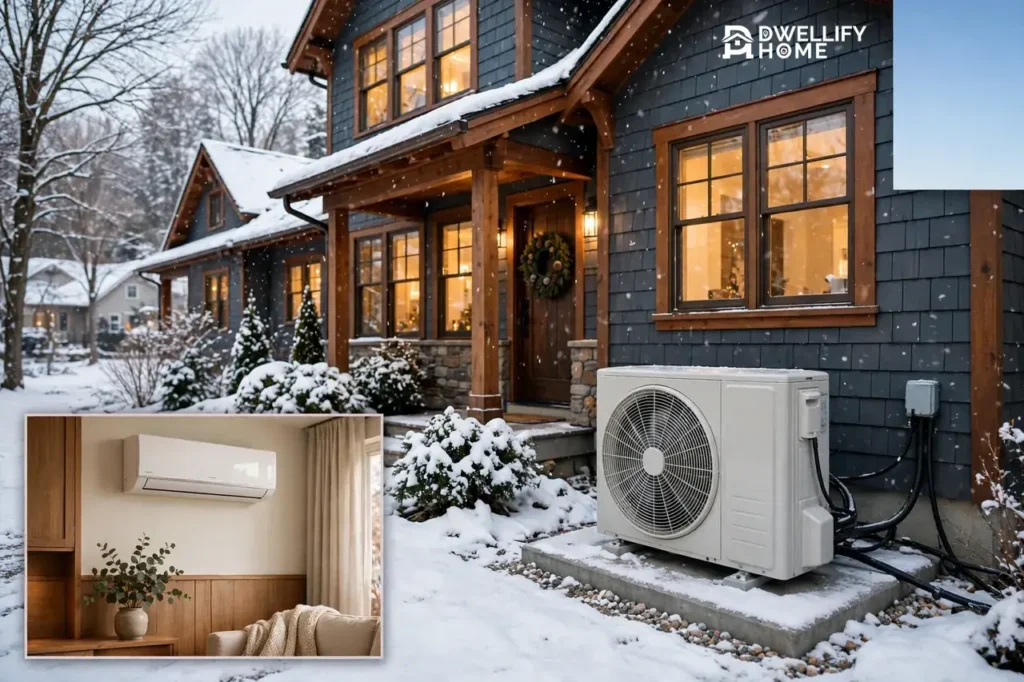
A heat pump heats and cools with one outdoor unit. It does not burn fuel to make heat. Instead, it moves heat from outside to inside in winter, and reverses to move heat out in summer. Because moving heat takes less energy than making it, a heat pump can cut heating bills in mild and moderate climates. Modern cold-climate models keep working well below freezing, though they may need backup heat on the coldest nights. The U.S. Department of Energy explains that ductless mini-split heat pumps make good retrofit add-ons for houses with non-ducted heating, such as hot-water or radiant heat. If your heat pump ever switches to its backup heat, our guide to what auxiliary heat is explains what is happening and what it costs. For the difference between the two heat settings on your thermostat, see emergency heat vs. heat.
3. Ductless Mini-Split
A mini-split is a heat pump without ducts. One outdoor unit connects to one or more small indoor units mounted on walls or ceilings, and each indoor unit heats or cools its own room. This makes it ideal for homes without ducts, room additions, converted garages, and older homes where adding ducts would tear up walls. It also gives you room-by-room temperature control, so you stop heating empty rooms. The trade-off is the look of the indoor units and a higher cost per room when you need many of them. For a single room that is always too cold, a portable heater can help in the short term, but check whether space heaters use a lot of electricity before you lean on one all winter. A small window unit can also cover one room; see our roundup of the best low profile window AC units for short windows.
4. Boiler Plus a Cooling Solution
A boiler heats water and sends it through radiators, baseboards, or underfloor tubes. The heat is quiet and even, with no blowing air and no dust stirred up. Boilers last a long time, often 20 to 35 years with care. The catch is that a boiler only heats. For cooling, you still need a separate system, such as a ductless mini-split or a central air handler. Boilers suit older homes that already have radiators and owners who love steady, silent heat.
5. Packaged Unit
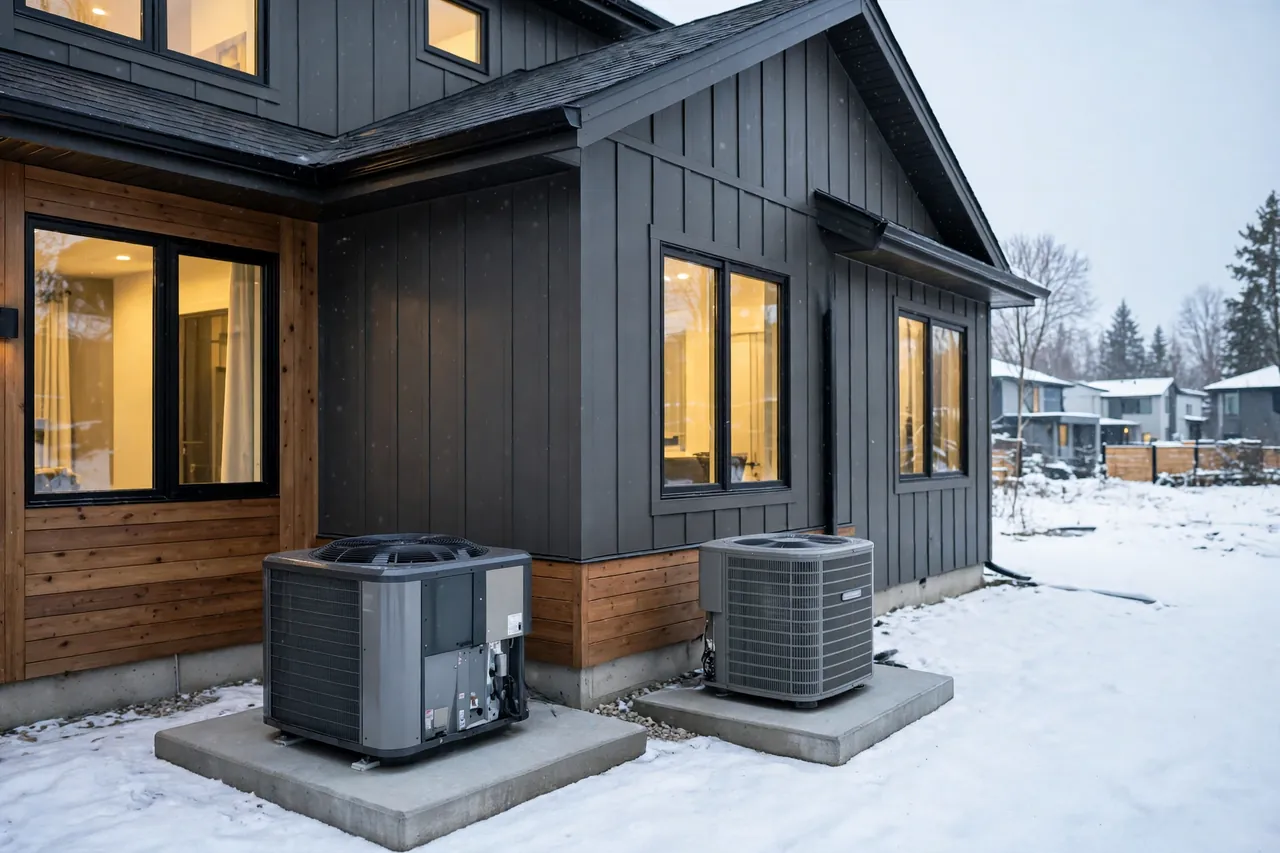
A packaged unit puts all the heating and cooling parts into one big box, usually outside on a slab or on the roof. It connects to the home through one duct opening. It saves indoor space and suits small homes, homes without a basement or attic, and some warm-climate houses. Because everything sits outside, service is easy to reach, but the single box can be noisier and its efficiency options are narrower than a split system.
Here is how the five types compare at a glance.
| System type | Heats and cools? | Needs ducts? | Best fit |
|---|---|---|---|
| Gas furnace + central AC | Yes, two units | Yes | Cold winters, gas line, existing ducts |
| Heat pump | Yes, one unit | Yes, unless ductless | Mild to moderate winters, all-electric homes |
| Ductless mini-split | Yes, one unit | No | No ducts, additions, room-by-room control |
| Boiler + cooling | Heat only; cooling added | No | Older homes with radiators, quiet even heat |
| Packaged unit | Yes, one box | Yes | Small homes, no indoor equipment space |
How to Size a System the Right Way
Sizing is the single most important decision in this whole process, and it is the one homeowners get wrong most often. Size means capacity: how much heating and cooling the system can deliver, not how big the metal box is. Cooling capacity is measured in tons, and one ton equals 12,000 BTU per hour, as the building-science group ASHRAE explains in its guide to choosing the right system for your home. Heating capacity is measured in BTU per hour.
Bigger is not better. An oversized air conditioner cools the house fast, then shuts off. That short cycling wears out parts, causes temperature swings, and leaves humidity in the air, so your home feels clammy even when the temperature looks right. An undersized system has the opposite problem. It runs all day, never quite catches up, and drives your bill up. The goal is a system that runs in long, steady cycles and pulls moisture out of the air as it cools.
The right way to size a system is a Manual J load calculation. This is the industry-standard method from the Air Conditioning Contractors of America (ACCA). A contractor measures your home’s square footage, ceiling height, insulation, windows and their direction, air leakage, and local climate, then calculates the exact heating and cooling load. Never let anyone size your system from square footage alone, and never copy the size of your old unit. If the old system was the wrong size, matching it just repeats the mistake.
Ask every contractor this question before you accept a quote: “Will you run a Manual J load calculation, and can I see the results?” A contractor who refuses, or who sizes by a quick walk-through, is guessing with your money. Also ask about your ducts. ENERGY STAR reports that in a typical house, about 20 to 30 percent of the air moving through the duct system is lost to leaks, holes, and poorly connected ducts. A great new system on leaky ducts still wastes energy, so get the ducts checked and sealed as part of the job.
Efficiency Ratings in Plain English
Efficiency ratings tell you how much comfort you get for each dollar of energy. Three ratings matter, and each one covers a different job.
SEER2: Cooling Efficiency
SEER2 stands for Seasonal Energy Efficiency Ratio 2. It measures how efficiently an air conditioner or heat pump cools your home over a whole season. Higher is better. The U.S. Department of Energy switched to the tougher SEER2 test in January 2023, so the same unit scores about 4.5% lower on SEER2 than it did on the old SEER scale. Nothing got worse. The ruler changed.
HSPF2: Heat Pump Heating Efficiency
HSPF2 stands for Heating Seasonal Performance Factor 2. It measures how efficiently a heat pump heats over a winter season. Higher is better. This rating only applies to heat pumps, and in a cold climate it matters as much as SEER2, because heating runs for months.
AFUE: Furnace and Boiler Efficiency
AFUE stands for Annual Fuel Utilization Efficiency. It is a percentage that shows how much of your fuel becomes useful heat. A furnace rated 96% AFUE turns 96 cents of every fuel dollar into warmth and sends 4 cents up the flue. An 80% furnace wastes 20 cents of every dollar. High-efficiency condensing furnaces reach 95% to 98% AFUE, while the federal minimum for a new non-weatherized gas furnace is 80%.
Use this table to see where the legal minimums and the ENERGY STAR bar sit.
| Equipment | Federal minimum (since Jan 2023) | ENERGY STAR level |
|---|---|---|
| Split central AC, North region | 13.4 SEER2 | 15.2 SEER2 |
| Split central AC, Southeast and Southwest | 14.3 SEER2 (under 45,000 BTU/h) | 15.2 SEER2 |
| Split heat pump, all regions | 14.3 SEER2 and 7.5 HSPF2 | 15.2 SEER2 and 7.8 HSPF2 |
| Packaged systems | 13.4 SEER2 and 6.7 HSPF2 | 15.2 SEER2 |
| Gas furnace | 80% AFUE | 95% AFUE and above |
Do not chase the highest rating on the shelf. A higher rating costs more up front and less every month, so the right choice depends on how long you will stay and how much you run the system. A very efficient unit in a mild climate may never pay back its premium, while the same unit in a hot, humid climate can pay for itself in a few years. Also check your electric bill before you choose. If your bills already run high, a higher-efficiency system helps more. Our guide to why your electric bill is so high shows the common causes worth fixing first.
What a New System Costs in 2026
A new heating and air conditioning system is a big purchase, so set your budget from real numbers, not guesses. The figures below are national installed averages, checked on November 5, 2026. Your local price will differ with labor rates, home size, and the work your house needs.
| Job | Typical installed cost, 2026 | Source |
|---|---|---|
| Full replacement, furnace + central AC | $11,590 to $14,100 average | Modernize, 56,000 homeowner projects |
| Same job, 2,000 to 2,500 sq. ft. home | About $13,430 average | Modernize cost calculator |
| Full HVAC install, all system types | $7,000 to $20,000 | Bryant installation guide |
| Small home under 1,500 sq. ft., low-labor area | From about $5,000 | Modernize cost calculator |
| New ductwork for a 2,000 sq. ft. home | About $2,100 to $4,000 extra | Modernize cost calculator |
A second national source, Angi, puts the average HVAC replacement at $7,500, with a typical range of $5,000 to $12,500. The gap between sources is normal. Prices vary by region, and each source counts slightly different jobs. Use these ranges as a yardstick, then compare itemized quotes for your own home. Every quote should separate equipment from labor, so you can see what you are paying for.
Five things move your price most: the system type, the size your home needs, the efficiency rating, the state of your ducts, and the difficulty of the install. A straight swap on good ducts costs far less than a job that needs new ducts, electrical work, or a new gas line. High-cost cities run well above these averages, and lower-cost areas run below them.
Two money notes for 2026. First, new equipment now uses low-GWP refrigerants such as R-454B or R-32 instead of R-410A, which adds a small equipment premium. Second, the federal 25C tax credit for efficient HVAC ended for equipment placed in service after December 31, 2025, so do not let anyone bake that credit into a 2026 quote. Check state and utility rebates instead, since those still exist in many areas. For furnace-only costs in detail, see our guide to gas furnace replacement cost.
Repair or Replace? How to Decide
Not every struggling system needs replacing. Use age, repair cost, and comfort together to decide. Most heating and cooling systems last 15 to 20 years with regular care. Boilers and radiant systems can reach 20 to 35 years, while heat pumps usually last 10 to 15 years because they run all year. These lifespan figures come from Modernize’s homeowner guide, updated August 12, 2026.
Replace when several of these are true. Your system is past 15 years old. A major part, such as the compressor or heat exchanger, has failed. Repair bills keep coming, or one repair costs close to half the price of a new system. Your bills keep climbing while your comfort falls. Some rooms never reach the right temperature, or the system runs loud and long. At that point, new equipment usually costs less over the next few years than nursing the old one along.
Repair when the system is under 10 years old, the fix is small, and the rest of the system is healthy. A failed capacitor, a dirty coil, a bad thermostat, or a clogged drain line are all cheap fixes on a system with years left. Before you call anyone, work through the simple checks in our guide to how to fix heater problems safely before calling a pro. Just remember the safety line: gas leaks, burning smells, and electrical work belong to a licensed professional, not a DIY fix.
One more timing tip: if your system still works, replace it in spring or fall, when contractors have open schedules and mild weather makes the job easy. Waiting for a mid-summer or mid-winter breakdown means paying rush prices while your home is uncomfortable.
Your Step-by-Step Choosing Checklist
Work through these steps in order, and the right system usually picks itself.
- List your home’s facts. Square footage, ceiling height, insulation, window count and direction, duct condition, fuel type, and your climate zone. Note any rooms that are always too hot or too cold.
- Fix the shell first. Seal air leaks and add insulation where it is thin. A tighter home needs a smaller system and lower bills. Our guide to how to winterize a house covers the seasonal steps.
- Pick the system type. Ducts and gas point to a furnace plus central AC. Mild winters point to a heat pump. No ducts point to a mini-split. Radiators point to a boiler plus cooling.
- Demand a Manual J load calculation. Accept no quote that sizes by square footage alone or copies your old unit’s size. Ask to see the calculation.
- Compare efficiency with a payback test. Ask each contractor what a higher SEER2 or AFUE saves per year, then divide the extra cost by the yearly saving. If the payback is longer than your stay, choose the mid-range model.
- Get three itemized quotes. Each one should list equipment, labor, ductwork, permits, and warranty separately, so you can compare like with like.
- Check the installer, not just the brand. License, insurance, reviews, and a written warranty matter more than the badge on the box. A great unit installed badly will disappoint you.
- Plan the install date. Spring or fall beats the peak season, and it gives you time to claim any state or utility rebates before the work starts.
After You Choose: What Happens Next
Choosing the system is the hard thinking part. The next part is the purchase: getting quotes, vetting installers, checking rebates and financing, and timing the install. That process has its own steps, and we cover it in full in our guide to how to buy a new HVAC system. Read it once you know which system type and size you want, and it will walk you through the rest.
Choosing at a Glance: Quick Reference
Keep this table beside you when you talk to contractors. It holds the key numbers from this guide in one place.
| Question | Answer |
|---|---|
| What decides the system type? | Your home’s ducts, fuel, climate, and budget |
| How is the size set? | A Manual J load calculation, never square footage alone |
| Cooling size unit | Tons; 1 ton equals 12,000 BTU per hour |
| Minimum SEER2, split AC | 13.4 in the North, 14.3 in the Southeast and Southwest |
| Minimum heat pump ratings | 14.3 SEER2 and 7.5 HSPF2, nationwide |
| Minimum gas furnace AFUE | 80%; high-efficiency models reach 95% to 98% |
| Typical full replacement cost, 2026 | $11,590 to $14,100 average (Modernize) |
| Typical system lifespan | 15 to 20 years; heat pumps 10 to 15 years |
| Biggest sizing mistake | Buying too big; it short cycles and leaves humidity |
| Hidden energy waste | Leaky ducts lose 20% to 30% of conditioned air (ENERGY STAR) |
Related Guides
How to Buy a New HVAC System: A Step-by-Step Guide to Getting It Right · What Is Forced Air Heating? How It Works, Pros and Cons · Gas Furnace Replacement Cost: What You’ll Pay in 2026
Frequently Asked Questions
What size AC unit do I need for a 2,000 square foot house?
As a rough starting point, a 2,000-square-foot home often needs a 3.5 to 4 ton system, but square footage alone is only a guide. The real answer comes from a Manual J load calculation that factors in your insulation, windows, ceiling height, and climate. Two same-size homes can need different systems.
Is it better to undersize or oversize an AC?
Neither is good, but oversizing is the more common and costly mistake. An oversized unit short cycles, leaves your home humid, and wears out faster. An undersized unit runs nonstop and struggles on hot days. The goal is the right size, which is why the load calculation matters more than the brand.
How much does a new HVAC system cost?
A full furnace plus central AC replacement averaged $11,590 to $14,100 in 2026, according to Modernize’s data from 56,000 homeowner projects. Small homes in low-labor areas can start near $5,000, while large homes in high-cost cities can pass $20,000. Get itemized quotes, because ducts and electrical work move the price most.
How long should a new HVAC system last?
Most new systems last 15 to 20 years with regular maintenance. Heat pumps often land closer to 10 to 15 years because they run year-round, while boilers and radiant systems can reach 20 to 35 years. Regular filter changes and yearly tune-ups are the surest way to reach the high end of that range.
When should I replace my system instead of repairing it?
Replace when your system is past 15 years old and faces a major repair, such as a failed compressor or heat exchanger, or when repair bills keep adding up and bills climb while comfort falls. Repair when the system is under 10 years old, the fix is small, and the rest of the unit is healthy.
Choosing a heating and air conditioning system comes down to four moves: know your home, pick the type that fits it, size it with a load calculation, and buy the efficiency that pays back while you live there. Do those four well, and the system will keep you comfortable for 15 to 20 years. Your next step is simple: book a load calculation with a licensed contractor, then read our guide to how to buy a new HVAC system before you sign anything.
Note: Heating and cooling work involves gas, electricity, and refrigerant. Leave gas lines, electrical connections, and refrigerant work to a licensed HVAC professional. The steps in this guide cover choosing a system, not installing one, and your home’s needs may differ from the examples here.