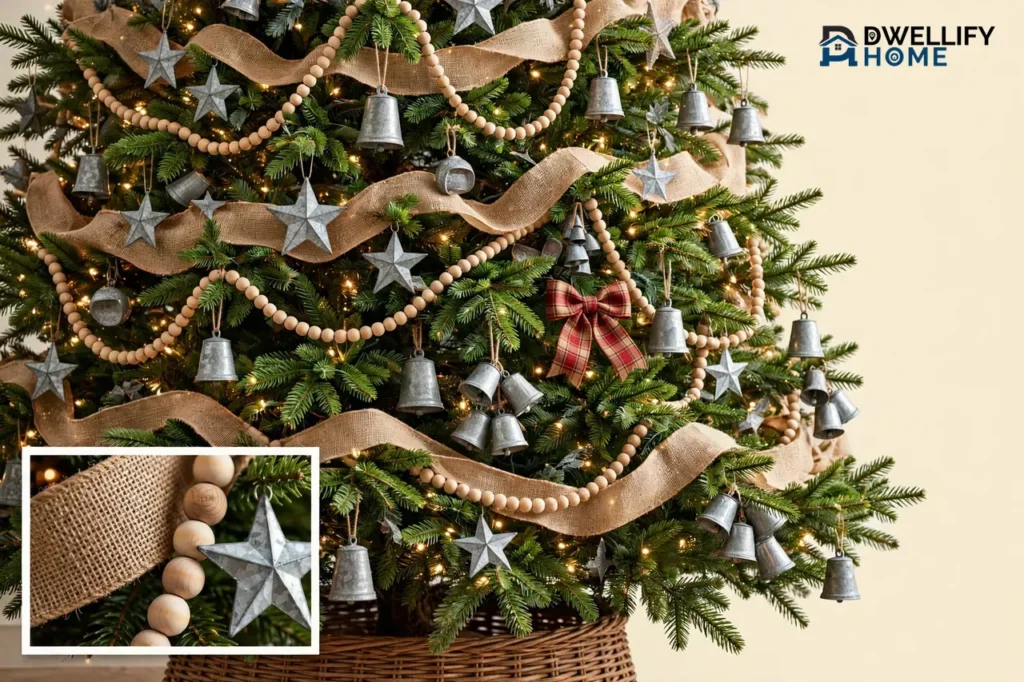
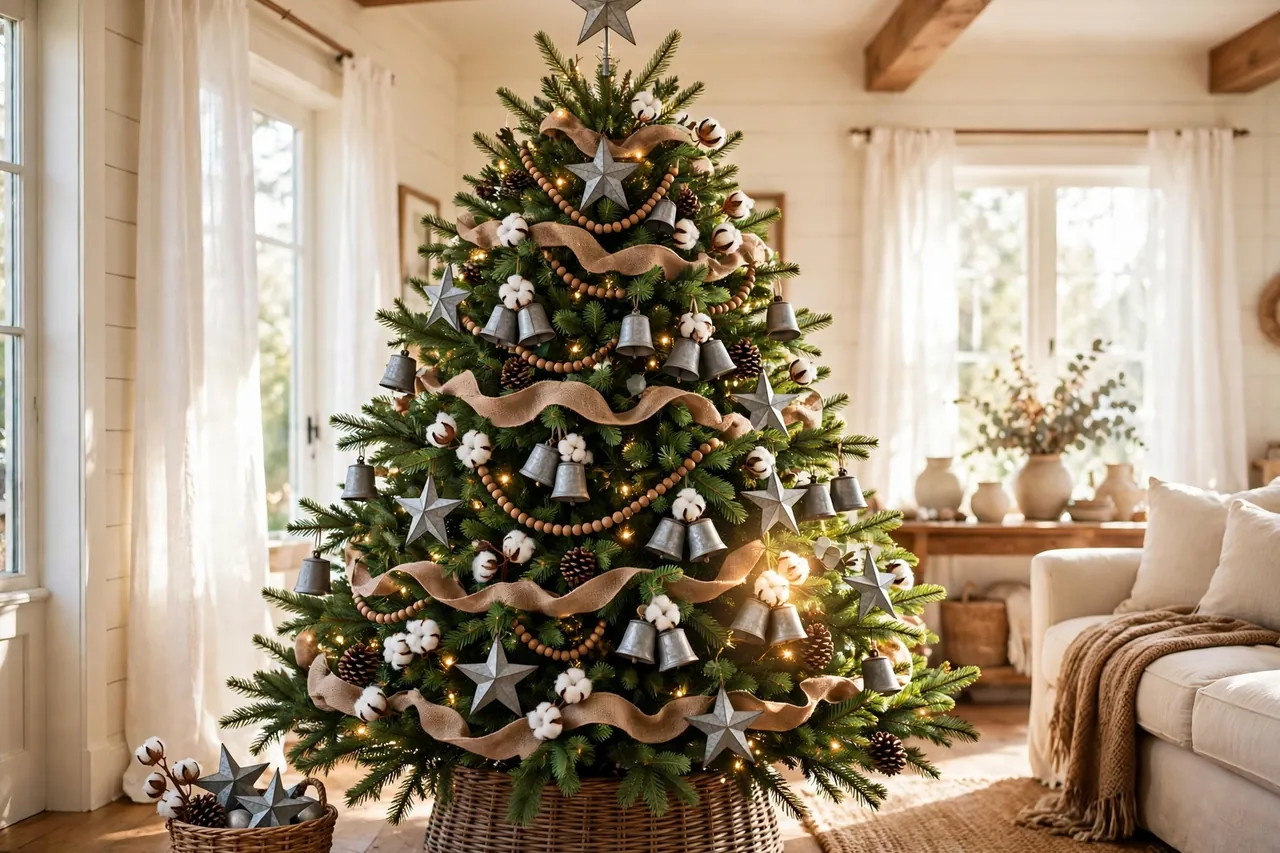
Farmhouse Christmas tree decorations turn a plain green tree into a warm, lived-in centerpiece with burlap ribbon, wood bead garland, galvanized metal ornaments, and a calm neutral palette. Start with warm white lights, layer natural textures instead of shine, and finish with a simple metal or wood star and a basket or crate at the base. That is the whole farmhouse look: soft, a little imperfect, and easy to live with all season.
If you picture a farmhouse Christmas tree, you probably picture a room that smells faintly of pine and cinnamon, a chunky throw on the sofa, and a tree that looks gathered over time rather than bought in one trip. Good news: you can build that feeling on purpose, even if you start with a brand-new artificial tree and a small box of ornaments. Farmhouse Christmas tree decor works because it leans on texture and warmth, not on expensive pieces or perfect symmetry.
What Makes a Tree Farmhouse (and What Does Not)
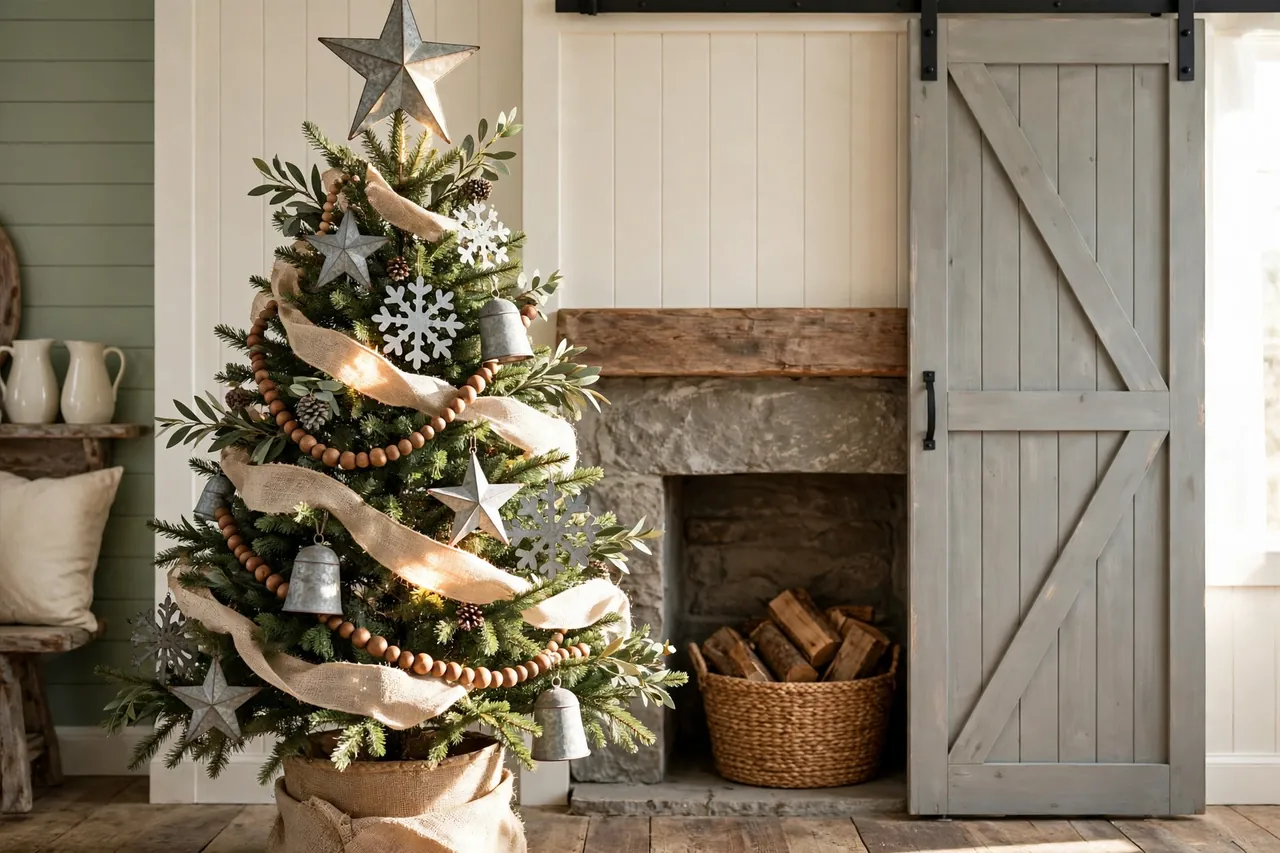
A farmhouse tree looks like it belongs in a country home where people cook, gather, and leave their boots by the door. It mixes wood, cotton, burlap, galvanized metal, and greenery, and it keeps colors soft: cream, white, warm brown, soft gray, and sage green, with one warm accent like red or buffalo plaid. Nothing on it looks slick, glossy, or brand-new. A slightly worn finish, a handmade ornament, or a ribbon that drapes a little unevenly all help, because farmhouse style forgives imperfection.
Farmhouse style also has a clear limit, and that limit keeps your tree from turning into a general rustic pile. Rustic is broader: it covers cabins, forests, and woodland scenes, with deeper colors and wilder natural textures. Farmhouse stays closer to the house itself. Think of a farmhouse kitchen, a front porch, a barn door, and a basket by the fire. If a piece looks like it came from a working home, it fits. If it looks like it came from a deep forest trail, it belongs on a woodland tree instead.
That distinction also separates farmhouse from its closest tree-style cousins. A flocked tree wears snow on its branches, and the snow does most of the talking. A miniature tree solves a small-space problem, and its size shapes every choice. A wooden tree celebrates wood itself, from carved ornaments to a wooden tree form. A farmhouse tree can borrow from any of these, but it never lets one of them take over. You can put farmhouse ornaments on a flocked tree, for example, and the result is a flocked farmhouse tree. The farmhouse part still comes from the burlap, the wood beads, and the galvanized metal, not from the snow.
Country Christmas tree decorations overlap with farmhouse style a lot, and many people use the two phrases for the same look. Country leans a touch more toward gingham, red trucks, and playful rural motifs. Farmhouse leans a touch more toward neutral rooms, clean lines, and quiet texture. You do not need to police the line. Just pick one mood, neutral farmhouse or cheerful country, and let it guide your shopping.
Farmhouse Christmas trees decorated well share one more trait: restraint. Three textures beat ten, and two or three colors beat six. A tree with breathing room looks gathered and calm, while a tree covered edge to edge looks like a shop display. Balsam Hill’s farmhouse decorating guide makes the same point: vintage ornaments, natural textures, burlap ribbon, and an antiqued star or wooden crate collar set the farmhouse tone.
Farmhouse style at a glance
| Farmhouse choice | What it looks like | What to skip |
|---|---|---|
| Colors | Cream, white, warm brown, soft gray, sage green, one red or plaid accent | Neon brights, hot pink, heavy glitter |
| Materials | Burlap, wood, cotton, galvanized metal, twine, linen | Shiny plastic, chrome, tinsel, acrylic |
| Finish | Matte, weathered, handmade, slightly worn | High-gloss, perfect, factory-shiny |
| Base | Woven basket, wooden crate, galvanized collar, knit skirt | Shiny foil skirt, bright novelty cover |
| Topper | Wood star, galvanized star, burlap bow, twig star | Oversized glitter topper that fights the tree |
Pick Your Farmhouse Palette and Materials First
Pick your palette before you buy anything, and write it down. Choose two main colors and one accent, then shop inside that list only. A safe farmhouse palette is cream and warm brown with a red accent, or cream and soft gray with sage green. A third option, cream and white with a buffalo plaid accent, suits bright rooms with white walls and light wood floors.
Your room should agree with your palette, because the tree lives in that room all December. Stand where the tree will stand and look around. If your sofa is warm brown and your rug is cream, a cream-and-brown tree will settle right in. If your room runs cool gray, lean toward gray, white, and galvanized metal, and let red play a smaller role. Our guide to decorating ideas for a living room at Christmas shows how to repeat those colors on the sofa and mantel so the whole room reads as one plan.
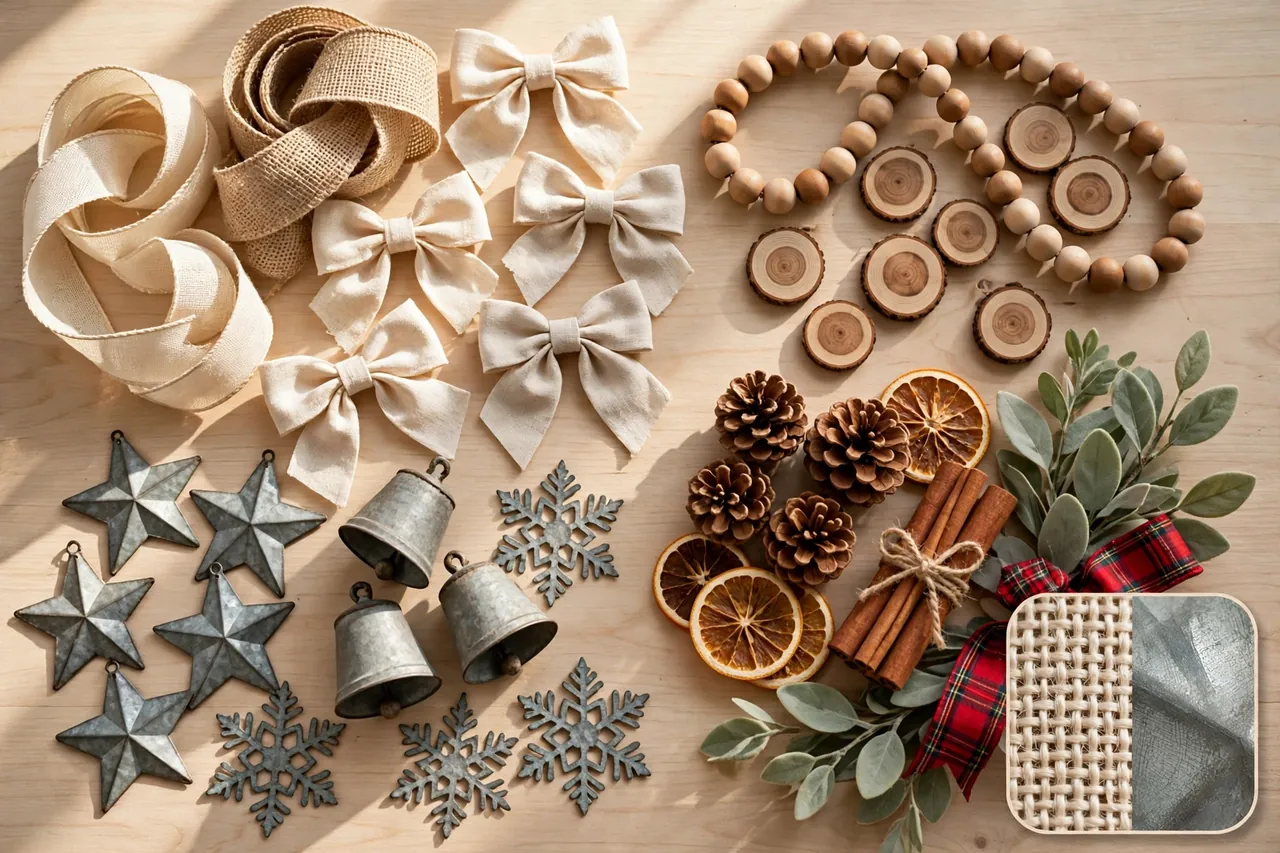
Next, gather your materials in four families, and aim for at least one piece from each. First, soft fibers: burlap ribbon, linen bows, cotton stems, and a knit or woven skirt. Second, wood: wood bead garland, wood slice ornaments, small wooden stars, and a wooden crate or collar. Third, metal: galvanized stars, bells, buckets, and snowflakes with a dull, weathered finish. Fourth, nature: pinecones, dried orange slices, cinnamon sticks tied with twine, and fresh or faux greenery sprigs.
Shop your own house before you shop a store. Most homes already hold half a farmhouse tree: a basket, a plaid throw, a few wooden ornaments, and a jar of pinecones. Build on those pieces, buy ribbon and garland first, and buy special ornaments last, once you can see how much room the tree still has.
The Pieces That Do the Work
Every farmhouse tree needs a few workhorse pieces, and each one earns its place by adding texture the tree cannot get any other way. Start with these five, and add personal pieces only after they sit well together.
Burlap Ribbon and Linen Bows
Burlap ribbon gives a farmhouse tree its soft, earthy backbone. Cut it into shorter lengths instead of wrapping one long piece around the whole tree, and tuck each length into the branches so it billows out and falls back in, like a gentle wave. That tucked-and-billowing method looks fuller than a tight spiral, and it hides bare branch tips at the same time. Tie a few loose burlap bows at the ends of the waves, and let the tails hang a little unevenly. Perfect bows look store-bought. Slightly loose bows look homemade, and homemade is the point.
Linen ribbon plays the same role in a softer voice. If burlap feels too rough for your room, use wide linen or cotton ribbon in cream, and save burlap for the bows and the base. Buffalo plaid ribbon adds the one bold note in the palette, so use it sparingly: a few bows, or one ribbon wave near the middle of the tree, not both everywhere. When plaid shows up in three places, it becomes the theme. When it shows up once or twice, it becomes the accent.
Wood Bead Garland
Wood bead garland is the quiet hero of a farmhouse tree. Unfinished wooden beads in natural tones add warmth without adding color, and they catch the light in a soft, matte way that shiny garland never does. Drape the beads in loose swags across the front of the tree, and let them dip a little lower in the middle of each swag. If your garland only reaches the front, that is fine. Most people only see the front, and beads on the back add weight without adding beauty.
Galvanized Metal Ornaments
Galvanized metal gives farmhouse trees their honest, working-home edge. Look for stars, bells, snowflakes, and tiny buckets with a dull gray finish, not a polished chrome shine. Hang metal ornaments where they catch the tree lights, because the matte metal glows softly instead of glaring. Cluster two or three small metal pieces near a larger wooden ornament, and the pair will read as one rich moment instead of two lonely dots.
Watch the weight. Metal ornaments run heavier than plastic ones, so hang them on strong branches, closer to the trunk, and save the branch tips for lighter pieces like cotton stems and small wooden stars. If a branch droops under a metal ornament, move the ornament inward or swap it for a lighter one. A drooping branch tells the whole room that the tree is struggling, and farmhouse style should look easy, not strained.
Natural Touches: Pinecones, Cotton, and Dried Orange
Natural touches make a farmhouse tree smell and feel real, even when the tree itself is artificial. Tuck pinecones deep into the branches, where they fill dark gaps near the trunk. Push cotton stems into the outer branches, where their soft white puffs break up the green and echo the cream in your palette. Hang dried orange slices on twine loops for a warm amber note, and tie cinnamon sticks in small bundles with twine for scent and texture.
Use these pieces in small numbers and repeat them. Five pinecones spread evenly look intentional. One pinecone looks lost. The same rule holds for cotton stems and orange slices: repeat each natural piece three to five times, and let the repetition tie the tree together. If you use real dried fruit or cinnamon, keep them away from open flames and check them at the end of the season, because natural pieces age faster than metal and wood.

Decorate in This Order, Step by Step
Decorate a farmhouse tree in this order: shape the tree, hang the lights, add ribbon and garland, hang large ornaments, add medium and small ornaments, place the topper, and finish the base. This order matters, because each layer supports the next. Lights buried under ornaments look dim. Ribbon hung after ornaments gets tangled in hooks. A topper added first gets knocked crooked by every later step.
Before you start, run two safety checks. First, check every light strand for frayed cords, cracked sockets, and loose bulbs, and throw damaged strands away instead of trying to rescue them. Use lights with a safety-testing label, and follow the maker’s limit for connected strands. Second, set your ladder on flat, dry ground, face the tree while you climb, and keep your hips inside the ladder rails. Never lean out sideways to reach a high branch, and never stand on the top step. Ask another person to hold the ladder if the tree is tall, and keep the topper light enough that you can place it with one steady hand while the other holds the ladder.
Now work through the steps:
- Shape and fluff the tree. Pull every branch outward and slightly downward, fill thin spots by hand, and turn the tree slowly to check it from all sides. A farmhouse tree needs fullness, because sparse branches make burlap and beads look thin instead of lush.
- String warm white lights first. Start at the base, weave strands from the trunk outward to the branch tips, and work upward. Test the lights as you go, so you can spot dark patches before ornaments cover them. As a starting point, decorating guides commonly suggest about 100 lights per foot of tree height, so a six-foot tree wants roughly 600 lights, and you can adjust up or down for a slim or very full tree.
- Add burlap ribbon and wood bead garland. Tuck ribbon in waves and drape beads in loose swags, as described above. Step back after this layer and check the balance from across the room before you hang a single ornament.
- Hang the largest ornaments deep inside. Place big wooden pieces, large galvanized stars, and chunky ornaments toward the trunk first. These inner pieces fill the dark center and make the tree look thick.
- Add medium ornaments at eye level. Give this band your best pieces and your accent color, because most people look here first. Space clusters of three, with mixed sizes, instead of spacing every ornament evenly apart.
- Fill gaps with small ornaments and natural touches. Tuck pinecones, cotton stems, dried orange slices, and small wooden stars into bare spots. These finishers turn a good tree into a full one.
- Place the topper, then finish the base. Wire a light wood or galvanized star firmly to the top branch, and check it from three sides. Then hide the stand with a basket, crate, collar, or skirt, and pull it out past the lowest branches.
- Step back in low light. Turn the room lights down, walk to the far side of the room, and look for bare spots, color clumps, or a leaning topper. Fix those now, not on Christmas Eve.
Choose a Topper and Finish the Base
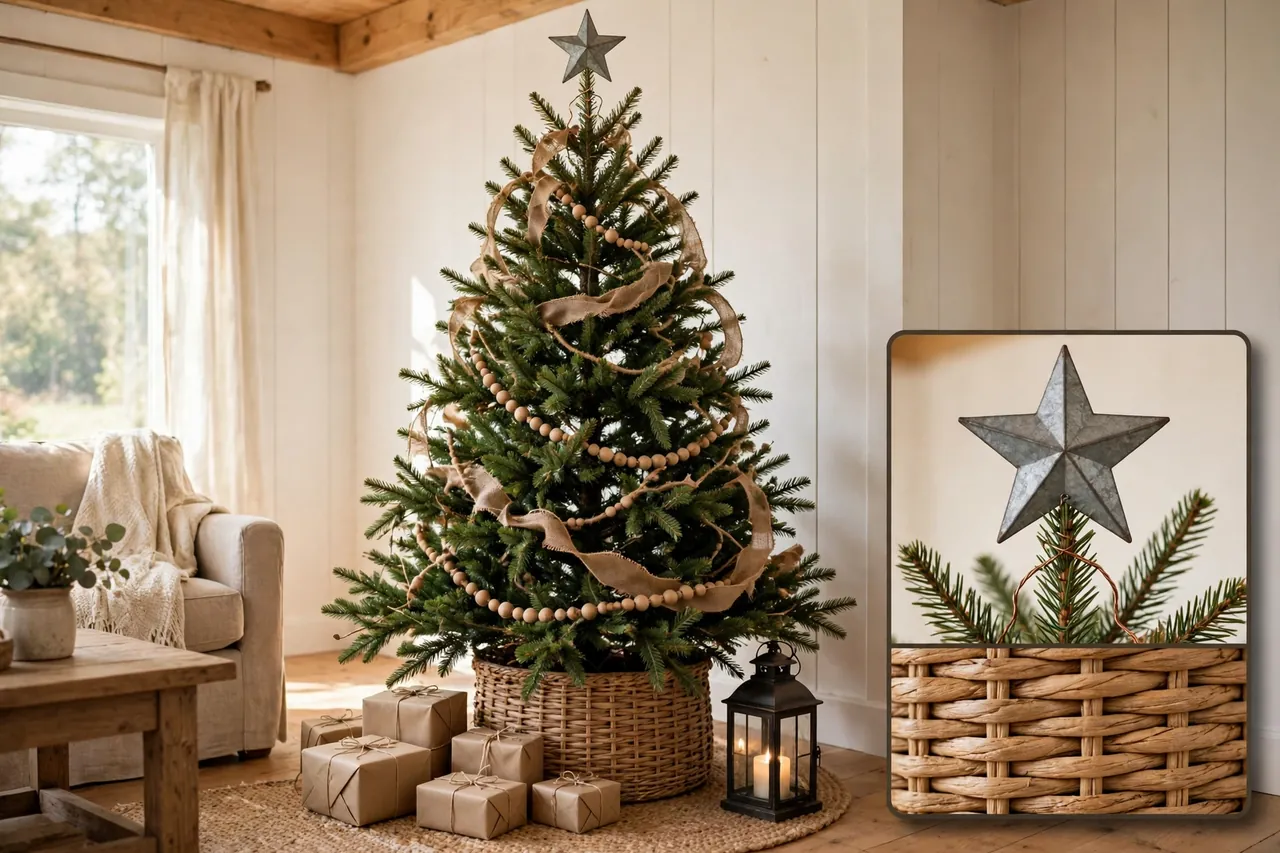
Choose a topper that acts as your theme in miniature. A wood star, a galvanized metal star, a twig star, or a large burlap bow all suit a farmhouse tree, because each one repeats a material already on the tree. Size matters more than style here: the topper should crown the tree, not outweigh it. If the top branch bends under the topper, swap in a lighter one or add a short wooden dowel alongside the branch as a firm post, and wire the topper to both.
At the base, a farmhouse tree wants something that looks found, not bought for the occasion. A woven basket with the bottom cut out slides over the stand and reads as a farmhouse classic. A wooden crate, turned on its side or cut to fit, gives the same effect with a sturdier feel. A galvanized metal collar suits rooms with gray tones and metal accents, while a chunky knit skirt suits soft, cozy rooms. Whatever you choose, keep it clear of heaters and open flames, and keep cords tucked where feet cannot catch them.
Carry the Look Into the Room
A farmhouse tree looks twice as good when the room quietly agrees with it. You do not need to redecorate the house. You only need to carry one or two of your palette colors to three or four nearby spots, and the whole room will feel planned.
Start with the mantel, if you have one. A simple garland, a few wooden ornaments that match the tree, and knit stockings in cream or plaid tie the fireplace to the tree in one glance. Our guide to Christmas ideas for decorating a fireplace mantel walks through that spot in detail, including a farmhouse mantel built from greenery, twine, and plaid ribbon. Then carry the same colors to the sofa with a chunky throw and one or two plaid or linen pillow covers, and to the coffee table with a wooden tray holding pinecones and a flameless candle.
For the whole-home picture, our guide to indoor Christmas decorations shows how to spread one theme across rooms without cluttering them. The rule stays the same: repeat colors, repeat one material, and leave breathing room. A farmhouse home feels calm because it repeats a little, not because it adds a lot.
When the season ends, label ornament boxes by material and coil light strings around cardboard so they do not tangle. Our guide to Christmas tree storage bags covers bags that protect the tree itself until next year.
Farmhouse Tree Troubleshooting
Most farmhouse trees go wrong in the same few ways, and every one has a quick fix. Use this numbered guide as your linkable quick reference when the tree looks off and you cannot say why.
- The tree looks flat. Add texture, not color. Mix matte wood, soft burlap, dull metal, and cotton stems, and hang ornaments at three depths: deep, mid-branch, and tip.
- The tree looks cluttered. Remove one piece from every crowded branch, and move the rest into clusters of three. If a color appears only once, move it to another room or repeat it twice more.
- The tree looks too shiny. Swap glossy ornaments for matte ones, drop tinsel entirely, and let wood and burlap carry the tree. One shiny accent, like a mercury glass ball, can stay, but it should be the exception.
- The topper leans. Choose a lighter topper, wire it to the strongest center stem, and add a wooden dowel post if the top branch bends. Check the topper from three sides before you finish.
- The base looks unfinished. Pull the basket, crate, collar, or skirt out past the lowest branches so no stand legs peek out, and add kraft-paper gifts or lanterns beside it for weight.
- The room fights the tree. Repeat the tree palette on the mantel and sofa, and remove any room accent that introduces a fourth or fifth color. Two or three colors, repeated, calm a room fast.
- The tree smells like plastic, not Christmas. Tuck fresh greenery sprigs, cinnamon bundles, or dried orange slices into the branches, and keep real scent pieces away from heat and flames.
Stay Safe While You Decorate
Farmhouse decorating uses a lot of natural, flammable material, so safety belongs in the plan, not as an afterthought. The National Fire Protection Association advises keeping a tree at least three feet from any heat source, including fireplaces, radiators, candles, heat vents, and lights, and never blocking an exit with the tree. Water a real tree daily, and remove it when it starts dropping needles, because a dried-out tree catches fire far faster than a well-watered one.
Handle lights with the same care. Check cords before you hang them, replace any strand with worn or broken cords or loose bulb connections, and follow the maker’s limit for connected strands. Turn lights off before you leave the house or go to bed, and use a timer if you worry you will forget. Never use lit candles to decorate a tree, and keep burlap, twine, dried pinecones, and dried orange slices away from open flames. Flameless candles give you the same glow near greenery and fabric without the risk. Safety guidance from the Connecticut State Fire Administrator, sharing NFPA tips covers these points in full.
One more caution: farmhouse trees often sit in busy family rooms, so secure the tree well, keep small ornaments, metal hooks, and batteries out of reach of young children and pets, and keep cords out of walkways. A tree that cannot tip, and a floor nobody trips on, lets everyone relax around it.
Disclaimer: Homes, trees, and budgets vary, and this guide covers decoration choices only. If a branch feels weak, a cord feels warm, or a light strand looks frayed, fix that problem before you finish decorating, and get qualified help for any electrical fault. Keep flammable decorations away from heat and open flames at all times.
Related Guides
Rustic Christmas Tree Decorations: A Warm Woodland Look for Your Home · Flocked Christmas Tree Decorating Ideas That Let the Snow Shine · Wooden Christmas Tree Decorations: Warmth You Can Touch
Frequently Asked Questions
What is a farmhouse Christmas tree?
A farmhouse Christmas tree is styled with a rustic, cozy, and natural feel, inspired by country living. It typically uses burlap ribbons, wooden ornaments, galvanized metal accents, and a palette of whites, creams, greens, and browns for a warm, gathered look.
How can I decorate a farmhouse Christmas tree on a budget?
Use natural pieces like pinecones, dried oranges, and cinnamon sticks as ornaments, and make garlands from burlap, plaid fabric, or wood beads. Thrift stores often hold inexpensive wooden and rustic-style ornaments, and pieces you already own cost nothing at all.
What colors work best for a farmhouse Christmas tree?
Neutral tones such as white, cream, and gray, combined with earthy browns and greens, work best for a farmhouse tree. Pops of red or buffalo check add a classic touch, but keep the palette to two or three colors so the tree stays calm.
Can I use artificial trees for a farmhouse Christmas look?
Yes, artificial trees work perfectly for a farmhouse look. Choose a simple green tree and dress it with rustic, handmade ornaments, or pick a frosted tree for a vintage feel. The farmhouse character comes from the decorations, not from whether the tree grew outdoors.
What type of ornaments should I use for a farmhouse Christmas tree?
Use wooden ornaments, metal stars, galvanized accents, and handcrafted decorations for a farmhouse tree. Burlap bows, twine-wrapped balls, cotton stems, and vintage-inspired pieces in muted colors all add to the charm without adding shine, and they mix well with family keepsakes.
Start with your palette, hang lights first, and let texture do the talking. Step back often, remove one thing from every crowded branch, and stop when the tree feels like home. That is the farmhouse test, and it never fails: if the room feels warmer with the tree in it, you got it right.