
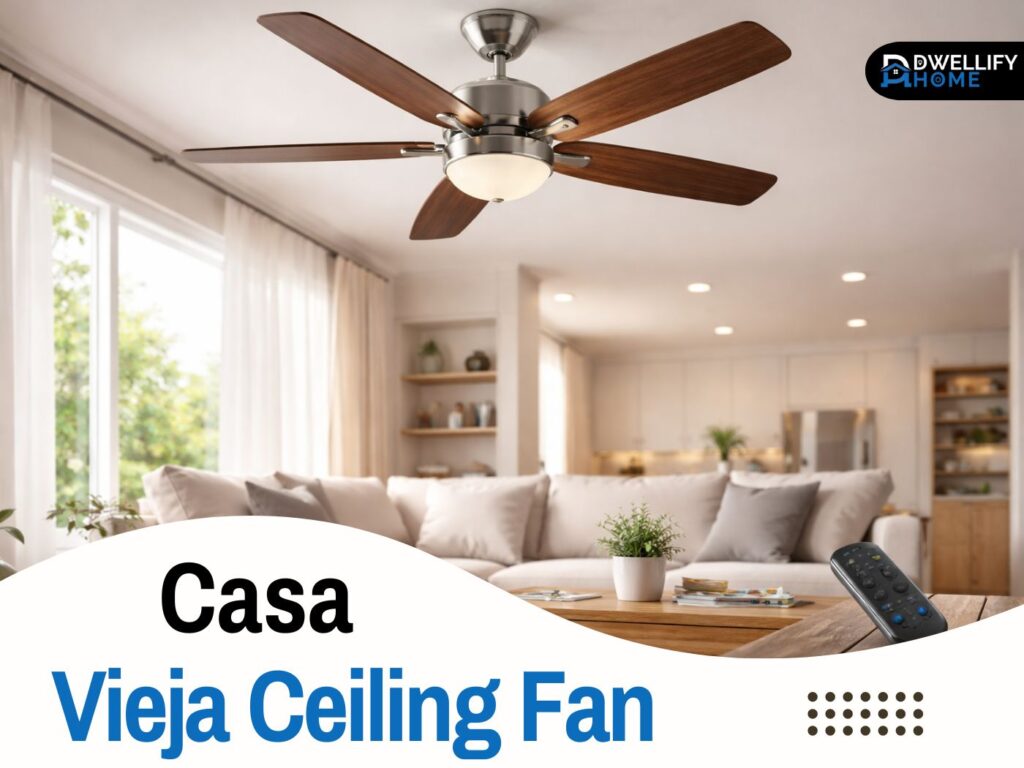
If you’re thinking about a Casa Vieja ceiling fan for your home, you’re probably looking for two things at the same time. You want it to look right in the room, and you want it to move air in a way that actually feels comfortable. In my day-to-day work installing fans, those two goals don’t always line up with what people expect from online photos.
In this guide, I’ll walk you through how these fans behave in real rooms, what to check before you buy, how to avoid common installation headaches, and how to get the remote and lighting working smoothly. I’ll keep it practical, like we’re standing in your room and making decisions based on your ceiling height and layout.
Snippet-ready definition:
A Casa Vieja ceiling fan is a design-focused residential fan line sold through Lamps Plus, offered in multiple sizes and mounting styles, often with remote control options, built for everyday airflow and comfortable room circulation.
Mission Statement:
At Dwellify Home, our mission is to help homeowners make confident, practical decisions about home products and upgrades using clear guidance, real-world experience, and safety-first advice.
Casa Vieja Ceiling Fans: What They’re Known For
Casa Vieja fans are usually chosen because the designs fit modern and transitional spaces without looking too industrial or too traditional. In real homes, I’ve seen them work especially well in bedrooms and living rooms where the fan needs to blend in, not dominate the ceiling.
Performance-wise, most homeowners care about three things after installation: airflow you can actually feel, noise at night, and how predictable the controls are. When the model is sized correctly and mounted the right way, you can get a smooth breeze without the “helicopter chop” effect that some fans create when the blades are too close to the ceiling or the fan is undersized for the room.
One thing I tell clients upfront is this: a fan’s comfort is not just the brand. It’s sizing, mounting height, and blade clearance. Get those right and you’ll be happy with almost any decent model. Get them wrong and even a good fan can feel weak or wobbly.
Quick Guide Table (Size, Mounting, Best Use)
| What you’re deciding | Best choice in real homes | Why it works |
| Room size feels “average” (most bedrooms, many living rooms) | 52 inch class models | Balanced airflow without needing top speed all the time |
| Ceiling is low (typical 8 ft) | Hugger / low-profile | Keeps safe clearance, looks tidy in smaller rooms |
| Ceiling is high or vaulted | Downrod mount | Brings airflow down to where people actually sit |
| You want simple daily control | Remote included model | Convenient speed and light control from the bed or sofa |
| Covered patio or humid area | Damp-rated model | Better suited for moisture-prone spaces |
Step-by-step mini checklist (before you buy)
- Measure the room and note ceiling height.
- Decide mounting style: hugger for low ceilings, downrod for taller ceilings.
- Confirm blade span and rating (indoor vs damp).
- Make sure the listing includes the remote and links to product documents.
- Save the manual PDF on your phone before install day.
Where to Buy (Official Sources, Trusted Retailers, and Avoiding Wrong Models)
Start with a trusted listing that clearly shows the model name, blade span, and what comes in the box. If you can, buy through the brand’s primary retailer and product pages, basically the casa vieja ceiling fans website ecosystem where the specs and documents are usually complete. That matters because missing details often lead to surprises like “remote not included” or “downrod not compatible.”
Marketplaces can be fine, but only if the listing includes a proper model number and downloadable documents. If a page doesn’t show a manual link or a “product documents” section, you’re taking a chance. I’ve been called out to “finish” installs that got stuck simply because the homeowner couldn’t confirm the wiring and receiver setup for that exact model.
Before you click buy, check these basics:
- Blade span and mounting type, hugger or downrod
- Indoor or damp rated, depending on where it’s going
- Whether the remote and receiver are included
- Whether the light is integrated LED or a replaceable bulb style
- Warranty and return policy, because fans are not fun to rebox
Choosing the Right Size (Including the Popular 52-Inch Option)
The most common sizing mistake I see is people choosing based on style first and size second. It looks nice in the listing photo, but in a real room it can feel underpowered if the blades are too small, or overly drafty if the fan is too large and mounted too low.
A 52-inch fan is popular for a reason. In many average bedrooms and living rooms, a casa vieja ceiling fan 52 size tends to land in the “comfortable” zone, meaning you can feel airflow without having to run it on the highest speed all the time. That usually keeps noise down and makes the room feel more evenly conditioned.
Quick size guide (simple, practical)
Here’s a simple way I explain it on-site:
- Small bedrooms and offices often do well with a smaller span
- Medium rooms often land in the 52-inch range
- Larger living rooms or open areas may need a bigger span or even two fans
Ceiling height changes the decision too. A fan that’s too close to the ceiling can lose some efficiency because it can’t pull air as well. And a fan that’s too low can feel like it’s blasting you, especially over a bed or sofa.
Understanding Mounting Types: Hugger/Flush Mount vs Downrod
Mounting type is one of the biggest comfort factors, and it’s also where a lot of installs go sideways. A hugger, also called low-profile or flush mount, sits close to the ceiling. It’s a good solution for lower ceilings where head clearance is tight, like many bedrooms and hallways.
The tradeoff is that airflow can feel softer with a hugger compared to the same fan installed on a downrod. It’s not always a problem, but in rooms that already run warm, a little more drop from the ceiling can make a noticeable difference.
When you need a downrod (and how to choose length)
A casa vieja ceiling fan downrod setup is usually the better choice when:
- The ceiling is high and you want airflow where people actually sit
- The room is large and you need better circulation
- You have a sloped or vaulted ceiling with a compatible mount
As a rough rule, you want the blades to sit at a height where they can move air through the occupied zone of the room, not just stir hot air near the ceiling. In tall rooms, that often means adding a downrod so the fan isn’t “wasting” airflow up high.
Popular Casa Vieja Models & Styles (What to Expect)
Across different Casa Vieja models, you’ll usually see a mix of clean finishes, contemporary blade profiles, and options that target either low ceilings or standard ceilings. The important part is matching the fan’s purpose to the room. A fan that feels great in a living room might feel too drafty in a small bedroom, and a low-profile model that’s perfect for a bedroom might feel mild in a large open space.
Also pay attention to whether the design leans toward integrated lighting. Some homeowners love that, because it keeps the ceiling looking uncluttered. Others prefer replaceable bulbs for flexibility and easier long-term maintenance.
Spotlight: Casa Vieja Windspun (why people search it)
The casa vieja ceiling fan windspun models are often chosen for a modern look and a low-profile feel. In real installs, I’ve seen them work well in bedrooms with standard height ceilings where you want a clean ceiling line and straightforward remote control.
The key is not expecting a low-profile design to behave like a long downrod fan in a tall great room. If you’re trying to cool a big vaulted space, you’ll usually be happier choosing a model designed for downrod mounting and larger airflow reach.
Key Features to Compare Before You Buy
Motor type matters more than most people realize. Many newer fans use DC motors, which can feel smoother at low speeds and can be efficient. AC motors are common too and can be perfectly solid, but the quality of the speed steps and the sound profile can vary by model.
Blade design is another real-world factor. Blade pitch and blade shape affect how the breeze feels. Some fans move air in a way that feels gentle and wide, while others feel more focused and direct. If the fan is going in a bedroom, I usually aim for smooth airflow that doesn’t feel like it’s “thumping” the air.
Lighting is where expectations often don’t match reality. Integrated LED is convenient, but you want to know the brightness and the color tone. If you like warm light at night, make sure the light doesn’t run too cool. If it’s a primary room light, make sure it’s bright enough, because some integrated kits are more “ambient” than functional.
Finally, check the rating. Indoor fans are for dry spaces. If you’re putting a fan in a covered patio or a humid area, you need the correct rating, or you’re risking early wear on the electronics.
Installation Overview (Safe, Clean, and Manual-Aligned)
I’ll say this in the same calm way I tell homeowners: ceiling fans are not difficult, but they are unforgiving if the mounting and wiring basics are skipped. The electrical box must be fan-rated, the bracket must be tight, and the fan must be balanced and secured exactly as the manufacturer intends.
Most installation problems I troubleshoot come down to one of three things: a loose bracket, a wiring connection that’s not fully seated, or a receiver that’s crammed into the canopy in a way that pinches wires. When a fan hums, wobbles, or randomly loses remote response, it’s often something mechanical or connection-related, not a “bad fan.”
If you’re dealing with old wiring, a high ceiling, or a sloped mount, it can be worth hiring a licensed electrician for the install. You’re not just paying for labor, you’re paying for a clean, safe setup that won’t start clicking or wobbling a month later.
Casa Vieja Ceiling Fan Manual: Where to Find It + What to Check First
The casa vieja ceiling fan manual is usually available as a downloadable PDF through the product listing or included paperwork in the box. If you’re missing it, start with the retailer’s product documents section. That’s the quickest way to match your exact model.
Before you begin installation, confirm the model number and mounting type. Manuals often cover both flush mount and downrod setups, and the steps are not interchangeable. Using the wrong section can lead to a fan that hangs slightly off-level or a canopy that won’t seat properly.
When I’m on a job site, these are the pages I check first:
- Safety instructions and mounting recommendations
- Wiring diagram for the fan and receiver
- Blade installation sequence
- Remote setup section
- Troubleshooting page, because it saves time later
Remote Setup & Controls (Simple, Real-World Instructions)
A casa vieja ceiling fan remote setup is usually straightforward, but small details matter. The remote works through a receiver module inside the canopy. If the receiver is not seated correctly, or if the wiring bundles are too tight, the remote can become unreliable.
Also, keep in mind that a standard wall switch still matters. Many remote-controlled fans expect a steady power supply. If someone turns the wall switch off, the fan will obviously stop responding. In family homes, I often recommend labeling the switch or using a switch guard so it doesn’t get flipped accidentally.
Remote control instructions (pairing plus common setup steps)
For casa vieja ceiling fan remote control instructions, the most common practical steps look like this:
- Confirm the wall switch is on and the fan has steady power
- Install fresh batteries in the remote
- Follow the manual’s pairing or sync process, if the model requires it
- Make sure the receiver wiring matches the diagram and is firmly connected
- Tuck wires gently so nothing is pinched when closing the canopy
If you use smart switches or dimmers, be careful. Many fan remotes don’t like being fed through a dimmer, and that can cause flicker or odd behavior. If you want smart control, choose a setup designed for remote fans, not a generic dimmer.
Common Problems & Fixes (Troubleshooting That Actually Works)
If the fan won’t respond to the remote, start with power and batteries, then move to the receiver connections. I’ve fixed plenty of “dead” fans by reseating a connector and giving the receiver enough space so it isn’t pressed tightly against the metal canopy.
Wobble is usually mechanical. Check that the bracket is tight to the box, all blade screws are snug, and the blades are evenly seated. A fan can be perfectly good and still wobble if one blade screw isn’t fully tightened. If the wobble is mild, a balancing kit can help, but I always fix mounting and blade seating first.
Noise depends on the type. A clicking sound is often a loose screw, a wire tapping the housing, or a blade bracket slightly out of alignment. A steady hum can be normal to a point, but loud hum can suggest a wiring issue, an incompatible control, or a poorly grounded box. If anything feels unsafe, stop and get a pro.
A simple maintenance routine goes a long way. Dust buildup changes blade balance over time. Every few months, wipe blades, check visible screws, and confirm the fan feels stable.
Casa Vieja Ceiling Fan Reviews: What Buyers Usually Like (and Don’t)
When I read casa vieja ceiling fan reviews for clients, I look for the details that match real installation conditions. Reviews that mention room size, ceiling height, and mounting type are the most helpful. A complaint like “weak airflow” means nothing unless we know whether it was installed as a hugger in a big room or mounted too close to a tall ceiling.
What homeowners usually like is the style and the overall comfort when the fan is matched to the room. What they don’t like is when the remote learning curve catches them off guard, or when they expect a low-profile fan to cool a large space like a downrod model.
The best way to use reviews is to treat them like clues. If multiple reviews mention remote responsiveness, noise type, or wobble, that’s worth paying attention to. If one person has an issue but everyone else is fine, it may be installation related.
Expert Buying Checklist
Here’s the checklist I use when I’m helping someone choose a fan for a real room:
- Measure the room and note the ceiling height
- Decide on blade span, including whether a 52-inch option fits your layout
- Choose the mount type, hugger for low ceilings, downrod for better airflow reach
- Confirm the listing includes the remote, receiver, and manual
- Decide on lighting needs, ambient vs primary room light
- Confirm the correct rating for the space, indoor vs damp rated
- Make sure the electrical box is fan-rated before you plan the install
If you do those steps, you avoid the most common purchase regret: a fan that looks right but doesn’t feel right.
FAQs
What is the most reliable brand of ceiling fan?
Reliability usually comes down to motor quality, a solid warranty, and consistent parts support. Look for long warranty coverage, stable remote performance, and clear manuals, then match the fan size and mount to the room.
Who makes Casa ceiling fans?
Casa Vieja is a ceiling fan brand sold through Lamps Plus.
Where are Casa Vieja fans made?
Lamps Plus states the fans are designed in the USA in California. Manufacturing location is not always clearly listed for every model, so check the specific product documents for your exact fan.
Why won’t my Casa Vieja ceiling fan turn on?
Most common causes I see:
- Wall switch is off (remote fans still need steady power)
- Remote batteries are dead
- Receiver wiring connection is loose in the canopy
- A safety cutoff trips because a wire is pinched
The Casa Vieja installation manual covers wiring, receiver setup, and troubleshooting steps.
How do I reset or re-pair a Casa Vieja ceiling fan remote?
Many setups involve power-cycling the fan and then using the remote’s pairing process or matching DIP switches between remote and receiver, depending on the model. Follow your manual’s remote section for the exact steps.
Conclusion
A good ceiling fan choice is less about hype and more about matching the fan to your room. If you take a few minutes to measure the space, pick the right mounting style, and confirm the remote and manual details, you’ll save yourself a lot of frustration later.
If you’re deciding between a low-profile model and a downrod setup, let the ceiling height make the call. Low ceilings need clearance and a clean hugger mount. Taller ceilings usually need a downrod so the airflow reaches where you actually live in the room.
Once it’s installed, don’t ignore small signs like wobble or clicking. Those are usually easy fixes early on. Tighten, balance, and keep the wiring and receiver neatly arranged. Do that, and your fan will feel quiet, steady, and comfortable for years.
Disclaimer:
This article is for general information and homeowner education. Electrical work can be hazardous. Always follow your fan’s manual and local electrical codes, and hire a licensed electrician if you’re unsure or your wiring is outdated.

I’m Bilal Hassan, the founder of Dwellify Home. With 6 years of practical experience in home remodeling, interior design, and décor consulting, I help people transform their spaces with simple, effective, and affordable ideas. I specialize in offering real-world tips, step-by-step guides, and product recommendations that make home improvement easier and more enjoyable. My mission is to empower homeowners and renters to create functional, beautiful spaces—one thoughtful update at a time.