
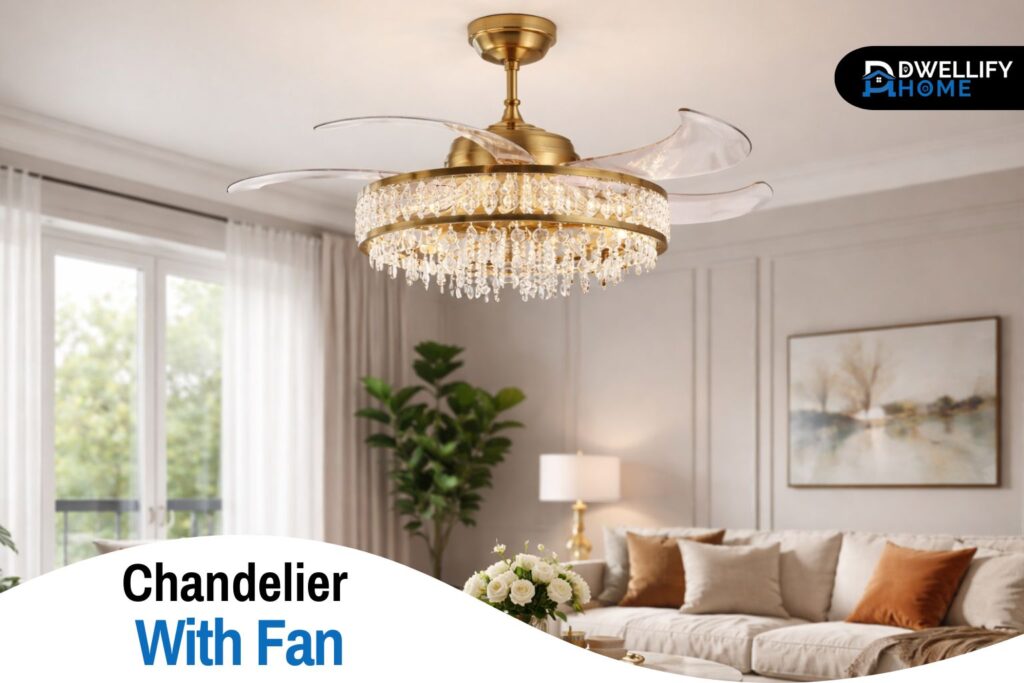
A chandelier that also moves air sounds like the best of both worlds. In real homes, it can be—when you choose one with the right expectations.
I’ve installed and helped pick these fixtures for years, and the happiest homeowners tend to do one simple thing: they decide whether they care more about the “chandelier” part or the “fan” part. Once that’s clear, the rest of the choices (size, ceiling height, lighting, and controls) fall into place without regret.
This guide walks you through what a chandelier-with-fan really is, what it does well, where it disappoints, and how to pick one that feels right the day you install it and still feels right six months later.
Snippet-Ready Definition:
A chandelier with fan is a ceiling fixture that combines decorative lighting with a built-in fan for gentle airflow. It’s often used in living rooms, bedrooms, or dining areas where homeowners want both style and comfort.Mission Statement:
Dwellify Home helps homeowners make practical and stylish home décor decisions through clear guidance, thoughtful design advice, and real-life insights.
What Is a Chandelier With Fan?
A chandelier with fan is a hybrid ceiling fixture that combines a decorative light (the chandelier look) with a built-in ceiling fan. You’ll also see it called a “chandelier ceiling fan” or “fandelier.” Different name, same idea: one ceiling mount that handles both lighting and airflow.
In a lot of homes, these show up in spaces where a standard ceiling fan feels too casual, but a chandelier alone doesn’t solve comfort. Think living rooms where you host guests, bedrooms where you want a softer look, or dining rooms where a bold fixture anchors the table but you still want air moving in warm months.
One thing I always point out up front: most of these fixtures are designed to look refined, so they’re often more compact than traditional ceiling fans. That doesn’t automatically make them “bad,” but it does affect performance, especially in larger rooms.
Quick Mini Guide: When a Chandelier With Fan Makes Sense
| Situation | Good Choice? | Why |
| Small or medium living room | Yes | Adds airflow without the look of a standard ceiling fan |
| Bedroom | Yes | Quiet circulation and decorative lighting in one fixture |
| Dining room | Often | Works well when mounted at the right height above the table |
| Large open space | Sometimes | Airflow may be lighter than a traditional ceiling fan |
| Low ceilings | Depends | Flush-mount designs may work better |
Key Benefits of a Chandelier With Fan
- Combines lighting and air circulation in one ceiling fixture
- Adds a decorative focal point without installing two separate fixtures
- Works well in bedrooms, living rooms, and dining spaces
- Often quieter and more compact than standard ceiling fans
- Available in modern, crystal, and enclosed designs
Chandelier With Fan vs Traditional Ceiling Fan vs Chandelier
A traditional ceiling fan is usually the best tool for strong airflow. It’s built for performance first: bigger blades, more aggressive air movement, and designs that prioritize function.
A chandelier is all about lighting and style. It can completely change a room’s mood, but it won’t help with comfort when the air feels still.
A chandelier-with-fan sits in the middle. It gives you decorative impact plus a breeze, but you’re often trading a little airflow for a better-looking fixture. That trade is totally worth it in plenty of rooms—just not all of them.
Here’s the real-life decision point I use with clients:
- If you want noticeable cooling in a large open-plan living room, consider whether you’re okay with a “gentle breeze” instead of “fan you feel across the room.”
- If you mainly want air circulation and comfort without a big fan look, a chandelier-with-fan is usually a good fit.
Types of Chandelier With Fan Designs
Design is the fun part, but it’s also where some performance differences hide.
Modern chandelier with fan styles tend to have clean lines, simple shades, and matte finishes. They blend nicely in contemporary homes and don’t visually “hang heavy,” which matters in smaller spaces or rooms with standard ceilings.
Crystal chandelier with fan models lean more decorative. They can look beautiful in a formal living room or a bedroom with glam touches, but they also demand a little more upkeep. Dust and fingerprints show up faster, and cleaning takes time if the crystal elements are detailed.
Enclosed or cage-style chandelier fans are popular because they look tidy and compact. The trade-off is that airflow can feel softer, depending on the design. In a small bedroom, that’s often fine. In a larger living room, you may wish you’d chosen something with a more open blade layout.
Retractable blade styles are another common choice. The blades tuck away when the fan is off, which keeps the chandelier look front and center. Performance varies a lot between models, so this is a category where you want to be careful not to buy based on photos alone.
Choosing the Right Size for Your Room
Size is one of the easiest ways to accidentally ruin the look of the room. Too small and it feels like a pendant light trying to be a fan. Too large and it dominates the ceiling and can feel low or bulky.
I like to think of sizing in two layers: visual scale and airflow. Even if a compact fixture looks right, you still want enough blade span (or effective airflow design) to move air in the space you’re putting it in.
A simple, practical approach:
- Measure the room, then look at fan diameter recommendations as a starting point.
- Step back and consider furniture scale. A large sectional and high ceilings can handle a larger fixture. A tidy bedroom setup usually looks best with a smaller, cleaner piece.
When people are unsure, I suggest taping out a rough circle on the floor to visualize how large the fixture will feel overhead. It’s not perfect, but it prevents the “this looked bigger online” problem.
Ceiling Height and Mounting Options
Ceiling height is where many problems start, especially with high ceilings.
On standard ceilings, you’ll usually be choosing between flush mount (sits close to the ceiling) and a short downrod (drops the fixture slightly). Flush mounts are great for bedrooms and smaller rooms where you don’t want the fixture hanging into the space.
For a chandelier with fan for high ceiling rooms, downrod length matters. If the fixture sits too high, you may barely feel air movement and the light can look lost. If it hangs too low, it can feel intrusive and even unsafe in walkways.
In most homes, a comfortable setup keeps the fan blades well above head height while still low enough to circulate air effectively. If the room has a tall ceiling, don’t guess—use the manufacturer’s mounting guidance and consider hiring an electrician for a proper fit.
Airflow Performance: What Most Buyers Overlook
This is the part that saves people from disappointment. Many chandelier fans are built to circulate air and provide comfort, not to push high airflow like a full-size ceiling fan.
If you want a fixture that does more than stir the air, pay attention to:
- Motor type: DC motors are often quieter and more energy-efficient, with smoother speed control. AC motors are common and can perform well, but noise and control range depend on model quality.
- Blade design and exposure: open blades usually move air more effectively than enclosed designs.
- Reversible direction: a reversible motor helps in winter by gently pushing warm air down from the ceiling.
I’ve seen a lot of “it looks great but I barely feel it” complaints. Most of the time, the fixture was chosen for style, installed correctly, and still felt underpowered because the room was too large or the fan design was compact. Knowing that ahead of time makes the decision much easier.
Lighting Quality and Brightness
A chandelier-with-fan is still your main light source in many rooms, so lighting quality matters as much as the fan.
Start with brightness. Some fixtures look large but have surprisingly modest light output. In a living room, that might be okay if you have lamps. In a kitchen-adjacent dining space, it can feel dim and impractical.
Then consider color temperature. Warm light tends to feel cozy and flattering in bedrooms and living rooms. Neutral light can work well in dining rooms where you want clarity without the cold look of daylight-toned bulbs.
Dimming is another common snag. Not every LED setup plays nicely with every dimmer switch. If dimming matters to you, make sure the fixture supports it and that your dimmer is compatible. That’s the difference between a smooth, cozy glow and annoying flicker.
Controls and Smart Features
Controls affect how often you actually use the fan. I’ve had clients who rarely used their fan simply because the controls were awkward.
Remote controls are common and convenient, especially in bedrooms. Wall controls feel cleaner and more “built-in,” but you’ll want to confirm compatibility before planning one. Some systems support both, which is ideal when you want a wall switch for daily use and a remote for fine control.
Smart features can be helpful if they’re simple. Timers are great at night, and speed memory saves you from resetting settings every time. Just make sure you’re not paying extra for app features you won’t use.
Choosing the Right Chandelier With Fan for Different Rooms
A chandelier with fan for living room needs to balance statement style with enough airflow to feel comfortable when people are sitting, chatting, and moving around. This is where sizing up slightly can help, especially in open-plan spaces. Modern chandelier with fan designs often work well here because they look intentional without feeling heavy.
A chandelier with fan for bedroom should prioritize quiet operation. Even a small amount of motor hum can feel loud at 2 a.m. I also prefer softer lighting options in bedrooms—dimming and warm tones make a bigger difference than people expect.
A chandelier with fan for dining room requires extra attention to height and glare. The fixture should feel centered over the table and sit at a comfortable height so it doesn’t block sightlines. If the fan will be used while dining, go for a design that doesn’t create an obvious draft directly over the table.
Installation Considerations and Safety
This is where I get firm, because it’s not worth gambling with.
A chandelier-with-fan needs a fan-rated electrical box and secure mounting. Even if the fixture isn’t huge, it has movement and vibration. The wrong box or weak mounting leads to wobble, noise, or worse.
If you notice wobble after installation, don’t ignore it. It’s often fixable with proper tightening, balancing, or adjustments, but it needs attention early. I also recommend professional installation for heavy fixtures, older wiring, or high ceilings. It’s not just convenience—it’s safety and long-term reliability.
Maintenance and Cleaning
Maintenance is easy to underestimate, especially with crystal chandelier with fan models. They’re beautiful, but they collect dust in places you won’t notice until the light hits it.
For most styles, a light dusting of blades and wiping light shades every few weeks keeps things looking clean. For crystal or detailed fixtures, plan for a more thorough clean occasionally. Make sure the fixture is off and cool, and avoid harsh cleaners that can cloud finishes or damage delicate parts.
One practical tip: choose a design you’ll actually maintain. A slightly simpler fixture that stays clean often looks better than an elaborate one that’s always dusty.
Common Mistakes to Avoid When Buying a Chandelier With Fan
The same mistakes show up again and again:
- Choosing based on photos without considering airflow needs
- Picking the wrong size, so it looks awkward in the room
- Ignoring ceiling height, then struggling with clearance or weak airflow
- Overlooking lighting output and ending up with a room that feels dim
- Assuming any junction box can support it, which can create safety issues
Most of these problems aren’t expensive to avoid. They just require a little planning before the purchase, not after.
Chandelier With Fan Price Considerations
Prices vary widely because you’re paying for a mix of design, materials, and motor quality.
The biggest price drivers are:
- Motor type and build quality
- Materials (crystal and heavy metal finishes typically cost more)
- Size and lighting system (integrated LED, dimming features, control options)
- Brand support and warranty
For chandelier with fan price in Nigeria or the Philippines, I’d focus less on a single number and more on what matters locally: voltage compatibility, warranty support, replacement parts, and return policies. Shipping a bulky fixture can quickly change what’s “affordable,” and local after-sales support is worth real money when something goes wrong.
If you’re comparing chandelier with fan Philippines listings or chandelier with fan price Philippines options, check whether the remote, mounting hardware, and downrod options are included. Those “small extras” add up fast when they’re sold separately.
Is a Chandelier With Fan the Right Choice for Your Space?
This hybrid fixture is a smart choice when you want a room to feel finished and comfortable without a traditional fan look. It works especially well in bedrooms, dining rooms with careful height planning, and living rooms where you want gentle circulation and a central statement piece.
It’s not always the best option for large spaces that need serious airflow. In that case, you might be happier with a traditional ceiling fan in a more refined style, or a separate chandelier plus a fan placed elsewhere in the room.
The sweet spot is a space where you want both comfort and a decorative focal point, and you’re okay with airflow that’s pleasant rather than powerful.
FAQs
Can you have a chandelier and a fan?
Yes. Some homes install them separately, but a chandelier-with-fan combines both functions in one fixture. This helps save ceiling space and keeps the room looking clean and balanced.
What is a chandelier with a fan called?
It’s commonly called a chandelier ceiling fan or a fandelier. Both terms describe a decorative light fixture that includes a built-in fan.
Do chandelier ceiling fans work?
Yes, they circulate air and provide lighting at the same time. However, airflow is usually gentler than a traditional ceiling fan, so they work best in small to medium rooms.
Do ceiling fans make your electric bill go up?
Ceiling fans use electricity, but they typically consume far less energy than air conditioning. In many homes, using a fan can actually help reduce cooling costs by improving air circulation.
Are chandelier fans good for bedrooms?
They often work well in bedrooms because they provide soft lighting and quiet airflow. Choosing a model with a quiet motor and dimmable light improves comfort at night.
Conclusion
A chandelier with fan can be a practical choice and a style upgrade at the same time, but it only works well when the details match your room. Get clear on whether you’re prioritizing the chandelier look or the fan’s performance, then choose the right size, the right mounting for your ceiling height, and lighting you’ll enjoy every day.
Once those pieces line up, this kind of fixture stops feeling like a compromise. It just feels like the right finishing touch—one that looks good, keeps air moving, and makes the room more comfortable to live in.
Disclaimer:
Information provided on Dwellify Home is for general educational purposes. Always consult qualified professionals for electrical installation or structural modifications.

I’m Bilal, the founder of Dwellify Home. With 6 years of practical experience in home remodeling, interior design, and décor consulting, I help people transform their spaces with simple, effective, and affordable ideas. I specialize in offering real-world tips, step-by-step guides, and product recommendations that make home improvement easier and more enjoyable. My mission is to empower homeowners and renters to create functional, beautiful spaces—one thoughtful update at a time.