A living room can look almost finished, but still feel slightly off. In my experience, that usually comes down to the small pieces. A good end table is one of those quiet helpers that makes the room feel more comfortable, more balanced, and honestly easier to live in.
I’ve worked with all kinds of spaces, from tight apartments to large family rooms with sectionals. And no matter the layout, the right end table fixes the same problems: where to put your drink, where the lamp should go, where the remote disappears, and how to make the seating area feel pulled together.
In this guide, I’ll walk you through how to choose, place, and style end tables in a way that fits your real life. Not a showroom. Your home.
Snippet-ready definition:
End tables for living room are small tables placed beside sofas or chairs to hold essentials like drinks, lamps, remotes, and décor. The best ones match sofa height, fit the space, and support how you actually live.
Mission Statement:
At Dwellify Home, our mission is to make home styling feel simple and doable, with honest, experience-based guidance that helps you choose furniture that fits your space, your routine, and your personal style.
What are end tables (and how they’re different from side and accent tables)
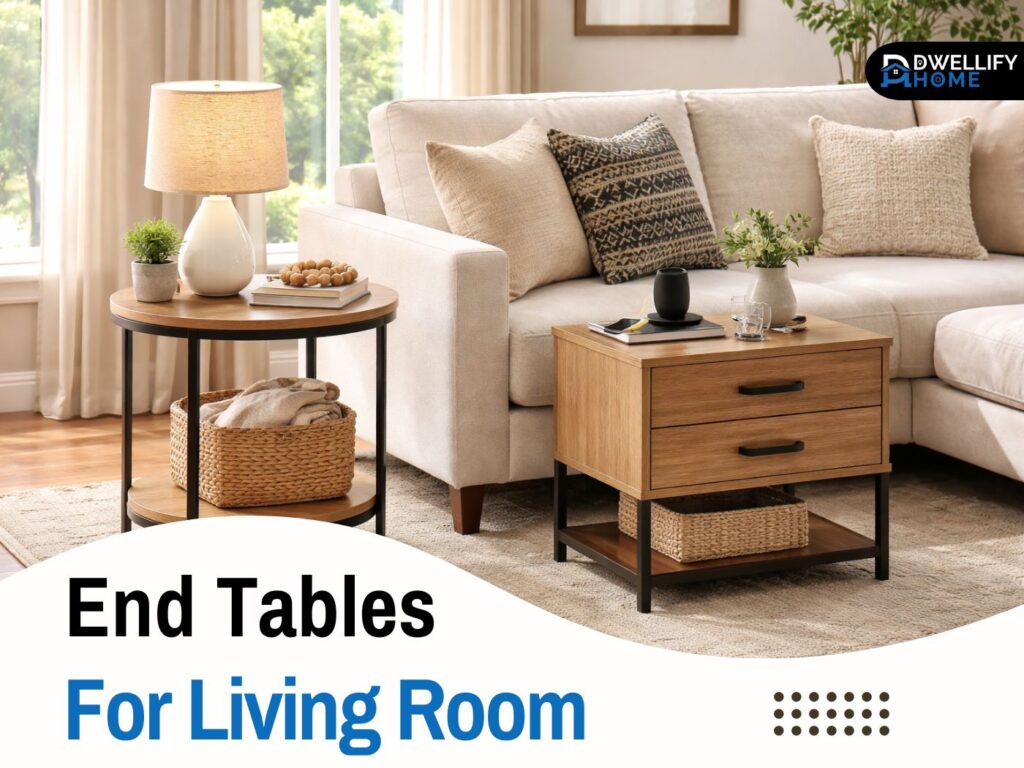
An end table is the small table that sits right next to seating, usually at the end of a sofa or beside an armchair. It’s meant to be within easy reach, so you can set down a cup, hold a lamp, or keep essentials close without getting up.
Now, people often use the terms side table and end table interchangeably. That’s fine, but there is a small difference in how designers think about them. End tables typically live beside sofas and are chosen to work with the seating height. Side tables can be a little more flexible, like a small table beside a chair or tucked near a wall.
Accent tables are more about looks first. They might be smaller, lighter, or more decorative. They’re great in the right spot, but they don’t always give you the surface space or stability you want next to a main sofa.
If your goal is comfort and daily use, treat your end tables like part of the seating setup, not just decoration.
Quick Guide Table: Choose the Right End Table Fast
| Your living room need | Best choice | Why it works |
| Small space, tight walkways | Round or narrow table | Easier to move around, fewer sharp corners |
| Clutter builds up daily | End table with drawers or cabinet | Hides remotes, chargers, small mess fast |
| You like an airy look | Open shelf table + basket | Storage without heavy visual weight |
| Tech heavy seating area | End table with charging station | Keeps power close, reduces cable chaos |
| Big sofa or sectional | Set of 2 or flexible nesting tables | Balanced look and enough surface spots |
Quick sizing rule (easy):
- Aim for a table height within 1 to 2 inches of your sofa arm height for comfort and proportion.
Step-by-step mini checklist (simple, not messy)
- Measure sofa arm height and target a table close to it.
- Pick a shape that fits your layout: round for flow, square for structure.
- Decide storage level: drawers if you hate clutter, shelf if you like baskets.
- Choose material based on lifestyle: wood for warmth, metal for a modern feel.
- If charging matters, plan where cords will drop and how you’ll hide them.
Start with your needs (this makes choosing easy)
Before you look at shapes or finishes, start with one simple question: what do you want this table to do for you? This one step saves people from buying a table that looks great online but feels annoying in real life.
For some homes, the table’s main job is holding a lamp and a drink, nothing more. In others, it needs to handle remotes, coasters, tissues, kids’ stuff, and a charger. I’ve also seen living rooms where the table becomes a mini landing zone for keys and mail, especially when the front door is nearby.
If your living room tends to collect small clutter, you’ll probably be happiest with end tables for living room with storage. A drawer can hide the daily mess in seconds. If you like a clean, airy look, an open shelf can hold a basket and still feel light.
Also think about tech habits. If your phone is always low by evening, end tables for living room with charging station can be a game changer. It’s a practical upgrade that makes your living room feel more modern without changing the entire space.
End table size guide for living rooms (the rules designers actually use)
Getting the size right is what makes an end table feel like it belongs. When the size is off, the room can look awkward, even if the table itself is beautiful. The good news is you don’t need complicated formulas, just a few designer rules that work in most homes.
Height (the sofa arm rule)
The most reliable rule is simple: aim for a table that’s about the same height as your sofa arm, or slightly lower. That way, reaching for a drink feels natural, and the table doesn’t tower over the sofa.
If your sofa arms are low or your sofa has no arms, measure from the seat cushion instead. In those cases, I usually look for a table that lines up around cushion height, then I adjust with the lamp choice and styling.
One real example from a client’s home: they bought a tall table because it looked sleek. But every time they set down a cup, it felt like placing it on a counter. We swapped it for a lower table and suddenly the seating area felt relaxed, like it was meant to be used.
Width and surface space (what should fit on top)
Think about what needs to fit on the surface without looking crowded. A lamp base, a coaster, maybe a small tray, and one personal touch like a book or a plant is a solid goal.
If the top is too small, you’ll constantly be shifting things around. If it’s too large, it can overwhelm the sofa end and eat into your walkway. When in doubt, pick a size that feels proportionate to the seat next to it, not the entire room.
A quick trick I use is painter’s tape on the floor to mark the footprint. Walk around it. Sit down next to it. If it feels easy, you’re on the right track.
Depth and spacing (walkway comfort)
Depth matters most in real homes with real traffic. You want enough surface space, but you don’t want a table that blocks movement or makes the room feel tight.
As a general guideline, leave clear space so people can pass without bumping corners, especially near doorways, recliners, or the path to the kitchen. If your living room is narrow, slim and small end tables for living room often work better than chunky styles.
If you’re working with a sectional, keep the table depth modest near the main walkway. In compact homes, I’ve used nesting tables so clients can pull out extra surface space when guests are over, then tuck it away after.
Best shapes for your space (and why it matters)
Shape is one of those decisions that affects both style and comfort. It’s not just about what looks good, it’s also about how the room flows.
Round end tables for living room are one of my favorite solutions for tight spaces or busy family homes. With no sharp corners, they’re easier to walk around and feel softer visually. They also work beautifully beside rounded chairs or curved sofas.
Square and rectangular tables are great when you want a more structured look, especially next to boxy sofas. They can also give you more usable surface space, which helps if you like a lamp, a tray, and a few essentials on top.
If space is limited, small end tables for living room and narrow designs can keep things comfortable. I often use a slim table beside a sofa and add a floor lamp nearby, instead of forcing a big lamp onto a tiny tabletop.
Nesting tables are another smart option. They’re perfect when you want flexibility, like extra surface space for snacks during movie night, without committing to a larger table footprint every day.
Styles that look right in real homes (without overthinking)
A lot of people worry their end tables have to match perfectly. They don’t. In fact, the best rooms often look more natural when things coordinate, not copy each other.
If your sofa is the star, pick end tables that support it. That might mean matching the general vibe, like warm wood with cozy textures, or clean metal with a modern space. You can repeat one element, like a similar finish tone, and still choose a different shape.
End tables for living room modern usually have cleaner lines, slimmer profiles, and mixed materials like wood and metal. They feel light and intentional. If you love modern style, keep your table décor simple too, a lamp, a tray, and one accent piece usually looks best.
If you want to mix styles, focus on visual balance. For example:
- Pair a heavier wood table with a lighter lamp and airy décor
- Use two different tables but keep them close in height
- Match one detail, like black hardware or warm wood tones
This approach keeps the room cohesive, but still personal.
Materials and finishes (what lasts, what’s easy to maintain)
Material choice matters more than people expect, because it affects durability, maintenance, and how the table feels in everyday life. I always ask clients, do you want something that hides wear, or something that stays looking crisp with regular care?
Wood end tables for living room are the most versatile. They bring warmth, they fit almost any style, and they age well when the finish is decent. If your living room sees a lot of cups and snacks, use coasters or a tray. That one habit protects the surface and keeps the table looking new.
Metal tables can feel modern and lightweight, and they’re often sturdy for their size. They’re great if your space already has black accents, brass details, or an industrial touch.
Glass tops look airy and can make a small room feel bigger, but they show fingerprints fast. If you have kids, pets, or a lot of activity, I usually suggest glass only if you’re okay with frequent wiping.
Stone or marble-look surfaces can feel high-end, but they can be heavy. In smaller rooms, they add visual weight quickly. If you love that look, choose a lighter base or a smaller footprint.
One more pro tip: matte finishes are often more forgiving than glossy ones. They hide little scratches and smudges better, especially in busy homes.
End tables for living room with storage (clutter control that works)
If your living room is where life happens, storage helps. It’s not about hiding everything, it’s about making it easy to reset the room in two minutes.
A drawer is the quickest win. It’s perfect for remotes, chargers, lip balm, or anything small that makes the tabletop look messy. If you want the room to feel calm without constant tidying, drawers are your friend.
Shelves are great for books, décor, and baskets. I often recommend a basket on the lower shelf, because it gives you hidden storage without the table feeling bulky. It’s a simple way to keep blankets, toys, or extra cables out of sight.
Cabinet-style end tables work well when you want a clean look and you don’t want items visible. They can feel heavier, though, so in smaller rooms I prefer one cabinet table paired with a lighter table on the other side for balance.
End tables for living room with charging station (modern convenience done right)
Charging tables can be incredibly practical, but the key is choosing one that doesn’t create a cable mess. The best setups feel neat and intentional, not like a power strip on display.
Look for tables where outlets and USB ports are placed thoughtfully, usually on the back or side. That way, cords can drop down behind the table instead of crossing the tabletop.
A small cable tip I use all the time: run cords along the back leg and secure them with simple clips. It keeps everything tidy and makes cleaning easier.
Charging tables shine in homes where people use the living room as a daily hub. If you’re always on your phone, if kids use tablets, or if you like a laptop nearby, an end table with built-in power can make your routine smoother.
How many end tables do you need (set of 2 vs set of 3 vs just one)
This is where function meets layout. The right number depends on how your seating is arranged and how many people use the space daily.
End tables for living room set of 2 is the classic choice. One on each side of a sofa creates balance, gives everyone a place for a drink, and makes the room feel finished.
End tables for living room set of 3 can make sense in larger spaces, especially with sectionals or multiple seating zones. I’ve used three-table setups when there’s a sofa, a chair, and an extra corner seat that all need a surface nearby.
But you don’t always need two or three. In small rooms, one end table plus a coffee table might be enough. Or you can do one full-size end table on one side and a smaller accent table on the other to keep things open.
Here’s a simple rule I share with clients: everyone should have a reachable surface somewhere nearby. It doesn’t have to be perfectly symmetrical, it just needs to feel practical.
Styling end tables (simple formula that always looks good)
Styling is where a basic table becomes part of your décor story. And the best part is you don’t need a lot of stuff. You just need the right mix.
A quick 5-step styling method
- Start with one taller item, usually a lamp or a vase
- Add something practical, like a coaster or small tray
- Bring in texture, like a book stack or a woven detail
- Add one personal touch, like a framed photo or candle
- Leave breathing room, because empty space is what makes it look polished
A quick real-life tip: if your table always ends up cluttered, use a tray. It creates a visual boundary, so even a few items look organized instead of messy.
Also, keep the scale in mind. Tiny décor on a big table looks lost. Oversized décor on a small table feels crowded. When it looks balanced, it feels calming.
Quick buying checklist (before you purchase)
Before you buy, take two minutes and check these. It saves so much frustration later.
- Measure sofa arm height and aim for a similar table height
- Check the footprint and make sure walkways feel clear
- Decide if you want storage, open shelves, or a clean tabletop
- Choose a material that fits your lifestyle and cleaning habits
- Pick the best shape for your layout, especially in tight spaces
- If it has charging, plan how cords will drop and stay hidden
That’s it. Simple, but it covers what matters.
Common mistakes (and easy fixes)
The most common mistake is choosing a table that’s too tall or too short. If it feels awkward to reach, it will annoy you daily. Fix it by swapping the table, or in some cases by adjusting your lamp and tabletop styling so the height balance looks right.
Another issue is choosing a table that’s too small for how you live. If you always need more surface space, use nesting tables or add a small drink table near the main seat.
Over-matching is also common, especially with sets. If your room looks flat, mix in texture. Add a lamp with a different finish, or style the two tables slightly differently while keeping the height and general vibe consistent.
And finally, clutter. If your end table becomes a catch-all, give it a reset routine. A tray for small items, a drawer for remotes, and a quick five-second tidy at night keeps the room feeling good.
FAQs
1) What shape end table is best for a living room?
Round tables are great for tight spaces and busy homes because they’re easier to walk around. Square or rectangular tables give more usable surface space and work well beside structured sofas.
2) Do people still use end tables in the living room?
Yes, because they solve everyday needs: a spot for drinks, lighting, remotes, and charging. Even minimalist rooms usually keep at least one side table for comfort and function.
3) What is the difference between a side table and an end table?
An end table usually sits at the end of a sofa and is chosen to match seating height. Side table is a broader term and can be used beside chairs, along walls, or in flexible spots.
4) What is the rule for end tables?
The easiest rule is height: your end table should be about the same height as the sofa arm, typically within 1 to 2 inches. If you have to reach up, it’s usually too tall.
5) How big should an end table be?
Many end tables land in a practical range around 18–24 inches wide, with heights often in the 18–28 inch range depending on seating. Treat these as starting points, then confirm with your sofa measurements.
Conclusion (use keyword naturally)
Choosing the right end tables for living room comes down to a few simple decisions, and once you get those right, everything feels easier. Start with how you live. Then nail the size, pick a shape that fits the flow, and choose a material that matches your lifestyle, not just your mood.
If clutter is your daily battle, storage tables will make your room calmer fast. If your living room is your charging zone, built-in power can be one of those small upgrades you’ll appreciate every day.
And don’t forget styling. A lamp, a tray, one personal touch, and some breathing room can make even a simple table look like it belongs. The goal isn’t perfection, it’s comfort and balance, the kind you feel the moment you sit down.
Disclaimer:
This guide shares general interior design advice based on common sizing principles and real-home experience. Always measure your own furniture and space before buying, and follow the safety instructions provided by the manufacturer for stability and electrical features.

I’m Bilal, the founder of Dwellify Home. With 6 years of practical experience in home remodeling, interior design, and décor consulting, I help people transform their spaces with simple, effective, and affordable ideas. I specialize in offering real-world tips, step-by-step guides, and product recommendations that make home improvement easier and more enjoyable. My mission is to empower homeowners and renters to create functional, beautiful spaces—one thoughtful update at a time.