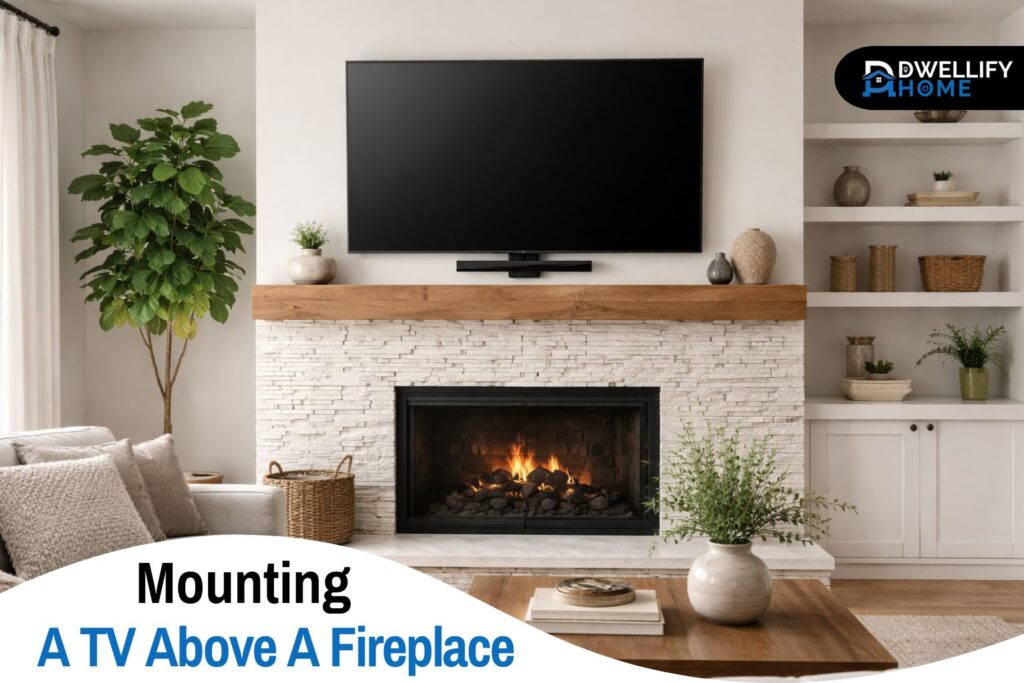
I’ve mounted more TVs over fireplaces than I can count. Some turned out clean and comfortable. Others looked great on day one but caused neck strain, heat issues, or wiring headaches a few months later. The difference always comes down to planning.
A fireplace wall can be a good spot for a TV. It can also be the worst place in the room. The goal isn’t to follow a trend. It’s to make sure the setup works in real life, not just in photos.
Snippet-Ready Definition:
Mounting a TV above a fireplace means installing a television on the wall over the mantel to save space and keep a clean focal point, while managing heat exposure, viewing height, and safe wiring.
Mission:
Dwellify Home helps homeowners make practical, stylish, and informed décor decisions that work in real life.
Is It Actually a Good Idea?
Sometimes it’s the only wall that makes sense. Open floor plans, large windows, or awkward layouts often leave the fireplace as the main focal point. In those cases, you can make it work with the right mount and proper heat checks.
But there are situations where it’s simply not worth it. Very tall mantels, wood-burning fireplaces that run hot, or seating placed far below the TV can create ongoing discomfort. I’ve had clients insist on it for symmetry, then call later asking how to lower the screen because watching a full movie became uncomfortable.
Before you commit, stand where your sofa is and look at the fireplace. Imagine the center of the TV several inches above the mantel. If that feels high just picturing it, that’s a red flag.
Mini Decision Guide (Quick Comparison)
| Your situation | Best approach | Why it helps |
| TV ends up too high | Pull-down mount | Lowers the screen to a comfortable viewing height |
| Height is only slightly high | Tilting mount | Improves viewing angle and reduces glare |
| Brick/stone fireplace wall | Masonry-rated mount + proper anchors | Keeps the mount secure on hard surfaces |
| No studs where you need them | Reinforce structure or use masonry mounting | Drywall-only mounting isn’t safe for TV loads |
| You want the cleanest look | In-wall power kit + recessed box | Hides cables without visible raceways |
| Fireplace gets noticeably warm above mantel | Don’t mount there (or reduce heat output) | Protects electronics and avoids long-term issues |
Key benefits (when it’s done right)
- Keeps the room layout clean when wall options are limited
- Reduces furniture clutter from TV stands and consoles
- Can look intentional with hidden wiring and balanced sizing
- Works better with tilt or pull-down mounts for comfort
The Three Biggest Issues Most Homeowners Miss
Heat Exposure and Long-Term Damage
Heat rises. That’s basic physics, but it matters more than people think. Gas and wood fireplaces can push significant heat directly toward the wall above. Even if it doesn’t feel hot to your hand for a few seconds, electronics don’t like sustained warmth over time.
Here’s what I always recommend: run the fireplace for 45 to 60 minutes the way you normally would. Then check the wall temperature where the TV would sit. An infrared thermometer works best, but even holding your hand there for 30 seconds can give you a clue. If it feels noticeably warm, you need to rethink placement or improve shielding.
Electric fireplaces are usually safer, but don’t assume. Some models vent heat upward. Always test.
Viewing Height and Neck Strain
Comfort matters more than perfect symmetry. The center of a TV should ideally sit around eye level when you’re seated. Over a fireplace, that’s rarely possible.
A slight upward angle is fine. But once the screen center climbs too high, you’ll start tilting your head back during longer viewing sessions. That strain builds slowly. People often notice it during sports games or movie nights, not quick news checks.
Tilt mounts can help reduce glare and improve angle, but they don’t lower the height. That’s where pull-down mounts come into play.
Structural and Installation Challenges
Fireplace walls aren’t always straightforward. Some have studs positioned awkwardly around the firebox. Brick and stone surfaces add drilling complexity. I’ve seen DIY installs rely on drywall anchors alone. That’s not safe.
Any TV mount should anchor into solid framing or masonry. No exceptions. The load isn’t just the TV weight. It’s leverage, especially with pull-down mounts that extend outward.
How High Should It Be?
Start by measuring your seated eye level from the floor. Most sofas land somewhere between 40 and 44 inches. The center of your screen should ideally be close to that.
Now measure from the floor to the top of your mantel. Add about 6 to 12 inches above the mantel as a starting clearance. That’s often where the bottom of the TV ends up.
For a 55-inch TV, the screen height is roughly 27 inches. Half of that is about 13.5 inches. So if your TV bottom sits at 60 inches, the center lands around 73.5 inches. That’s much higher than ideal eye level.
This is why many people choose a pull-down mount. It allows the TV to sit higher when not in use, then drop closer to eye level when you’re watching.
Practical Rules for Hanging a TV Over a Fireplace
After years of installs, I stick to a few non-negotiables:
- Never mount directly to drywall alone.
- Leave space behind the TV for ventilation.
- Don’t block heat vents built into the fireplace surround.
- Plan wiring before drilling anything.
Symmetry looks nice in photos. Comfort and safety matter more once you’re living with it every day.
Heat Safety and Protection
A mantel can help deflect rising heat, especially if it’s deep enough. Shallow mantels do less than people assume. In some cases, adding a thicker mantel or a proper heat shield above the fireplace improves protection.
Ventilation behind the TV is often overlooked. Ultra-slim mounts press the TV tightly against the wall, trapping warm air. A slight gap improves airflow and can extend the life of your electronics.
If your fireplace consistently makes the wall hot, no mount will solve that. In those cases, consider relocating the TV or converting to a lower-heat insert.
Choosing the Right Mount
Fixed mounts are rarely ideal above fireplaces. They keep the screen high and flat against the wall, offering no flexibility.
Tilting mounts are better. They allow you to angle the screen downward, reducing glare and improving the viewing angle slightly.
Pull-down mounts, often called mantel mounts, are usually the most comfortable solution. They let you lower the screen to near eye level during use and raise it back afterward. Before installing one, check:
- Mantel depth and clearance
- Wall strength
- Cable slack for movement
- Total weight rating of the mount
These mounts add leverage to the wall, so secure anchoring is critical.
DIY or Hire a Pro?
Mounting a TV above a fireplace DIY style is possible if you’re comfortable with tools and understand wall structure. You’ll need:
- Stud finder
- Level
- Drill with proper bits
- Lag bolts or masonry anchors
- A second person to help lift
Brick and stone fireplaces require masonry bits and anchors. Drilling into mortar is sometimes easier but not always stronger. Uneven stone can prevent mounts from sitting flush, which requires spacers or adjustment plates.
If you can’t find solid studs or you’re unsure about wiring inside walls, it’s worth calling a professional. Structural mistakes aren’t easy to fix later.
What If There Are No Studs?
People often ask how to mount a TV above a fireplace with no studs. The honest answer is that drywall alone isn’t an option.
On masonry walls, heavy-duty concrete anchors can work well. On framed walls with awkward stud placement, you may need a mounting plate that spans multiple studs or reinforcement behind the drywall.
If you can’t confidently anchor into structure, stop. This isn’t a place to experiment.
Hiding Wires the Right Way
Clean cable management makes a big difference visually. In-wall power kits and recessed outlet boxes create a tidy look, but they must be installed safely and in accordance with local electrical codes.
Never run a regular extension cord inside the wall. That’s unsafe and against code.
Surface raceways are a simpler alternative. They can be painted to match the wall and still look clean. Built-ins or cabinetry around the fireplace offer another solution for hiding streaming devices and consoles.
Plan cable routing before mounting. Once the TV is up, adjustments are harder.
Comfort and Design Details
Glare is common above fireplaces, especially with windows opposite the screen. Tilting the mount slightly downward often helps. So does repositioning nearby lamps.
Soundbars present another challenge. Mounting one directly below the TV keeps audio aligned with the screen. If using a pull-down mount, attach the soundbar to the moving bracket so it travels with the TV.
Proportion matters too. A TV that’s much narrower than the fireplace can look awkward. Ideally, the screen width should visually relate to the fireplace opening or mantel width for balance.
When It’s Better Not to Do It
There are times I advise against it. Excessive heat. Extremely high mantels. Seating that forces a steep upward viewing angle. In those cases, an adjacent wall often provides a more comfortable experience.
Corner setups, media consoles, or built-in cabinetry sometimes create better results long term. The fireplace doesn’t have to carry every focal point in the room.
Real-World Examples
Photos of TVs mounted above fireplaces can be helpful, but look closely. Notice the screen height relative to the mantel. Check whether wires are visible. Look at how the soundbar is positioned.
The best setups balance comfort, clean wiring, and safe heat management. The worst ones usually ignore at least one of those factors.
FAQs
Is it a good idea to mount a TV over a fireplace?
It can be, but only if heat is low, the TV isn’t forced too high, and the mount is anchored into studs or masonry. If the wall gets hot or the screen center ends up very high, it usually isn’t worth it.
What are common mistakes when mounting a TV above a fireplace?
Mounting too high, skipping a heat test, using drywall anchors instead of structure, trapping heat with an ultra-slim mount, and routing power unsafely or leaving cables visible.
Is a 65 inch TV too big above a fireplace?
Not automatically. The bigger issue is height and width balance. A 65-inch TV can look great if it doesn’t overwhelm the mantel and the viewing angle is comfortable (often easier with a pull-down mount).
What is the best TV to hang over a fireplace?
Choose a TV with strong off-angle viewing (so it still looks good when mounted higher), good brightness control for glare, and enough ports/features for your setup. A frame-style TV can also blend in visually when off.
How high should the TV be above the mantel?
Aim to keep the screen as low as practical while maintaining clearance and airflow. If the center of the screen ends up uncomfortably high, a pull-down mount usually makes the biggest difference.
Conclusion
Mounting a TV above a fireplace can work. I’ve installed plenty that clients love. The key is respecting heat, prioritizing viewing comfort, anchoring into solid structure, and planning wiring carefully.
Take the time to measure. Run a proper heat test. Choose the right mount. If the numbers and conditions don’t line up, it’s better to use a different wall than live with a setup that feels wrong every time you sit down to watch.
Disclaimer:
This guide is general information. For electrical work or uncertain wall structure, consult a qualified professional.

I’m Bilal, the founder of Dwellify Home. With 6 years of practical experience in home remodeling, interior design, and décor consulting, I help people transform their spaces with simple, effective, and affordable ideas. I specialize in offering real-world tips, step-by-step guides, and product recommendations that make home improvement easier and more enjoyable. My mission is to empower homeowners and renters to create functional, beautiful spaces—one thoughtful update at a time.