
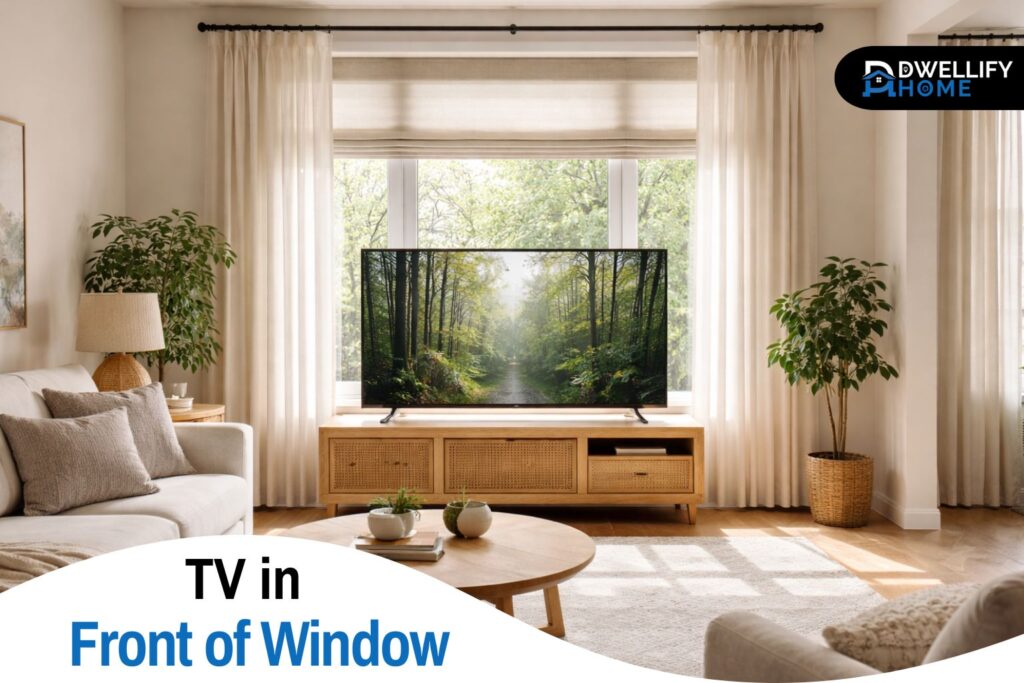
A TV in front of a window usually isn’t anyone’s dream layout. It’s the solution you land on when the room has too many doors, a fireplace takes the best wall, or the only “open” wall ruins the seating plan. I’ve seen homeowners fight it for weeks, only to place the TV there anyway and wonder why the picture feels harsh during the day.
Here’s the good news: this setup can work. The not-so-good news is it only works when you treat it like a light and layout problem, not just a “where do I put the screen?” question. The details matter more than people think.
Snippet-Ready Definition:
TV in front of window means placing a television on or near a window wall when other walls aren’t practical. It saves space, but can cause glare and backlighting, so light control and placement angle matter.
Mission Statement:
Dwellify Home helps homeowners make practical, stylish, and informed décor decisions with clear guidance that works in real rooms.
Is It OK to Put a TV in Front of a Window?
It can be okay, but it’s rarely the easiest option. The biggest downside isn’t just “blocking the window.” It’s how daylight hits the screen, how your eyes handle the contrast, and whether the TV ends up overheating or feeling awkward in the space.
In rooms with soft daylight (often north-facing windows), I’ve seen it work with minimal adjustments. In rooms where direct sun pours in (especially late afternoon), it can become a daily annoyance unless you add serious glare control. So the real question is: can you control the light and keep the setup comfortable?
It’s workable when you can add shades or curtains, keep the TV low-profile, and still access the window when you need to. It’s a mistake when the sun is intense and you can’t manage it, or when the TV blocks a window you regularly open and clean.
The 5 Real Problems With a TV in Front of a Window
1. Screen Glare and Reflections
Glare is the complaint that shows up first. Sometimes it’s obvious—sunlight hits the screen and it looks like a mirror. Other times it’s sneaky: bright sky and soft daylight still create reflections, especially on glossy screens.
One common surprise is that closing curtains doesn’t always solve it. Light can leak around the edges, bounce off pale walls, and still reflect on the screen. Even sheer fabric can create a bright haze that makes darker scenes hard to see.
If you’ve ever found yourself tilting your head or squinting during daytime TV, that’s glare doing its job.
2. Backlighting and Eye Strain
Even when glare isn’t extreme, backlighting can be. A bright window behind the TV makes the screen look dim by comparison. Your eyes keep adjusting between the bright background and the darker image, and that can feel tiring over time.
This is why some setups feel “fine” for quick clips but uncomfortable for a full movie. It’s not always about the TV’s brightness. It’s the contrast your eyes have to manage.
3. Sunlight and Long-Term TV Damage
Direct sun on a screen for hours isn’t great. Heat and UV exposure can shorten the life of electronics and, in some cases, lead to discoloration or panel issues. The risk depends on the room, the season, and the window direction.
West-facing windows are the classic trouble spot because the late-day sun can be intense and low in the sky. I’ve walked into rooms where the TV looks perfect in the morning, then becomes unusable around 5 pm. That’s a layout that needs a plan, not a quick fix.
4. Ventilation and Overheating Risks
TVs need airflow. When a TV sits tight against curtains or right up near the glass, it can trap heat. Add a thick curtain panel behind it, and you’ve basically created a warm pocket.
This tends to happen with console setups where the TV is pushed back to “save space.” A little breathing room behind the unit and a clean path for warm air to escape can make a bigger difference than people expect.
5. Blocking Light, View, and Window Access
Even if you handle glare, blocking a window changes how the room feels. The space can look heavier, and you lose the visual openness that window walls usually bring.
There’s also the practical side: can you still open the window, lock it, and clean it without dragging furniture around? If the answer is no, that inconvenience adds up fast.
A Simple Test to See If It Will Work in Your Room
Before you buy anything or mount anything, do a quick reality check. This takes minutes and saves a lot of frustration later.
- Sit where you’ll actually watch TV.
- Look at the screen area during the brightest time of day. For many rooms, that’s late afternoon.
- Notice where reflections show up: center of the screen, corners, or the whole panel.
- Stand where the TV would go and check if you can still reach the window hardware.
- Measure clearance behind the future TV position so it won’t be pressed against fabric or glass.
If the screen area is already uncomfortable in peak daylight, don’t assume you’ll “get used to it.” Plan for light control from the start.
Control the Light First (Most Important Fix)
Light control is what separates “this was a mistake” from “this is fine, actually.”
Best Curtains for a TV in Front of a Window
If you want the most predictable results, blackout curtains are the simplest answer. They’re especially useful for a bedroom setup, where you’ll likely want darkness anyway.
In living rooms, blackout curtains can feel too heavy if they’re your only layer. That’s why solar shades and light-filtering options are so popular for glare control without turning the room into a dark box.
A practical approach that works in a lot of homes is layering:
- A solar shade or light-filtering roller shade for daytime
- Curtains for evening privacy and full glare control when needed
One small detail that makes the whole wall look intentional: hang curtain rods wider than the window so the panels stack to the sides when open. It keeps the glass visible and reduces the “TV blocked my window” feeling.
Smarter Placement Strategies That Reduce Glare
Even with good window treatments, placement can make or break the setup.
The simplest rule is the 90-degree idea: a TV tends to behave better when it’s not directly facing the window. If you can angle the TV slightly or position it so the window is off to the side, reflections usually drop a lot.
Corner placement near a window can also work surprisingly well. You’re changing the reflection lines and often improving viewing angles at the same time. It’s not always the cleanest look, but it’s practical in rooms that don’t give you much wall space.
Keeping the TV low helps too. A low media console reduces how much of the window you block and makes the wall feel lighter. It also usually lands the screen closer to eye level, which makes long viewing more comfortable.
A swivel or tilt mount is worth considering when glare shifts throughout the day. In real homes, the sun moves, and being able to adjust the screen angle slightly can solve problems that curtains alone can’t.
Mounting vs Console — What Works Better Here?
A low-profile console is often the easiest way to keep the setup looking calm. It also makes it simpler to change positions slightly if you’re still fine-tuning the layout.
Wall mounting can look cleaner, but it has a few trade-offs in front-of-window situations:
- It can block more of the window visually if the screen sits higher than it needs to
- It can make window access harder depending on the mount and spacing
- Cable routing needs a real plan, because messy cords stand out on window walls
If you do mount it, an articulated mount can be more useful than a fixed one. It gives you a chance to shift the viewing angle when the light changes and makes cable access easier when you need it.
TV Settings and Small Adjustments That Improve Daytime Viewing
People often try to “solve” glare by cranking brightness, and sometimes that helps a little. But it won’t fix reflections. It mainly helps with backlighting—when the window is bright and the screen feels dim.
A few practical tweaks that don’t get overly technical:
- Use a brighter daytime picture mode if your TV has one
- Turn off energy-saving settings during daytime viewing if the screen looks too dim
- Add soft lighting behind or near the TV at night to reduce harsh contrast (bias lighting helps comfort more than it helps glare)
Anti-glare films can help in certain rooms, but they’re not magic. They’re best viewed as a “nice extra” after you’ve handled the real problem: daylight control.
TV in Front of Window in a Living Room
Living rooms are where this setup is most common, and also where people notice the compromises more. You want daylight for the room, but you also want a watchable screen.
This is where solar shades shine. They keep the room usable during the day while cutting the worst reflections. Pair them with curtains and you get flexibility—open and bright when you want it, controlled when you need it.
Visually, living rooms do best when the TV and console don’t overpower the window wall. A slim console, tidy cables, and simple curtain lines make the setup feel intentional instead of “we ran out of wall.”
TV in Front of Window in a Bedroom
Bedrooms are easier because comfort and light control go together. Blackout curtains are often welcome, and most people don’t mind covering the window at night.
The main things to watch in bedrooms are height and clutter. A TV that ends up too high becomes annoying quickly, especially when you’re lying down. Keep the screen at a comfortable angle and avoid stacking too many devices around it.
If you want the room to stay calm, keep the wall simple: clean curtains, minimal accessories, and hidden cords.
Small Rooms and Apartments (When You Have No Other Wall)
Small spaces force compromises, and that’s okay. The goal is to keep it practical and visually light.
A slim, low console is usually the best friend here. It keeps the TV stable, avoids blocking the entire window, and gives you a place to hide power strips and cables. “Floating” setups can look tidy too, but they need careful cord routing to avoid looking messy.
In tight rooms, a lift cabinet or a concealed TV option can also be worth considering. It’s not for everyone, but it’s one of the cleanest ways to keep the window wall feeling like a window wall.
How to Make It Look Intentional — Not Like a Compromise
This is where people either nail it or end up with a setup that feels awkward.
A few design moves that consistently help:
- Use curtains as a frame, not as an afterthought
- Keep the console and TV visually simple (matte finishes are often calmer)
- Hide cables completely—window walls make cords look louder
- Don’t crowd the area with extra decor that competes with the screen
When the surrounding area is clean and balanced, most people stop noticing that the TV sits in front of glass.
TV in Front of Window Feng Shui Considerations
Some people worry about feng shui here, and the concern is usually about blocking energy flow and “closing off” the room’s connection to the outside.
Whether you follow feng shui closely or not, the practical takeaway is reasonable: a window is meant to bring light and openness, and a large dark object in front of it can feel heavy. If the setup bothers you visually or emotionally, that matters.
A workable compromise is to keep the TV and console low, avoid clutter, and use curtains that can open fully so the window wall doesn’t feel permanently blocked. It’s less about rules and more about how the space feels day to day.
Situations Where It’s a Bad Idea
Some rooms don’t forgive this layout. In those cases, you’ll spend more time fighting the setup than enjoying it.
It’s usually a no-go when:
- The window gets strong direct sun and you can’t add shades or curtains
- The TV would block a window you need to open often
- The only workable height puts the screen uncomfortably high
- Safety is an issue (kids, pets, unstable stand, reachable cords)
- The room has condensation problems on windows and the TV would sit in that zone
If more than one of these applies, it’s worth looking at alternatives instead of forcing it.
Smarter Layout Options to Consider
Sometimes the best solution is stepping back and rethinking the room, not the TV.
A few options that often work better:
- Place the TV between windows if you have a gap wall
- Use a side wall and adjust seating slightly rather than blocking the brightest wall
- Try a corner placement that changes reflection angles
- Consider a projector setup in window-heavy rooms, especially if nighttime viewing is the priority
Even a small shift—moving the TV a foot off the window line—can reduce glare more than you’d expect.
Frequently Asked Questions
Is it okay to put a TV in front of a window?
It can be, as long as you can control glare with shades or curtains and keep the TV low-profile with enough airflow behind it.
How to make a TV in front of a window look good?
Use wide-hung curtains that stack off the glass, keep the console slim and low, hide cables, and avoid clutter so the window wall still feels light.
Is it feng shui to put a TV in front of a window?
Some feng shui views discourage blocking windows. A practical compromise is keeping the setup low and tidy and using curtains you can open fully.
Where not to put a TV?
Avoid placing it where direct sun hits the screen for hours, where it blocks a frequently used window, or where you must mount it too high for comfortable viewing.
What curtains work best behind a TV?
Blackout curtains are best for full control (especially bedrooms). For living rooms, solar shades or light-filtering rollers plus curtains usually feel more livable.
So, Is a TV in Front of a Window a Bad Idea?
It’s not ideal, but it’s also not an automatic dealbreaker. The difference comes down to sunlight direction, glare control, and whether the setup stays comfortable and practical in daily life.
The smartest move is simple: test the room at peak daylight, then solve the light with the right shades or curtains before you lock in the placement. When you handle those basics and keep the TV low and tidy, the setup can feel like a thoughtful choice—not a compromise.
Disclaimer:
This article is for general home layout guidance. Always follow your TV manufacturer’s recommendations and use a qualified installer for wall mounting when needed.

I’m Bilal, the founder of Dwellify Home. With 6 years of practical experience in home remodeling, interior design, and décor consulting, I help people transform their spaces with simple, effective, and affordable ideas. I specialize in offering real-world tips, step-by-step guides, and product recommendations that make home improvement easier and more enjoyable. My mission is to empower homeowners and renters to create functional, beautiful spaces—one thoughtful update at a time.