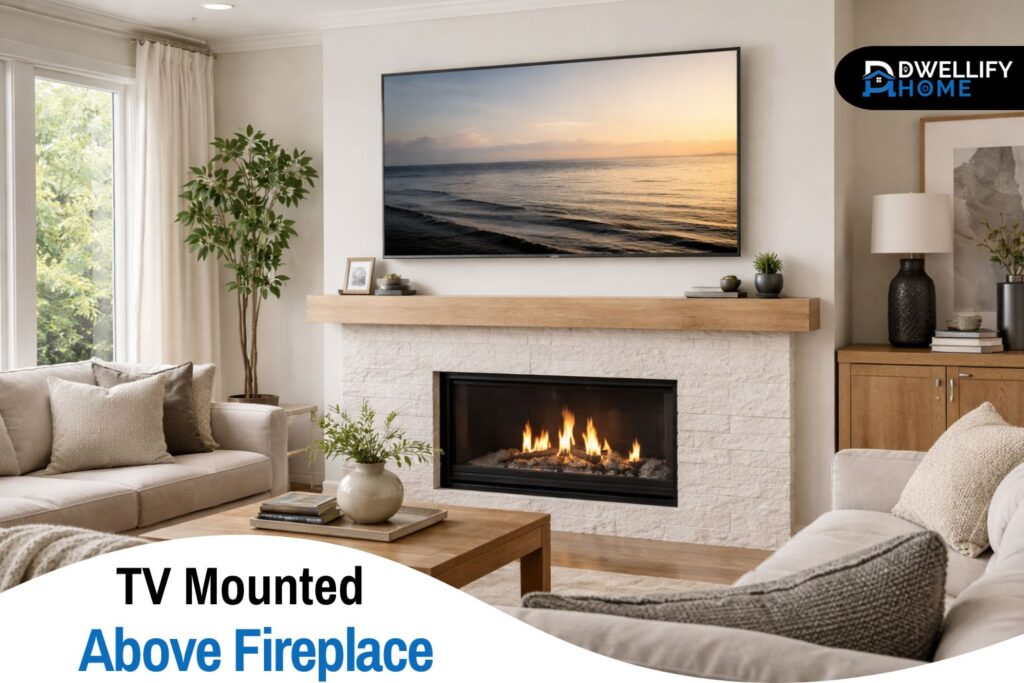
A TV over the fireplace can look clean and intentional. It keeps the room’s focal point in one place, frees up wall space, and avoids the “where does the TV even go?” headache in smaller living rooms.
But the same setup also creates the most common complaints people bring up later: the screen ends up too high, the area runs warmer than expected, or the wiring and devices become a mess. The good news is you can avoid most of that before you drill a single hole. You just need to make the decision based on heat, height, and how you actually use the room.
Snippet-Ready Definition:
A tv mounted above fireplace is a layout choice where the television is installed on the wall above the firebox, often to save space or center the room’s focal point while balancing heat, height, and viewing comfort.
Mission Statement:
At Dwellify Home, our goal is to help homeowners make practical, stylish, and informed décor decisions that work in real homes, not just in photos.
Should You Mount a TV Above Your Fireplace?
This setup makes the most sense when the fireplace wall is the only real option. Think tight rooms where every other wall has windows, doorways, or traffic flow that would put the TV in a weird spot. It also works better in spaces where the fireplace is used occasionally, not every night for hours.
Where it usually goes wrong is in primary TV rooms where you watch a lot, especially for long stretches. The viewing height becomes the daily annoyance. Heat becomes the “maybe it’s fine” risk that people ignore until the wall feels hot, the TV runs warm, or the picture acts up.
If you’re on the fence, it helps to consider alternatives before committing. Often, the best-looking rooms aren’t the ones that force the TV above the firebox. A few options that regularly work better:
- An adjacent wall with a low media console
- A corner mount that keeps the screen closer to seated eye level
- Built-ins that give the TV a “home” without perching it over the heat
- A media wall where the fireplace and TV are planned as a pair, not stacked by default
Quick Decision Guide
| Factor | When It Works | When to Reconsider |
| Fireplace Type | Electric or low-heat gas units | Wood-burning or high-output gas |
| Viewing Height | Screen can tilt or lower | Mantel is very high with fixed mount |
| Heat Levels | Wall stays within safe temps | Wall gets hot during long use |
| Room Layout | No better wall available | Adjacent wall allows eye-level setup |
Key Benefits
- Saves wall space in smaller living rooms
- Keeps fireplace and TV as one focal point
- Works well with modern linear or electric units
- Cleaner look with proper cable management
Fireplace Type Changes Everything
Not all fireplaces behave the same, and this is where a lot of bad advice starts. “It’s fine above a fireplace” might be true for one type and a terrible idea for another.
Wood-burning fireplaces are the most unpredictable and usually the riskiest. Heat output is high, the chimney pull can change how heat rolls up the face of the wall, and smoke or soot can be an issue over time. Even if the TV survives, the wall and the area behind the screen can take a beating.
Gas fireplaces sit in the middle. Some direct-vent units push heat forward and out, while others let more heat rise up the wall. Ventless models can dump a surprising amount of heat into the room. The exact insert and surround design matter more than the label “gas.”
Electric fireplaces are often the friendliest option for TV-above setups. Many of them send heat outward through a front vent and don’t create the same rising heat column. They still get warm, but the risk level is usually more manageable, especially in modern installs designed for this layout.
Modern linear fireplaces can also be designed with TV placement in mind, but only when they’re installed with proper clearance and heat management. The key is following the manufacturer’s specs, not guessing.
Heat Safety: How to Protect Your TV
Heat damage isn’t always dramatic. It doesn’t have to “melt” anything to shorten the life of electronics. Persistent warmth can stress internal components, and it can also trap heat behind the TV where airflow is already limited.
The bigger issue is that heat above a fireplace isn’t consistent. A quick fire for 20 minutes is one thing. A long evening with the fireplace running is another. People tend to test with a short run, feel the wall once, and assume it’s safe. That’s how problems get missed.
A simple heat test is worth doing before any mounting decision:
- Run the fireplace the way you really use it (same flame level, same duration).
- Place a thermometer on the wall above the mantel where the back of the TV would sit, and check it periodically.
- If you have an infrared thermometer, it can help spot hot zones, but even a basic thermometer gives useful direction.
You’re looking for stability, not a one-time reading. If the wall keeps climbing or stays hot to the touch, treat that as a warning sign.
A mantel can help because it breaks up the rising heat path. A deeper mantel generally deflects heat better, while a shallow one might not do much. If you’re planning a TV above the mantel, the mantel isn’t just decoration anymore. It’s part of the heat strategy.
In higher-heat situations, a heat shield for a TV above a fireplace can be the difference between “borderline” and “comfortable.” The goal is to redirect heat away from the wall zone behind the TV, not to trap heat in the surround. Ventilation matters. Leaving a small air gap behind the TV helps prevent heat buildup.
Also, check the clearances in both manuals: the fireplace and the TV. Some warranties are picky about placement near heat sources. It’s better to know that upfront than to learn it later.
The Height Problem: Avoiding “TV Above Fireplace Too High”
The most common regret is simple: the TV feels too high. It looks fine standing up. It looks fine in photos. Then you sit down, watch a movie, and your neck tells you what your eyes already knew.
The most practical target isn’t the bottom of the TV or the top of the mantel. It’s the center of the screen relative to where your eyes sit on the couch. In a normal setup, that center point is near seated eye level. Above a fireplace, it often ends up much higher than that.
A quick test takes three minutes:
- Mark the TV’s outline on the wall with painter’s tape.
- Sit in your usual spot.
- Look at where your eyes land naturally.
If you feel like you’re looking up the whole time, that feeling doesn’t usually go away. People adapt a little, but discomfort builds over weeks and months.
This is where “rules for hanging TV over fireplace” can be misleading. A rule like “X inches above the mantel” can’t account for mantel height, ceiling height, couch distance, and TV size. Use guidelines as a starting point, then validate with your room.
Choosing the Right Mount
The mount choice is where comfort is either solved or locked in.
A fixed mount is the cleanest, but it only works when the TV height is already reasonable. If the screen is too high, a fixed mount simply preserves the problem forever.
A tilting mount is the basic upgrade. It lets you angle the screen downward a bit, which helps with glare and viewing comfort. It’s not a magic fix for extreme height, but for modestly high placements, it can make a noticeable difference.
A full-motion mount adds flexibility if you need side-to-side movement or want to angle toward a different seating area. The tradeoff is it can push the TV farther from the wall, which can look less streamlined and may reduce airflow behind the screen if cable management is messy.
A pull down TV mount is usually the best answer when the fireplace is tall and the TV would otherwise be uncomfortably high. It lets the screen sit higher when you want the “clean look,” then lower into a more natural viewing position when you’re actually watching. The details matter here: you need clearance so it can lower without hitting the mantel, and you need enough cable slack and safe routing so the movement doesn’t stress connections.
Before choosing a pull-down option, check:
- The TV’s weight and size compatibility
- How far it drops and whether it blocks the fireplace opening
- Where the power and cables will sit when the TV is lowered
- Whether the mantel depth interferes with the mechanism
Safe Installation: Wall Structure and Mounting Rules
Mounting safety is non-negotiable. A TV mount must be anchored into studs or solid masonry. Drywall alone isn’t a structural surface, and “heavy-duty anchors” aren’t a substitute for proper framing support.
Stud walls are usually straightforward once studs are located accurately. The most common mistakes are missing the stud, using the wrong fasteners, or assuming a decorative fireplace surround is structural.
Brick and stone fireplaces can be secure mounting surfaces, but they require the right approach. Anchors must match the material, and drilling needs care. The bigger concern is what’s behind the surface. Some fireplace constructions have sensitive zones where drilling deep can create real hazards.
When there’s uncertainty about what’s behind the wall, that’s the moment to bring in a pro. It’s not about being afraid of tools. It’s about respecting that fireplaces aren’t just “a wall with brick on it.”
Wiring, Power, and Cable Management
The cleanest TV setups are planned like a small project, not like a quick weekend task.
Power is the first issue. A dangling cord down to an outlet looks messy and can be unsafe near heat. A proper outlet behind the TV is the clean solution, but it should be handled correctly and in line with local electrical rules.
For cables, heat and movement are the main enemies. Keep wires away from hot zones, avoid pinching them behind the mount, and don’t route anything where it can get baked over time.
There are neat options that don’t turn into a remodel:
- Surface raceways painted to match the wall
- In-wall cable kits designed for TV installs
- Recessed boxes to keep plugs from sticking out behind the screen
A little planning here prevents the “I hate looking at this every day” feeling later.
Where to Put Components
This comes up constantly: tv mounted above fireplace where to put components. Streaming boxes, game consoles, and cable boxes need ventilation and reasonable access, and they shouldn’t live in a hot pocket above a working firebox.
The easiest solutions are usually off to the side:
- A vented media console on an adjacent wall
- Built-in cabinets with airflow
- A floating shelf beside the fireplace (not directly above the hottest zone)
Also consider how you’ll control the devices. Hidden cabinets can block remote signals unless you plan for it. And don’t forget sound: a soundbar mounted too high can make dialogue feel like it’s coming from the ceiling. If possible, keep the soundbar closer to ear level, typically below the TV.
Design Balance: Making It Look Intentional
A TV above the fireplace can look sharp when the proportions make sense. When it looks off, it’s usually because the screen feels too small for the wall, too big for the mantel, or visually disconnected from the rest of the room.
A simple proportion check: the TV shouldn’t look like it’s “floating” over a tiny mantel. The mantel width and the TV width should feel related, not accidental.
Style choices can help too. Frame-style TVs and low-profile mounts reduce the “black rectangle on the wall” effect. Lighting matters as well. A bright window opposite the screen can create glare that makes even a good install feel annoying. Tilt and placement help, but sometimes window treatments are the real fix.
If you’re looking for tv mounted above fireplace ideas or photos of tv mounted above fireplace, focus on ones that solve function as well as looks. The best examples usually include a plan for heat, a plan for height, and a plan for components.
Step-by-Step Planning Checklist
Before drilling, walk through this in order:
- Measure mantel height, TV size, and seating distance
- Do a tape mockup and seated viewing check
- Run a realistic heat test
- Confirm clearance requirements in the fireplace and TV manuals
- Choose a mount that matches your height reality (tilt or pull-down when needed)
- Plan power, cable routing, and component placement with ventilation in mind
This is the moment where a few extra minutes can save a lot of regret.
Common Problems and Practical Fixes
TV feels too high
A tilt mount can help a bit. A pull-down mount helps a lot. In some rooms, the only true fix is changing the plan and moving the TV off the fireplace wall.
Heat concerns after installation
Add a better heat deflection strategy: deeper mantel, a deflector, more ventilation behind the TV, or simply not running the fireplace during long viewing sessions. Sometimes the right answer is admitting the fireplace and TV shouldn’t operate together.
Visible wires
Upgrade cable management. Surface raceways can look clean when painted. In-wall solutions look best when done safely and correctly.
Glare issues
Adjust tilt, shift the mount slightly, or add window treatments. Glare can make a TV feel “cheap” even when it isn’t.
Warranty worries
Check the manual language and keep records. It’s better to confirm early than assume it won’t matter.
FAQs
Is it a good idea to mount a TV over a fireplace?
It can be, but only if heat levels are safe and the viewing height is comfortable. Electric fireplaces are usually safer than wood-burning units.
Is a 65 inch TV too big above a fireplace?
Not necessarily. The bigger issue is proportion and height. The screen should feel balanced with the mantel width and still be comfortable to watch from your seating distance.
What are common mistakes when mounting a TV above a fireplace?
Mounting too high, skipping a heat test, using a fixed mount when tilt is needed, and ignoring cable management are the most common issues.
What is the best TV to hang over a fireplace?
Look for models rated to handle moderate ambient warmth, with strong brightness to fight glare. The mount choice often matters more than the TV brand itself.
How high should a TV be above a fireplace mantel?
There’s no single number. Aim for the center of the screen to be as close to seated eye level as possible, and use a tilt or pull-down mount if the mantel forces extra height.
Conclusion: TV Mounted Above Fireplace Can Work, but Plan for Heat and Height First
A tv mounted above fireplace can be a clean, space-saving choice, but it’s not automatically the best choice. The two things that decide whether you’ll enjoy it are heat management and viewing comfort.
Treat it like a real layout decision, not just a mounting job. Test the heat, mock up the height, pick the right mount, and plan where the devices and wires will live. Do that, and you end up with a setup that looks good and feels good, not one you quietly regret every time you sit down.
Disclaimer:
Always follow manufacturer guidelines and local building codes when installing a TV or modifying a fireplace setup. When in doubt, consult a qualified professional.

I’m Bilal, the founder of Dwellify Home. With 6 years of practical experience in home remodeling, interior design, and décor consulting, I help people transform their spaces with simple, effective, and affordable ideas. I specialize in offering real-world tips, step-by-step guides, and product recommendations that make home improvement easier and more enjoyable. My mission is to empower homeowners and renters to create functional, beautiful spaces—one thoughtful update at a time.