
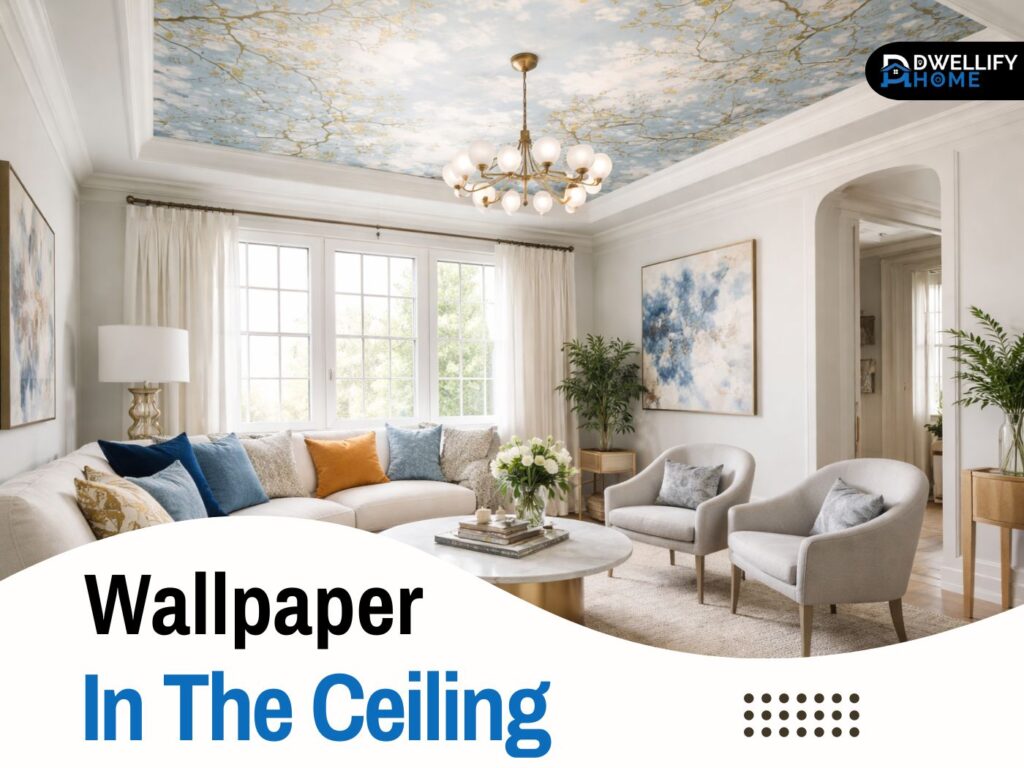
A ceiling is usually the last surface people think about. But once you start treating it like the “fifth wall,” a room can feel more finished, more intentional, and sometimes even a little calmer. That’s where wallpaper in the ceiling comes in.
I’ve installed and styled ceiling wallpaper in everything from classic dining rooms to modern powder rooms. When it’s chosen well and installed properly, it looks like it was always meant to be there. When it’s rushed, the ceiling is the first place problems show up. This guide walks you through both the design side and the practical side, so you can make a choice you’ll still like a year from now.
Snippet-ready definition:
Wallpaper in the ceiling is wallpaper applied overhead to turn the “fifth wall” into a design feature. People use it to add style, soften a room, and create a finished look without crowding the walls.
Mission Statement:
At Dwellify Home, our mission is to help you create modern, comfortable spaces with practical design guidance you can trust, from smart styling choices to real-world DIY tips that work in everyday homes.
Wallpaper on Ceiling Trend (2026): Why It’s Everywhere Again
Ceiling wallpaper is back for a few simple reasons. Paint trends have gotten quieter in many homes, and people want one spot that adds personality without filling the room with busy decor. The ceiling is perfect for that. It can carry pattern, texture, or even a mural effect while leaving the walls calm.
Another reason is that materials have improved. Modern non-woven papers, better primers, and higher-quality peel-and-stick options make ceiling work more doable than it used to be. Designers also use it as a trick for proportion. A thoughtfully wallpapered ceiling can make a long room feel balanced or make a small room feel intentional instead of cramped.
Quick Guide Table: Choose the Right Ceiling Wallpaper
| Option | Best for | Pros | Watch-outs |
| Peel-and-stick (removable) | Small rooms, rentals, quick makeovers | Cleaner install, easier removal | Can stretch overhead, seams may lift in humidity |
| Paste-the-wall (non-woven) | Most ceilings, beginner-friendly DIY | Stable, forgiving, strong hold | Needs proper primer and correct paste |
| Traditional paper (paste the paper) | Classic looks, experienced DIY | Wide style range | More sensitive to moisture and handling |
| Vinyl or washable | Bathrooms with strong ventilation | More moisture-resistant, wipeable | Still needs good prep, avoid direct shower spray |
Quick Step-by-Step: Ceiling Installation Checklist
- Prep the ceiling: clean dust, repair cracks, sand smooth, prime properly
- Plan the layout: center the pattern and snap a straight guideline
- Apply adhesive correctly: match paste to wallpaper type
- Hang and smooth: start from the center, work outward, align seams carefully
- Trim and finish: sharp blade for edges, light seam rolling, clean up paste
Is Wallpaper in the Ceiling a Good Idea for Your Room?
There are rooms where ceiling wallpaper feels effortless, and rooms where it can feel heavy. The key is to match the pattern and material to the space you actually have, not the one you wish you had.
If your ceiling is uneven, patchy, or full of repairs, wallpaper can highlight that. If the room has lots of angles, recessed lights, vents, and cutouts, it’s still possible, but you’ll want patience and a solid plan. And if the room has consistent moisture, like a steamy bathroom with weak ventilation, you need the right product and prep or you’ll be dealing with lifting seams later.
Best rooms to try first
If you’re new to ceiling wallpaper, start with a space where the payoff is high and the footprint is manageable. These are the rooms I usually recommend first:
- Powder rooms, where a ceiling feature feels special without taking over the home
- Bedrooms, especially over the bed, where a softer pattern can add comfort
- Dining rooms, where a ceiling treatment frames the table and light fixture
- Entryways and hallways, which benefit from added character
- Home offices, where a ceiling design adds personality during video calls
Small rooms often work well because you can create a complete look with one decision. A simple ceiling wallpaper in a tight space can feel like a custom design choice rather than an afterthought.
When you should avoid it
I usually steer people away from ceiling wallpaper when one of these is true:
- The ceiling has peeling paint, active water stains, or recurring cracks
- The room has very low ceilings and you want a dark, high-contrast pattern
- The bathroom stays humid and lacks a strong exhaust fan
- You need a quick refresh and do not have time for prep
None of these are permanent deal-breakers. They just mean the job needs extra steps or a different approach, like framing a smaller wallpaper panel instead of covering the whole ceiling.
Wallpaper in the Ceiling Ideas That Look Expensive, Not Random
A ceiling looks best when it feels connected to the rest of the room. I like to think in “buckets” of styles, because it keeps decision-making clear and helps you avoid picking a print that looks fun on a sample, but chaotic overhead.
Simple ceiling wallpaper for a clean, modern look
If you want a ceiling that feels polished but not loud, go simple. Think soft geometrics, subtle grasscloth looks, quiet stripes, or tone-on-tone patterns. This is my go-to approach for living rooms, home offices, and bedrooms where you want the room to feel calm.
A small-scale pattern is usually safer on a low ceiling. It adds texture and depth without making the ceiling feel like it’s coming down. If you love the idea of pattern but worry about commitment, a muted print is often the best first step.
Blue wallpaper in the ceiling for a calm, airy mood
Blue wallpaper in the ceiling works beautifully when the rest of the room is light and warm. Pale sky tones, dusty blues, and soft coastal patterns can create an open feeling, especially in bedrooms and bathrooms that have decent ventilation.
Here’s a practical pairing tip: blue overhead looks best when your wall color has a little warmth in it. Creamy whites, soft greiges, and warm light grays keep the room from feeling cold. Add brushed brass or warm wood accents and it looks intentional fast.
Ceiling wallpaper design 3D and depth effects
When people say “ceiling wallpaper design 3D,” they often mean one of two things. Either a true optical illusion, like faux beams or coffered detailing, or a mural-style print that adds depth, like clouds, botanicals, or architectural motifs.
These can look incredible in dining rooms and entryways, but scale matters. Large motifs need breathing room. If your ceiling is low, choose an illusion that is softer and less contrast-heavy so it does not feel like it’s pressing down.
Bold statement ceilings, done tastefully
Bold can be beautiful, but ceilings amplify everything. Dark florals, stars, and high-contrast geometrics tend to look best when the walls are simple and the furniture palette is controlled. If the walls already have strong color or heavy artwork, a bold ceiling can start to compete.
A good rule from real jobs: if the wallpaper sample makes you smile immediately, test it on the ceiling with your lighting on at night. Many prints feel calmer in daylight than they do under warm bulbs.
Framed ceiling wallpaper using trim or molding
If you want the ceiling wallpaper look without covering the whole surface, framing is a smart trick. You apply wallpaper inside a rectangle, often aligned with a light fixture or centered over a seating area, then frame it with molding or a subtle trim detail.
This approach works well in rentals too, because you can make it a smaller, controlled project. It also helps in rooms with lots of ceiling obstacles, since you can place the “panel” where the ceiling is cleanest.
Small-space tricks that feel intentional
Powder rooms and small hallways are perfect for ceiling wallpaper because the ceiling becomes a feature without needing extra decor. In tight spaces, I often choose:
- A small to medium pattern that reads clearly from below
- A lighter background so the ceiling still feels open
- A finish that can be wiped clean if needed
If you want drama in a small room, use contrast through pattern rather than using a very dark color on a low ceiling.
Choosing the Right Ceiling Wallpaper: Material and Finish
Ceiling wallpaper is not the place to gamble on bargain materials. Gravity is not forgiving. The right product makes installation easier and helps the ceiling stay crisp long-term.
Peel-and-stick wallpaper for ceiling, renter-friendly
Wallpaper for ceiling peel and stick can work, but you have to be picky. The best peel-and-stick for ceilings is thicker, has stable backing, and is meant to be repositionable without stretching.
Where peel-and-stick does well:
- Small ceilings, like powder rooms and closets
- Smooth, properly primed surfaces
- Designs without tight pattern matching, which reduces stress overhead
Where it can struggle:
- Textured ceilings
- Warm, humid rooms
- Large ceilings where seams multiply and stretching becomes noticeable
If you go this route, plan for extra time. Peel-and-stick can grab too quickly, and overhead you want a calm, controlled placement.
Paste-the-wall and non-woven wallpaper for ceilings
For most homeowners, paste-the-wall non-woven wallpaper is the sweet spot. It’s easier to handle, less likely to tear, and generally more stable during installation. With the right paste and good prep, it holds well on ceilings.
Traditional paper wallpaper can still be used, but it requires more care with booking time and moisture control. Vinyl-coated or washable wallpapers are often a smart choice for areas that need durability, like a bathroom ceiling in a well-ventilated room.
Finish matters more than people expect. Matte finishes hide small imperfections better. Slight sheen can reflect light and show seams if the installation is not perfect.
Design Rules That Prevent Ceiling Chaos
The ceiling is closer to your light sources than your walls, so any mismatch or bump can show faster. These rules keep the look clean.
Pattern scale is the big one. Large prints need larger rooms or higher ceilings. In a smaller room, a medium pattern usually reads best. Tiny, busy prints can look fussy overhead if they are high contrast.
Color contrast is next. A dramatic ceiling works best when the walls are quieter. If your walls already have bold color, choose a ceiling wallpaper with softer contrast or a simpler repeat.
Stripes deserve special mention. They can be great, but direction matters. Run stripes along the long direction of the room if you want to elongate it. Run them across the width if you want the room to feel less like a hallway.
Lighting changes everything. In real homes, the ceiling wallpaper that looks perfect in daytime can look harsher at night. Test your sample under your evening bulbs. If seams or repeats jump out, switch to a more forgiving print or a softer contrast.
Prep Checklist: Most Failures Start Here
If I could give you only one piece of advice, it’s this: ceiling wallpaper success is mostly prep. A ceiling that feels “fine” for paint might still be too dusty or uneven for wallpaper.
Here’s what I do before any ceiling install:
- Clean the ceiling to remove dust and residue
- Repair cracks, sand smooth, and remove loose paint
- Prime properly using a wallpaper-friendly primer
- Mark and plan the layout so the first strip is dead straight
- Remove or loosen fixtures when possible, so you can work cleanly around them
If your ceiling has a lot of texture, consider skimming it smooth first. Wallpaper will not hide popcorn texture. It will highlight it.
How to Install Wallpaper on a Ceiling Step-by-Step
Ceiling installation is a two-person job in many cases. It can be done solo, but it’s slower and mistakes are more likely. I’ll outline the process the way I’d explain it on-site.
Start by measuring and planning the layout. You usually want to center the pattern so it looks balanced from the doorway. Then snap a guideline for your first strip. If the first strip is off, everything after it will drift.
Next, apply adhesive according to your wallpaper type. Paste-the-wall means the paste goes on the ceiling, not the paper. Traditional papers may need booking time. Then place the first length carefully, smoothing from the center outward. Work slowly, because bubbles overhead can be stubborn.
Continue with the next strips, matching the pattern at the seam. Trim edges cleanly at the perimeter with a sharp blade. This is not the place for a dull knife. You’ll get cleaner corners and fewer tears.
Working around lights, vents, corners, and seams
Turn off power at the breaker before working around light fittings. For fixtures, I cut an X-shape where the opening will be, then trim gradually. With vents, I remove the cover if possible and cut a clean opening, then reinstall.
Seams need special care. Use a seam roller lightly, not aggressively. Pressing too hard can squeeze out paste or stretch peel-and-stick. If you see lifting at a seam edge, fix it immediately with the right adhesive rather than hoping it settles.
Bathroom Ceiling Wallpaper: What Works and What Fails
Wallpaper ceiling bathroom projects can work, but only when the room behaves. A powder room is usually fine because steam levels are low. A full bath needs strong ventilation, and I mean a fan that actually clears humidity, not one that just makes noise.
If you want wallpaper on a bathroom ceiling, choose a product designed for durability. Vinyl-coated and washable wallpapers tend to hold up better, and proper priming matters even more. Keep wallpaper away from direct shower spray areas, and avoid papers that absorb moisture.
If your bathroom regularly fogs up mirrors and stays damp for a long time, paint may be a better choice than wallpaper. That’s not being cautious, that’s just respecting how humidity behaves over time.
Maintenance, Cleaning, and Long-Term Durability
A well-installed ceiling wallpaper should not need much maintenance. Still, real homes have real life, so here’s what helps.
For cleaning, use a soft microfiber cloth and, if the wallpaper allows it, a lightly damp wipe. Do not scrub seams. If you notice an edge lifting, address it early. Small lifts are easy to fix. Ignored lifts attract dust and become more visible.
Lifespan depends on material, prep, and environment. In a dry bedroom or dining room, a good ceiling wallpaper can stay sharp for years. In humid spaces, the lifespan depends heavily on ventilation and product choice.
Removal Plan: So You Don’t Regret It Later
Even if you plan to keep the wallpaper for a long time, it helps to think about removal upfront. Peel-and-stick usually removes more easily, but some versions can leave adhesive behind if the surface was not properly primed.
Paste wallpapers vary. Some are strippable, meaning they come off in sheets. Others need more work. Priming properly before installation is what protects your drywall and makes removal less stressful later.
If you know you’ll want to change it in a few years, choose a wallpaper type and paste system that supports clean removal. It’s a small decision now that saves hassle later.
Common Mistakes to Avoid: Quick Expert Checklist
Most ceiling wallpaper problems are predictable. Here are the ones I see most often:
- Going too dark on a low ceiling, which can make the room feel shorter
- Choosing a busy, tiny pattern in a small room, which can look messy overhead
- Skipping primer or applying wallpaper over dusty paint
- Misaligning the first strip and chasing crooked seams across the ceiling
- Using the wrong adhesive or the wrong wallpaper type in a bathroom
- Rushing seam alignment, especially with repeating patterns
- Trying to do a large ceiling solo when a second set of hands would prevent slips
A little patience here gives you the “professional finish” people notice without knowing why.
FAQs
1) Is wallpaper on the ceiling a good idea?
Yes, if the ceiling is smooth, clean, and properly primed. It works especially well in powder rooms, bedrooms, dining rooms, and entryways. In damp rooms, material choice and ventilation matter a lot.
2) Can wallpaper be applied on a ceiling?
It can. The process is similar to walls, but gravity makes alignment and adhesion more demanding. Using a stable wallpaper type and following proper prep steps are what make it last.
3) What are the disadvantages of wallpaper on the ceiling?
The main downsides are harder installation, more visible seams under certain lighting, and risk of edge lift if prep or adhesive is wrong. In humid bathrooms, moisture can shorten lifespan.
4) What is the new trend for ceilings?
The big trend is treating the ceiling as a feature, often called the “fifth wall.” Popular looks include framed ceiling panels, soft geometrics, sky-inspired prints, and tasteful statement patterns.
5) Is peel-and-stick wallpaper okay for a ceiling?
Sometimes. It’s best on small, smooth ceilings with low humidity. For large ceilings or bathrooms, paste-the-wall non-woven wallpaper is usually more reliable and easier to keep seamless.
Conclusion
Wallpaper on the ceiling is one of those design choices that feels bold until you see it done well. Then it just looks right. The best results come from matching the pattern scale to the room, keeping contrast under control, and choosing a ceiling-friendly wallpaper type with the correct paste.
If you want a safe starting point, pick a small room and a simple ceiling wallpaper with a forgiving pattern. Get the prep right, plan your layout, and take your time with seams and cutouts. That’s how you end up with a ceiling that feels intentional, not trendy, and one you’ll actually enjoy living with.
Disclaimer
This article shares general design and installation guidance based on professional experience. Always follow product instructions, test materials in your space, and consult a qualified professional for electrical fixtures, structural repairs, or high-moisture bathroom conditions.

I’m Bilal, the founder of Dwellify Home. With 6 years of practical experience in home remodeling, interior design, and décor consulting, I help people transform their spaces with simple, effective, and affordable ideas. I specialize in offering real-world tips, step-by-step guides, and product recommendations that make home improvement easier and more enjoyable. My mission is to empower homeowners and renters to create functional, beautiful spaces—one thoughtful update at a time.