Most people hear the term “stick built home” somewhere between their first builder meeting and their third Google search. It sounds technical, but it describes something most of us have seen going up on a vacant lot — a house built from scratch, piece by piece, right on the ground where it will eventually stand.
After years of working with homeowners through new construction decisions, one thing is clear: a lot of confusion in this process comes from not understanding the basics early. This article covers what a stick built home actually is, how it’s constructed, what it costs, and how it compares to the other options competing for your attention.
SNIPPET-READY DEFINITION
A stick built home is a house constructed on-site using wood framing, built from the ground up on a permanent foundation. It offers full design flexibility, strong resale value, and qualifies for conventional financing — making it the most common method of residential construction.
Mission Statement
At Dwellify Home, we help homeowners make practical, well-informed decisions about building, designing, and improving their homes. Every article is written to give you clear, honest guidance — so you can move forward with confidence, not confusion.
What Is a Stick Built Home?
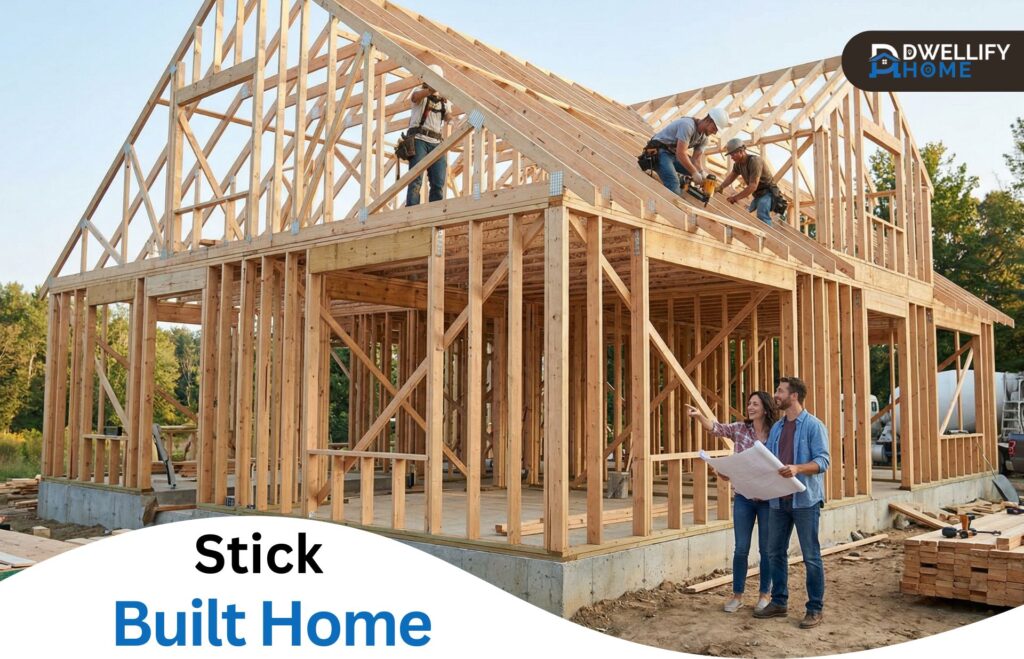
A stick built home is a house constructed on-site using individual pieces of wood framing — dimensional lumber — assembled directly on its permanent foundation. Every wall, floor, and roof structure is built at the location where the home will sit, rather than in a factory or warehouse.
Where the Name Actually Comes From
The term “stick built” refers to the wood studs, joists, and beams — the “sticks” — used to frame the structure. Builders cut and fasten these pieces together one at a time on your lot. It’s a straightforward name for a straightforward process.
Why It’s Also Called a Site-Built Home
You’ll often see “site-built” and “stick built” used interchangeably. They mean the same thing. The distinction matters primarily when comparing to modular or manufactured homes, which are constructed elsewhere and then delivered to the property.
How It Differs from Other Home Types at a Glance
The core difference is location of construction. A stick built home is born on the lot. A modular home is assembled in a factory and transported in sections. A manufactured home is built entirely off-site on a steel chassis. Understanding this separation makes every other comparison easier.
Quick Comparison Table
| Feature | Stick Built | Modular | Barndominium | Manufactured |
| Built on-site | Yes | Partially | Yes | No |
| Full customization | Yes | Limited | Yes | No |
| Conventional financing | Yes | Yes | Difficult | Restricted |
| Avg. cost/sq ft | $150–$400 | $100–$200 | $95–$145 | $50–$100 |
| Resale value | Strong | Moderate | Variable | Lower |
| Build timeline | 4–6 months | 2–4 months | 3–5 months | Weeks |
Key Benefits at a Glance
- Built entirely on your lot — no transport or assembly limitations
- Fully customizable floor plan, layout, and finishes at every stage
- Qualifies for conventional mortgages, FHA, and VA loans without classification issues
- Subject to local building code inspections throughout construction
- Historically holds and appreciates in value more reliably than prefab alternatives
- Adaptable to almost any lot type, terrain, or site condition
How a Stick Built Home Is Constructed — Step by Step
Setting the Foundation and Sill Plate
Everything starts below grade. Once the foundation — whether a slab, crawl space, or full basement — is poured and cured, a pressure-treated sill plate is bolted directly to the top of it. This plate anchors the entire wooden frame to the foundation and is often overlooked as one of the most important connections in the whole structure.
Building the Sub-Floor and Framing the Walls
With the sill plate secured, the sub-floor is framed and sheathed with plywood or OSB (oriented strand board). Then the walls go up. Stud walls are typically framed at 16 inches on center, which gives the home its structural rigidity and makes it straightforward to run plumbing, wiring, and insulation between the studs later.
Roof Trusses and the Exterior Shell
Once the walls are plumb and braced, roof trusses are lifted into place. This is when the home starts to look like a home. Exterior sheathing goes on, then the house wrap, then whatever cladding — siding, brick, or stone — the design calls for.
Interior Finish Work — Plumbing, Electrical, and HVAC
After the shell is weather-tight, the rough-in work begins: plumbing runs, electrical wiring, and HVAC ductwork. Insulation follows, then drywall, then finishes. This sequence is methodical, and each stage typically requires a building inspection before the next one begins — which is actually one of the practical benefits of site-built construction.
What Materials Go Into a Stick Built Home?
Dimensional lumber is the backbone, but it’s far from the only material involved. OSB sheathing covers the walls and roof deck. Insulation — whether fiberglass batts, spray foam, or rigid foam boards — goes into the walls and attic. Concrete, steel hardware, and engineered wood products like LVL beams handle structural loads where standard lumber isn’t enough.
Material selection matters more than most first-time builders expect. The type of insulation you choose affects your energy bills for decades. The sheathing grade affects how well the structure resists moisture. These aren’t decisions to leave entirely to the contractor without at least understanding the options.
The Advantages of a Stick Built Home
Customization at Every Stage of the Build
This is where site-built construction genuinely stands apart. You can move a wall, add a window, raise a ceiling, or redesign the floor plan from scratch. And because it’s being built in front of you, you can make adjustments mid-build when you see something that doesn’t feel right. That flexibility is difficult to replicate with any prefab method.
Strong Resale Value and Long-Term Appreciation
Stick built homes have historically held and gained value more consistently than modular or manufactured alternatives. Conventional lenders, appraisers, and buyers are all familiar with how to evaluate them. That familiarity translates to better financing terms, cleaner appraisals, and broader buyer appeal when it’s time to sell.
On-Site Oversight and Hands-On Quality Control
Because construction happens on your property, you can visit at any stage. You can see the framing before it’s covered. You can catch a problem before it becomes a costly fix. Inspections happen at multiple stages, which creates built-in accountability that factory construction simply doesn’t offer in the same way.
Straightforward Financing Through Traditional Lenders
Stick built homes qualify for standard construction loans and conventional mortgages without the classification complications that manufactured homes sometimes face. Most lenders know exactly how to process them, which means fewer surprises during financing.
Freedom to Build on Almost Any Plot of Land
Site-built construction adapts to the lot, not the other way around. Sloped terrain, irregular shapes, tight access — experienced framers handle these routinely. That adaptability matters if you’re building in a rural area or on land with unique site conditions.
The Honest Downsides to Consider
Higher Upfront Costs Than Prefab Alternatives
Labor is the biggest driver of cost in stick built construction. Every piece is cut, positioned, and fastened by hand on-site. That craftsmanship adds up. A modular or manufactured home will almost always cost less per square foot upfront, though the gap narrows when you factor in transportation, assembly, and long-term maintenance.
Longer Build Timeline
A typical stick built home takes four to six months from breaking ground to move-in, sometimes longer. Material delays, subcontractor scheduling, and permit timelines all affect the schedule. This isn’t a flaw in the method — it’s just the reality of building something from scratch.
Weather Can Slow or Halt Construction
The framing and exterior work happen outdoors, which means rain, snow, and extreme heat can interrupt the schedule. Extended weather delays can push your move-in date back and occasionally affect material quality if framing lumber sits wet for too long before the roof goes on.
How Much Does a Stick Built Home Cost?
Typical Cost Per Square Foot
Stick-built home cost varies significantly by region, but a reasonable range in most U.S. markets falls between $150 and $400 per square foot for a custom build. Entry-level production builds on the lower end, fully custom architect-designed homes on the higher end.
What Pushes the Price Up — and What Keeps It Down
Complex rooflines, specialty windows, high-end finishes, and custom cabinetry are common cost drivers. Simpler rectangular floor plans, standard ceiling heights, and builder-grade materials keep costs closer to the lower range. Site conditions — especially if grading or soil work is needed — can add significant cost that’s easy to underestimate.
Budgeting Smart and Planning for the Unexpected
A 10–15% contingency buffer on top of your builder’s estimate is not excessive — it’s standard practice. Change orders, material price fluctuations, and unforeseen site issues are part of almost every build. Experienced builders will tell you this upfront. Be wary of any contractor who insists everything will go exactly to plan.
Stick Built Home vs. Modular Home — What’s the Real Difference?
Where Each One Is Actually Built
A stick built home is constructed entirely on your lot. A modular home is built in sections inside a climate-controlled factory, then transported to your property and assembled on a permanent foundation.
Customization, Design Flexibility, and Building Codes
Modular homes have improved considerably in recent years and must meet the same local building codes as site-built homes. But customization is still more limited — you’re working with module dimensions and factory-set configurations. Stick built construction has no such constraints.
Cost, Financing, and Resale Value — Side by Side
Modular homes are typically 10–20% less expensive to build. However, lenders treat them the same as stick built homes once they’re on a permanent foundation, and the resale value gap has narrowed. The real difference shows up when you want something highly customized or architecturally unique.
Which Makes More Sense for Your Situation
Modular works well when speed and budget are the primary constraints and the design is relatively standard. Stick built makes more sense when you want full design control, have a complex lot, or are building something that needs to stand out in the resale market.
Stick Built Home vs. Barndominium — A Practical Comparison
Construction Method and Structural Differences
A barndominium uses a steel frame — typically erected from a kit — rather than wood framing. The shell goes up faster, and the open-span design allows for large, uninterrupted interior spaces. Stick built framing requires bearing walls, though engineered beams can create open plans as well.
Cost, Financing Challenges, and Appraisal Realities
Barndominiums are often marketed as the affordable alternative, and the per-square-foot build cost can be competitive. But financing is more complicated. Many conventional lenders struggle to appraise them because comparable sales data is limited in most markets. Stick built homes have none of those complications.
Long-Term Value and Who Each Option Suits Best
Barndominiums suit buyers who want a rural property with a specific aesthetic — open space, industrial feel, workshop or garage integration. For buyers prioritizing resale liquidity, neighborhood compatibility, and conventional financing, stick built remains the more practical long-term investment.
Stick Built Home vs. Manufactured Home — Key Differences
The distinction here goes beyond construction method. A manufactured home is built on a steel chassis and, in most cases, classified as personal property rather than real estate. That classification affects your mortgage options, property tax treatment, and resale value in ways that catch many buyers off guard.
Stick built homes sit on permanent foundations and are classified as real property from day one. They qualify for conventional mortgages, FHA loans, and VA loans without the additional restrictions that manufactured homes often face.
What Are Stick Built Home Kits — and Are They Worth It?
Stick built home kits provide pre-cut and sometimes pre-engineered framing packages — lumber cut to spec, with detailed plans — that a builder assembles on your site. They’re not the same as modular or manufactured homes. The construction still happens on your land.
Kits can reduce material waste and speed up the framing phase, which lowers labor costs. They work well for straightforward floor plans on clear sites. Where they fall short is in highly customized designs — modifications to kit plans can get complicated and sometimes cost more than starting from scratch with a custom build.
How to Choose the Right Stick Built Home Builder
Questions to Ask Before You Commit
Ask to see completed homes — not just photos, but actual addresses you can drive by. Ask how many projects they’re running simultaneously and who will be your day-to-day contact. Ask how they handle subcontractors and whether they use the same crews consistently.
Red Flags That Should Give You Pause
A builder who can’t provide references, resists putting specifics in writing, or quotes a price with significant items listed as “TBD” is worth approaching carefully. Vague allowances for things like cabinetry and flooring are a common way for costs to balloon well beyond the original estimate.
What a Solid Builder Contract Should Cover
Your contract should specify the scope of work in detail, a payment schedule tied to construction milestones, a clear change order process, warranty terms, and a realistic project timeline. These aren’t extras — they’re the minimum for a well-managed build.
Is a Stick Built Home Right for You?
Here’s how to think through it honestly. If you want a home that’s completely tailored to how you live, built on land you’ve chosen, and likely to hold its value reliably over time — stick built construction is the most proven path to that outcome.
If your primary concerns are speed and upfront cost, and the design is relatively standard, a modular home deserves a serious look. If you’re drawn to an industrial aesthetic and have rural land with flexible zoning, a barndominium might fit your lifestyle. If budget is the overriding factor and permanence is less of a priority, a manufactured home has its place.
Most people who’ve worked through this decision come back to the same conclusion: a stick built home costs more to build and takes longer, but it gives you more control, more flexibility, and a clearer path to long-term value. For most buyers, that trade-off is worth it.
FAQs
What does it mean if a house is stick-built?
It means the home was constructed on-site, piece by piece, using dimensional wood framing. Every wall, floor, and roof element was assembled directly on the property where the house stands — as opposed to being built in a factory and delivered. Most houses you see being framed on a vacant lot are stick built homes.
How much do stick built homes cost?
In most U.S. markets, expect to pay between $150 and $400 per square foot for new stick built construction. The range is wide because location, lot conditions, material choices, and design complexity all affect the final number. A simple rectangular plan with standard finishes costs considerably less than a custom architect-designed build. Always budget a 10–15% contingency on top of your builder’s quote.
What are the disadvantages of stick built homes?
The three most practical downsides are higher upfront labor costs compared to prefab options, a longer build timeline of four to six months or more, and vulnerability to weather delays during construction. None of these are dealbreakers, but they’re worth factoring into your timeline and budget planning before you commit.
Is it cheaper to stick build or go modular?
Modular is typically 10–20% less expensive per square foot upfront because factory construction reduces labor costs. However, transportation, site assembly, and foundation work can close that gap. For standard designs on straightforward lots, modular can save money. For complex or highly customized builds, stick built construction often becomes more cost-competitive because modular modifications can get expensive quickly.
Can you get a mortgage on a stick built home?
Yes — and without the complications that sometimes come with other construction types. Stick built homes qualify for conventional loans, FHA loans, VA loans, and standard construction-to-permanent financing. Lenders and appraisers are fully familiar with how to evaluate them, which makes the financing process more predictable than with barndominiums or manufactured homes.
Conclusion
A stick built home is, at its core, the most traditional and flexible way to build a house. It’s not the fastest method, and it’s rarely the cheapest upfront. But it offers something the alternatives don’t quite match — a home built exactly to your specifications, on your land, with the kind of long-term value that conventional markets understand and reward.
The decision comes down to what matters most to you right now and five years from now. Take the time to talk to builders, visit completed projects, and run the real numbers before committing. The right choice becomes clear quickly once you have honest information in front of you.
Disclaimer
The information provided on Dwellify Home is for general informational purposes only. Cost estimates, timelines, and comparisons reflect typical market conditions and may vary based on location, builder, and project scope. Always consult a licensed contractor, builder, or financial professional before making construction or investment decisions.

I’m Bilal Hassan, the founder of Dwellify Home. With 6 years of practical experience in home remodeling, interior design, and décor consulting, I help people transform their spaces with simple, effective, and affordable ideas. I specialize in offering real-world tips, step-by-step guides, and product recommendations that make home improvement easier and more enjoyable. My mission is to empower homeowners and renters to create functional, beautiful spaces—one thoughtful update at a time.