Older Winter Park homes sit on clay soil full of tree roots, hard water runs through the pipes, and the rainy season tests every drain you own. I have watched neighbors panic over a $180 fix because they never mapped their plumbing. Here is the short version: know your shutoff valve, learn how your water behaves, and line up your plumbing services in winter park before something fails at 11 pm on a Sunday.
That is the whole premise of this guide, and it holds up. Winter Park is not a new-build suburb where everything is plastic and predictable. You are living alongside homes built between the 1920s and the 1970s, wrapped in oak and camphor roots that treat every pipe joint as a puzzle worth solving. Your house needs a different kind of attention than a house outside the city limits.
What follows is a practical map. You will learn how the soil and water shape your system, how to spot trouble early, and how to plan repairs so they land on your terms instead of your insurance deductible. Most of it costs nothing but a weekend of looking around.
Why Winter Park Plumbing Is Its Own Beast
The old citrus-era neighborhoods sit on Orange County clay. That soil swells and shrinks with rain, and the movement flexes older copper and cast iron lines until a small weep becomes a slow drain leak. Meanwhile, the huge live oaks, which are half the reason you moved here, push roots toward condensation on the outside of sewer laterals. I have walked Winter Park blocks where a beautiful front yard hid a county maintenance crew because a root had cracked a lateral and the lawn had turned into a wet sponge.
Add the water. Central Florida pumps water out of the Floridan aquifer, and that water carries dissolved limestone, which is why your shower glass fogs up in a month and the kettle looks like it climbed out of a cave. According to the EPA, mineral content is normal in public water and not a health concern, but the same minerals build up inside your water heater, reduce its efficiency, and shorten its life. In Winter Park, that is part of your baseline maintenance math.
Read the Whole House, Not Just the Clog
Most plumbing calls happen because one pipe got a homeowner’s full attention after a slow winter. That is the wrong way to think about it. The better approach is to understand the whole system: supply, drainage, water quality, and hot water. A clog in the kitchen sink tells you something about the grease in your drain line. A foggy showerhead tells you the water is scaling your fixtures. A water bill that climbs two months in a row tells you maybe nothing is wrong with your fixtures at all.
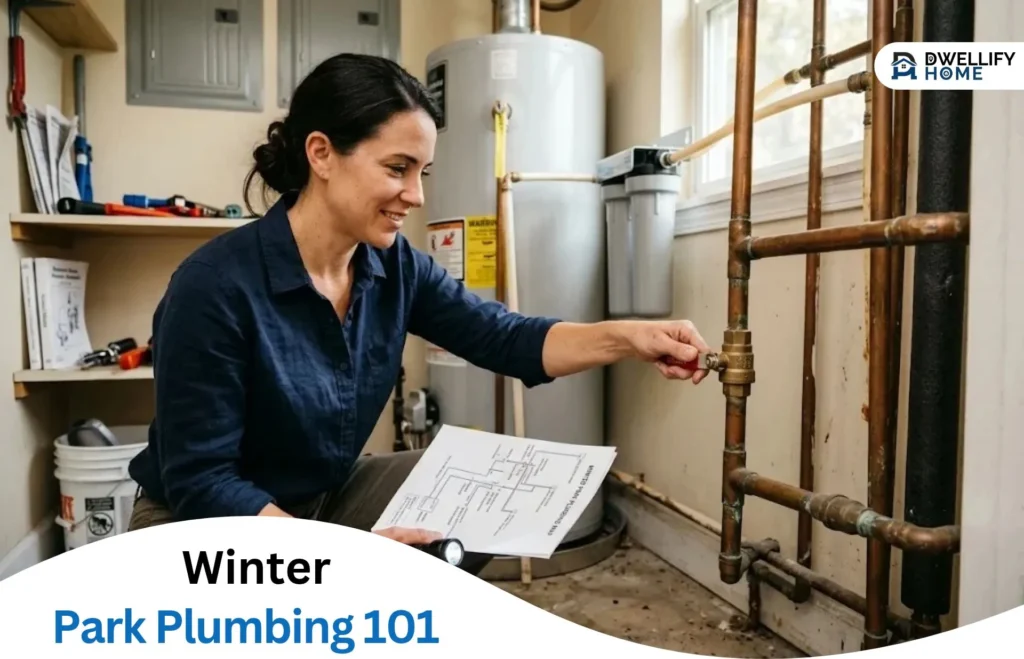
Here is the framework I would hand a neighbor: the Four-Quart Check. Four quarters of the house, one visit each.
- Quarter one: the meter at the curb. Turn every tap off and watch the main dial for ten minutes. Any movement means a leak you have not found yet.
- Quarter two: the water heater. Check the pan, the relief valve, and the age sticker on the tank.
- Quarter three: the outside taps and the irrigation manifold. Cheap parts, expensive failures if they freeze or crack.
- Quarter four: the shutoff valve under each sink and behind each toilet. Open and close them once. If a handle breaks in your hand, that is a ten dollar fix that saves a much larger one.
The check takes about ninety minutes and it will teach you more than any article. Do it once a year, ideally in early fall before the rainy season lets up. Is that overkill? Maybe. But a fifteen dollar washer under the kitchen sink looks like a bargain next to a swollen cabinet base.
When to Call and When to Wait
Plumbers are expensive because water damage is worse. Here is my rule. If water is where it should not be, you call. If a drain is slow but the sink still drains, you try the plunger and the drain snake first. If the slow drain is in your main line and comes with gurgling in the toilet, you call. If it is one bathroom sink and you are handy, you can likely fix it yourself.
Some problems deserve immediate attention regardless of your pride. Any visible leak under a cabinet, a toilet that rocks, a water heater over ten years old that starts sighing, or a shutoff valve that will not close. Others are patient. Copper pipe noises, a tub that drains slowly, a showerhead that needs descaling. Those can go on a list and you can bring in help when you schedule it.
The National Weather Service notes that Central Florida gets the bulk of its rain between June and September, which is exactly when Winter Park sewer lines are under the most stress. A house that is prone to slow drains will announce itself in July. Plan repairs before the season, not after.
A Simple Budget for Plumbing Reality
New homeowners in Winter Park tend to budget for the mortgage, insurance, and then nothing. I would argue plumbing deserves its own line. The number matters less than the habit. Set aside a repair fund, and treat these as your likely triggers:
- Water heater replacement on an eight to twelve year cycle
- One drain cleaning per year if your house is older than 1980
- A camera inspection on the sewer lateral when the house is new to you
- Fixture replacement as a slow rolling project, not a crisis purchase
You also want to know your water hardness before deciding whether a softener or a whole house filter is worth it. Skip that step and people buy an expensive system and leave the shower glass just as foggy.
| Condition | What it usually means | When to act
|
| Meter dial moves with taps off | Hidden leak | Same day |
| One slow sink or shower drain | Local clog or buildup | Try DIY first, call if it returns |
| Gurgling toilets plus slow sink | Main line blockage | Call within a day or two |
| White crust on fixtures | Mineral hardness | Plan for a softener |
| Water heater over ten years old | End of service life | Budget, do not wait for a leak |
Tree Roots, Slabs, and the Troubles You Cannot See
The hardest part of Winter Park plumbing is that the expensive failures hide under concrete slabs and tree canopies. A camera inspection of the sewer line tells you more than any visual inspection of the interior. It also gives you a picture you can keep, which matters if you ever sell. On the supply side, older homes sometimes still have galvanized lines, which rust from the inside out and slowly drop pressure. If your shower gets weaker every year, that is your clue. Do not accept “it is just the showerhead” as an answer until someone checks the pressure at the fixture.
If you have a slab leak, you may hear a hiss under the floor or notice a warm spot in the hallway that never gets cold. A plumber can often isolate the section and reroute rather than break up half your tile, which is one of those upgrades that pays for itself by not destroying your floor. Nobody tells you that before the leak happens, so I am telling you now.
The Bottom Line Before Your First Repair Call
Map the system, run the Four-Quart Check, keep your shutoffs working, and know how your water and soil shape the house. Those moves cost almost nothing and they turn a plumbing emergency into a scheduled item on a Saturday morning. Line up your go-to plumber before you need one, and ask them a single question: what is the most likely failure point in this particular house? Write the answer down. When the water comes, and it usually does, you will already know what you are looking at, and you can decide whether to grab a wrench or the phone.
Some references included in this article may be connected to affiliate programs or sponsored collaborations. Dwellifyhome.com may receive financial compensation through these relationships, where applicable.