On any particular day, machines transform natural land into building materials, whilst project administrators examine numbers from spreadsheet files of thousands of items. Prices of structural metal rise and fall just like stock market tickers, expert availability changes dramatically, and shipping troubles can change an economically viable shipment into an economic disaster overnight.
The conventional estimating system gets an assignment off the ground; however, estimates lose credibility as soon as construction groups commence working with the concrete. In order to save lots of their assignments, enterprise developers, manufacturing contractors, and industry experts rely on dynamic forecasting. Forecasting expenses isn’t always an art of guessing the future. It is a science of technological records that involves recording real-time field data, identifying cost drivers, and recalculating ultimate prices before small differences consume complete margins.
1. The Financial Landscape of Modern Construction Projects

Venture budgeting needs to have a good understanding of how the cost of materials and labor varies through the venture. The starting point is having an estimate of the cost of the venture; nonetheless, when you start implementation of the venture, things change.
| Step | Workflow Stage | Input / Function | Output / Key Objective |
| 1 | Static Budget Baseline | Initial project cost estimate & baseline plan | Establishes the target financial benchmark |
| 2 | Real-Time Field Execution Data | Labor hours, material tracking, equipment tracking
Data from site operations is fed into the system in real time |
Labor hours, material tracking, equipment tracking
Data from site operations is fed into the system in real time |
| 3 | Continuous Forecasting Engine | Dynamic cost modeling & variance analysis | Generates real-time projections & triggers Early Mitigation Decisions |
| 4 | Protected Profit Margin | Proactive adjustments & cost controls | Secures overall project profitability and prevents overruns |
When challenge groups release a complicated business corporation, bringing on a specialized Construction Estimating Service subsequently in early pre-development creates a rock-solid operational foundation. This baseline offers financial officers the clear visibility needed to isolate unpredictable cost spikes from network trade hard paintings inefficiencies.
Core Characteristics of Dynamic Cost Forecasting
- Active Field Feedback Loops: Unlike static estimates that sit in a drawer, dynamic forecasts combine every day’s method logs, internet web page development updates, and difficult painting hours.
- Categorical Cost Separation: Raw materials, heavy tool rentals, specialized subcontractors, and direct labor hours are tracked as independent variables in the location of being bundled together.
- Predictive Variance Analysis: Financial forecasts compare real budgets in competition to actual overall performance to flag rate overruns weeks earlier than invoices come due.
- Risk Mitigation Buffers: Contingencies are calculated dynamically based on actual international volatility metrics in the region of arbitrary constant possibilities.
The Real Importance of Good Forecasting
Why then does recognition take so much care in non-prevention economic forecasting? In an institution where normal profit margins lie between 3% and 6%, a 5% price increase in raw materials kills all profits right there and then.
Good forecasting becomes an early warning system. It provides excellent negotiators with bargaining power when negotiating with suppliers, gives the owners timely and appropriate adjustments to their credit limits, and prevents mid-job capital shortages.
2. Quantitative Tools for Material and Labor Volatility Control
| Forecasting Method | Primary Application Phase | Scaling Value Range | Primary Input Sources | Accuracy Variance Margin |
| Unit Cost Modeling | Conceptual / Feasibility | ±15% to ±25% | Sq. Ft. Fees, historical $ | High potential for macro variability |
| Parametric Estimating | Schematic Design | ±10% to ±18% | Assembly ratios, RSMeans | Moderate proximity variability |
| Earned Value Management | Active Field Execution | ±3% to ±8% | Daily hard work records, turnover | High accuracy level |
| Bottom-Up Line Item Analysis | Construction Documents | ±2% to ±5% | Sub Bids, Purchase Orders | Highly detailed baseline |
| Trend Line Extrapolation | Mid-Project Schedule Tracking | ±5% to ±10% | Burn rate, historical pattern | Captures complex workflow |
Earned Value Management (EVM) Deep Dive
Earned Value Management is a business enterprise broadly used for measuring actual hassle paintings towards planned budgets. It ties financial spending properly to physical development, getting rid of the phantom that a project is on budget honestly because it hasn’t spent its cash reserve, however.
The number one metrics in EVM depend upon clean mathematical relationships:
| Metric / Indicator | Formula | Interpretation & Threshold (< 1.0) | Project Impact |
| Cost Performance Index (CPI) | CPI=EarnedValue(EV)ActualCost(AC) | CPI<1.0: Project is over budget. | Spending more money than the completed work is actually worth. |
| Schedule Performance Index (SPI) | SPI=EarnedValue(EV)PlannedValue(PV) | SPI<1.0: Project is behind schedule. | Work is taking longer than planned, driving up labor and overhead costs over time. |
| Estimate at Completion (EAC) | EAC=BudgetatCompletion(BAC)CPI | Adjusted Forecast: Predicts total project cost based on current CPI efficiency. | Shows the projected final cost overrun if current cost inefficiency continues. |
3. Controlling Labor Inefficiencies and Structural Scope Creep
Labor prices are notoriously risky. Raw materials take a seat down on pallets till set up; but, hard paintings burn fees tick every 2nd humans are on net internet web page on line. Weather delays, alternate overcrowding, incomplete architectural drawings, and lousy internet website online on line coordination hastily harm productiveness.
| Stage | Trigger / Root Cause | Intermediate Impact | Direct Consequence | Operational Result | Final Financial Outcome |
| 1 | Incomplete Drawings | Trade Clashes | On-site Rework | Unplanned Overtime Hours | Budget Overrun |
| 2 | Unclear Specifications | Trade Clashes | On-site Rework | Unplanned Overtime Hours | Budget Overrun |
Unclear formats are another leading cause of wasteful critical work. By integrating the services of Shop Drawing Services in the initial procurement process, such disagreements can be sorted out before installation commences. The metal structures, HVAC ducts, and architectural millwork fabrication drawings will be an accurate and perfect addition to the website.
Scaling Values and Economic Consequences Based on Different Project Sizes
Understanding how price volatility scales in the course of superb challenge footprints is important for placing practical monetary reserves:
- Small Commercial Builds ($500k – $2M): Direct hard artwork variance money owed for as an amazing deal as $ 20% of typical price range fluctuations. Crew flexibility is restrained, which means a single-day delay can incur a heavy proportional fee.
- Mid-Scale Developments ($2M – $25M): Material price spikes represent a share of $ forty-5%$ of overall financial risk. Bulk-buying approaches and early provider locking emerge as crucial to survival.
- Infrastructure & High-Rise Projects ($25M+): Trade scheduling clashes, internet net internet page congestion, and supply lead instances compound exponentially. Unmanaged variances without issues balloon and miss budgets with the useful resource of $ 25%$ to $ 35%$.
4. Real-World Case Study: Commercial Industrial Facility
To see dynamic forecasting in motion, keep in mind a 16 million organization warehouse assembled within the route of a 146-month timeline. Six months into creation, sudden worldwide supply chain bottlenecks pushed structural metal prices up by 16%. At the same time, lack of certified welders in the community resulted in a rise in community wages by 22%.
Month 1-5: On Target Baseline ──► Month 6: Steel +sixteen% & Wages +22% ──► Month 7: Re-forecasting & Risk Management ──► Month 14: Profitable End
Process for Forecasting Revision
- Variance Signal Detection: The web manager reported a drop in the textCPI from 1.04 to zero.86 in three weeks, due to difficulty with structural alignment.
- Problem Determination: The financial managers divided the variance into sections: 60% proved to be due to material cost hikes, while 40%$ was a result of structural realignment.
- Bottom-Up Re-Forecasting Implementation: The problem resolution team estimated the Estimate at Completion (EAC), estimating a projected $680,000 deficit range.
- Implementation of Modifications: The contractor moved the production of frames from the website to an alternative site, and re-negotiated metal acquisition prices.
- Final Result: The task absorbed market spikes and was completed within $ 1.2\%$ of the target margin variance, clearly defending the general contractor’s profit margin.
5. Strategic Procurement and Material Price Management
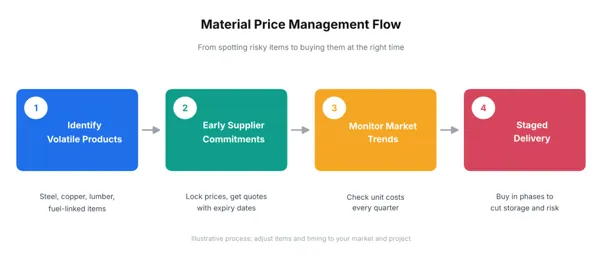
The fabric material market is solely determined by the monetary laws of the world, fuel prices, and supply and demand of the season. The management of such volatile prices is fully determined by the procurement process that aligns well with the forecasted prices.
Identification of Volatile Products ➔ Early Supplier Commitments ➔ Monitoring of the Current Market Trends ➔ Stage Field
- The involvement of a Construction Cost Estimator will help in assessing the market environment, carrying out a sensitivity analysis, and reaching inflation-proofing agreements.
Procurement Strategies
- Escalation Clause: There should be an arrangement in the contract between the owner and contractor to have variable costs such that the cost risk will be shared by all the parties in case of high inflation.
- Buy Early and Store Safely: Buy risky materials such as metal framework, copper wiring, and pipework prior to the start of the assignment process and store them safely in off-site warehouses to ensure unit costs.
- Engineering through Value Substitution: It is important that you have value substitution before the start of the assignment process (like the use of bloodless steel framework in place of structural metallic frameworks). This makes it easier to do the artwork.
- Price Adjustment Agreement: Payment for your change orders should be according to commodity market indices. This will ensure that you pay the real price per day.
6. Contemporary Technology Frameworks for Real-Time Financial Transparency
The first risk factor in managing present-day production forecast estimates through separate spreadsheet systems is that spreadsheets do not have any real-time links to the venture internet site, thus delaying discovery of emerging cost leakage until invoicing takes place.
| Source Input Stream | Integration Hub Component | Final Output & Real-Time Intelligence |
| Field Mobile App
(Daily progress, labor hours, material logs) |
Cloud Integration Hub
(Assures seamless, consistent, and synchronized cross-platform data feeds) Cloud Integration Hub (Assures seamless, consistent,t and synchronized cross-platform data feeds) Cloud Integration Hub (Assures seamless, consistent,nt and synchronized cross-platform data feeds) |
Real-Time Dashboard & Risk Alerts
(Provides instant visibility into budget variances, schedule shifts, and emerging risk metrics) |
| 5D BIM Model
(Visual quantity takeoffs and time-linked spatial progress) |
Cloud Integration Hub
(Assures seamless, consistent, ent and synchronized cross-platform data feeds) Cloud Integration Hub (Assures seamless, consistent, and synchronized cross-platform data feeds) Cloud Integration Hub (Assures seamless, consistent, and synchronized cross-platform data feeds) |
Real-Time Dashboard & Risk Alerts
(Provides instant visibility into budget variances, schedule shifts, and emerging risk metrics) |
| Accounting API
(Actual costs, invoices, payroll, and financial disbursements) |
Cloud Integration Hub
(Assures seamless, consistent, and synchronized cross-platform data feeds) Cloud Integration Hub (Assures seamless, consistent,t and synchronized cross-platform data feeds) Cloud Integration Hub (Assures seamless, consistent,nt and synchronized cross-platform data feeds) |
Real-Time Dashboard & Risk Alerts
(Provides instant visibility into budget variances, schedule shifts, and emerging risk metrics) |
Important Technological Factors in Contemporary Forecasting:
- 5D Building Information Modelling (5D BIM): 3-d structural designs integrated correctly with fee databases and production schedules in the cloud. If there is any change in the structural wall done by the architect in the virtual world, it automatically computes the quantity of material and costs involved in it.
- Field Data Capture for Mobile Devices: In cloud-enabled mobile apps, the superintendents can input the installed fabric quantity and man-hour data from the field to the internet. The above-given data is directly input into the EVM dashboards.
- Invoice & PO Automated Matching: The robotic process flow of the AI system cross-checks the incoming invoices and purchase order data of subcontractors for any billing mistakes.
- Analytics Engine for Predictive Performance: The algorithm does the testing on historical records of optimal performances in hundreds of projects to find out the delays and cost overruns in the timetable.
Conclusion
Accurate charge prediction is an important ingredient in surviving in the manufacturing business for a long period of time. It will make the process of economic planning a proactive rather than reactive process by using real-time progress and statistical tools. In this way, contractors and developers will be able to surmount difficult market circumstances and unexpected requirements.
Creating your own lifestyle in the field of cost management without any predictability ensures profit margins, maintains clear relations with project owners, Construction Estimating Services in Kansas and ensures efficiency of task completion within budget.
Frequently Asked Questions
What is the main distinction between a production estimate and rate forecast?
A production estimate is a fixed monetary document ready for a duration of early pre-production to create budgets, bid on contracts, and get finance. Rate forecast is an energetic financial model which is consistently refreshed at several stages in advance throughout the procedure of combining actual time website spending, hard cash manufacturing charges and present market expenses of fabric to evaluate ultimate contract prices.
How frequently do fee forecasts need to be up to date at an organization’s production website?
The working time at the field level and cloth consumption must be tracked each day via means of website supervisors. Fee forecasts primarily based totally on tsk ought to be refreshed monthly for venture proprietors and financial parties, regardless of the fact that rapid development ventures with high-priced materials usually gain from fortnightly refreshes.
How is that it prevents surprising price increases for hard work due to accurate submittals?
Accurate submittal drawings resolve any layout conflicts and discrepancies within the measurements before the components are fabricated and erected on the building site. By coordinating submittals for construction, there will be no need to make alterations on-site that will lead to expensive changes and rework.
Why are hard work costs harder to estimate than material costs?
Material costs are impacted by cost rates, transportation agreements, and the physical aspect of materials. Labor efficiency levels vary depending on many factors such as climatic conditions, the business’s ability level, normal performance, market shortages, and safety regulations on-site.
This article may contain references to products, services, or businesses through paid promotional arrangements. Dwellifyhome.com may receive compensation for certain sponsored placements featured within its content.