Twelve minutes. That is how long the average buyer actually spends looking at a house before deciding whether they love it, and most of those minutes go to the kitchen.
I get it. The kitchen is where the photos live. But the things that cost the most to fix after closing are usually outside, underneath, or in a closet you did not open. Learning to read a house in sequence fixes that. Start at the street, move clockwise around the exterior, then work your way inward through the systems that keep the place comfortable. If you are buying in a small valley town with big lots and mixed-era construction, bring a sharper checklist, because a local elverta hvac company will tell you the same thing we tell every buyer: the mechanicals age differently out here than they do in a subdivision.
Here is the order I use, and why it works. Exterior first, because water damage always starts outside and works inward. Systems second, because they are expensive and invisible. Cosmetic stuff last, because you can change paint but you cannot change a cracked heat exchanger with a weekend and a roller.
Start at the curb, not the front door
Stand across the street and look at the roofline. Is it straight? A sag in the middle of a ridge tells you something about the structure that a fresh coat of paint cannot hide. Now look at the grade. Soil should slope away from the foundation on every side, and if it does not, you are looking at a drainage problem waiting for the next big storm.
Walk the perimeter clockwise, and keep your phone out. Photograph every crack over a quarter inch wide in the foundation, every stain on a downspout, and every spot where a fence post meets the dirt. You are not diagnosing anything. You are building a record so an inspector can tell you whether what you saw matters.
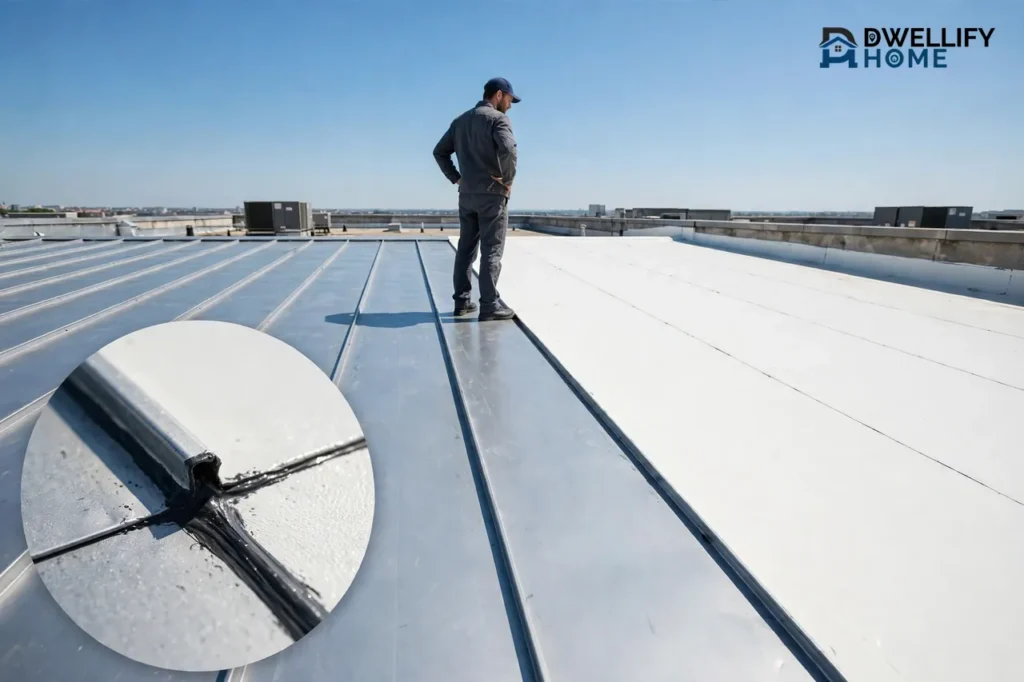
The roof is the one thing you should refuse to guess at. From the ground, look for lifted shingles, dark streaks that never dry, and any spot where a valley dumps water directly onto siding. If you can see the roof from a second-story window, use that. If not, ask the seller for the age of the roof and get it in writing.
On larger parcels, look at the outbuildings too. A detached shop or barn often has its own power, its own slab, and its own water source, and none of that shows up in the listing photos.
Open the closet with the air handler in it
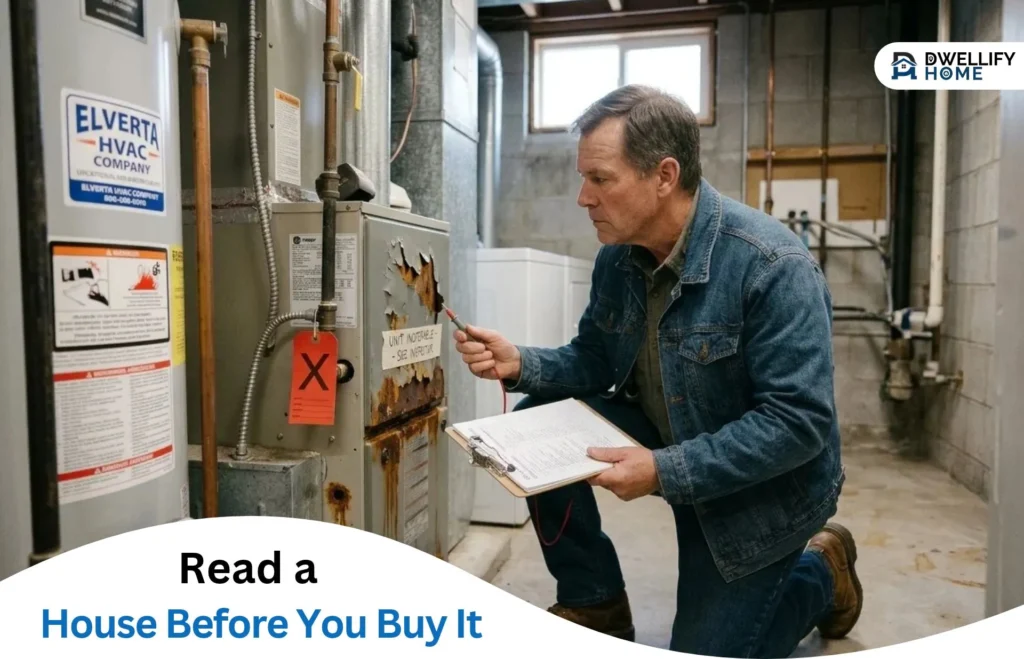
This is the part most buyers skip, and it is the part I would never skip. Find the furnace or air handler. Open the closet. Look at the service tag.
Age matters more than brand. A furnace that has been running for twenty-five years in a house with a crawlspace is a different proposition than the same model installed last spring. Write down the model and serial numbers, then look them up later from your couch. Manufacturers date-code those plates, and the code is usually a small sticker near the gas valve or on the blower door.
While you are in there, check three things. Does the closet door close and seal? Is there a filter in the slot, and is it gray with dust? Is there a drip pan under the unit, and is it dry? A wet pan in July means something, and a dry pan with a rust ring around the drain means something else.
Ask when the system was last serviced and who serviced it. A homeowner who can name the company and hand you a receipt is a homeowner who kept records. That single question tells you more than the inspection report will about how the house has been treated.
Read the water before you read the walls
Turn on every faucet at once. Flush both toilets. Run the shower and the kitchen sink together. What you are watching for is pressure drop, which points to a supply problem, and slow drains, which point to a waste problem. Neither is fatal, and both are worth knowing before you write an offer.
Then find the water heater. The tag gives you manufacture year, and the tank gives you condition. Look for rust at the base, mineral crust on the fittings, and any sign of a pan that has overflowed. Tankless units are a different read: ask for a descaling record, because hard water and skipped maintenance are how those units die young.
If the house is on a private well, ask three questions in this order. When was the pressure tank last replaced? When was the water last tested? And where does the waste go? The Environmental Protection Agency publishes baseline guidance on private wells and septic systems that is worth a read before you tour a rural property, because those two systems carry maintenance schedules a city buyer has never had to think about.
The crawlspace, the attic, and the middle of winter
You do not need to crawl anywhere. You need to put your head through the access hatch with a flashlight and look for two things: standing water and daylight.
Daylight means a hole to the outside, which means heat in the summer and cold in the winter. Standing water means drainage, plumbing, or both. Look at the insulation while you are there. If it is sagging, compressed, or hanging in strips, plan for replacement.
In the attic, look at the underside of the roof deck. Dark rings and white staining mean moisture has been getting in and staying in. Look at the insulation depth, and look at whether the bath fans vent outside or dump warm wet air straight into the attic. That second one is common, cheap to fix, and expensive to ignore.
Then ask the question nobody asks on a sunny July afternoon: how did this house feel in January? Cold floors over a crawlspace, fog that hangs for days, and a heat pump that runs constantly are all clues about insulation and air sealing, not just equipment. The Department of Energy covers the air sealing and insulation baselines that make the biggest difference, and knowing them lets you price a fix instead of fearing it.
A quick comparison table for the tour
Bring this with you. Write in the margins. Two minutes per line is enough.
| What you check | Good sign | Flag to raise
|
| Grade around foundation | Soil slopes away on all sides | Mulch piled above siding, puddles near the slab |
| HVAC service tag | Recent date, matching filter, dry pan | Rust ring, missing filter, no service record |
| Water pressure | Steady with multiple fixtures running | Noticeable drop, slow drains in more than one room |
| Attic deck | Clean, dry, even insulation | Dark rings, bath fans venting into the attic |
| Water heater | Dry base, readable tag, pan intact | Rust at the base, crusted fittings, no pan |
What I would actually do with all this
I would not walk away from a house because of one flag. I would walk away from a house where the seller cannot answer basic questions, because that is a pattern, not a coincidence.
Here is the rule I use. If you find three or more flags in the systems column, budget for a professional evaluation before you remove your inspection contingency. A cracked heat exchanger, a failing well pump, or a sewer line with roots in it can each cost more than a year of mortgage interest, and none of them show up in staging.
One more piece of context worth knowing: the Department of Housing and Urban Development maintains resources on the home buying process, including what inspections cover and where the gaps are. Read the gap section. That is where your own walkthrough earns its keep, because a standard inspection is a snapshot and you are the one who will live in the house.
The cosmetic stuff can wait. You will repaint the hallway eventually no matter what the listing photos promised, and that bathroom tile you hate will still be there in five years. But the roof, the mechanicals, the water, and the envelope around all of it decide whether the next decade is quiet or expensive.
So on your next tour, give the kitchen five minutes and give the air handler closet the other seven. Then ask yourself one question: could I describe how this house handles a hundred-degree afternoon and a foggy January morning? If the answer is yes, you have read the house. If not, you know exactly what to ask before you make an offer.
At Dwellifyhome.com, transparency is important when discussing our business relationships. Certain links may be affiliate or sponsored links that provide commissions or other compensation to our website.