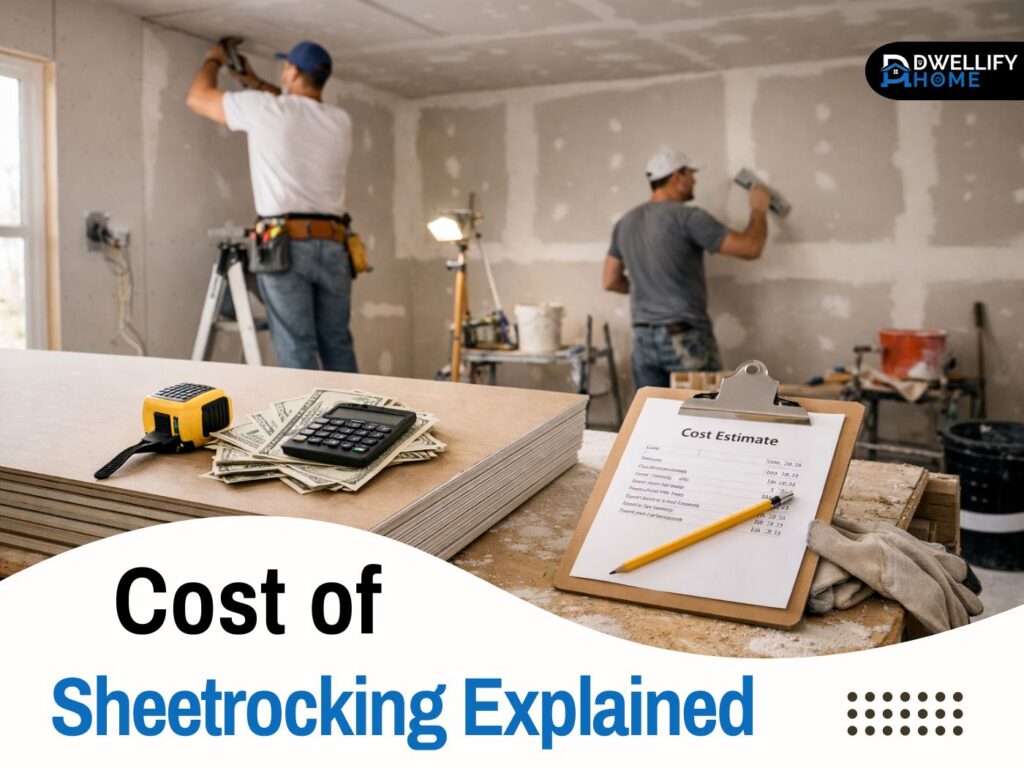
If you’re planning a remodel, finishing a basement, or building new walls, the cost of sheetrocking is probably on your mind. I’ve been installing and finishing drywall for over 15 years, and here’s the thing: drywall pricing looks simple on paper, but small details can swing the final number more than most homeowners expect.
In this guide, I’ll walk you through real-world pricing the same way I do during an in-person consultation. You’ll learn what sheetrocking actually includes, how contractors estimate costs, and how to avoid surprises when the invoice shows up.
Snippet-Ready Definition:
The cost of sheetrocking refers to the total price of installing and finishing drywall, including materials, labor, and finishing work. Costs vary by square footage, finish level, drywall type, and job complexity.
Mission Statement:
At Dwellify Home, our mission is to help homeowners understand real construction costs through clear, honest, experience-based guidance, so they can plan smarter, budget confidently, and avoid costly surprises.
Cost of sheetrocking per square foot (installed)
Most homeowners want a quick number, so let’s start there. The cost of sheetrocking per square foot usually falls between $1.50 and $3.50 installed. That range includes materials, labor, and standard finishing for most residential projects.
Here’s what matters. Lower-end pricing often assumes simple layouts, standard drywall, and a basic finish. Once ceilings get taller, rooms get tighter, or special drywall is needed, costs move up fast. I’ve seen jobs that looked cheap online double in price once real conditions were measured.
Installed pricing typically includes hanging drywall, taping joints, applying joint compound, and sanding. What it usually does not include are demolition, insulation upgrades, major repairs behind walls, or paint. Those items are often priced separately, so always ask what’s included.
Quick Cost Guide Table (Comparison Style)
| Project Type | Typical Cost Range |
| Cost of sheetrocking per square foot | $1.50 – $3.50 |
| 500 sq ft room | $1,100 – $2,800 |
| 1,000 sq ft of drywall | $1,500 – $3,500 |
| 1,500 sq ft house | $6,000 – $15,000 |
| Labor cost to hang & finish drywall | $1.50 – $3.00 per sq ft |
| Drywall sheets (materials only) | $0.24 – $0.70 per sq ft |
Tip from experience: If a quote is far below this range, ask what’s excluded. It’s often finishing, prep, or disposal.
Simple Step-by-Step: How Contractors Estimate Sheetrocking Cost
- Measure wall and ceiling surface area (not floor size).
- Convert square footage into drywall sheets with waste allowance.
- Choose drywall type and thickness.
- Select finish level (Level 4 vs Level 5 matters).
- Apply local labor rates and add extras like ceilings or demolition.
Cost breakdown (materials vs labor vs finishing)
When homeowners see a drywall quote, they often focus on sheet prices. Guess what? The sheets are usually the cheapest part of the job.
Materials cost
Standard drywall sheets generally cost between $0.24 and $0.70 per square foot. That includes the boards themselves, plus screws, joint tape, corner bead, and compound. Specialty boards like moisture resistant or fire rated drywall push that number higher.
Labor cost
Labor is where most of the money goes. Hanging drywall is fairly quick for a skilled crew. Finishing is not. Taping, mudding, sanding, and dust control take time and skill. Labor alone often runs $1.50 to $3.00 per square foot, depending on the finish level and job complexity.
Finishing cost
Finishing is where corners get cut on cheap jobs. A rushed finish leads to visible seams, cracks, and uneven walls. A proper finish adds about $0.35 to $1.50 per square foot, depending on how smooth the walls need to be.
Real price examples (so you can compare quotes fast)
Let’s put real numbers to common questions I hear every week.
How much does 1,000 sq ft of drywall cost?
For about 1,000 square feet of drywall surface, most homeowners pay between $1,500 and $3,500 installed. That range covers basic hanging and finishing using standard drywall.
If ceilings are tall or walls need a higher finish level, expect the upper end of that range. Always confirm whether the square footage refers to wall surface or floor area, because that’s a common source of confusion.
How much would it cost to drywall a 1500 sq ft house?
This is one of the most searched questions, and it trips people up. A 1,500 sq ft house usually has closer to 4,000 to 5,500 square feet of drywall surface once walls and ceilings are counted.
In most areas, drywalling a 1,500 sq ft house costs between $6,000 and $15,000 depending on layout, ceiling height, and finish level. Homes with open layouts and vaulted ceilings land on the higher side.
Small room example (around 500 sq ft)
A single room with roughly 500 square feet of drywall surface often costs $1,100 to $2,800. Small jobs feel expensive because contractors still have setup time, material delivery, and minimum labor costs.
Sheetrocking cost calculator (DIY estimate in minutes)
If you want a ballpark estimate before calling contractors, here’s how we calculate it on-site.
Step 1: Measure properly
Measure wall length times height, then add ceiling area. Don’t use floor square footage alone. Subtract large windows and doors only if you want a tighter estimate.
Step 2: Convert square footage to sheets
Drywall comes in 4×8, 4×10, and 4×12 sheets. Divide total square footage by the sheet size and add 10 percent for waste. Complex layouts may need closer to 15 percent.
Step 3: Add labor, finish level, and extras
Multiply square footage by local labor rates. Add extra costs for moisture resistant drywall, fire rated boards, ceilings, insulation, or demolition. This approach mirrors most drywall installation cost calculators and gives realistic results.
Price to hang and finish drywall (per sheet vs per sq ft)
Some contractors price per sheet, others per square foot. Both methods work if the scope is clear.
Per sheet pricing is common on new construction where layouts are simple. Per square foot pricing is more common for remodels and repairs. Small jobs often include a minimum charge, which explains why a single room can feel pricey.
Labor cost to hang and finish drywall
Labor is influenced by finish level more than anything else.
Drywall finish levels
Most homes use a Level 4 finish, which is smooth enough for standard paint. Level 5 is ultra smooth and usually reserved for glossy finishes or strong lighting. Level 5 costs more because it takes more time and skill.
Smooth walls vs texture
Textured walls hide imperfections and cost less to finish. Smooth walls look cleaner but require more sanding and inspection. If budget matters, this choice alone can save or add thousands on a full house.
Drywall type and thickness
Not all drywall is the same, and choosing the wrong type can cause problems later.
Drywall type
Standard drywall is fine for most living spaces. Green board or mold resistant drywall is used in bathrooms and laundry rooms. Fire rated drywall is required in garages and between certain living spaces. Soundproof drywall costs more and is usually overkill unless noise is a real issue.
Thickness
Half-inch drywall is standard for walls. Five-eighths inch is heavier, more fire resistant, and often required on ceilings or shared walls. Thicker boards cost more and take longer to install.
Key factors that influence sheetrocking cost
Here’s the part homeowners rarely consider until it’s too late.
Ceiling height matters. Eight-foot ceilings are faster to work with than ten or twelve-foot ceilings. Vaulted ceilings and stairwells slow crews down and raise costs.
Layout complexity also matters. More corners, soffits, and cutouts mean more labor. New installs are cheaper than replacements because demolition and surprises behind walls add time.
Location plays a role too. Labor rates are higher in major cities. Rushed timelines also cost more because crews may need overtime or extra help.
Room-by-room cost notes
Bathrooms and laundry rooms usually cost more due to moisture resistant boards and tighter spaces. Garages often require fire rated drywall by code.
Basements and ceilings are labor heavy. Ceilings cost more because working overhead is slower and harder on the crew.
Replacement and remodel scenarios
Replacing plaster with drywall costs more than new installs. Prep work, leveling, and potential testing add time. Replacing wood paneling usually requires wall repairs before drywall goes up.
Overlaying drywall on existing surfaces can save money, but it’s not always the right choice. It depends on wall condition and room dimensions.
Hidden costs and add-ons
This is where budgets often break.
Demolition, hauling, and disposal are rarely included unless specified. Insulation upgrades make sense while walls are open but add cost. Repairs behind drywall like mold or framing issues can’t always be predicted upfront.
Painting and trim reinstall are usually separate trades. Always ask if they’re included or excluded.
Permits, code, and safety
Permits may be required when adding new walls or converting spaces. Older homes sometimes need testing before drywall work begins. A good contractor will flag these early instead of surprising you later.
DIY vs hiring a pro
DIY drywall looks cheaper until tools, rentals, and wasted material add up. Panel lifts, sanding equipment, and dust control aren’t cheap.
Small patches are reasonable DIY projects. Full rooms, ceilings, and whole houses are where pros save time and deliver better results. Poor finishing is hard to fix and often costs more later.
How to get accurate quotes
Ask for detailed scopes. Finish level, drywall thickness, ceiling work, disposal, and dust control should be written clearly.
Ask who does the finishing and how many coats of compound are included. Watch for vague pricing or missing details. Those are red flags.
Ways to save money without lowering quality
Bundle rooms into one project instead of multiple visits. Prep the space by clearing furniture. Choose higher finish levels only where lighting demands it.
Use specialty drywall only where required. Overbuying premium boards wastes money.
FAQs
How much does it cost to sheetrock a 2000 square foot home?
A 2,000 sq ft home usually has 6,000–7,000 sq ft of drywall surface. Most projects fall between $9,000 and $20,000, depending on layout, ceiling height, and finish level.
What’s the average labor cost to hang drywall?
Labor typically costs $1.50 to $3.00 per square foot. Finishing work often takes longer than hanging and accounts for most of the labor cost.
How do you quote drywall labor?
Contractors measure wall and ceiling area, determine finish level, assess complexity, and apply local labor rates. Small jobs often include minimum charges due to setup time.
What is the difference between sheetrock and drywall?
Drywall is the general term. Sheetrock is a brand name commonly used to describe drywall. They function the same in construction.
Why do drywall quotes vary so much?
Differences come from ceiling height, finish level, drywall type, room layout, and whether demolition or repairs are included.
Conclusion
Understanding the cost of sheetrocking helps you budget with confidence. Prices aren’t just about square footage. Labor, finish level, ceiling height, and job complexity matter just as much.
If you measure correctly, understand what’s included, and ask the right questions, you’ll avoid surprises and get walls that look good for decades. That’s how I guide homeowners every day, and it’s how you should approach your project too.
Disclaimer:
Cost estimates shared in this article are based on industry averages and professional experience. Actual sheetrocking costs vary by location, job conditions, and contractor pricing. Always obtain local quotes before making financial decisions.

I’m Bilal, the founder of Dwellify Home. With 6 years of practical experience in home remodeling, interior design, and décor consulting, I help people transform their spaces with simple, effective, and affordable ideas. I specialize in offering real-world tips, step-by-step guides, and product recommendations that make home improvement easier and more enjoyable. My mission is to empower homeowners and renters to create functional, beautiful spaces—one thoughtful update at a time.