If you’ve ever stood in a yard and thought, “I need something tall, evergreen, and not wide,” you’re exactly where Skyrocket juniper shines. It’s one of those plants that gives you a strong vertical look without eating up your whole bed. And when it’s planted in the right spot, it can look sharp for years with very little fuss.
Most disappointment with upright junipers comes from two simple issues: planting them where the soil stays wet, or expecting instant privacy without giving them enough space and time. In this guide, I’ll walk you through what I’ve learned after planting and maintaining these in home gardens, new builds, and tight side yards. You’ll know what to expect for size, how fast they grow, how to plant them for a clean screen, and how to fix the common problems before they turn into a headache.
Snippet-Ready Definition:
Juniper Skyrocket conifers are tall, narrow evergreen trees with blue-green foliage, commonly used for privacy screens and accents. They thrive in full sun, need well-drained soil, and stay slim even at maturity.
Mission Statement:
At Dwellify Home, our mission is to provide clear, experience-based home and garden guidance that helps homeowners make confident decisions, avoid costly mistakes, and create spaces that truly work long-term.
Skyrocket Juniper at a glance: quick facts homeowners actually need
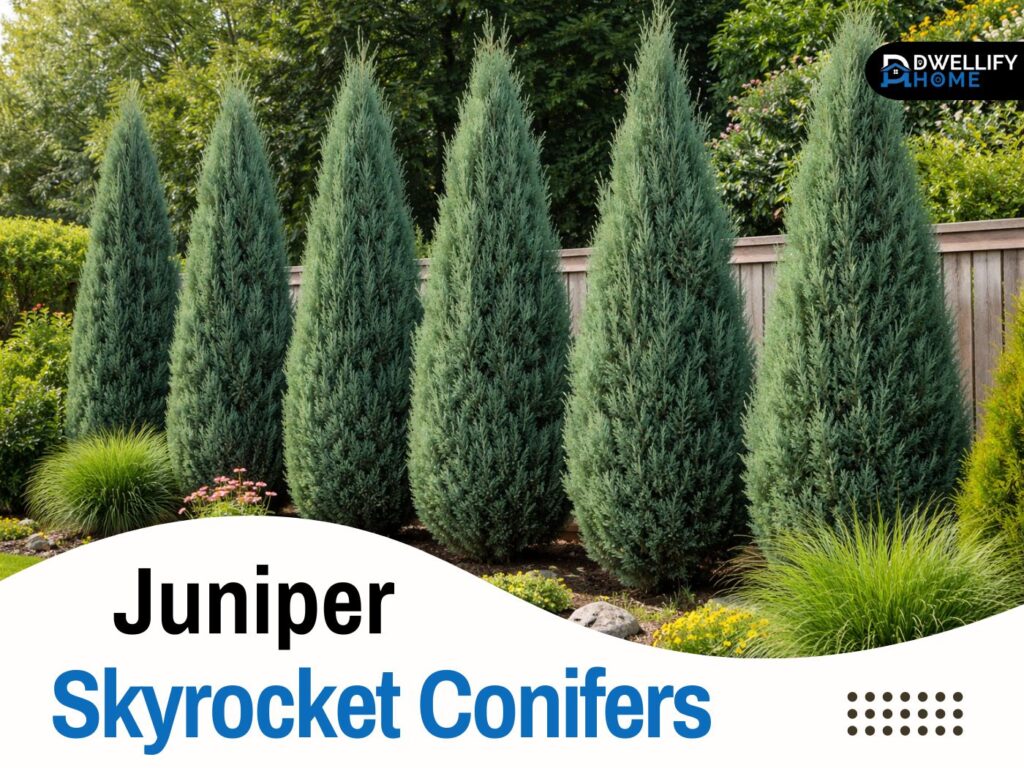
Skyrocket juniper is famous for one main reason: it stays extremely narrow compared to most evergreens. In many landscapes, it ends up around 15 to 25 feet tall over time, while often staying just a few feet wide. That tall, slender profile is why people love it for narrow beds, corners of the house, and privacy along fences where you can’t spare much depth.
You’ll also notice the foliage color. A healthy plant has that silvery blue-green look that reads “clean” from the street. It’s an evergreen conifer, so you get structure and color all year. And yes, those small blue berry-like cones can show up, which birds often appreciate.
If you’re scanning for the basics, remember these “success signals”:
- Full sun keeps it dense and upright
- Well-drained soil prevents most long-term decline
- Light pruning is fine, heavy shearing is not
- It’s drought tolerant once established, but not drought proof in year one
Quick Guide Table: Juniper Skyrocket Conifers at a Glance
| Feature | Details |
| Common Name | Skyrocket Juniper |
| Botanical Name | Juniperus scopulorum ‘Skyrocket’ |
| Mature Height | 15–25 feet (sometimes taller in ideal conditions) |
| Mature Width | 2–4 feet |
| Growth Rate | Moderate to fast (about 10–12 inches per year) |
| Sun Requirement | Full sun |
| Soil Preference | Well-drained soil |
| Water Needs | Low once established |
| Best Uses | Privacy screens, narrow spaces, vertical accents |
| Maintenance Level | Low |
Simple Step-by-Step: Is Skyrocket Juniper Right for You?
- Need height but not width?
Skyrocket is perfect for narrow beds and tight spaces. - Do you have full sun (6+ hours)?
If yes, great. If mostly shade, look for another option. - Does your soil drain well?
This is non-negotiable. Wet soil causes most problems. - Want low maintenance, not zero maintenance?
Occasional watering, light pruning, and inspection are needed. - Okay with waiting 2–3 years for a full screen?
It’s fast for a conifer, but not instant.
What Skyrocket Juniper is and why it grows like a blue column
Skyrocket is a cultivated form of Rocky Mountain juniper. In plain English, it’s been selected because it naturally grows like a narrow column. That’s why it holds that “rocket” shape without you having to constantly trim it into a cone.
In real yards, I usually describe it as a living architectural element. You can use it like a vertical line in a design, the same way you’d use a tall lamp in a room. The best part is, it does this without the aggressive root behavior people worry about with some big trees. It’s not a plant that’s out to crack your foundation. The bigger risk is the opposite: putting it in a wet pocket where the roots never get enough oxygen.
One quick note from experience. Skyrocket’s tight form also means airflow inside the plant matters. In humid areas or in crowded plantings, it can be more prone to blights and dieback. That doesn’t mean you should avoid it, it just means spacing and siting are not optional.
Juniper skyrocket conifers size: height and width you can expect
When people search juniper skyrocket conifers size, they usually want two things: the real mature height, and whether it will stay skinny. In most residential landscapes, you’ll commonly see it in the 15 to 25 foot range, sometimes taller in ideal conditions. The width is typically narrow, often around 2 to 4 feet, though a stressed plant can look wider if branches splay from snow, wind, or poor structure.
Now, here’s the thing I tell homeowners during consults. Don’t judge this plant by the 1 gallon or 3 gallon pot at the nursery. A small plant may look like it will always stay “cute and thin,” but it’s going to develop a stronger trunk and fuller vertical mass over time. That’s good, as long as you plan for it.
Skyrocket juniper height and width: realistic ranges, not hype
If you’re looking for skyrocket juniper height and width expectations, think of it like this. It’s tall and narrow by nature, but it still needs breathing room. I’ve seen people jam these into a 12-inch strip next to a driveway, then wonder why the foliage browns on one side. Tight spaces can work, but you need sun and airflow.
A practical way to plan is to picture the plant as a narrow column that still wants a couple feet of clearance from walls, fences, and large shrubs. That buffer keeps the foliage dry and reduces disease pressure.
Spacing guide: single accent vs privacy screen row
Spacing is where good results separate from so-so results.
For a single accent plant, give it room to show off. You’ll get the best shape when it can hold foliage from top to bottom without being shaded by other plants.
For a screen or hedge effect, don’t plant them shoulder-to-shoulder. People often do that because they want instant privacy, but it usually backfires. Crowding traps moisture and invites tip dieback.
A simple spacing approach that works well in real yards:
- For a tight screen look, many homeowners choose roughly 3 feet apart
- For healthier airflow and long-term fullness, 4 to 5 feet apart is often smoother
- If your area is humid or you’ve had juniper disease before, lean wider
That spacing keeps them narrow, reduces problems, and still creates a strong vertical wall over time.
Skyrocket juniper growth rate: timeline from year 1 to year 10 plus
Skyrocket juniper growth rate is often described as fast for a conifer, but the truth depends on your site. In good sun with decent drainage, it can put on around a foot of growth per year. In heavy clay that stays damp, it can stall, thin out, or slowly decline.
Year one is usually about root establishment, not height. That’s the part many people don’t expect. A plant can look like it’s barely doing anything up top while it’s building roots below. Then in years two and three, you often see more noticeable upward growth and better density.
If you want a real-world example, I’ve planted these in two different front yards on the same street. One had sandy loam, full sun, and a slight slope. Those plants looked like they “took off” in the second season. The other yard had clay with a low spot that held water. Same watering schedule, same plant size, totally different results. That’s why I put drainage above almost everything else.
Best growing conditions: the success formula most people miss
If you want Skyrocket to stay upright, dense, and attractive, focus on two basics: sun and drainage. Everything else, fertilizing, pruning, even watering frequency, becomes easier when those two are right.
Sunlight and placement: why full sun matters
Full sun is the sweet spot. When these are grown in partial shade, you’ll often see thinner growth and more interior browning. They can still live, but they won’t look as crisp. If you’ve got a narrow side yard, check how many hours of direct sun it really gets. Morning sun plus afternoon shade can work better than deep shade all day.
A small tip from the field. Watch where your roofline casts winter shade. In winter, the sun angle is lower, and those shadows can stretch farther than you expect. If the plant is shaded most of the cold season, it may stay damp longer, which can contribute to disease problems.
Soil and drainage: the number one factor behind failures
Skyrocket juniper wants well-drained soil. That doesn’t mean it needs perfect soil, it means water can’t sit around the roots for long. If you dig a hole and it fills like a bathtub after irrigation or rain, that’s a red flag.
Quick ways to improve your odds:
- Plant on a slight mound if your soil is heavy
- Amend wide, not deep, so water doesn’t collect in a bowl
- Avoid low spots where downspouts dump water
Guess what. Many “mystery” skyrocket juniper problems are really drainage problems wearing a disguise.
Planting Skyrocket juniper the right way so it stays upright and healthy
Planting is where you set the plant up for the next 10 years. I like to keep it simple and consistent.
Start by placing the plant so the top of the root ball sits slightly above the surrounding grade. That helps prevent settling and keeps the trunk base from staying wet. Backfill with the native soil, and use compost lightly if your soil is extremely poor, but don’t turn the hole into a pot of rich mix. You want the roots to move out into the native soil.
Mulch is helpful, but keep it a few inches away from the trunk. Mulch piled against the trunk can hold moisture and invite bark issues. And if the plant is in a windy corridor, a temporary stake can help for the first season. Just don’t leave ties on too long, because the trunk needs to flex a bit to strengthen.
For screens, I always mark the line, step back, and look at it from the street before planting. It’s an easy moment to catch spacing mistakes before you dig ten holes.
Watering and feeding: low-maintenance, not no-maintenance
Once established, Skyrocket is often considered drought tolerant. That’s true, but only after the root system is built. In the first year, you want consistent moisture, not constant wetness. There’s a difference.
A simple watering rhythm that works for many homeowners:
- First 2 to 4 weeks after planting: water deeply a couple times per week, depending on heat and soil
- Remainder of first season: water deeply weekly, then adjust based on rainfall
- Year two: water during dry spells, especially in heat waves
- Year three and beyond: supplemental water only during extended drought
On top of that, avoid daily light sprinkling. It encourages shallow roots and can keep foliage damp, which is not your friend with junipers.
As for fertilizer, most established Skyrocket junipers don’t need heavy feeding. If your soil is poor or the plant looks pale and stalled, a light slow-release evergreen fertilizer in spring can help. More is not better here. Overfeeding can push soft growth that’s more prone to disease and winter damage.
Pruning, shaping, and seasonal upkeep: keep the rocket look
The best part about this plant is that it naturally keeps its form. That means your pruning job is mostly cleanup.
I recommend pruning only when you need to:
- Remove dead or damaged tips
- Correct a branch that’s rubbing or sticking out awkwardly
- Clean up light winter burn
Avoid shearing it like a hedge. Shearing creates a dense outer shell that shades the inside, and the interior can thin out. Instead, make small, selective cuts. If snow is heavy in your region, a simple winter trick is to loosely tie the plant with soft twine in late fall. Not tight, just enough to keep branches from splaying under wet snow. Remove it in spring.
Also, take a minute each year to check for mulch creeping up and soil settling around the trunk. Those small maintenance habits prevent big problems later.
Skyrocket juniper problems: diagnose fast, fix smart
Let’s talk about the thing everyone worries about: skyrocket juniper problems. The key is not to panic when you see a little browning. Some interior browning is normal as older foliage sheds. What matters is the pattern and the speed.
Browning tips, thinning, and dieback: common causes checklist
When a homeowner shows me browning, I ask a few quick questions:
- Is the browning on the inside only, or on the outer tips?
- Did it start after a wet period, heat wave, or winter wind?
- Is one side worse, like the shaded side near a wall?
Common causes I see in real landscapes:
- Poor drainage, leading to root stress and gradual thinning
- Underwatering during the first year, especially in hot, windy sites
- Winter burn from drying winds and frozen ground
- Crowding, leading to damp foliage and disease pressure
Start with the basics. Check the soil moisture a few inches down. If it’s soggy days after rain, you’ve found a likely culprit.
Fungal issues and rust: when climate and nearby hosts matter
Junipers can get twig blights and rust diseases, especially where humidity is high or airflow is poor. You might notice tips turning brown and dying back, sometimes in patches. Rust issues are more common when certain host plants are nearby, like apples or crabapples, depending on the specific rust.
Here’s the practical approach I use:
- Prune out affected tips during dry weather
- Improve airflow by correcting crowding
- Avoid overhead watering
- Keep the plant vigorous, but don’t overfertilize
If a problem repeats year after year, that’s when it can be worth talking to a local extension office or a trusted nursery for diagnosis. Treating the wrong issue wastes time and money.
Root rot and wet feet: how to confirm and what to do
Root rot is the slow, frustrating one. The plant may look dull, thin, and progressively worse. You water it, it doesn’t improve. In many cases, the soil is staying too wet.
Signs I’ve seen:
- Consistent decline despite normal watering
- Browning and dieback that doesn’t match a weather event
- Soil that smells sour or stays wet long after rain
Solutions depend on severity. Sometimes you can improve drainage, redirect downspouts, or raise the grade around the plant. Other times, the best solution is to replace it and plant on a mound or choose a species better suited to that site.
Pests: what to watch for, without going paranoid
Junipers can attract pests like spider mites, scale, or bagworms in some regions. Most homeowners don’t need a chemical approach right away. Start with observation.
A simple routine:
- Check foliage for webbing, sticky residue, or chewing
- Hose off dust and mild infestations with a strong spray
- If you’re seeing heavy damage, take a sample to a local nursery for ID
Healthy plants handle pests better, so sun, spacing, and proper watering are still your first line of defense.
Landscape uses that look high-end, not random
This plant is a design tool. Use it like one.
My favorite uses:
- Flanking an entryway to create a formal look
- Vertical accents in a mixed bed to break up horizontal lines
- A narrow privacy screen along a fence line
- Corner plantings where you want height without shade from a big tree
If you like the Italian cypress look but need something hardier for cold winters, Skyrocket can give a similar vibe in the right setting. Just keep it in full sun and give it a dry-root zone, and it looks intentional, not awkward.
Companion plants that pair well: simple combos that work
Skyrocket looks best when it’s not surrounded by thirsty, shade-loving plants. Pair it with sun-loving companions that like similar watering habits.
A clean approach I use often is layering:
- Low groundcover or gravel mulch at the base to keep weeds down
- A band of drought-tolerant perennials or ornamental grasses in front
- A few flowering shrubs placed far enough away to keep airflow
Plants like catmint, Russian sage, and other sun lovers can complement the blue tone nicely. The main rule is to avoid crowding the trunk and to keep moisture from being trapped around the base.
Buying guide: juniper skyrocket conifers for sale
When people search skyrocket juniper for sale, they’re usually trying to decide if they should buy online or from a local nursery, and what size is worth the money. I’m a fan of buying locally when you can, because you can inspect the plant and it’s often grown closer to your climate. But good online sources can be fine if they ship carefully and at the right season.
How to choose a healthy plant: fast quality checks
Before you buy, do a quick check:
- Look for a straight central leader and a naturally narrow shape
- Avoid plants with lots of brown tips or obvious thinning
- Check the pot. If roots are circling heavily, it may be stressed
- Look for insects or webbing in the inner foliage
Also, don’t be fooled by a plant that looks “sprayed” or artificially perfect. A healthy plant has consistent color and firmness, not a glossy coating.
What size to buy: instant impact vs best value
Bigger plants give faster visual impact, but smaller plants often establish easier and catch up quicker than you’d think. In many projects, I’ve seen a mid-size plant outperform an oversized one because it roots in faster and handles weather swings better.
If you need instant privacy, you can buy larger, just be prepared to water properly in the first season. If you’re patient, smaller plants often give you the best long-term return.
Dwarf and smaller options: if Skyrocket is too tall
People also search dwarf juniper skyrocket conifers, and I get why. Not every yard can handle a 15 to 25 foot vertical element.
Here’s the honest answer: Skyrocket itself isn’t truly dwarf. What most shoppers mean is either a smaller columnar juniper alternative, or a compact juniper with a similar blue tone.
If your space is tight, ask your nursery for:
- Compact columnar junipers that stay shorter
- Dwarf blue junipers for foundation areas
- Options that match your climate and disease pressure
A local nursery can point you to cultivars that perform better in your exact region, which matters more than the label on the internet.
FAQs
How tall do skyrocket juniper trees get?
Most skyrocket junipers grow 15–25 feet tall, depending on soil, sun, and climate. In ideal conditions, some may grow slightly taller over many years.
What are the downsides of junipers?
The main downsides are:
- Poor tolerance for wet or soggy soil
- Can develop browning or disease in humid, crowded areas
- Not ideal for shady locations
Most issues come from site selection, not the plant itself.
Does juniper come back every year?
Yes. Skyrocket juniper is an evergreen perennial, meaning it stays green year-round and continues growing each year without replanting.
Are skyrocket juniper roots invasive?
No. Skyrocket juniper roots are not invasive. They grow relatively close to the surface but don’t aggressively spread or damage foundations when planted correctly.
How far apart should I plant skyrocket junipers for privacy?
For a healthy screen, spacing them 3–5 feet apart works well. Closer spacing gives faster privacy but requires good airflow and sun.
Conclusion: the best way to get a perfect Skyrocket, long-term
If you want a tall, narrow evergreen that brings structure to your landscape without taking up much space, Skyrocket juniper is a solid choice. I’ve used it in tight side yards, front entry designs, and fence-line screens, and when it’s happy, it stays clean-looking with minimal work.
But remember the two rules that save people the most frustration. Give it full sun, and keep its roots out of wet soil. Do that, and you’ll avoid most of the common browning and dieback issues people blame on the plant. Space it well if you’re making a screen, water it thoughtfully in the first year, and keep pruning light and selective.
If you follow those steps, you won’t just have an evergreen. You’ll have a long-lasting vertical accent that makes the whole yard look more intentional, season after season.
Disclaimer:
This article is for informational purposes only and is based on professional horticultural experience and general growing conditions. Always consult a local nursery or extension service for advice specific to your climate and soil.

I’m Bilal, the founder of Dwellify Home. With 6 years of practical experience in home remodeling, interior design, and décor consulting, I help people transform their spaces with simple, effective, and affordable ideas. I specialize in offering real-world tips, step-by-step guides, and product recommendations that make home improvement easier and more enjoyable. My mission is to empower homeowners and renters to create functional, beautiful spaces—one thoughtful update at a time.