
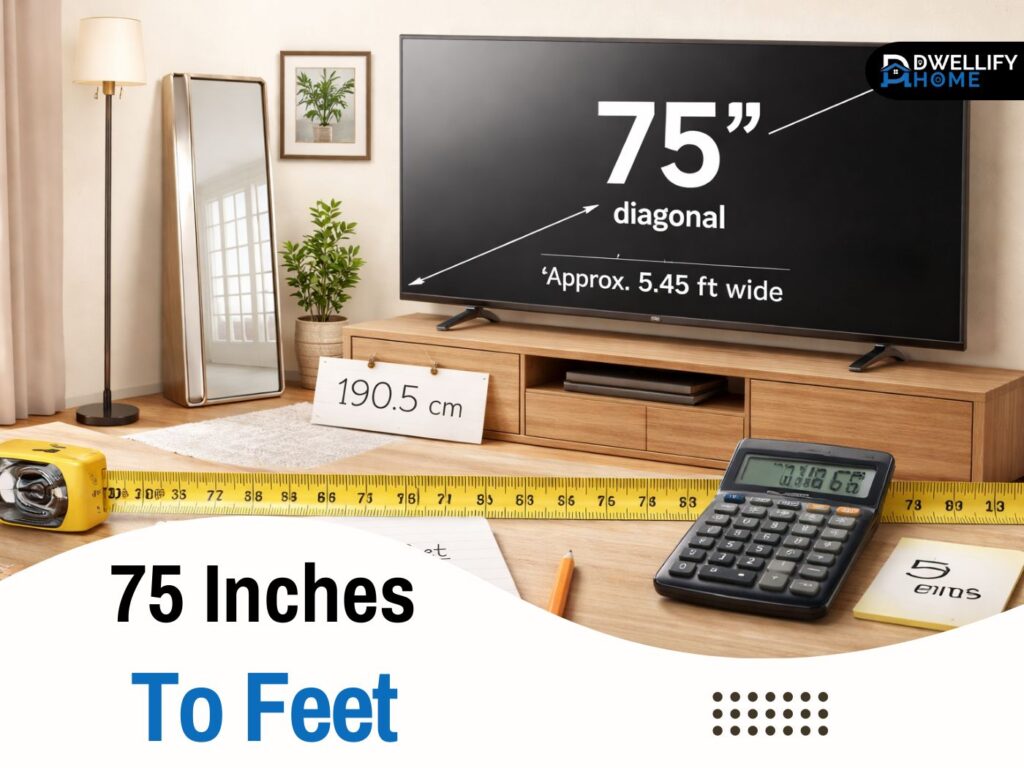
Getting measurements right sounds simple until you’re staring at a tape measure and your brain goes, “Wait, how many feet is that again?” I’ve been there, especially when you’re planning something at home, like a wall shelf, a mirror, a doorway clearance, or even picking the right TV size.
In this guide, we’ll break down 75 inches to feet in a clear, practical way. You’ll also see what that number looks like in real life, how it compares in centimeters and meters, and where people commonly get tripped up.
Snippet-ready definition:
75 inches equals 6.25 feet, or 6 feet 3 inches. To convert inches to feet, divide by 12. This helps with height, furniture sizing, room planning, and TV dimension checks.
Mission Statement:
At Dwellify Home, our goal is to explain everyday measurements in plain English, so you can plan rooms, choose furniture, and understand product sizes with confidence.
75 Inches to Feet (Quick Answer)
Let’s get straight to it.
75 inches = 6.25 feet
If you prefer feet and inches (which is often easier for visualizing), it’s also:
75 inches = 6 feet 3 inches
That decimal, 6.25 feet, is perfect for room plans, building layouts, and anything where measurements are written in feet. The 6 feet 3 inches version is usually easier for height and everyday comparisons.
Quick Guide Table
| Measurement | Result |
| 75 inches to feet | 6.25 ft |
| 75 inches in feet and inches | 6 ft 3 in |
| 75 inches in cm | 190.5 cm |
| 75 inches in meters | 1.905 m |
| 75 cm in feet (comparison) | about 2.46 ft (approx.) |
Note: The 75 cm value is an approximation because cm-to-feet often gets rounded in quick guides.
Step-by-step conversion (simple)
- Remember: 12 inches = 1 foot
- Divide: 75 ÷ 12 = 6.25
- Convert decimal to inches: 0.25 × 12 = 3 inches
- Final: 6.25 ft = 6 ft 3 in
How to Convert Inches to Feet (Simple Formula)
Here’s the thing: you don’t need fancy tools to do this. You just need one basic rule.
The easy rule
1 foot = 12 inches
So the conversion is:
Feet = Inches ÷ 12
That’s it. Once you remember 12, the rest becomes routine.
Step-by-step conversion for 75 inches
Now let’s convert 75 inches using simple math:
- Start with 75
- Divide by 12
- 12 goes into 75 six times (because 12 × 6 = 72)
- You have 3 inches left over
- The remaining 3 inches is 3 ÷ 12 = 0.25 feet
So the final result is:
- 6 + 0.25 = 6.25 feet
- Or in feet and inches: 6 feet 3 inches
Quick tip from real measuring work: when you see a leftover number, keep it as inches if you’re measuring furniture or a person. Use the decimal only when you’re working with plans or spreadsheets.
75 Inches to Feet Height (How Tall Is That in Real Life?)
If you’re talking about height, 75 inches in height is 6 feet 3 inches. That’s tall, and it’s easy to picture if you compare it to common home features.
For example, many interior doors are around 80 inches tall. So 75 inches is just 5 inches shorter than a typical door height. If you’re measuring a standing mirror, a tall bookshelf, a floor lamp, or even a gym rack, that comparison helps immediately.
Here’s a practical way to visualize it at home: stand next to a door frame and imagine a point about a palm-width below the top. That’s roughly what 75 inches to feet height feels like in real life.
75 Inches in Height vs 75 Inches in Width (Don’t Mix These Up)
The conversion stays the same whether it’s height or width. The difference is what it means in your space.
- 75 inches in height means something tall, like a cabinet or a mirror.
- 75 inches to feet width means something wide, like a console table, a headboard, or a wall art layout.
Both still equal 6.25 feet. The only thing that changes is how you plan the room around it.
A simple planning habit I recommend: write the label next to your number. Instead of writing “75 inches,” write “75 inches wide” or “75 inches tall.” That one small detail prevents expensive mistakes.
75 Inches to Feet Width (When It’s a Straight Measurement)
When a product listing says something is 75 inches wide, it means straight across, not diagonal. So:
75 inches wide = 6.25 feet wide
This comes up a lot in home projects, especially with furniture. Think of:
- A large TV console
- A wide sideboard
- A three-seat bench
- A long floating shelf
- A rug width when you’re planning coverage under a sofa
Here’s a tape-measure tip that saves time: mark 6 feet first, then add 3 inches. It’s faster than trying to read 75 inches from scratch, and it reduces misreads.
75 Inches to Feet Width and Height (If You Have Both Dimensions)
Sometimes you’ll see measurements like width and height listed together, especially for wall decor, windows, cabinets, or large furniture. In that case, you convert each side separately.
Let’s say you have a piece that’s:
- Width: 75 inches
- Height: 40 inches
You’d do:
- 75 ÷ 12 = 6.25 feet (width)
- 40 ÷ 12 = 3.33 feet (height, which is about 3 feet 4 inches)
This is where decimals can be handy, especially when sketching layouts or using room-planning apps. But if you’re cutting material or placing anchors, feet-and-inches is usually safer because it matches how tape measures are read.
75 Inches in cm (Metric Conversion)
If you’re shopping internationally, reading product manuals, or comparing dimensions on imported furniture, metric numbers show up quickly. So let’s convert 75 inches in cm.
The rule is:
1 inch = 2.54 cm
So:
75 inches × 2.54 = 190.5 cm
That means:
75 inches in cm = 190.5 cm
A quick reality check: around 190 cm is close to the height of a tall adult. So if you see 190.5 cm listed for a height measurement, you’re looking at the same size as 75 inches.
75 Inches in Meters (Metric Conversion)
Now for 75 inches in meters. This is useful when you’re working with construction specs, large room measurements, or international design drawings.
The rule is:
1 inch = 0.0254 meters
So:
75 × 0.0254 = 1.905 meters
That means:
75 inches in meters = 1.905 m
If you like a simple mental shortcut, remember this: about 2 meters is roughly the height of a tall door or a tall wardrobe. So 1.905 m is slightly under that.
75 cm in Feet (Important Comparison)
Guess what? One of the most common mix-ups I see is confusing inches and centimeters because the numbers look similar.
75 cm is not the same as 75 inches. Not even close.
To give you a clear comparison, 75 cm in feet is about:
- 75 cm = 0.75 meters
- And 1 meter is about 3.28 feet
- So 0.75 × 3.28 ≈ 2.46 feet
That’s roughly 2 feet 5.5 inches, give or take a tiny rounding difference.
So here’s the takeaway:
- 75 inches = 6.25 feet
- 75 cm = about 2.46 feet
That difference matters a lot if you’re ordering a rug, a vanity, or a shelf online.
If You Mean a 75-Inch TV: It’s the Diagonal (Not the Width)
This is where many people get surprised. A 75 inches TV measurement is the diagonal of the screen, from one corner to the opposite corner. It is not the width.
On top of that, the actual size can vary slightly depending on bezel thickness and model design. Most modern TVs are close, but not identical.
So what does it mean in real room planning? It means a 75-inch TV will be wide, but not 75 inches wide.
Approximate 75-inch TV width and height in feet (16:9 screens)
Most TVs use a 16:9 aspect ratio. Using that, a typical 75-inch screen is approximately:
- Width: about 65.4 inches
- Height: about 36.8 inches
Converted:
- Width in feet: 65.4 ÷ 12 ≈ 5.45 feet
- Height in feet: 36.8 ÷ 12 ≈ 3.07 feet
So for quick room planning, you can think:
- Roughly 5.5 feet wide
- Roughly 3.1 feet tall
Practical setup tip from experience: give yourself a little breathing room on both sides. If your console is exactly the same width as the TV, it can look cramped. A few extra inches on each side often looks more balanced and makes cable routing easier.
Common Mistakes and Quick Accuracy Checks
Even simple conversions can go wrong when you’re in a hurry. Here are the mistakes I see most often, and how to avoid them.
Mistake 1: Dividing by 10 instead of 12
It sounds small, but it throws off the result. Always remember, feet are based on 12 inches, not 10.
Mistake 2: Rounding too aggressively
6.25 feet is not the same as 6.3 feet. That difference is around 0.05 feet, which equals 0.6 inches. In tight spaces, half an inch can matter.
Mistake 3: Mixing inches with centimeters
A listing might show cm, while you’re thinking in inches. If you see 190.5 cm, that matches 75 inches.
A quick accuracy check I use:
- 72 inches = 6 feet
- 75 inches is 3 inches more
- So it should be 6 feet 3 inches
If your answer doesn’t land near that, something went off.
Quick Reference (Nearby Conversions People Also Search)
Sometimes you just want to compare sizes without doing the math again. Here are a few close conversions that come up often in home measurements:
- 72 inches = 6 feet
- 74 inches = 6 feet 2 inches
- 76 inches = 6 feet 4 inches
- 80 inches = 6 feet 8 inches
These are handy when you’re comparing furniture widths, checking clearance, or sizing wall features.
FAQs About 75 Inches to Feet
1) What is 75 inches in height?
It’s 6 ft 3 in, which is also 6.25 ft. In metric, it’s 190.5 cm (1.905 m).
2) Is 72 inches 9 feet?
No. 72 inches is 6 feet, because 72 ÷ 12 = 6.
3) Is 72 inches 6 ft?
Yes, 72 inches = 6 ft exactly.
4) Is 70 inches 5 ft 10?
Yes. 5 ft 10 in equals (5 × 12) + 10 = 70 inches.
5) How do I convert inches to feet fast without a calculator?
Use the rule feet = inches ÷ 12. For quick mental math, find the nearest multiple of 12 (like 72 = 6 ft) and add the leftover inches.
Conclusion
Now you’ve got the full picture, not just a number. The clean conversion is simple: 75 inches equals 6.25 feet, and in everyday terms it’s 6 feet 3 inches. Once you lock in the “divide by 12” rule, you’ll stop second-guessing your measurements.
The best part is you can use this confidently across real home situations. Whether you’re planning a tall mirror, a wide console, a wall-mounted shelf, or figuring out a TV setup, you now know how to convert inches to feet and how to sanity-check the result.
If you want one final pro tip to remember: 72 inches is 6 feet, so anything close to 75 inches will always land just a few inches above 6 feet. That quick mental anchor makes measuring feel a lot less stressful.
Disclaimer:
Measurements in this guide are for general education. Always measure your actual space and check manufacturer specifications, especially for TVs, furniture, and building materials. If a project affects safety or structure, consult a qualified professional.