Bathroom vanity height sounds like a small detail, but it has a big impact on daily comfort. If the counter is too low, you end up bending your neck and back every morning. If it’s too high, your shoulders lift and your arms feel awkward, especially for kids or shorter adults.
Here’s the thing. A vanity is not just a cabinet. It’s a work surface you use multiple times a day. As a bathroom designer and ergonomic space planning expert, I treat vanity height like I treat stair height or kitchen counter height. It’s about long-term usability, not just looks.
This guide will help you choose a height that feels natural in real life. We’ll cover standard options, comfort height, accessibility guidance, vessel sinks, floating vanity height, depth, and the common mistakes that make a bathroom feel off.
Snippet-ready definition:
Bathroom vanity height is the finished distance from the floor to the top of the countertop. The right height improves posture and daily comfort, and it changes depending on sink style, user height, and accessibility needs.
Mission Statement:
Dwellify Home helps homeowners make smart, comfortable design choices through clear, experience-backed guides that focus on everyday usability, not just looks.
Quick Answer — What Is the Standard Bathroom Vanity Height?
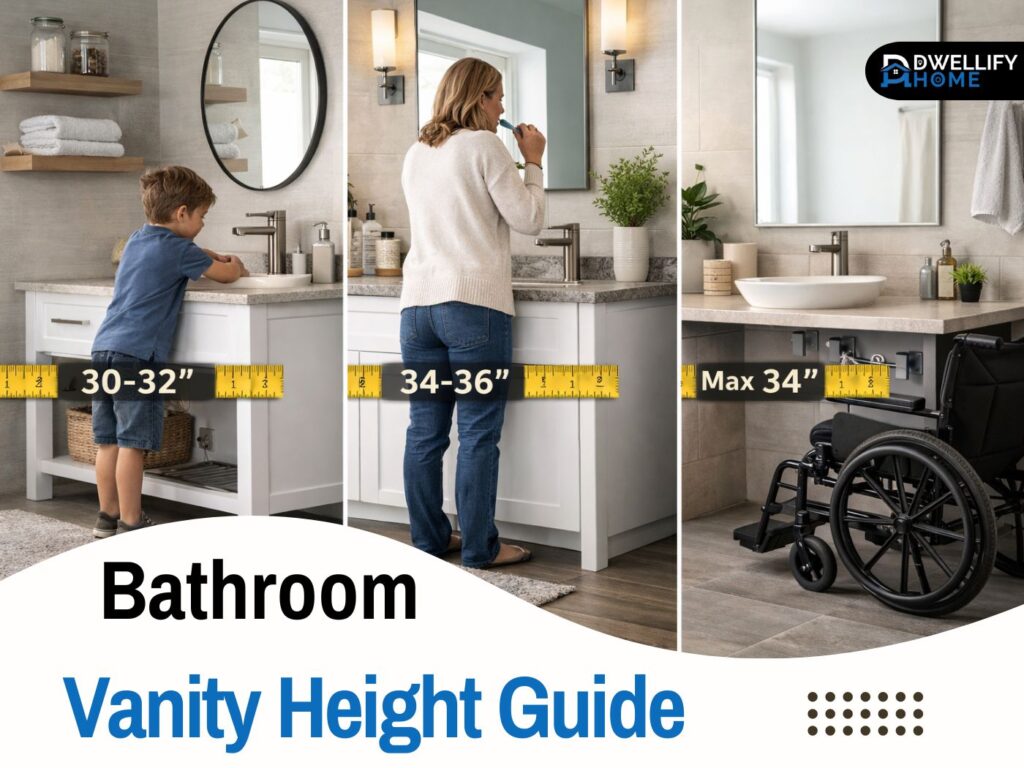
Most modern vanities fall within a range of about 30 to 36 inches from the finished floor to the top of the countertop. Older homes often sit closer to 30 to 32 inches, while many newer homes use 34 to 36 inches because it feels easier on the back.
The best part is that you don’t need a complicated formula to pick the right one. Start with who uses the bathroom most. Then adjust based on sink type and whether you want a more ergonomic comfort setup.
If you remember one thing, remember this. The number that matters most is the finished height, meaning the countertop height after flooring and countertop thickness are included. That is what your body experiences every day.
Quick Guide Table: Bathroom Vanity Height at a Glance
| Situation | Recommended finished height (floor to countertop) | Notes |
| Traditional setup | 30–34 in (about 76–86 cm) | Common in older homes, often easier for kids and shorter users |
| Comfort height vanity | 34–36 in (about 86–91 cm) | Feels more ergonomic for many adults, reduces bending |
| Accessibility focused | Up to about 34 in (about 86 cm) | Often paired with knee clearance and reachable controls |
| Vessel sink setup | Aim for total around 35–36 in | Use a lower cabinet because the bowl adds height on top |
| Floating vanity height | Usually set so top lands 32–36 in | Adjust for user height, sink style, and plumbing location |
Quick measuring steps (simple and practical)
- Measure from the finished floor to the countertop surface, not the cabinet only.
- Add countertop thickness to your cabinet height.
- If using a vessel sink, add the bowl height too, then adjust the cabinet down if needed.
Standard Bathroom Vanity Height Ranges And Who Each One Fits Best
There are three practical height categories that cover almost every home. Once you know what they’re for, choosing becomes much easier.
A traditional range around 30 to 32 inches often works well in kids’ bathrooms, smaller guest baths, or homes where people prefer a lower counter. A comfort range around 34 to 36 inches is typically better for most adults and master bathrooms. An accessibility-focused setup often aims to stay at or under about 34 inches, depending on the needs of the user and local requirements.
If your bathroom is shared, you don’t have to pick a side and hope for the best. There are smart compromises, and I’ll show you a few options that keep the space comfortable for everyone.
Comfort Height vs Traditional Height (Simple Pros and Cons)
Traditional height feels familiar and can be easier for children and shorter adults. It also pairs well with vessel sinks because the total height can climb quickly when the bowl sits on top.
Comfort height reduces bending. It tends to feel more like a kitchen counter, which many adults find natural for grooming tasks. On top of that, comfort height can make a bathroom feel more modern, especially in a primary suite.
Comfort Height (34 to 36 Inches): Why It Became the New Favorite
Comfort height is popular for a simple reason. It reduces the everyday forward bend that causes back and neck strain. When I design a master bath, this is usually the first height range I test, especially if the main users are average height or tall.
Imagine brushing your teeth at a low counter twice a day for ten years. You probably won’t notice it in week one. You’ll notice it after months of mornings. Comfort height gives your spine a break without changing how the bathroom looks in a dramatic way.
A practical tip I use in real projects is a quick elbow check. Stand straight, relax your shoulders, and bend your elbows as if you’re washing your hands. The countertop should sit in a place where your arms feel natural and your shoulders stay relaxed. If your shoulders creep up, the height is likely too high for you.
When 36 inches is ideal:
- Taller adults who hate leaning forward
- Master bathrooms where adults are the main users
- Homes aiming for a more modern feel
When comfort height can feel too tall:
- Young children using the sink daily
- Shorter adults who prefer a lower reach
- Setups with vessel sinks unless the cabinet is lower
Traditional Height (30 to 32 Inches): When It’s Still the Best Choice
Traditional height is not outdated. It’s still the right move in plenty of homes. I often recommend it for children’s bathrooms, small guest baths, and older homes where plumbing rough-ins are already placed for a lower cabinet.
It also solves one common problem. If you’re using a vessel sink, the bowl sits above the counter and adds height fast. A standard cabinet paired with a vessel sink can feel surprisingly tall. A traditional cabinet height can keep the finished height comfortable.
Another situation where traditional height works well is for households with shorter primary users. A vanity should support the people who live in the home, not an imaginary average person.
ADA and Accessibility Vanity Height Guidelines (What to Follow)
Accessibility design is about dignity and ease, not just rules. If someone uses a wheelchair, or has limited balance or mobility, the right vanity height can turn daily routines from frustrating to smooth.
A common target is keeping the counter or sink rim height at or under about 34 inches for accessibility-friendly planning. The exact requirement can vary by project type and local standards, but the principle is consistent. The user needs comfortable reach, and the space under the sink may need to allow knee clearance.
Here’s a practical way to approach it. Think about the whole station:
- Height of the counter or sink rim
- Space underneath for knees and toes if needed
- Faucet controls that are easy to operate
- Mirror placement that works for seated and standing users
A tip from real remodels. If you are planning for accessibility, avoid deep cabinets that push the user too far from the faucet. This is where bathroom vanity depth and reach become just as important as height.
Vanity Height With Countertop — What You Should Measure (Cabinet vs Finished Height)
This is where many homeowners get tripped up. The cabinet height is not the same as the final working height. The final number includes the cabinet, the countertop thickness, and the sink style.
Here’s the thing. Two vanities can look the same in a showroom but feel different at home because the countertop and sink choices change the finished height. A thicker stone top can add noticeable height. A vessel sink can add even more.
To measure bathroom vanity height with countertop correctly:
- Measure from the finished floor to the top surface of the counter
- Include tile or flooring that will be installed
- Include the countertop thickness
- Include the sink style, especially if the rim sits above the counter
A quick real-world example. If a cabinet is 34 inches and the countertop adds 1 inch, your finished height is already 35 inches before the sink style even enters the picture. That is why planning matters.
Vessel Sink Vanity Height (How to Avoid a Too Tall Setup)
Vessel sinks look great, but they demand careful planning. Because the bowl sits on top, the finished height can creep into an uncomfortable range quickly. I’ve walked into newly finished bathrooms where the counter felt fine on paper, but the vessel sink made handwashing feel like doing shoulder shrugs.
The easiest fix is to choose a lower cabinet when using a vessel sink. Many designers aim for a lower cabinet height so the total finished height stays within a comfortable zone.
A simple approach that works:
- Decide the comfortable finished height first
- Subtract the vessel sink height and countertop thickness
- That result guides the cabinet height choice
Don’t forget the faucet. Vessel setups often require taller faucets or wall-mounted faucets. Pay attention to spout reach and splash control. A faucet that’s too short forces awkward hand angles. A faucet that’s too high can increase splashing.
Floating Vanity Height (Wall Mounted): Best Mounting Heights and Real World Install Tips
Floating vanities are one of my favorite tools for modern bathrooms. They look clean, make the room feel bigger, and make floor cleaning easier. The best part is that floating vanity height is flexible. You can set it for the people who live in the home.
Most floating vanities are installed so the countertop ends up in the comfort height range. But you can adjust based on real needs. A kids’ bathroom may benefit from a lower mount. A tall user may want a bit higher, as long as the sink and faucet remain comfortable.
Two installation details matter a lot:
- Wall structure and blocking to support weight
- Plumbing placement to keep traps and drains hidden but serviceable
A practical tip. Before final mounting, mock the height with painter’s tape on the wall. Then stand at the tape line and mimic daily tasks. It sounds simple, but it prevents expensive regrets.
Bathroom Vanity Depth (Why Reach Matters as Much as Height)
People focus on height, then wonder why the sink feels hard to use. Often, the real issue is depth. Bathroom vanity depth affects how far you have to lean and how comfortably you can reach the faucet.
Standard vanity height and depth should work together. If a vanity is deep, a shorter person may lean forward more, even if the height is technically correct. If the vanity is shallow, it can feel easier to use in tight bathrooms, especially when space is limited.
Here’s what I watch for in design:
- A depth that allows comfortable reach without leaning
- Enough counter space for daily items without clutter
- Clearance in front of the vanity for walking and door swings
In small bathrooms, shallow depth vanities can be a smart move. They protect walkway space and can reduce that cramped feeling near the door.
Bathroom Vanity Height Code — What’s Real, What’s Standard Practice, and What Varies
In many residential remodels, vanity height is guided more by standard practice than strict rules. Builders follow common sizes because they work for most people. That said, accessibility-focused projects can involve clearer requirements for height and clearance.
If you’re doing a major renovation, or your project falls under accessibility guidelines, it’s worth checking what applies locally. The goal is not to make it complicated. The goal is to avoid rework and ensure the bathroom is safe and comfortable for the intended users.
A practical approach I use is to plan for comfort first, then confirm whether any special requirements apply. That keeps the design human-centered and avoids last-minute surprises.
How to Choose the Right Height for Your Home (Simple Decision Guide)
If you want an easy decision path, use this. Pick the range that matches your household, then fine-tune based on sink type and bathroom style.
For adult-focused bathrooms:
- Comfort height is often the best starting point
- Adjust slightly based on user height and sink choice
For kids’ bathrooms:
- Traditional height can make daily use easier
- If you want a taller vanity for long-term use, consider a step stool approach
For shared bathrooms:
- A middle height can be a good compromise
- Or choose comfort height and make kids comfortable with a safe stool
A quick personal-experience style tip. In family homes, I often recommend a comfort-height vanity plus a sturdy, non-slip stool stored under the counter. Kids grow fast. Your back does not.
Remodel Reality Check (Plumbing, Electrical, and Hidden Constraints)
This part saves homeowners money. Changing from a lower vanity to a taller one can affect plumbing, mirrors, lighting, and even outlet placement. It’s not always a big deal, but it’s best to know early.
Plumbing considerations:
- Drain height may need adjustment if the sink outlet changes
- Supply lines should remain accessible
- P-trap clearance matters, especially with drawers
Electrical and mirror considerations:
- Mirror height may need to shift to match the new counter height
- Vanity lights may need adjustment to avoid glare
- Outlets should stay safe and practical, especially near water
Flooring considerations:
- New tile thickness changes the finished height
- Uneven floors can make a vanity look crooked if not leveled carefully
If you plan these details up front, the installation feels smooth. If you ignore them, you can end up with a vanity that looks great but functions poorly.
Standard Bathroom Vanity Height in cm and Vanity Height in mm (Quick Conversions)
Some people prefer planning in metric, especially when ordering from certain brands or reading spec sheets. The common ranges translate cleanly.
Typical ranges:
- Traditional height around 30 to 32 inches is roughly 762 to 813 mm
- Comfort height around 34 to 36 inches is roughly 864 to 914 mm
If you need the standard height of bathroom vanity in cm, think of it as roughly:
- Traditional range: about 76 to 81 cm
- Comfort range: about 86 to 91 cm
A practical reminder. When you see bathroom vanity height mm listed, make sure it refers to the cabinet only or the finished height with countertop. Product sheets can vary, so always confirm what the measurement includes.
Common Mistakes to Avoid (Short, High Value Section)
Most vanity height regrets come from a few predictable mistakes. Avoid these, and your bathroom will feel right from day one.
Common mistakes:
- Measuring cabinet height only and forgetting the countertop thickness
- Using a vessel sink on a standard cabinet and ending up too tall
- Ignoring depth, then leaning forward every time you use the sink
- Installing a floating vanity without planning plumbing clearance and support
- Choosing a height that works for one person but not the household
Here’s the thing. A bathroom should feel effortless. If you notice discomfort daily, the setup is not working, even if it looks perfect.
FAQs
Is a 36 inch vanity too high?
For many adults, 36 inches feels great because it reduces bending. It can feel tall for kids or shorter adults, so a 34–35 inch finished height is often a safer middle ground.
What is the most comfortable vanity height?
A comfort-height range of about 34–36 inches is commonly preferred for adult bathrooms because it’s easier on the back during daily routines.
What is a comfort height bathroom vanity?
It’s a vanity installed so the finished countertop height sits around 34–36 inches, similar to a kitchen-style working height, designed to feel more ergonomic for adults.
How high should a vanity be off the floor?
Most homes land between 30 and 36 inches finished height. The right pick depends on the main users, sink type, and whether you want accessibility-friendly sizing.
What cabinet height should I use with a vessel sink?
Start with your target finished height, then subtract countertop thickness and the vessel bowl height. Many vessel setups need a lower cabinet so the total doesn’t end up uncomfortably tall.
Conclusion
Choosing the right vanity height is one of the easiest ways to make a bathroom feel comfortable for years. The vanity becomes part of your daily routine, so it should support your posture, not fight it.
If you want a simple takeaway, use this approach. Decide who uses the bathroom most, choose a height range that matches their comfort, then adjust for sink style, countertop thickness, and vanity depth. After that, double-check plumbing and mirror placement so the whole station works together.
Do that, and you’ll end up with a bathroom that looks good and feels right every single day.
Disclaimer:
This guide is for general information only. Measurements and accessibility requirements can vary by product and local rules. Always verify manufacturer specs and consult a qualified contractor or local inspector for code-sensitive projects.

I’m Bilal, the founder of Dwellify Home. With 6 years of practical experience in home remodeling, interior design, and décor consulting, I help people transform their spaces with simple, effective, and affordable ideas. I specialize in offering real-world tips, step-by-step guides, and product recommendations that make home improvement easier and more enjoyable. My mission is to empower homeowners and renters to create functional, beautiful spaces—one thoughtful update at a time.