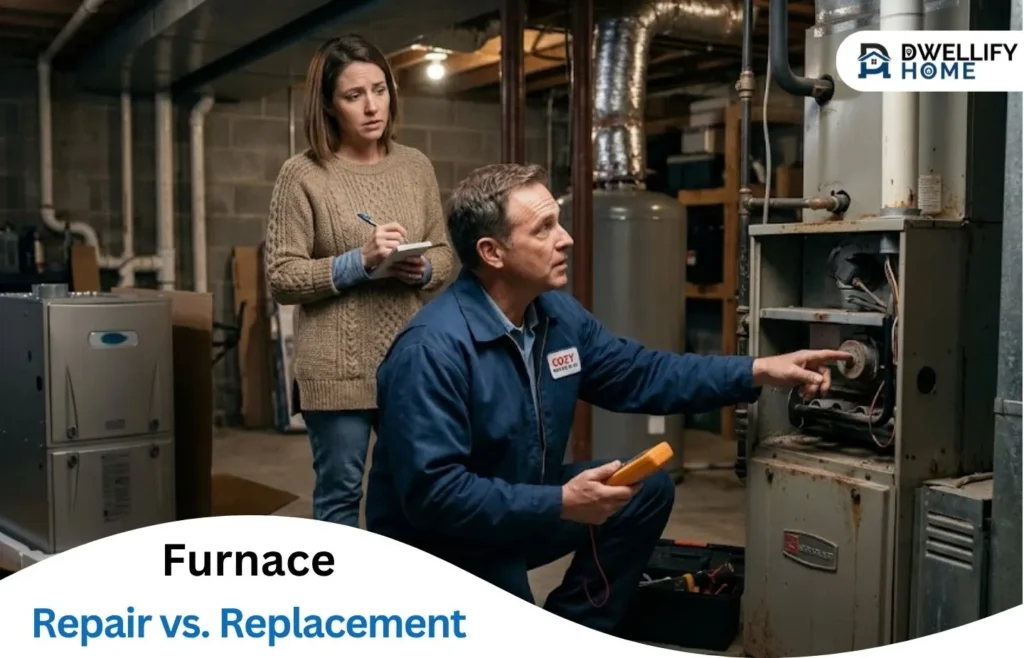
The call usually comes on a cold night. The furnace has stopped, a technician has found the problem, and now you’re standing in the basement trying to decide whether to spend a few hundred dollars on a repair or several thousand on a new system. It’s not a great moment to make a big financial decision.
It helps to know how the decision works before you’re in that spot. Below are the six things that matter most, roughly in the order a good technician would look at them.
The Short Answer
Repair usually makes sense when:
- The furnace is under about 12 years old.
- The repair is a routine part like an igniter, flame sensor, or capacitor.
- The part is still under warranty, so you’re paying for labor only.
- There’s no safety issue with the heat exchanger or venting.
Replacement usually makes sense when:
- The furnace is 15 years or older and needs a major repair.
- The repair would cost more than half the price of a new system.
- The heat exchanger is cracked, or the furnace has been shut off for safety.
- You’ve needed repairs several winters in a row.
Most real situations fall somewhere in between. The rest of this guide walks through how to weigh them.
Step 1: Find Out How Old the Furnace Is
A well-maintained gas furnace typically lasts 15 to 20 years. If you don’t know how old yours is, look for the data plate inside the furnace door. Some list the manufacture date outright. Others hide it in the serial number, and a quick search for the brand name plus “serial number date” will show you how to read it.
Age matters because it tells you how much life you’re buying with a repair. Fixing a six-year-old furnace can buy you another decade. The same repair on an 18-year-old unit might only last until the next part gives out.
While you’re looking at the data plate, write down the model number. Many manufacturers back their furnaces with parts warranties of 10 years or more when the unit was registered after installation. If the failed part is covered, the repair gets a lot cheaper and the math tilts toward fixing it.
Step 2: Put the Repair Cost in Context
Two rules of thumb are worth knowing. Neither is perfect, but together they give you a reasonable starting point.
The 50 Percent Rule
If the repair would cost more than half of what a new furnace costs, replacement deserves a serious look. This one matters most for furnaces past the midpoint of their lifespan.
The $5,000 Rule
Multiply the furnace’s age by the repair cost. If the total is over $5,000, many technicians would lean toward replacing it.
- A $350 repair on an 8-year-old furnace: 8 x $350 = $2,800. Repair it.
- A $450 repair on a 16-year-old furnace: 16 x $450 = $7,200. Start getting replacement quotes.
Treat both as a gut check, not a final answer. A furnace that’s been well maintained, or a house you plan to sell in a year or two, can change the decision.
Step 3: Know Which Repairs Are Routine
A lot of no-heat calls come down to small parts that wear out on their own schedule. Igniters, flame sensors, capacitors, pressure switches, thermostats, and clogged condensate drains are all common, usually inexpensive, and often fixed in a single visit. On a furnace in decent shape, there’s rarely a reason to replace the whole system over one of these.
Bigger parts are where it gets harder. A blower motor, inducer motor, or control board costs considerably more. On a furnace that’s five or eight years old, it’s still usually a sensible repair. On one that’s 17 years old and has had other problems, that same bill can be a down payment on a system that won’t last much longer anyway.
Step 4: Take Safety Problems Seriously
The heat exchanger is the part that keeps combustion gases, including carbon monoxide, separate from the air blowing through your home. When it cracks, those gases can leak into the airflow. A technician who finds a crack will usually shut the furnace down and tag it as unsafe to run.
On most older furnaces, replacing a heat exchanger costs close to what a new furnace would, so a crack is one of the clearest signs it’s time to replace. Venting problems, scorch marks around the burners, and a carbon monoxide alarm going off are all reasons to stop using the furnace and call for service right away.
These problems are much easier to catch before they become an emergency. A yearly tune-up should include a heat exchanger inspection and a carbon monoxide test, which is exactly the kind of check that gives you time to plan instead of scrambling.
Step 5: Run the Efficiency Numbers
Furnace efficiency is measured by AFUE, the share of fuel that actually turns into heat. Many furnaces installed in the 1990s and early 2000s are rated around 80 percent, and some older ones are lower. High-efficiency models today are commonly rated at 95 percent or more.
Here’s what that looks like in practice. Say you spend $1,200 a winter on gas with a 70 percent furnace. Producing that same amount of heat with a 95 percent furnace would cost about $885, a savings of roughly $315 a year. That alone won’t justify replacing a furnace that works fine. But if you’re already facing an expensive repair on an old, inefficient unit, the lower bills belong in the comparison.
Step 6: Decide Before It’s an Emergency
The worst time to replace a furnace is the night it fails in January. You have fewer options, less time to compare quotes, and every hour without heat adds pressure. If your furnace is getting old or has needed a few repairs, it’s worth getting a replacement quote in the fall, while you can still make the decision on your own schedule.
If you do go ahead with a furnace replacement, make sure the new unit is sized for your home rather than matched to the old one. Insulation upgrades, new windows, and finished basements all change how much heat a house needs, and an oversized furnace tends to short-cycle, wear out sooner, and leave rooms uneven.
Questions to Ask Your Technician
- What failed, and what caused it?
- Is the part covered by the manufacturer’s warranty?
- What will the repair cost, itemized, and is the labor guaranteed?
- Is anything else on the furnace close to failing?
- Did you check the heat exchanger and venting?
- If I replace it, how will you size the new system?
A good technician will answer these plainly. If the only option you’re offered is a new furnace and the explanation stays vague, get a second opinion.
What a Good Contractor Should Do
Whoever you call, look for a few things: a clear diagnosis, an itemized quote before work starts, and no pressure toward the most expensive option. Anderson Heating & Cooling, a family-owned heating and cooling company in Elyria, Ohio, is a good example of that approach. It promises an honest diagnosis rather than steering homeowners toward the priciest fix, and it gives customers itemized pricing before any work begins. That’s a fair standard to hold any contractor to, wherever you live.
The Bottom Line
If the furnace is fairly young, the repair is routine, and there’s no safety concern, fix it. If it’s old, the repair is expensive, it keeps breaking down, or the heat exchanger is cracked, replacement is usually the better investment. In between, the age, the warranty, and an itemized quote will tell you most of what you need to know.
Certain links in this article may be provided through commercial partnerships, including affiliate or sponsored arrangements. Dwellifyhome.com may receive compensation from qualifying purchases made through these links.