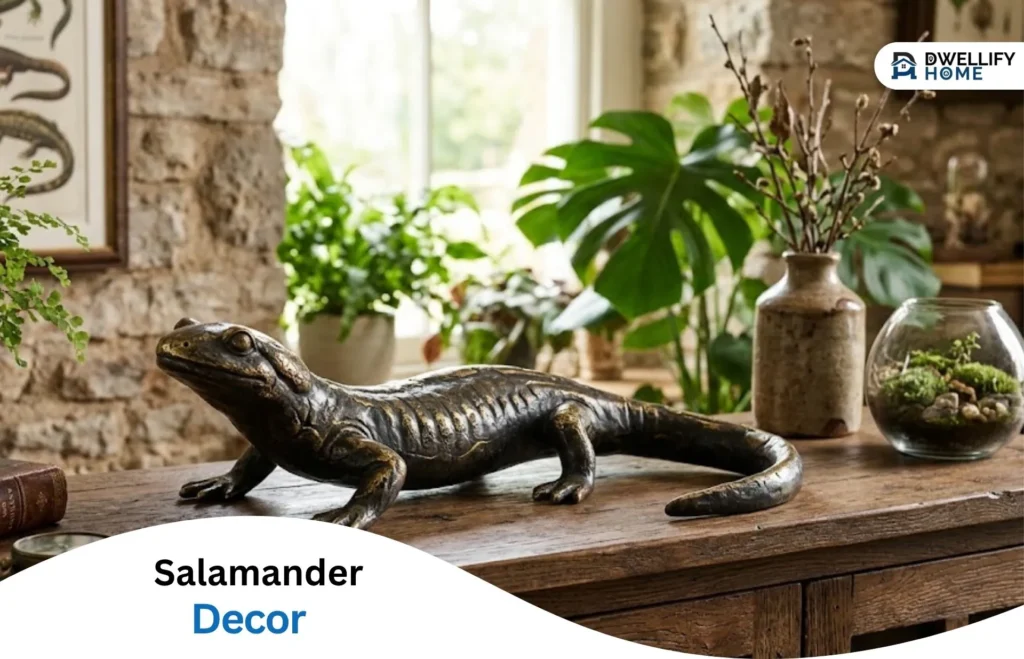
The salamander is one of the oldest and most symbolically loaded creatures in human culture — a living emblem of fire, transformation, resilience, and mystery. Long before it became a subject for naturalists, it captivated alchemists, heraldic artists, and storytellers across continents.
In ancient mythology, the salamander was believed to be born from fire itself — immune to flames, a creature of pure elemental power. Aristotle wrote about it. Paracelsus, the Renaissance alchemist, named the fire elemental after it. French king Francis I adopted the salamander as his royal emblem, surrounding it with the motto “I nourish and I extinguish” — a perfect encapsulation of duality. This is a motif with genuine centuries of decorative heritage, not a passing trend.
Why does this matter for interior design? Because meaningful decor changes how a space feels. A room anchored by a motif with deep cultural roots invites curiosity, conversation, and a sense of intentionality that purely aesthetic choices rarely achieve. Decorating with symbolically rich animals — like the salamander — gives your home a narrative layer that resonates on a psychological level, making spaces feel curated rather than simply furnished.
What Makes Salamander Decor Unique in Nature-Themed Interiors
Salamander decor stands apart from mainstream nature motifs precisely because it is unexpected. While foxes, owls, and deer have become staples of woodland-themed interiors, the salamander remains genuinely rare in home decor — which is exactly what makes it so compelling for design-forward homeowners.
Visually, the salamander is extraordinary. Its sinuous, elongated form lends itself beautifully to graphic and illustrative art styles. The fire salamander in particular — jet black with vivid yellow or orange markings — offers a striking natural contrast that translates powerfully into wall art, textiles, and decorative objects. It is bold without being aggressive, wild without being threatening.
From a biophilic design perspective, incorporating amphibian imagery connects indoor spaces to the damp, mossy woodland environments salamanders inhabit — evoking a sense of cool forest floors, ancient trees, and quiet natural mystery. This aligns perfectly with the growing movement toward nature-inspired interiors that go beyond the predictable.
- Salamanders are visually distinctive — no other common decor motif looks quite like them
- Their graphic contrast makes them adaptable across art styles, from botanical illustration to bold modern print
- They signal a sophisticated, well-researched approach to nature-themed decorating
- Rare wildlife motifs are increasingly sought after in contemporary home decor circles
Choosing the Right Color Palette for a Salamander-Inspired Room
The most effective salamander color palette draws directly from nature: deep black, vivid yellow, forest green, and earthy brown form the core of a fire salamander-inspired interior. These are moody, grounded tones that feel both dramatic and organic.
For walls, consider deep forest greens, charcoal, or warm off-whites — shades that allow a salamander motif to breathe without competing. Terracotta and ochre accents echo the amphibian’s warm markings and tie the palette together with an earthy warmth.
Texture is equally important. Matte finishes, natural stone, raw wood, and moss-inspired textiles all complement salamander-themed decor by reinforcing the woodland atmosphere. Avoid overly glossy or clinical surfaces — they undercut the organic quality that makes this motif so effective.
- Primary palette: Black, yellow-gold, deep green
- Supporting tones: Terracotta, ochre, warm grey, moss
- Accent materials: Unfinished wood, slate, linen, ceramic
- Avoid: Bright whites, chrome finishes, overly saturated synthetic colors
The goal is a palette that feels like it was drawn from the forest floor — layered, complex, and quietly alive.
How to Use Salamander Wall Art as a Focal Point
A single, well-chosen piece of wall art can anchor an entire room’s identity — and salamander wall art is particularly effective in this role because of its visual distinctiveness and symbolic weight.
When selecting salamander art for your walls, prioritize pieces that balance detail and graphic clarity. Fine art prints and canvas works in a botanical illustration style tend to work best — they honor the natural subject while maintaining the sophistication expected of a statement art piece.
Placement Tips
- Living room: Center a large salamander print above a sofa or fireplace — the fireplace placement is particularly resonant given the salamander’s mythological fire connection
- Hallway or entryway: A vertically oriented salamander print creates an immediate impression and sets the tone for the whole home
- Study or home office: Position at eye level beside a desk to create an inspiring, nature-connected workspace
- Height: Eye level at approximately 57–60 inches from the floor to the center of the piece is the standard for optimal visual impact
Surround the wall art with complementary decor elements — a wooden shelf with a small ceramic, a trailing plant, a textured throw — to create a cohesive vignette rather than an isolated piece. The salamander motif bridges decorative art and meaningful symbolism most effectively when it exists within a considered environment.
Room-by-Room Guide: Where Salamander Decor Works Best
Salamander decor is more versatile than most people expect. Here is how to deploy it effectively across different rooms and design styles.
Living Room
The living room is the natural home for a statement salamander art piece. Build a nature gallery wall combining the salamander with botanical prints, stone textures, and woodland creature illustrations. This creates a conversation-starting focal point that feels curated rather than themed.
Home Office or Study
The salamander’s associations with transformation and resilience make it an inspired choice for a workspace. A single framed print or small canvas keeps the energy focused without overwhelming a functional room.
Bathroom or Entryway
Small-scale salamander accents — a ceramic tile detail, a framed mini print, a sculptural object — deliver unexpected delight in transitional spaces. These are rooms where surprise and personality make the strongest impression.
Bedroom
For bedrooms, opt for subtler salamander references: a muted print in earthy tones, a textured cushion, or a small framed illustration. The goal is serene woodland atmosphere rather than bold statement.
Modern Minimalist vs. Rustic Cottagecore
Salamander decor adapts to both. In a minimalist interior, a single high-quality black-and-white salamander print against a white wall is clean and sophisticated. In a cottagecore or rustic space, layered with botanicals, wood, and warm textiles, it becomes part of a rich, story-filled environment.
Practical Tips for Styling Salamander Decor Like a Pro
The most common mistake with nature-themed decor is overloading a space with too many motifs. With salamander decor, restraint is power. One or two well-placed pieces will always outperform a room scattered with the same image repeated.
- Mix thoughtfully: Pair salamander motifs with botanical prints, stone objects, and woodland textures — not with competing animal motifs
- Limit repetition: One statement piece plus one or two small accents is usually the ideal ratio
- Invest in quality: A single high-quality salamander wall art print will transform a room more effectively than several cheap reproductions
- Check print quality: Look for archival inks, quality paper or canvas, and accurate color reproduction before purchasing
- Size matters: For a focal point, go larger than feels comfortable — art that is too small loses impact on a wall
The beauty of nature-themed art is that a single piece can refresh an entire room without requiring a full redesign. Start with the wall art, then build the surrounding decor outward from that anchor point.
FAQ: Salamander Decor and Nature-Themed Interiors
What does salamander decor symbolize?
Salamander decor symbolizes fire, transformation, resilience, and mystery. Rooted in ancient mythology and alchemical tradition, the salamander motif brings centuries of cultural meaning into a living space, making it a powerful choice for homeowners who want decor with genuine depth and story.
Is salamander wall art suitable for every room?
Yes. Salamander wall art works across most rooms — living rooms, home offices, hallways, bathrooms, and bedrooms — though the scale and style of the piece should be adapted to the room’s function and atmosphere. Bold, large-format prints suit living rooms and studies; smaller, subtler pieces work well in bedrooms and transitional spaces.
What interior styles work best with salamander motifs?
Salamander decor is compatible with a wide range of styles, including biophilic, cottagecore, rustic, Japandi, and modern minimalist interiors. The key is choosing the right color palette and art style — a graphic black-and-white print reads as minimalist; a detailed botanical illustration fits a more layered, nature-rich aesthetic.
Thank you for reading Dwellifyhome.com. Please note that certain links in this article may be affiliate or sponsored links through which we may receive compensation. This support helps us continue publishing useful and informative resources for our audience.