Buying a bathroom sink feels simple until you’re standing in the aisle or scrolling online and thinking, “Will this actually fit my vanity, faucet, and plumbing?” Here’s the thing, most sink problems aren’t about style. They’re about specifications that didn’t get checked early enough.
When I help homeowners choose a sink, I treat it like a small planning project. You match the size to the space, the bowl to the way you live, and the hardware to what’s already in the wall. Do that, and you avoid the classic headaches: splashy faucets, drawers that won’t close, and plumbing that suddenly needs to be moved.
This guide breaks down bathroom sink specifications in plain English so you can pick the right sink confidently and get it installed without surprises.
Snippet-Ready Definition:
Bathroom sink specifications explain a sink’s size, bowl depth, material, faucet holes, and plumbing fit. These details help ensure the sink works comfortably, fits your vanity, and installs without issues.
Mission Statement:
At Dwellify Home, our mission is to simplify home decisions with clear, experience-based guidance. We help homeowners choose fixtures and layouts that actually work in real homes, not just in showrooms.
Bathroom Sink Specifications at a Glance (Quick Standard Ranges)
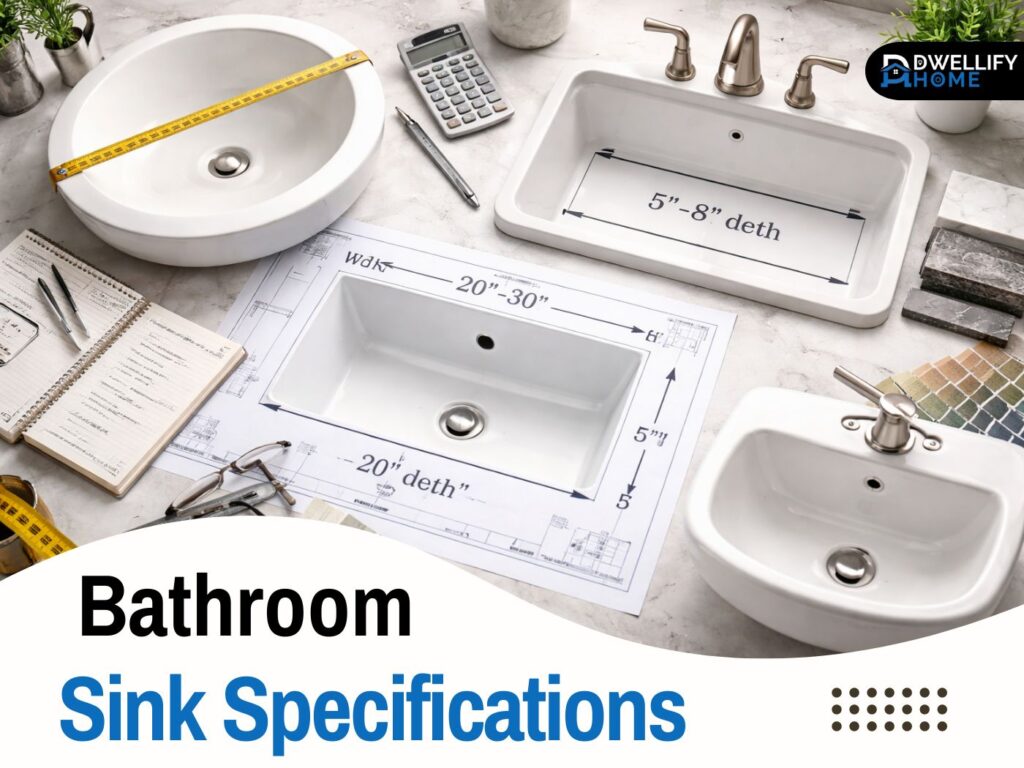
Most bathroom sinks fall into familiar size ranges, even though styles vary. A typical sink is often around 16 to 24 inches wide, with front-to-back depth commonly around 12 to 22 inches. Bowl depth usually lands around 5 to 8 inches for many everyday sinks, while vessel designs can feel different depending on shape.
On top of that, “standard” doesn’t mean “universal.” An undermount sink might have a similar outer size to a drop-in, but the inner bowl space and the cutout requirements can be completely different. That’s why I always look at specs as a bundle: measurements, mounting method, faucet fit, and clearance.
Quick tip from the field: if you only remember one thing, remember this. Your vanity and faucet decide most of the sink choices, not the other way around.
The 9 Sink Measurements You Must Check Before Buying
1) Overall width and front-to-back depth
Width tells you how much counter space the sink takes. Depth tells you how far the sink reaches toward you. That front-to-back number matters more than people expect, especially in small bathrooms where you don’t want the sink sticking out too far.
I’ve seen tight spaces where a sink that was only two inches deeper made the room feel cramped. It can also put the faucet too close to the front edge, which leads to water splashing onto the floor.
2) Bowl depth
Bowl depth changes daily comfort. A deeper bowl holds more water and handles messy tasks better. A shallow bowl can look sleek, but it’s easier to splash if the faucet reach or water pressure isn’t a good match.
If you wash your face at the sink, rinse hair dye, or clean kids’ hands often, bowl depth is not a “nice-to-have.” It’s part of how the sink performs.
3) Inner bowl size vs outer size
This one is sneaky. Two sinks can share the same outer dimensions but have different usable bowl space. Thick rims, sloped sides, and design shapes can reduce the actual space you get.
For undermount sinks, the inner bowl size matters a lot because the counter hides the outer rim. You want to know what you’ll actually be able to use day-to-day.
4) Sink height and rim height
This comes up most with vessel sinks. A vessel can add several inches above the counter, which can make the sink feel too tall if the vanity is already high.
Here’s a real example. I once worked in a home with a taller vanity and a vessel sink chosen only for looks. The sink ended up too high for kids and awkward for adults. We fixed it by changing the sink style, but it could’ve been avoided with one quick height check.
5) Faucet hole setup and spacing
This is a big one. Sink decks come in a few common setups:
- Single-hole
- 4-inch centerset
- 8-inch widespread
If your faucet doesn’t match the hole spacing, you either need a different faucet or a different sink. It’s one of the most common mismatch mistakes I see.
6) Faucet reach and height
Guess what, splash problems are usually faucet problems, not bowl problems. If the spout lands too close to the drain, it can splash. If it lands too close to the front slope, it can splash. The goal is a clean “landing zone” that hits the bowl in a calm spot.
If you’re choosing a vessel sink, you’ll usually need a taller faucet or a wall-mounted faucet. If you’re choosing an undermount, you’re often pairing it with a standard deck-mounted faucet on the countertop.
7) Drain position and overflow compatibility
Drains vary by location and by whether the sink has an overflow channel. If a sink has an overflow, the drain assembly should be compatible with overflow. If it doesn’t, you use a non-overflow drain.
I always advise homeowners to confirm this before ordering parts. It’s a small detail that can turn into a frustrating return.
8) Minimum vanity or cabinet size and drawer clearance
Sinks don’t just need counter space. They need room underneath for the drain, trap, and water lines.
If your vanity has drawers, check the inside layout. I’ve had jobs where a gorgeous vanity was installed, and then the sink choice forced us to rework the drawers because the trap landed right where the drawer box lived.
9) Weight and mounting support
Wall-mounted sinks need solid support inside the wall. Heavy materials can also demand better mounting and countertop support.
If you’re going wall-mounted, plan for proper blocking in the wall. It’s not complicated, but it’s not optional either.
Standard Bathroom Sink Size Chart (Inches, cm, mm, and meters)
Let’s keep this practical. Most homeowners compare sinks in inches, but it helps to understand conversions if you’re looking at a spec sheet from another region or a bathroom sink specifications pdf that lists metric units.
Typical reference ranges:
- Standard bathroom sink size in inches: often 16 to 24 inches wide, 12 to 22 inches deep
- Standard bathroom sink size in cm: roughly 41 to 61 cm wide, 30 to 56 cm deep
- Standard bathroom sink size in mm: roughly 410 to 610 mm wide, 300 to 560 mm deep
- Standard size of bathroom sink in meters: roughly 0.41 to 0.61 m wide, 0.30 to 0.56 m deep
For small bathroom sink specifications, I usually look for compact width and a shallower projection, but still enough bowl room to use comfortably. A sink that’s too tiny can feel annoying fast, especially if the faucet reach is short.
Quick measuring tip: measure the usable counter space and also measure how far the vanity top can handle a sink without crowding the walkway.
Bathroom Sink Sizes by Installation Type
Undermount sinks (bathroom sink sizes undermount)
Undermount sinks sit below the counter, which gives a clean look and makes wiping water into the bowl easier. The best part is the rim is hidden, so the counter looks sleek.
But undermount specs matter. You’ll often see a required cutout size and sometimes a template. You also need to know how the sink will sit under the counter edge. A small change in the cutout can affect how much bowl opening you end up with.
Practical tip: always check the minimum cabinet size. Some undermount bowls look fine up top but need more space below because of their shape.
Drop-in (top-mount) sinks
Drop-in sinks are usually the easiest for replacements. They sit into a cutout and rest on the rim.
They’re forgiving in older homes because the rim can cover small imperfections around the cutout. That’s why I often recommend them when someone wants a smoother install without countertop work.
Vessel sinks
Vessel sinks sit on top of the counter. They can be beautiful, but they’re pickier about faucet height and overall sink height.
I always check three things for vessel setups:
- Total sink height above the counter
- Faucet height and reach
- Drain alignment and pop-up style
If you get those right, a vessel sink can be a joy. If you don’t, it can feel awkward or splashy.
Wall-mounted sinks
Wall-mounted sinks are great when you want a lighter look or need to save floor space. They’re also useful in very tight layouts.
The key is support. The sink must be anchored properly, and the plumbing is often visible. That can be a design choice, but it needs to be planned, not accidental.
Pedestal and console sinks
Pedestal sinks hide plumbing with a base, while console sinks use legs and usually show more of the plumbing.
They’re a classic choice, but they don’t offer much storage. They also require clean rough-in alignment so the drain and supply lines line up neatly.
Bowl Depth, Shape, and Splash Control (Real-World Performance)
Bowl depth is your daily experience. If a sink is too shallow, you’ll notice it when washing hands quickly and water bounces out. If it’s too deep, it can feel less comfortable for kids or shorter users.
Shape matters too. Rectangular bowls look modern, but they sometimes have sharper corners that collect grime. Round and oval shapes tend to clean a bit easier because water and soap don’t get trapped in tight angles.
Here’s a trick I use when planning faucet placement: aim the water stream to land near the center of the bowl, not right above the drain and not near the front slope. That simple idea reduces splash more than changing the sink most of the time.
Material Specifications (Durability, Maintenance, and Feel)
Most homes use ceramic or vitreous china, and for good reason. It’s durable, smooth, easy to clean, and doesn’t require special care. If you want a low-stress sink, it’s often the safest choice.
Cast iron with an enamel finish can feel incredibly solid and long-lasting, but it’s heavy. You want to be sure the vanity and counter can support it without flexing.
Stone resin and natural stone can look high-end, but they come with care expectations. Some need sealing, and they can show water spots. I’m not against them at all, I just want homeowners to know what daily maintenance looks like before committing.
Metal sinks can be stylish, but they show spotting and fingerprints more easily. If you love the look, go for it, just plan to wipe it down more often.
Faucet Compatibility Specifications (Avoid Costly Mismatches)
This is where many purchases go sideways. A sink can be perfect, but if the faucet doesn’t match the hole pattern or the spout reach, you’ll be unhappy.
Start with the holes:
- One hole usually pairs with single-handle faucets
- 4-inch centerset is common and easy to find
- 8-inch widespread gives a more custom look
Now consider reach. If you choose a faucet with a short reach, the water may hit too close to the back of the bowl. If it’s too long, it may hit the front slope. Either way, you get splash.
Also confirm the drain setup. If the sink has an overflow channel, use an overflow-compatible drain. If it doesn’t, use a non-overflow drain. It sounds small, but it matters.
Plumbing and Rough-In Specifications (What Must Line Up)
Most sink installs go smoothly when the rough-in lines up. If it doesn’t, the job gets bigger fast.
At a minimum, you want the drain location and water supplies to work with:
- The vanity layout
- The trap space
- Any drawers or shelves
If you’re changing sink type, like switching from a pedestal to a vanity sink, plumbing placement can shift. In older homes, that sometimes means adjusting supply lines or drain height.
Wall-mounted sinks need blocking behind the wall. I’ve opened walls for this, and it’s always easier to do before tile is finished.
ADA and Comfort Specifications (Practical, Not Complicated)
Even if you’re not building for ADA, comfort specs are worth thinking about. A sink that’s too high or too low can feel off every single day.
If you have family members with different heights, consider a setup that feels natural for the main users. Knee clearance and reach space matter most in wall-mounted or open-console layouts, especially for aging-in-place planning.
Simple comfort check: stand at your vanity and imagine washing your face. If your elbows feel cramped or the sink feels too high, it’s worth adjusting the plan before you buy.
How to Read a Bathroom Sink Specifications PDF (Spec Sheet) Like a Pro
Spec sheets look intimidating, but they’re your best friend. The best part is once you know what to look for, you can compare sinks quickly.
Most bathroom sink specifications pdf sheets include:
- Overall width and depth
- Bowl depth and inner bowl dimensions
- Faucet hole layout and spacing
- Drain hole size and position
- Minimum cabinet size
- Cutout template notes for undermount or drop-in sinks
My routine is simple. I highlight the overall size, bowl depth, faucet holes, and minimum cabinet size. Then I compare those numbers to my real measurements at home.
If you do that, you’ll avoid the common “It looked right online” problem.
Choosing the Right Specs for Your Bathroom (Quick Pick Guide)
For a powder room, go compact. You don’t need a huge bowl, but you do want comfortable handwashing space and a faucet that doesn’t splash.
For a guest bath, balance is the goal. A medium bowl depth, easy-to-clean materials, and a straightforward install type like drop-in or undermount work well.
For a primary bath, think daily use. Many people prefer a deeper bowl, more counter space, and careful faucet selection. If you’re doing a double setup, leave enough elbow room between sinks so it doesn’t feel cramped.
Kitchen vs Bathroom Sink Specifications (Quick Comparison)
Kitchen sinks are often deeper because they handle pots, dishes, and heavier daily tasks. Bathroom sinks focus more on splash control, comfort, and fitting into a vanity without fighting drawers and plumbing.
That’s why kitchen bathroom sink specifications don’t translate directly. Materials can overlap, and styles can be similar, but bathroom setups are more sensitive to faucet reach, bowl shape, and the way water hits the basin.
Common Specification Mistakes (And How to Avoid Them)
I’ve seen the same issues come up again and again. Here are the big ones:
- Buying based on outer width only and ignoring inner bowl space
- Choosing a faucet without thinking about spout reach and splash
- Forgetting about drawer clearance and trap space in the vanity
- Skipping the cutout template for undermount sinks
- Mixing overflow sinks with the wrong drain hardware
The fix is simple. Measure carefully, read the spec sheet, and match the sink, faucet, and vanity as a set.
Quick Guide Table: Bathroom Sink Specifications at a Glance
| Specification Area | Common Range / Notes |
| Width | 16–24 inches (compact to standard) |
| Depth (front-to-back) | 12–22 inches |
| Bowl Depth | 5–8 inches (deeper = less splash) |
| Faucet Holes | Single-hole, 4-inch, 8-inch |
| Drain Size | Standard 1.25 inches |
| Overflow | With overflow or without (must match drain) |
| Vanity Size | Must exceed sink width and allow trap clearance |
Step-by-Step: How to Check Sink Specs Before Buying
- Measure your vanity width and depth.
- Confirm bowl depth based on daily use.
- Match faucet hole spacing with your faucet.
- Check faucet reach to reduce splash.
- Verify drain type (overflow or non-overflow).
- Review the sink’s specification sheet or PDF.
- Confirm cabinet and drawer clearance below.
FAQs
What are standard sizes for bathroom sinks?
Most bathroom sinks are 16–24 inches wide, 12–22 inches deep, with bowl depths around 5–8 inches. Size varies based on installation type and bathroom space.
What is the code for a bathroom sink?
Plumbing codes typically require proper drain sizing, trap installation, and correct venting. Height and clearance rules may apply in accessible bathrooms. Always check local plumbing codes.
What is the difference between 60/40 and 70/30 sink?
These ratios describe how the bowl space is divided. A 60/40 sink has more balanced bowl sizes, while a 70/30 sink gives one larger bowl for more usable space.
What is the best depth for a bathroom sink?
For most homes, a bowl depth of 6–8 inches works best. It holds water well and reduces splash without feeling awkward to use.
Are deeper bathroom sinks always better?
Not always. Deeper sinks reduce splash but can feel uncomfortable for kids or shorter users. Balance comfort with function.
Conclusion
If you want a sink you’ll love for years, treat the specifications like a checklist, not paperwork. Focus on width, front-to-back depth, and bowl depth. Then confirm faucet hole spacing, spout reach, and drain compatibility. After that, double-check vanity clearance and rough-in alignment.
Do those steps, and you’ll avoid the costly mistakes I’ve had to fix in real homes. And when you’re ready to buy, you’ll feel calm, not unsure, because you’ll know the sink fits your space and your daily routine, not just your style.
Disclaimer:
This guide is for general informational purposes only. Always confirm product specifications, plumbing requirements, and local building codes before purchasing or installing a bathroom sink.

I’m Bilal, the founder of Dwellify Home. With 6 years of practical experience in home remodeling, interior design, and décor consulting, I help people transform their spaces with simple, effective, and affordable ideas. I specialize in offering real-world tips, step-by-step guides, and product recommendations that make home improvement easier and more enjoyable. My mission is to empower homeowners and renters to create functional, beautiful spaces—one thoughtful update at a time.