If you’re standing in your bathroom trying to choose a warm metal finish that won’t feel too flashy, champagne bronze is a solid contender. I’ve installed this finish in powder rooms, guest baths, and primary bathrooms, and when it’s chosen well, it gives you that calm, high-end look without screaming for attention.
What matters most is not the catalog photo. It’s how the finish behaves under your bulbs, how it pairs with your mirror and faucet, and whether the light actually works for real daily use. Let’s walk through it step by step, the same way I’d guide a homeowner during a bathroom walkthrough.
Snippet-ready definition:
A champagne bronze vanity light is a bathroom light fixture with a warm, softly brushed metal finish that sits between gold and bronze, designed to give balanced face lighting while adding a calm, modern warmth to the space.
Mission Statement:
At Dwellify Home, our goal is to help you choose bathroom lighting that looks cohesive, lights the face well, and holds up in real daily use, with clear sizing, placement, and performance advice you can trust.
What Is Champagne Bronze and How It Actually Looks in Real Bathrooms
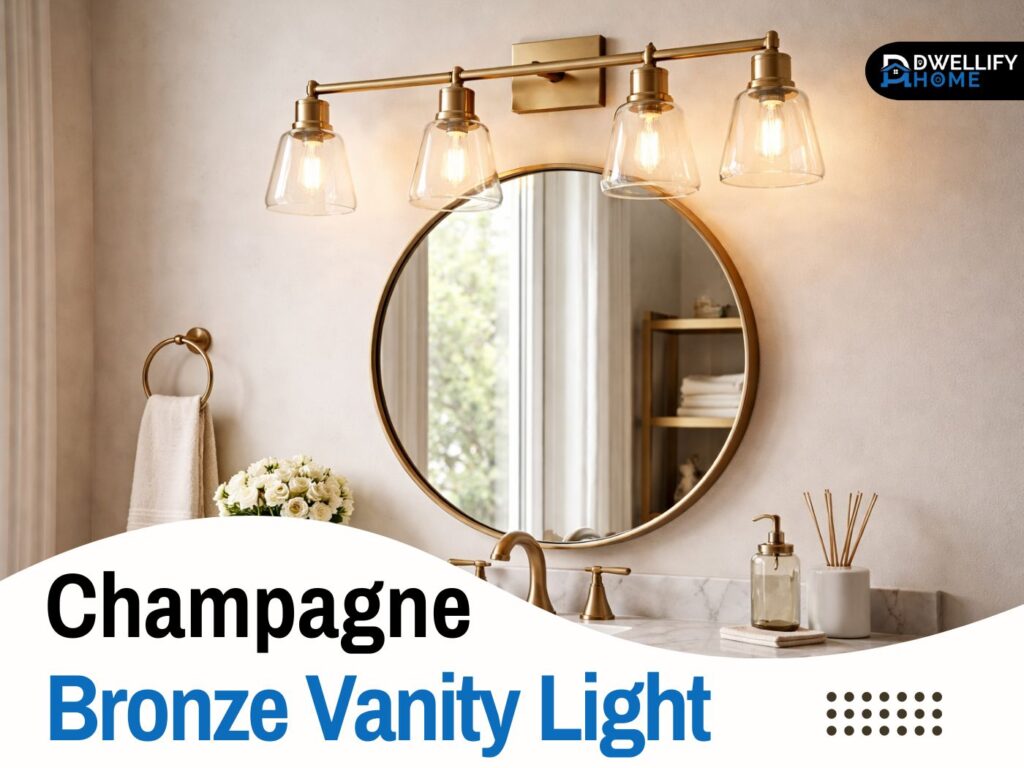
Champagne bronze sits between gold and bronze, but it usually looks softer than both. It’s warm, slightly muted, and often has a brushed or satin feel that keeps it from looking shiny. In most bathrooms, it reads like a gentle warm metal, not a bright yellow gold.
The biggest surprise I see is how much lighting changes the finish. Under warmer bulbs, champagne bronze can look richer and a bit more golden. Under neutral bulbs, it looks more balanced and modern. If your bathroom has lots of natural daylight, it tends to look lighter and cleaner during the day, then warmer at night.
Wall color and tile tone matter too. With warm whites, creams, beige stone, and natural wood, champagne bronze looks right at home. With icy grays, cool whites, and blue-toned finishes, it can feel a little warmer than everything else, so you’ll want to add one or two other warm touches to keep it intentional.
Champagne Bronze vs Gold vs Brass Quick Comparison
Here’s how I explain it in plain terms:
- Gold, especially polished gold, is bold and reflective. It grabs attention.
- Traditional brass is warmer and more yellow, often leaning classic or vintage.
- Champagne bronze is softer and calmer. It feels warm without looking loud.
If you want warmth that still feels modern and easy to live with, champagne bronze is usually the safest choice.
Quick Guide Table: Fast Decisions That Actually Work
| What you’re deciding | Best rule to use | Practical tip from installs |
| Fixture width | Aim for about 70–80% of mirror width (above-mirror) | Slightly larger usually looks better than too small |
| Light count | 2 for small, 3 for standard, 4+ for wide mirrors | Go up a light count if the vanity area feels dim |
| Glass type | Opal/frosted for softer light, clear for a sharper look | Clear glass needs better bulbs to avoid glare |
| Color temperature | Around 3000K for natural skin tones | Very warm can look yellow, very cool feels harsh |
| Color accuracy | Higher CRI gives truer skin tones | Helps a lot for grooming and makeup |
| Rating | Damp-rated for most vanity zones | Wet-rated only for direct exposure areas |
| Dimming | Strongly recommended | Lets you go bright in the morning, soft at night |
| Metal matching | Match undertone and sheen, not just the name | Satin with satin is safer than satin with shiny |
Step-by-step: Choosing the Right Fixture in 6 Steps
- Measure mirror width and note ceiling height
- Pick fixture width that visually fills the mirror area
- Choose light count based on vanity size and brightness needs
- Decide on modern or transitional styling to match mirror weight
- Select light quality: dimming, around 3000K, good color accuracy
- Confirm damp rating and plan mounting height before install
Is Champagne Bronze a Good Choice for Bathrooms? Pros, Cons, and Real-Life Expectations
In bathrooms, champagne bronze is popular for a reason. It hides fingerprints better than polished finishes and it pairs nicely with a wide range of materials. I’ve used it with white quartz tops, warm marble-look tile, oak vanities, and even matte black accents, and it stays flexible.
It also tends to age well visually. Trendy finishes come and go, but champagne bronze doesn’t feel like a short-lived look when you keep the rest of the bathroom simple and balanced.
That said, it’s not perfect for every space. If your bathroom is very cool-toned and minimal, with chrome everywhere and crisp blue-gray finishes, champagne bronze can feel out of place. Also, different brands’ champagne bronze can vary, so mixing pieces without thinking about undertone and sheen can lead to a mismatch you’ll notice every time you look at it.
Design Planning: Should You Choose the Mirror or the Vanity Light First?
If I’m guiding a remodel, I usually start with the mirror size and style. The mirror sets the scale and visual weight, and the light needs to support it, not fight it. A slim modern mirror looks best with a modern champagne bronze vanity light that’s clean and minimal. A heavy framed mirror can handle a thicker backplate and more decorative glass.
There’s also a practical reason: the mirror often dictates where the electrical box should land and how high the fixture can sit. If you choose the light first and then pick a taller mirror, you might end up cramming the light too close or mounting it higher than it should be.
If you already have the mirror, great. Measure its width and height, then choose a fixture that fits the scale and gives you enough light for your routine.
How to Choose the Right Size Vanity Light for Your Mirror
Sizing is where most people either nail it or regret it. A bathroom vanity light should feel proportionate to the mirror and the vanity, and it should throw light evenly across the face.
A simple rule that works in most homes is to choose a fixture that’s roughly 70 to 80 percent of the mirror width when mounting above the mirror. You don’t have to be exact, but you want it to feel centered and balanced, not tiny and lost.
Mounting height matters too. If the vanity light bar is too high, it creates shadows under the eyes and nose. Too low, and you risk glare in the mirror. In many standard bathrooms, mounting the fixture so the bulbs land a bit above eye level works well, but the mirror height and ceiling height can change the ideal spot.
Quick Sizing Examples So You Don’t Overthink It
Here’s what tends to work in real bathrooms:
- Small powder room with a compact mirror: a shorter bar or a 2 light option often looks right
- Standard 30 to 36 inch vanity: a 3 light bar is usually the sweet spot
- Wider mirror or double vanity: a 4 light fixture or two separate fixtures can look more balanced
If you’re on the edge between sizes, go slightly larger. Undersized vanity lighting is one of the most common “something feels off” problems I see after installs.
Choosing the Right Light Count 2-Light to 6-Light
Light count is not just about style. It affects brightness, how evenly your face is lit, and whether you need to add extra lighting elsewhere.
A 2 light champagne bronze vanity light works best in tight spaces like powder rooms or small guest baths. It keeps things simple and avoids overwhelming a narrow mirror. If your ceiling is low and the vanity is small, this can look clean and intentional.
A 3 light champagne bronze vanity light is the most common choice for a standard vanity. It tends to give enough spread without feeling too long. In real use, it usually lights the face evenly, especially with good bulbs and a dimmer.
A 4 light champagne bronze vanity light is a strong option for wider mirrors, bigger vanities, or bathrooms where the vanity is the main task-lighting source. I like 4 light fixtures when the mirror is wide and you want less falloff at the sides of the face.
A 5-light champagne bronze vanity light starts to make sense in larger bathrooms, longer mirrors, or when you want a brighter vanity zone without adding side sconces. It can look great, but it needs enough wall space so it doesn’t feel crowded.
A 6 light champagne bronze vanity light is for big double vanities, wider mirrors, or higher ceilings where you need more output. In these setups, a dimmer becomes almost non-negotiable, because full brightness at night can feel harsh.
Vanity Light Styles That Work Best in Champagne Bronze
Champagne bronze is flexible, but the style you choose changes the whole mood of the bathroom.
A modern champagne bronze vanity light usually has clean lines, a slim bar, and simple glass. Opal glass is a safe choice because it softens the light and reduces glare. Clear glass looks sharp, but you have to be more careful with bulb choice, because the bulb is part of the look.
Transitional styles blend modern and classic. You’ll see softer curves, slightly thicker backplates, and glass that feels more traditional. These work well if your bathroom has shaker cabinets, classic tile, or a framed mirror.
Vintage-inspired fixtures can look great in champagne bronze, but they need the rest of the bathroom to support them. If the fixture is ornate and the mirror is ornate too, it can start to feel busy fast. In bathrooms, simplicity usually reads cleaner and more expensive.
The Details That Matter So the Light Looks Expensive, Not Random
Small details separate a fixture that feels intentional from one that looks like it was picked in a rush.
Glass matters more than people think. Clear and seeded glass can throw more sparkle and shadow patterns, which can look nice, but it also makes glare more likely. Opal or frosted glass is more forgiving and tends to flatter faces better.
Shade direction also changes the experience. A fixture that throws light up can brighten the ceiling, but it can leave your face slightly shadowed. A downlight can brighten the vanity area, but it can create harsh shadowing if it’s too direct. A balanced design that spreads light forward and outward usually performs best at a mirror.
Also, pay attention to the fixture profile. A thin modern bar looks great in a minimal bathroom. A chunkier backplate and thicker arms look better in a more traditional space. It’s about matching visual weight, not just matching finish.
Lighting Performance: Brightness, Color Temperature, and CRI
This is the part I care about most as an installer, because it determines whether you like the light every single day.
Brightness is often discussed in watts, but what matters is usable light. If your bathroom feels dim at the mirror, makeup, shaving, and even skincare become annoying. If it’s too bright, you’ll avoid turning it on at night. A dimmer solves a lot of problems, so if you have the option, plan for it early.
Color temperature is where the finish and your skin tone meet. Very warm bulbs can make the room feel cozy, but they can also make champagne bronze look more golden and can shift makeup tones. Very cool bulbs can feel clinical and can make warm finishes look slightly dull.
In many bathrooms, neutral warm light around 3000K is a safe middle ground. It keeps skin tones natural and keeps champagne bronze looking balanced. If you want a warmer vibe, you can go slightly warmer, but don’t go so warm that everything turns yellow.
CRI is about how accurately colors show up. In real life, higher CRI means your face looks more like it does in daylight. If you care about grooming tasks, choose bulbs or integrated LEDs that are known for good color accuracy.
A quick performance checklist that works well:
- Use a dimmer if you can
- Choose a color temperature that feels natural, not overly yellow or overly blue
- Pick a light source that renders skin tones well
Placement: Above-Mirror Vanity Bar vs Side Sconces
Above-mirror vanity lights are common because they’re simple to install and they work well in many bathrooms. A champagne bronze vanity light fixture above the mirror can look clean and modern, especially when it’s centered and sized correctly.
Side sconces can be even better for face lighting, because they reduce shadows and light the face more evenly from both sides. If you have the wall space, sconces are often the most flattering option.
Here are the most common placement issues I see:
- Light mounted too high, creating dark shadows under the eyes
- A fixture that’s too short for the mirror, leaving the sides of the face dim
- Clear glass with bright bulbs, causing glare in the mirror
If you’re doing above-mirror lighting, prioritize even spread and soft diffusion. If you’re doing sconces, focus on balanced height so the light lands where you actually need it.
Finish Matching Like a Designer Especially With Faucets and Hardware
You don’t have to match every metal in a bathroom perfectly. In fact, trying too hard can make the room feel rigid. What you want is coordination, not cloning.
A simple approach is to pick a lead finish and a supporting finish. Champagne bronze can be the lead finish with a supporting finish like matte black, brushed nickel, or even warm brass, depending on the look you want.
It pairs especially well with:
- Matte black accents for contrast
- Warm whites and creams for a calm feel
- Natural wood tones
- Marble-look tile with warm veining
If you’re matching a faucet labeled champagne bronze, keep in mind that undertone and sheen vary by brand. I like to compare pieces in the same room lighting before committing. A slightly different champagne bronze can still work if the overall warmth and reflectivity feel similar.
Matching Delta Champagne Bronze If That’s What You Have
If you have a Delta champagne bronze faucet, it’s a strong reference point. The best way to avoid mismatch is to match warmth and sheen first. If the faucet is satin and the light is shinier, it can look like a near miss. If both are satin or brushed and live in the same warm family, it usually blends well even if the exact tone differs.
Brand Notes: What People Look For in Kichler Champagne Bronze Vanity Light and Similar Brands
I’ve installed Kichler champagne bronze vanity light options in several homes, and what people tend to appreciate is consistency within a collection. If you like matching towel bars or coordinating ceiling fixtures, buying within a brand family can make that easier.
No matter the brand, I look for the same practical things:
- Solid build with a stable mounting plate
- Parts availability, especially glass shades
- Clear dimensions that match your mirror width and wall space
- Safety listings and warranty information you can actually verify
One practical note: some fixtures look great online but feel lightweight in person. If you can, check reviews for build quality and finishing consistency, not just style photos.
Bathroom Safety and Durability: Damp Rating, Moisture, and Longevity
Bathrooms are humid, even in homes with good ventilation. That’s why rating and durability matter more here than in a hallway.
For most vanity locations, a damp rated fixture is the correct choice. Wet rated is typically needed for direct exposure zones, like inside a shower area. If your vanity is very close to a shower without a good partition, it’s worth checking requirements more carefully.
To help the finish last:
- Run the exhaust fan during showers and for a bit afterward
- Wipe down the fixture occasionally, especially if it’s near heavy steam
- Avoid harsh cleaners that can dull or strip finishes
As for electrical work, call an electrician if you need to move the junction box, if your wiring is older, or if you’re adding a dimmer and you’re not sure about compatibility. A clean install is part of what makes the light look high-end.
Quick Buying Checklist
This is the checklist I’d use with you in the bathroom before you click buy:
- Measure mirror width and choose a fixture that feels proportionate
- Decide your light count based on vanity size and how bright you want the mirror zone
- Pick a style that matches the mirror’s visual weight, modern, transitional, or vintage
- Choose glass and bulbs that reduce glare and flatter faces
- Plan for a dimmer if possible
- Confirm the fixture is damp rated for bathroom use
- Double-check mounting height and wall box placement before install
FAQs
Is champagne bronze still in style?
Yes. It’s stayed popular because it adds warmth without the shiny look of polished gold, and it mixes well with modern and transitional bathrooms. It also tends to photograph and age well compared to brighter metallics.
What color is champagne bronze similar to?
It’s closest to a muted, softly brushed gold with a subtle bronze undertone. In warmer lighting it can read more golden, and in neutral lighting it often looks more balanced and slightly bronzier.
What metals mix well with champagne bronze?
Matte black is the easiest pairing for contrast. Brushed nickel can work if you keep the overall look calm and match satin-to-satin sheen. Warm brass can work too, but it needs intention and similar undertones so it doesn’t look like a mismatch.
Is champagne bronze the same as brushed gold?
Not exactly. Brushed gold often reads brighter and more purely gold, while champagne bronze usually looks more muted with a bronze undertone. In real bathrooms, that undertone is what keeps it from looking too yellow.
What color bulbs look best with champagne bronze vanity lighting?
In most bathrooms, around 3000K gives the most natural skin tone while keeping the finish looking warm and balanced. If you go very warm, the finish can look more yellow; very cool can make it feel dull. (A dimmer is the best upgrade here.)
Conclusion
Champagne bronze works beautifully in bathrooms when you treat it like a finish that needs the right supporting cast. Get the size right, choose the light count that matches your mirror and brightness needs, and pay attention to glass and bulb quality so your face lighting is soft and even.
If you remember just one thing, make it this: vanity lighting is not only decor, it’s daily function. When the fixture is proportionate, the light is flattering, and the finish coordinates with your faucet and mirror, the whole bathroom feels calmer and more finished.
If you want, share your mirror width, vanity size, and ceiling height, and I’ll tell you whether a 3 light, 4 light, or larger champagne bronze option will fit best, plus a practical mounting height that works in real bathrooms.
Disclaimer:
This article shares general design and lighting guidance based on common installation practices. Electrical requirements vary by home. For wiring changes, box relocation, or dimmer compatibility, consult a licensed electrician and follow local codes and manufacturer instructions.

I’m Bilal Hassan, the founder of Dwellify Home. With 6 years of practical experience in home remodeling, interior design, and décor consulting, I help people transform their spaces with simple, effective, and affordable ideas. I specialize in offering real-world tips, step-by-step guides, and product recommendations that make home improvement easier and more enjoyable. My mission is to empower homeowners and renters to create functional, beautiful spaces—one thoughtful update at a time.