If you’re planning a big household, a 5-bedroom barndo can be one of the smartest ways to get space, flexibility, and comfort without building a complicated custom mansion. I’ve designed steel-frame barndominiums for over a decade, and here’s what I’ve learned: the best plans don’t just add bedrooms. They create calm, quiet zones for sleep and study, and they protect your living area from the realities of rural life, like mud, tools, noise, and guests coming and going.
Here’s the thing, a 5-bedroom layout will either feel smooth and livable, or it’ll feel like a long hallway with doors. The difference is planning, not square footage. In this guide, I’ll walk you through the layouts that work, the mistakes that cause regret, and how to think about budget and plan quality without getting overwhelmed.
Snippet-ready definition:
5 bedroom barndominium floor plans are home layouts that combine open, family-friendly living areas with privacy-zoned bedrooms, often paired with a shop or oversized garage for rural, hands-on lifestyles.
Mission Statement:
At Dwellify Home, our mission is to help families design practical, comfortable homes by translating floor plans into real-life living decisions, with honest guidance on layout, function, and long-term flexibility.
What Makes a 5-Bedroom Barndominium Floor Plan Actually Functional
Most families assume the main goal is fitting five bedrooms. In real life, the goal is protecting the daily rhythm of the home. When a plan is truly functional, you can cook while kids do homework nearby, someone can take a nap without hearing the TV, and guests can stay over without taking over your whole routine.
The biggest thing I design around is zoning. You want a clear separation between public space and private space. Public space is your kitchen, dining, and living area. Private space is bedrooms, baths, and quieter corners. When those zones blur, noise travels, mess spreads, and everyone feels on edge.
Another practical detail people don’t notice at first is circulation. That’s just a fancy way of saying, how you move through the house. A good plan minimizes dead hallways and makes movement feel natural. You’ll also want real storage, not just a coat hook. Think mudroom cubbies, a pantry that can hold bulk groceries, linen storage near bathrooms, and a mechanical closet that doesn’t steal space from bedrooms.
Quick Guide Comparison Table
One important note before you compare: many plan sites list “heated square footage” and may not include the garage or shop area in that number.
| Layout type | Best for | Why it works | Watch-outs |
| Single-story (one level) | Families who want easy daily flow and long-term accessibility | No stairs, simpler routines, bedrooms can be zoned into a quiet wing | Can sprawl if the core isn’t compact |
| Two-story plus loft or bonus | Households needing separation for teens, guests, or work | Adds a second living zone, keeps noise apart | Stairs, careful sound control, smarter framing needed |
| Split-bedroom | Privacy-focused families, multigenerational living | Primary suite stays quiet, secondary bedrooms can share a bath | Needs thoughtful hallway and bathroom placement |
| Dual-living (suite style or semi-duplex) | Extended family, future rental flexibility, frequent guests | Two “zones” so routines don’t collide | Extra plumbing and soundproofing planning helps |
Typical size reality: 5-bedroom barndo plans commonly span from the low 2,000s into 4,000+ heated sq ft depending on layout and features.
A 40×60 footprint equals 2,400 sq ft (before subtracting wall thickness, mechanical space, or carving out shop/garage zones).
Fast Step-by-Step Plan Picker (simple and practical)
- Pick your zoning style first
Decide if you want split-bedroom privacy, a single-story family hub, or a two-story setup with an upstairs quiet zone. - Set your “must-haves” that affect layout
Examples: mudroom between shop and kitchen, pantry size, office or flex room, number of bathrooms. - Match bathrooms to real routines
The simplest win is often: primary ensuite + one shared bath + a guest-friendly powder room. - Decide how the shop connects
Attached shop needs a buffer (mudroom or utility hall). Detached shop needs weather protection or a breezeway. - Pressure-test the plan with a busy-day walk-through
Imagine morning traffic, school bags, laundry, and a guest using the bathroom. If it still feels calm on paper, it’ll feel calm in real life.
Most Popular 5 Bedroom Barndominium Layout Types
There are a few layout styles I keep coming back to because they match how families actually live. Each has trade-offs, so I’ll lay them out the same way I would if we were standing on your land discussing where the driveway, shop, and porch will go.
5 bedroom barndominium floor plans single-story
Single-story plans are popular for a reason. Daily life is simpler when you’re not going up and down stairs with laundry baskets, toddlers, or groceries. They also tend to be easier for aging-in-place, which matters more than people think when they plan a “forever home.”
The trade-off is footprint. A single-level 5-bedroom layout can sprawl, especially if you want wide halls and large bedrooms. My tip is to keep the core compact: place the kitchen, living, and dining in a tight center, then branch bedroom wings off that core. That keeps your HVAC runs shorter and your plan feeling efficient rather than stretched.
Two-story plus loft or bonus room layouts
Two-story barndos can feel surprisingly cozy because you gain separation. I’ve designed plans where the main floor is all about family time, and the upstairs becomes a quieter zone for teens, guests, or a home office. A loft or bonus room can be a lifesaver when five bedrooms are full and everyone needs space.
The trade-off is stairs and structural planning. You’ll want to think about where the stair landing sits so it doesn’t dump noise straight into the living room. Also, steel-frame barndos with big open spans sometimes need smart framing choices to keep upstairs floors from feeling bouncy. It’s not a deal breaker, it just needs proper engineering and good floor design.
Split-bedroom layouts for privacy
If I had to pick one layout that works for the most families, it’s the split-bedroom plan. You place the primary suite on one side of the house and the other bedrooms on the other side, often with the living area in between.
This setup is a game-changer for privacy. Parents can go to bed while kids are still awake, guests can stay without being right next to the nursery, and shift workers can sleep without being disturbed. It’s also great for multigenerational living, because you can give grandparents a quieter wing with easy access to a bathroom.
Duplex or dual-living options
Dual-living layouts are the quiet trend I see more families asking for. It might be a true duplex plan with separate entries, or it might be a single home with two living zones: a main living room and a smaller family room, plus a bedroom cluster that can function almost like an in-law suite.
This layout shines when you want flexibility. Maybe you have an older parent moving in later. Maybe you want a private guest area. Or maybe you’re planning for a future rental wing. The key is to treat it like two households sharing one roof, which means planning sound control, storage, and bath access carefully.
Simple vs Modern 5 Bedroom Barndominium Floor Plans
People often say they want a simple 5 bedroom barndominium floor plan, but they don’t always mean small. They usually mean clean, efficient, and affordable to build. Simple plans avoid a bunch of jogs in the exterior walls, keep the roofline straightforward, and stack plumbing lines so bathrooms aren’t scattered all over the place.
A modern 5 bedroom barndominium floor plan usually focuses on visual style and lifestyle flow. Think bigger windows, cleaner exterior lines, more indoor-outdoor connection, and a kitchen that feels like the heart of the home. Modern doesn’t have to mean expensive, but it often introduces design choices that increase cost, like large glass openings, higher-end finishes, and more complex porches.
My practical advice is to decide what you want to be modern. For many families, the best “modern” upgrade is inside: great lighting, a functional pantry, and a layout that gives everyone space. You can keep the shell simple and still end up with a home that feels current and high-quality.
Must-Have Rooms and Features People Expect in a 5-Bed Barndo
When you’re planning five bedrooms, the supporting spaces matter just as much. I’ve seen families build beautiful homes and still feel cramped, simply because they skipped the right utility spaces.
Here are the features that tend to make a big difference in daily life:
- An open living core with clear sightlines between kitchen, dining, and living
- A pantry that can handle real groceries, especially if you buy in bulk
- A mudroom drop zone with storage for shoes, coats, backpacks, and work gear
- A flex room that can switch between office, homeschool space, or guest room
- Laundry placement that makes sense, not just wherever it fit on paper
A real-world example: one family I worked with had three kids, a grandparent, and a work-from-home setup. We designed a small study nook near the kitchen for homework, and a separate office near the primary suite for quiet calls. That one decision saved them from constantly battling noise.
Bathroom planning for 5 bedrooms
Bathroom layout is where a lot of plans quietly fail. Not because they have too few bathrooms, but because they’re placed poorly. You don’t want everyone walking through the living room to reach the main bath, and you don’t want guests using the same bath as the kids if you can avoid it.
In most 5-bedroom homes, these setups work well:
- One primary ensuite for privacy
- One shared bath for secondary bedrooms, sometimes a Jack-and-Jill
- One guest-friendly powder room near the main living area
If you can’t add a third bath, focus on layout. A well-placed powder room can protect family bathrooms from guest traffic, and that’s a bigger win than people expect.
Shop, Garage, and Shouse Planning
This is where barndominiums are different. A shop or garage isn’t just an add-on, it affects comfort, cleanliness, and long-term livability.
Attached shops are convenient, especially in bad weather. But they need a buffer. I like to place a mudroom or utility hallway between the shop and the living space. That transition zone helps control dust, odors, and noise. It also gives you a place for boots, coats, and gear, so you’re not dragging mess into the kitchen.
Detached shops reduce noise and smell issues, and they can be easier to expand later. The trade-off is walking outside, which sounds fine until you’re carrying groceries in a storm. If your land allows it, a covered breezeway can be a great compromise.
Oversized garages and RV bays are another big decision. They push the footprint up quickly. If you need RV storage, plan it intentionally so it doesn’t dominate the home’s layout. And make sure the insulation and ventilation are designed for the way you’ll actually use that space.
Outdoor Living Upgrades That Add Real Daily Value
On rural land, outdoor living isn’t just a luxury, it’s part of how you enjoy the property. A covered porch gives you shade, a place to sit during rain, and a buffer that keeps your home cleaner.
Wraparound porches are beautiful and practical, but they can add cost fast because you’re building a lot of roof and structure. If budget matters, a deep front porch plus a covered back patio often gives you the best of both worlds.
Outdoor kitchens are fun, but I only recommend them when the outdoor space will truly get used. If you host often, grill weekly, or have a pool setup, it’s worth considering. If not, a simpler design with good lighting, a ceiling fan, and a solid grilling area can be just as satisfying.
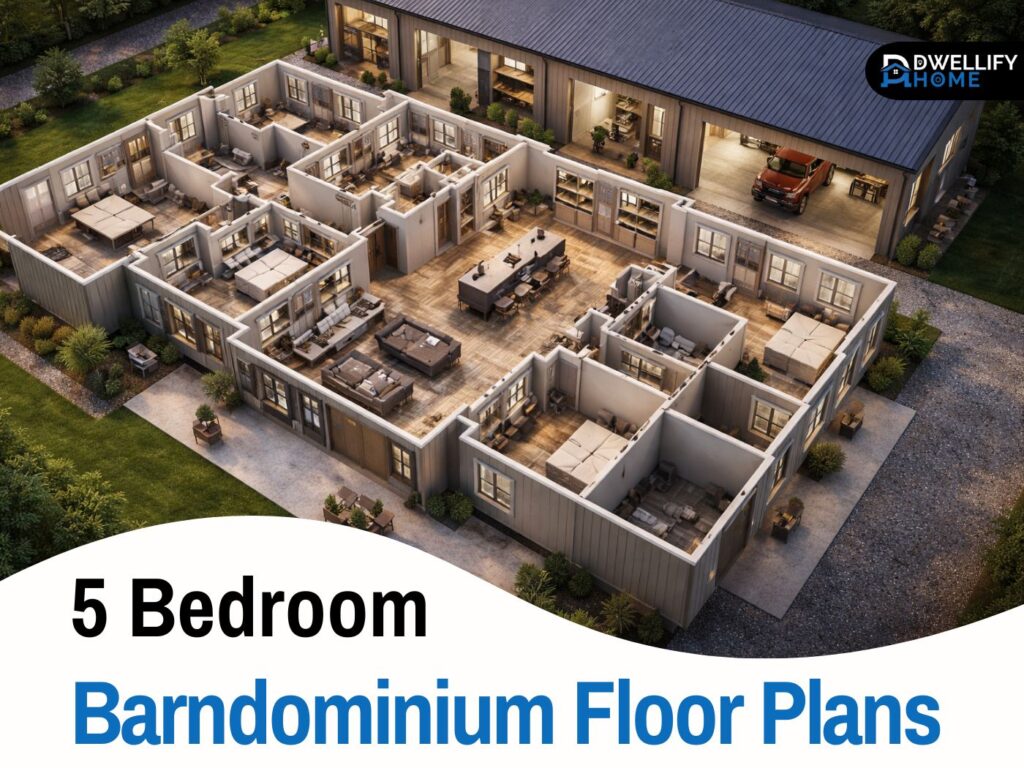
5 Bedroom Barndominium Floor Plans With Pictures
Photos and renderings are helpful, but they can also be misleading. A beautiful rendering doesn’t show how sound travels, how much storage you’ll need, or how awkward a hallway might feel.
When you’re looking at 5 bedroom barndominium floor plans with pictures, focus on livability clues:
- Are the bedrooms grouped in a way that makes sense for noise and privacy?
- Does the kitchen have a real pantry, or is it a tiny closet?
- Is there a mudroom between the garage or shop and the living area?
- Do bathrooms open into hallways in a way that feels private?
Here’s a small trick I teach clients. Imagine your busiest day. Kids coming home, someone cooking, someone taking a shower, someone needing quiet for work. If the pictures show a wide-open great room but the plan forces everyone to pass through it to reach bedrooms and baths, that’s a future headache.
5 Bedroom Barndominium Floor Plans With Prices
Let’s talk money in a realistic way. People love browsing 5 bedroom barndominium floor plans with prices, but pricing is always conditional. Land conditions, local labor rates, permits, utilities, and finish choices can swing the final number dramatically.
Instead of chasing one price tag, think in ranges and drivers. A simple footprint with standard rooflines, stacked plumbing, and moderate finishes will usually cost less than a plan with complex porches, big glass walls, and a large conditioned shop.
If you want to plan responsibly, get clear on three numbers early:
- A target square footage range
- Your shop and garage requirements
- Your finish level, basic, mid-range, or premium
5 bedroom barndominium cost: the biggest budget drivers
In my experience, these items change the budget the most:
- Site work: grading, driveway, drainage, and soil conditions
- Foundation type and slab details, especially if you want radiant heat
- Large doors and shop features, including insulation and ventilation
- Kitchen and bathrooms, because finishes add up fast
- HVAC zoning and energy efficiency, especially in extreme climates
Here’s the best part. Many cost-saving moves don’t reduce comfort. A cleaner footprint, smarter plumbing layout, and right-sized bedrooms often save money while making the home feel better.
Kit vs site-built: what you’re actually paying for
Barndominium kits can be a great option, but the word kit is broad. Some packages are shell-only, meaning you’re getting the steel structure and exterior components. Others include more, like windows, doors, and certain interior framing packages.
My advice is to ask for a clear inclusion list before comparing numbers. Confirm what’s included, what’s not, and what’s required to meet your local wind or snow load codes. Two kits can look similar online but differ a lot in what they actually deliver.
Free 5 Bedroom Barndominium Floor Plans
Free plans exist, but you need to understand what free usually means. Most free 5 bedroom barndominium floor plans are concept layouts. They can be great for inspiration and early planning, but they typically aren’t permit-ready and they usually aren’t engineered for your local requirements.
If you’re serious about building, a safer approach is to use free layouts to narrow down what you like, then invest in a proper plan set. That includes structural details, foundation notes, and documentation that builders and permit offices need. It’s not glamorous, but it prevents expensive surprises later.
When a 4 Bedroom Barndominium Plan Might Be the Better Fit
I’m a big fan of honest planning. Sometimes a 4 bedroom barndominium floor plan is the better choice, even if you love the idea of five bedrooms.
If the fifth bedroom will mostly be empty, consider designing a flex room instead. A flex room can be an office now, a guest room later, or a hobby room when kids move out. You get the function without paying for a space that sits unused.
Another option is to design four bedrooms plus a bonus room. It gives you a future bedroom if you need it, and it can be a game room or media room in the meantime. That’s often a better lifestyle fit for families who want breathing room more than extra doors.
Expert Checklist Before You Choose or Customize a Plan
This is the part I’d tell you face-to-face, because it saves people from regrets.
Before you buy a plan or start customizing, make sure you can answer these questions:
- Where will the mud and mess enter the home, and where does it get contained?
- Can someone sleep while others are cooking, watching TV, or working in the shop?
- Are bathrooms placed for privacy and convenience, not just symmetry?
- Is the plan engineered or engineer-ready for your climate and local codes?
- Does the plan keep plumbing lines reasonably grouped to control cost?
- Is there storage where you’ll actually need it, near bedrooms, baths, and entry points?
One more thing: watch out for change orders. The biggest budget blow-ups happen when families fall in love with a pretty plan, then realize it doesn’t match their life. Fixing that during construction is expensive. Fixing it on paper is much easier.
FAQs
How big is a 5 bedroom barndominium?
Most 5-bedroom layouts land roughly 2,300 to 4,300+ heated sq ft, depending on whether it’s single-story, two-story, and how many living zones or baths are included.
Remember, heated sq ft may not include the shop or garage.
How many rooms can a barndominium have?
There’s no fixed limit. A barndominium can be designed in many sizes and layouts, from small builds to large multi-bedroom homes, as long as the structure and plan meet local code and engineering needs.
What are the advantages of a 5-bedroom plan?
You get flexibility that smaller plans struggle with:
- A true guest room without disrupting kids’ bedrooms
- Space for multigenerational living
- Dedicated office or homeschool room
- Better resale appeal in family-heavy markets
The key advantage is lifestyle flexibility, not just extra sleeping space.
What size is a 40×60 barndominium?
A 40×60 footprint is 2,400 sq ft (40 × 60).
If part of that footprint becomes a shop or garage, the heated living area will be less.
Do “plans with prices” reflect real build costs?
They’re best treated as a starting point. Real costs shift based on site work, foundation choices, local labor rates, shop size, porch depth, and finish level. It’s smarter to compare plans by cost drivers than by a single advertised number.
Conclusion: choose for comfort now, and flexibility later
When you’re choosing a 5-bedroom barndo layout, don’t chase the flashiest rendering. Choose the plan that protects your daily routine. Focus on zoning, storage, sound control, and the transition between shop life and home life.
If you take one practical step today, shortlist two or three plans, then run them through the expert checklist. Picture a busy weekday and a relaxed weekend. If the plan supports both, you’re on the right track.
And when you’re ready, you can fine-tune the details to fit your land, your budget, and your future. That’s how you end up with a home that feels easy to live in, not just impressive on paper.
Disclaimer:
This content is for general informational and educational purposes only. Floor plan suitability, engineering requirements, permits, and construction costs vary by location and site conditions. Always consult qualified local professionals before finalizing design or budget decisions.

I’m Bilal, the founder of Dwellify Home. With 6 years of practical experience in home remodeling, interior design, and décor consulting, I help people transform their spaces with simple, effective, and affordable ideas. I specialize in offering real-world tips, step-by-step guides, and product recommendations that make home improvement easier and more enjoyable. My mission is to empower homeowners and renters to create functional, beautiful spaces—one thoughtful update at a time.