A small bedroom can feel calm and cozy, or it can feel cramped and “busy” depending on a few choices you make early. One of the biggest choices is the rug. I’ve helped clients in city apartments, compact guest rooms, and tiny rentals where every inch matters. Time and again, the rug is what pulls the space together, softens the room, and makes it feel more intentional.
A rug also affects how you read the room’s size. The right one can visually widen the floor and make the bed area feel grounded. The wrong one can chop the room into awkward sections and make everything feel tighter. Let’s walk through sizing, placement, and styling in a way that’s practical and easy to apply.
Snippet-ready definition:
A rug in a small bedroom is a floor covering chosen and placed to anchor the bed, soften footsteps, and improve proportions. The right size and placement can make the room feel larger and more cohesive.
Mission Statement:
At Dwellify Home, our mission is to make small-space decorating feel simple and doable, with design advice that’s practical, proportion-focused, and easy to apply in real homes.
Quick Answer: What Rug Size Works Best in a Small Bedroom?
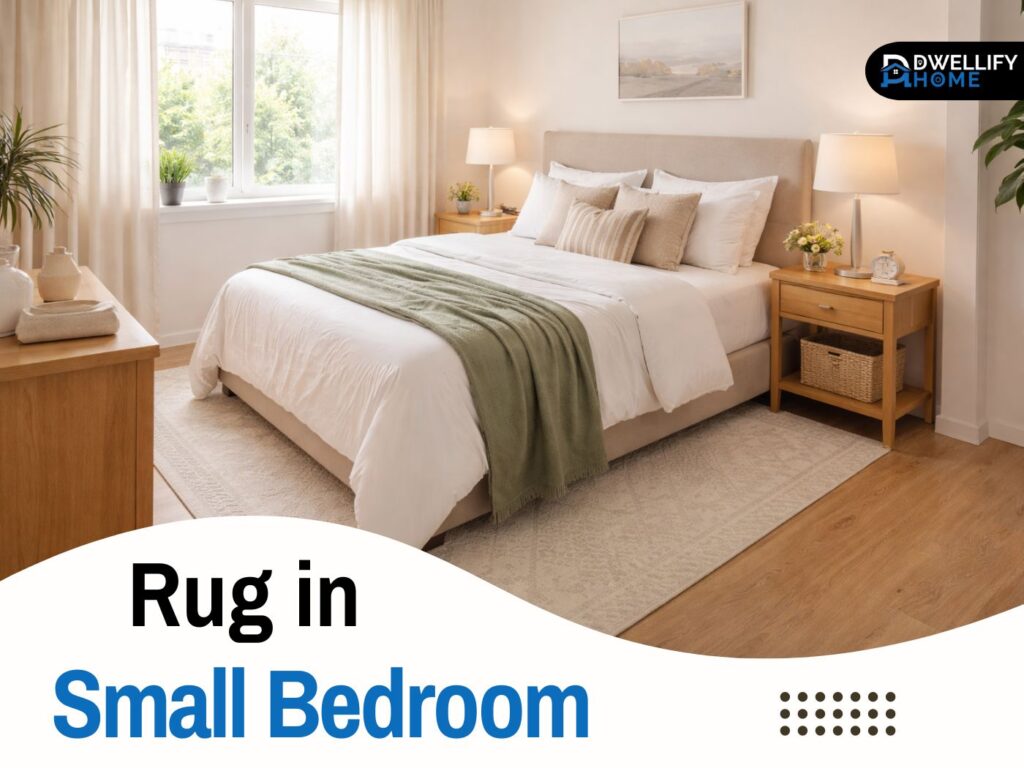
In most small bedrooms, a 5×8 or 6×9 rug is the sweet spot. It’s large enough to create a clear “zone” around the bed, but not so large that it fights with doors or squeezes the walkway.
If you remember just one thing, make it this: avoid tiny rugs floating in the middle of the floor. They tend to make the room feel chopped up. A rug looks best when it connects the bed to the rest of the space, even if it’s not huge.
Quick Guide Table
| Small Bedroom Situation | Best Rug Option | Simple Placement Rule |
| Most small bedrooms (safe choice) | 5×8 or 6×9 | Slide rug under the lower two-thirds of the bed |
| Tight walkways or door clearance issues | Two runners (or one runner) | Place runners along bedside landing zones |
| Very tight room, bed near doors/closet | Foot-of-bed rug | Keep it wide enough to relate to the bed |
| Want the “bigger room” look | Lighter, low-pile rug | Aim for 18–24 inches of rug showing past bed sides/foot |
Step-by-step placement checklist (simple and practical)
- Measure clearance first: check doors, drawers, and walking paths.
- Pick your layout: under-bed (best), runners (tight rooms), or foot-of-bed (very tight).
- Set the rug position: start it about two-thirds under the bed for the most balanced look.
- Check the reveal: try to show 18–24 inches of rug beyond the sides and foot (or as close as your room allows).
- Add a rug pad: reduces slipping and makes it feel softer underfoot.
Choose the Right Rug Size (So the Room Looks Bigger, Not Chopped Up)
Rug size isn’t about filling every inch of floor. It’s about proportion. In a compact room, your eye needs one strong, simple shape to read first, and the rug can provide that. When the rug is undersized, the room can feel like it’s made of scattered pieces rather than one calm layout.
Here’s how I decide size with clients. I look at three things: the bed size, how much walking space you actually use, and where doors and drawers swing. If a rug blocks a closet door or catches under a dresser, it’ll become annoying fast, even if it looks good in a photo.
Rug Size Guide by Bed Size (Twin, Full, Queen, King)
You don’t need a complicated chart. These are the combinations that usually work in real rooms:
- Twin bed: 5×8 is often perfect, or runners if the room is very narrow
- Full bed: 5×8 works in most cases, 6×9 if you have a little extra clearance
- Queen bed: 6×9 is the most reliable, 5×8 can work with careful placement
- King bed: In a truly small room, runners are often more realistic than forcing a large rug
A quick real-world example: I once designed a queen bed room that barely fit two nightstands. A 6×9 rug made it feel like a “complete” bedroom, while a smaller rug made it feel like the bed was just dropped into the space.
The 12–24 Inches Rule (How Much Rug Should Show)
A simple rule that works in small spaces is letting the rug extend about 12 to 24 inches beyond the sides and the foot of the bed. That gives your feet a soft landing in the morning and it also makes the bed look properly anchored.
If you can’t get that much space on both sides, don’t panic. Even one generous side and a clean extension at the foot can still look balanced. The goal is to avoid a rug that ends right at the bed edge, because that reads as too small.
Small Bedroom Rug Placement (3 Layouts That Always Look Intentional)
Placement is where a small bedroom either starts to feel polished or starts to feel cluttered. I’ll share the three layouts I use most often, including what I do when a room is tight and nothing seems to fit “the standard way.”
Rug for Bedroom Under Bed (Best Overall Layout)
This is the classic for a reason. Slide the rug under the lower two-thirds of the bed, so it starts around the middle of the bed and extends out beyond the foot and the sides. It keeps the headboard wall clean and it gives you that soft area where you actually step.
If the room is slightly larger, you can extend the rug far enough to also sit under the nightstands. In a smaller room, I usually don’t force that. It’s better to keep drawers opening smoothly and the walking path clear.
One tip from experience: if your bed is on a frame with legs, the rug edge looks cleaner when it sits under the bed rather than stopping right before it. That small overlap makes the rug feel “built into” the room.
Runners for Tight Rooms (Smart Alternative Layout)
When space is limited, runners can look more custom than a single rug that doesn’t quite fit. Two matching runners on either side of the bed is a favorite small-space solution. It gives you comfort where you step, and it keeps the center of the room open.
If you can’t fit two runners, use one runner on the side you step out of bed most often. Add a small runner at the foot of the bed if you want a little softness and a sense of length.
This approach is also great for homes with pets or kids, because runners are easier to clean, rotate, and replace.
Foot-of-Bed Rug (When a Full Rug Won’t Fit)
If a rug under the bed just isn’t realistic, place a rug at the foot of the bed. It works especially well in rooms where a closet door or bathroom door would snag on a larger rug.
To make this look intentional, choose a rug wide enough to relate to the bed. It shouldn’t look like a bathmat sitting in front of a mattress. You want it to feel like it belongs to the bed zone, not like an afterthought.
Bedroom Rug Placement Ideas by Room Shape and Real-Life Problems
Small bedrooms are rarely perfect rectangles with a centered bed. Real rooms come with quirks: a bed pushed into a corner, a dresser that must live by the door, or a window that forces the nightstand to be tiny. Here’s how I handle the most common situations.
In a long, narrow room, I often align the rug so it visually “widens” the space. That might mean letting the rug extend more on the open side of the bed and less on the wall side. As long as the rug is square to the bed, it still reads as intentional.
For a bed tucked into a corner, runners usually look better than trying to squeeze a big rug into one open side. Another clean option is a single rug that starts at the foot of the bed and extends forward into the room, making the walking area feel softer.
If your bed is off-center because of a closet or doorway, don’t fight it. Center the rug on the bed, not on the room. The bed is the focal point, and your rug should support that.
Make a Small Bedroom Look Bigger With the Right Rug Style
In small rooms, style choices need to work harder. A rug can open up the space or visually crowd it. The good news is you don’t need a lot of pattern or bold contrast to make it feel designed. In fact, subtlety usually wins.
Best Colors for Small Bedrooms (Light, Neutral, Airy)
Light and mid-tone rugs tend to make a room feel more open because they blend with the floor and reflect more light. Beige, warm cream, soft gray, and muted pastels are all reliable. If your walls and bedding are already light, a gentle contrast in the rug can add depth without feeling busy.
Dark rugs can work too, but I treat them carefully in a compact bedroom. If you love a darker rug, keep the rest of the room simpler and add a lighter throw or bedding to keep the space from feeling heavy.
Pattern and Texture Rules (So It Doesn’t Feel Busy)
In tight rooms, I usually choose texture over loud pattern. A subtle weave, a tone-on-tone design, or a small-scale pattern gives interest without shouting.
Stripes are one of my favorite tools in small bedrooms. A striped rug placed so the stripes run across the width can make the room feel wider. If stripes run lengthwise, they can make the room feel longer. Just keep the colors calm so the stripes don’t become the main event.
Best Rug Types for Small Bedrooms (Low-Pile and Flatweave)
Low-pile rugs and flatweaves are my go-to for small bedrooms. They sit flatter, look cleaner, and don’t swallow the room. They’re also easier with doors and furniture legs.
Plush rugs can still work if the room is calm and you want a cozy feel. If you go plush, I recommend keeping the color light and the pattern simple. Also check that doors can swing without catching.
Rug in Small Bedroom Feng Shui (Simple, Practical Guidance)
Feng shui gets misunderstood sometimes, but the practical idea is simple: your bedroom should feel supportive and calm. A rug helps by grounding the bed and softening the energy of a hard floor, especially in small rooms where everything feels close.
A common approach is placing the rug so it supports the bed area, either under the lower portion of the bed or neatly at the foot. The key is that it looks stable, not scattered. If you’re leaning into rug in small bedroom feng shui, avoid a rug that looks like it’s drifting in the middle of nowhere. Clean edges, steady placement, and a clear walking path usually feel best.
What to Avoid (Common Mistakes That Make Small Bedrooms Look Smaller)
Most rug mistakes come from trying to “make do” with a size that isn’t quite right. Here are the issues I see most often in small bedroom rug placement.
- Too small and floating: it slices the floor into pieces and makes the bed look bigger than the room
- Busy patterns with strong contrast: they create visual clutter fast
- Very thick shag in a tight layout: it can feel bulky and becomes harder to keep clean
- Ignoring clearance: rugs that catch under doors or block drawers become a daily annoyance
If you’re choosing between two sizes, I usually pick the larger one, as long as it doesn’t create door problems. In small rooms, the right larger rug often makes the space feel more complete.
Practical Details Most People Forget (But You Shouldn’t)
This is the part that makes your rug choice feel good long-term, not just on day one.
First, use a rug pad. It keeps the rug from sliding, adds a bit of cushion, and helps the rug wear evenly. If you have hardwood, it also protects the finish. For a tight room, choose a thinner pad so doors and furniture don’t wobble.
Next, measure the “real” walking zones. I like to mark rug edges with painter’s tape for five minutes. It sounds simple, but it saves returns and frustration. You’ll instantly see if the rug will block a closet door or make the room feel crowded.
Finally, plan for cleaning. In small bedrooms, washable rugs can be a relief, especially in kids’ spaces or if pets nap on the rug. Low-pile options generally vacuum better and show fewer marks.
Shopping Tips (Cute Small Rugs Without Buying the Wrong Size)
It’s easy to fall for cute small rugs for bedroom setups online, but the photos don’t always show scale. Before you click buy, confirm the rug dimensions in feet and inches, and compare them to your taped outline on the floor.
If you’re browsing small rugs for bedroom Target collections, or scrolling small rugs for bedroom Amazon listings, or checking small rugs for bedroom Walmart options, use filters that match real life. Look for low-pile, easy-care, and a return policy you’re comfortable with. Reviews that mention door clearance, vacuuming, and how the rug feels underfoot are often more helpful than styling photos.
One more thing I tell clients: decide your priority upfront. If comfort is the goal, place softness where your feet land and choose a material that feels good. If making the room look bigger is the goal, focus on the right size and a calmer color palette first, then shop for style within those boundaries.
FAQs
1) Should I put a rug in my small bedroom?
Yes, if you want the bed area to feel more grounded and comfortable. A properly sized rug makes the layout feel intentional and can reduce the “choppy” look of a small floor plan.
2) What size rug is best for a small bedroom?
Most small bedrooms do best with a 5×8 or 6×9. The goal is to have enough rug showing around the bed so it doesn’t look undersized or floating.
3) Does a rug make a small room look bigger or smaller?
It can do either. A rug that’s too small often makes the room feel smaller. A rug that’s sized well and placed under the bed usually makes the space feel more cohesive and visually larger.
4) How to lay a rug in a small bedroom?
The most reliable method is placing it under the lower two-thirds of the bed and letting it extend beyond the sides and foot for balance.
5) What if my bedroom is too small for a big rug under the bed?
Use runners beside the bed or a foot-of-bed rug. These options still add comfort and style without creating door or drawer problems.
Conclusion
A well-chosen rug can do more for a compact bedroom than people expect. Start by choosing a size that relates to your bed, then pick a layout that fits how you actually move through the room. After that, let style support the space: lighter tones, subtle texture, and low pile tend to look clean and feel easy.
If you only remember one practical rule, skip the tiny floating rug. A rug that connects with the bed, even in a simple way, makes the whole room feel calmer and more intentional. When you get that foundation right, everything else, from bedding to nightstands to lighting, suddenly looks more pulled together.
Disclaimer:
This article shares general interior design guidance. Room dimensions, furniture layouts, and materials vary, so measure your space carefully and follow product care and safety instructions for your specific rug and flooring.

I’m Bilal Hassan, the founder of Dwellify Home. With 6 years of practical experience in home remodeling, interior design, and décor consulting, I help people transform their spaces with simple, effective, and affordable ideas. I specialize in offering real-world tips, step-by-step guides, and product recommendations that make home improvement easier and more enjoyable. My mission is to empower homeowners and renters to create functional, beautiful spaces—one thoughtful update at a time.