Solar at home used to be fairly simple. Panels made electricity, your inverter converted it, and whatever you didn’t use went back to the grid. A smart setup adds another layer that matters just as much as the panels themselves: control.
That control is what makes the difference. It helps a home decide when to run certain loads, when to charge a battery, when to pull from stored power, and when it makes more sense to rely on the grid. Done well, it can lower waste, improve backup planning, and make energy use a lot easier to manage.
Snippet-Ready Definition
Smart home solar is a home solar setup with monitoring, automation, and often battery storage that helps manage energy use, lower grid reliance, and improve backup planning.Mission Statement
Dwellify Home helps homeowners make practical, stylish, and informed decisions for a better-functioning home.
What Is a Smart Home Solar System?
A smart home solar system is a solar setup connected to monitoring and energy management tools that help your home use power more efficiently.
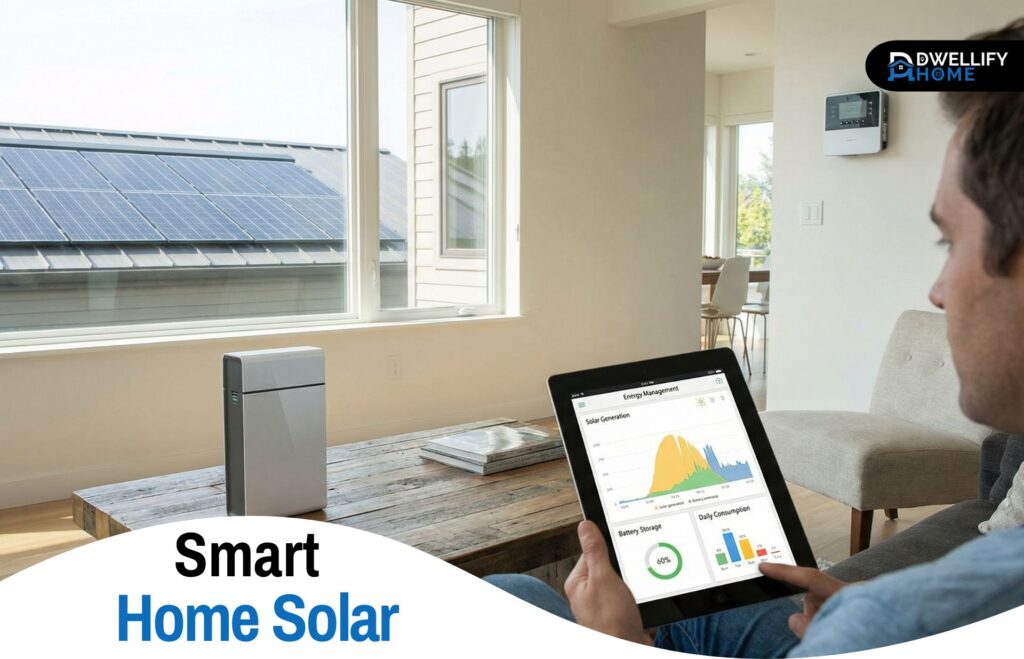
In a standard system, solar generation happens in the background. In a smarter one, you can actually see production and usage in real time, track what’s using power, and automate some of those decisions. That might include charging a battery during the day, running heavy appliances during strong solar output, or protecting key circuits during an outage.
The idea is not just to make electricity. It’s to manage it better.
Mini Guide
| Topic | Quick Answer |
| Best for | Homes that want lower bills, better energy control, or backup support |
| Main parts | Solar panels, inverter, monitoring, controls, and often battery storage |
| Biggest advantage | Better timing and management of power use, not just power generation |
| Good fit | Homes with high daytime use, EV charging, outages, or time-of-use rates |
| Main caution | “Smart” features vary a lot, so app quality and system compatibility matter |
Key Benefits
- Tracks solar production and home energy use in real time
- Helps shift heavy loads to sunny hours
- Can reduce peak-rate grid use
- Works well with battery backup and EV charging
- Gives better visibility into what your home is actually consuming
How Smart Home Solar Works in Everyday Life
During the day, rooftop panels produce electricity. That power goes through an inverter so your home can use it. From there, one of three things usually happens: your home uses it right away, extra power charges a battery, or the excess goes back to the grid through net metering where available.
The smart part comes from the control layer. A home energy management system can monitor production, household demand, battery level, and utility rates. Instead of treating energy use as one big blur, it helps organize it.
That becomes useful in normal daily situations. A dryer, water heater, or EV charger can be scheduled to run when solar production is strongest. In the evening, a battery can cover part of the home’s demand so you’re not buying expensive peak-rate electricity.
The Main Parts of a Smart Home Solar Setup
Every system is a little different, but most include the same core pieces.
Solar panels handle generation.
An inverter or microinverters convert that electricity into usable power.
Battery storage keeps excess energy for later use.
A home energy management system tracks and coordinates the flow of power.
A monitoring app gives you a live view of performance.
A smart panel or circuit-level controls add more precise control over what stays on and when.
That last piece is often overlooked. A lot of homeowners focus on panels and batteries, but circuit control is what helps a system behave more intelligently inside the home.
What Makes a Solar System “Smart”?
The word “smart” gets used loosely, so it helps to be specific.
A system starts to feel smart when it can do more than just show basic production numbers. The useful features are real-time monitoring, alerts, load scheduling, battery management, and time-of-use optimization.
For example, it’s one thing to know your system made 28 kWh today. It’s far more useful to know your EV charger ran during peak solar hours, your battery held enough reserve for the evening, and your high-cost grid usage dropped between 5 p.m. and 9 p.m.
That’s where smart home solar earns its keep.
How Smart Home Automation Connects With Solar Power
This is where solar and home automation finally start working together in a practical way.
A smart thermostat can reduce cooling demand during expensive grid hours. Smart plugs or appliance scheduling can shift some usage into the middle of the day. EV charging can be timed around solar production instead of convenience alone. Some systems even let you prioritize important loads automatically.
In a well-planned setup, your home isn’t just generating energy. It’s responding to it.
The Biggest Benefits of Smart Home Solar
The clearest benefit is better control over your electric bill. Not just lower usage, but better timing.
You also get much better visibility. Most people underestimate how useful that is until they can actually see what their home is doing hour by hour. Strange spikes become easier to spot. Waste becomes easier to correct.
There’s also a backup advantage. With the right equipment, a smart system can decide which circuits to keep powered during an outage instead of treating the whole house the same way.
Does Smart Home Solar Work During a Power Outage?
Not always.
This is one of the most common misunderstandings. A solar-only system usually shuts down during a grid outage unless it’s designed with backup capability. That safety feature protects utility workers and equipment.
To keep power available during an outage, you generally need battery storage and the right inverter and backup configuration. Even then, not every home runs the same way. Some systems back up only essential circuits like refrigeration, lighting, internet, and a few outlets. Others are sized for broader whole-home backup, but that takes more equipment and planning.
Do You Need a Battery for Smart Home Solar?
No, but it changes what the system can do.
Without a battery, solar can still cut electricity costs. With a battery, you add flexibility. You can save daytime energy for later, reduce reliance on peak utility rates, and maintain power during outages.
Whether a battery is worth it depends on your goals. For someone mainly focused on lowering bills in an area with strong net metering, solar-only may be enough. For a household dealing with outages, time-of-use pricing, or EV charging, battery storage often makes a lot more sense.
Smart Home Solar for New Homes vs Existing Homes
New builds have an easier path because wiring, panel placement, load planning, and future battery space can all be considered from the start.
Existing homes can absolutely be upgraded, but retrofits usually involve more tradeoffs. Main service panels may need work. Certain loads may need to be separated. Wi-Fi coverage, equipment placement, and battery location matter more than people expect.
That doesn’t make retrofits a bad idea. It just means planning matters more.
Can You Add Smart Features to an Existing Solar System?
In many cases, yes.
Homeowners often assume they need to replace everything, but that’s not always true. You may be able to add better monitoring, battery storage, smart breakers, or circuit controls without rebuilding the whole system.
The catch is compatibility. Some older inverters don’t integrate cleanly with newer battery platforms or home energy management tools. Before upgrading, it’s worth checking whether your current equipment supports expansion or whether you’d be layering too many disconnected parts together.
Smart Home Solar Price: What a Connected System Usually Costs
Cost depends on system size, battery capacity, equipment brand, installation complexity, and how much control you want inside the home.
A solar-only system will usually cost less upfront than solar plus storage. Once you add batteries, smart panels, advanced monitoring, and backup circuits, the budget rises quickly. Software and app quality also matter more than most buyers think. Cheap hardware paired with clunky controls often leads to frustration later.
The better way to judge cost is not just by sticker price. Look at what the system actually lets you do.
Is Smart Home Solar Worth It?
It can be, but not for the same reason in every home.
For some households, the value is mainly lower electric bills. For others, it’s resilience. For families with an EV, high summer cooling loads, or expensive time-based utility rates, the return is often more practical because the system has more chances to optimize usage.
Where people get disappointed is expecting every smart feature to create huge savings. Some features improve convenience and control more than payback. That still has value, but it helps to be honest about it.
Smart Home Solar in the US: Incentives, Net Metering, and Utility Rules
In the US, local rules shape the economics more than many buyers realize.
Federal tax credits can reduce upfront cost, but state incentives, net metering policies, and utility rate plans often have just as much impact on long-term value. In one area, exporting excess solar may be attractive. In another, battery storage may be the smarter move because export compensation is weak.
That’s why smart home solar in the US should always be evaluated with local policy in mind, not just equipment specs.
Compatibility Questions to Ask Before You Buy
A good installer should be able to answer a few practical questions clearly.
Will the system work with your existing inverter or battery?
Can it integrate with your smart home ecosystem?
Can it prioritize essential circuits during outages?
Will it still make sense if you add an EV later?
Is the monitoring app actually useful day to day?
These questions save people from expensive mismatches.
What to Look for in Smart Home Solar Reviews
A useful smart home solar review should go beyond panel wattage and warranty length.
Pay attention to app quality, monitoring accuracy, battery behavior, and support after installation. Homeowners usually live with the software every day, not the spec sheet. A system that looks good on paper but has poor controls or confusing alerts can become frustrating fast.
It’s also smart to separate whole-home systems from product-level accessories. A search for something like smart home solar panel EZVIZ may lead to solar accessories for cameras, which is a different category entirely.
Small Solar Smart Devices vs Whole-Home Smart Solar
This confusion comes up more often than it should.
A small solar panel for a camera, doorbell, or outdoor sensor is useful, but it is not the same as a full solar energy system for a home. One powers a specific device. The other supports household loads, battery storage, and energy management.
That distinction matters when comparing prices, reviews, and expectations.
Real-World Smart Home Solar Use Cases
The best use cases are usually practical, not flashy.
Running the dishwasher or laundry during midday solar production is a simple win. Charging an EV from daytime solar can make a big difference in high-mileage households. Using battery storage to cover evening peaks helps in markets with time-of-use rates. Keeping refrigeration, internet, and a few lights on during outages can be more valuable than whole-home backup for many families.
These are the moments where the system proves itself.
Common Mistakes and Red Flags to Avoid
One mistake is buying based on promises instead of system design. Another is paying for advanced features that don’t match how the home actually uses energy.
Watch for vague savings claims, weak installer explanations, and pushy sales tactics. Smart home solar calls and aggressive marketing pitches often skip over the details that matter most, like compatibility, backup limits, warranty support, and app quality.
A trustworthy proposal should explain what the system can do, what it can’t do, and how it fits your home specifically.
Future Trends in Smart Home Solar
The next phase is less about panels and more about coordination.
Battery control is getting smarter. Home energy management systems are improving. More utilities are moving toward dynamic pricing, which makes timing more important. Virtual power plant programs are also growing, allowing some homes to support grid demand in exchange for incentives.
That means connected energy systems will likely become more useful over time, not less.
Frequently Asked Questions About Smart Home Solar
No, it’s not only for new homes. Existing homes can often be upgraded.
Yes, it can lower bills without a battery, though storage adds flexibility.
Most systems can be monitored remotely through an app.
Lifespan varies by component, with batteries and inverters following different replacement timelines than panels.
If smart controls stop working, the outcome depends on the system design, which is why support quality matters.
Can I run 1.5 ton AC on a 5kW solar system?
Usually yes, especially with a 1.5-ton inverter AC during strong sunlight hours. Real performance still depends on other running loads, inverter sizing, and whether you want battery backup.
What is the price of smart solar panel in USA?
Prices vary by brand and setup, but recent Pakistan pricing guides show typical solar panel rates in the market and note that complete home systems depend heavily on inverter type, battery choice, and installation scope.
How many AC can 10kW run?
A 10kW solar system can often support about 2 to 3 AC units along with some household loads, but the exact number depends on AC efficiency, sunlight, startup surge, and what else is running at the same time.
Do I need a battery for smart home solar?
Not always. A battery matters most when you want backup power, better evening use of solar energy, or protection from expensive peak utility rates.
Can I add smart controls to an existing solar system?
Often yes. Many homes can add monitoring, battery storage, or smarter energy controls later, though compatibility with older inverters and panels needs to be checked first.
Conclusion
A well-designed smart solar setup does more than produce electricity. It helps a home use energy with better timing, better visibility, and fewer surprises.
That’s what makes it worth understanding properly. The strongest systems are not always the ones with the longest feature list. They’re the ones that match the home, the utility rules, and the way the household actually lives.
Disclaimer
This content is for general educational purposes and should not replace site-specific advice from a qualified solar installer or electrician.

I’m Bilal Hassan, the founder of Dwellify Home. With 6 years of practical experience in home remodeling, interior design, and décor consulting, I help people transform their spaces with simple, effective, and affordable ideas. I specialize in offering real-world tips, step-by-step guides, and product recommendations that make home improvement easier and more enjoyable. My mission is to empower homeowners and renters to create functional, beautiful spaces—one thoughtful update at a time.