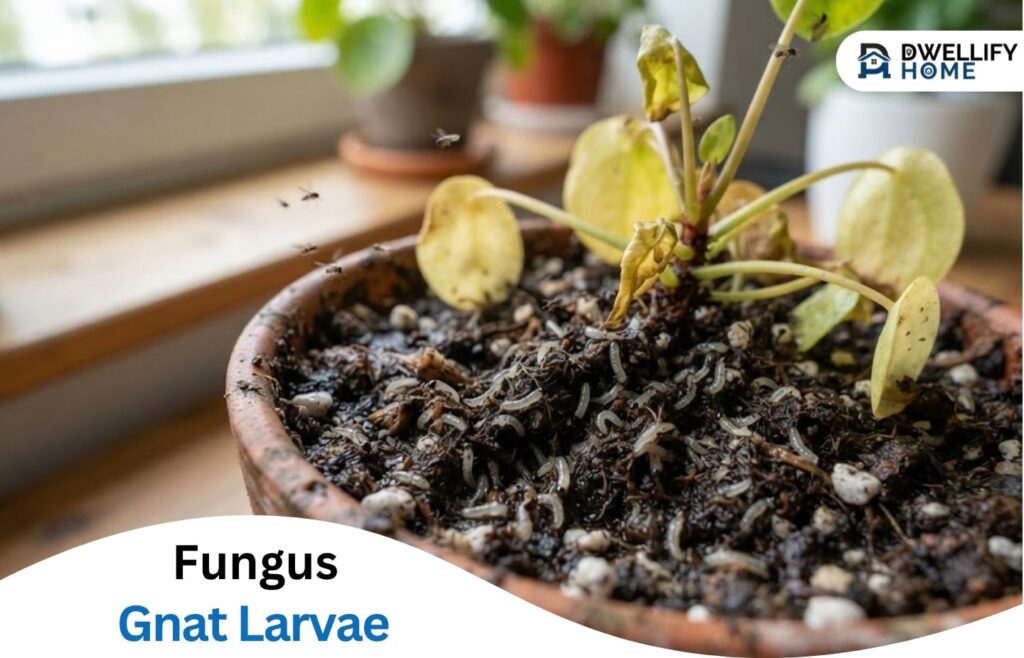
Tiny flies rise from the pot whenever you water. A sticky trap catches some, yet more appear a few days later. The next place to check is the potting mix, where fungus gnat larvae develop.
These pale, worm-like young insects can be easy to miss. To control them, address excess moisture, remove decaying debris, and use a suitable larval treatment when needed. Yellow sticky traps help you monitor the flying adults, but they cannot reach larvae in soil.
Start by confirming what you have. That small check can save you from treating harmless soil organisms or drying out a plant that needs steady moisture.
Direct Answer
Fungus gnat larvae are small, pale, legless insects with dark heads that live in damp potting mix. They feed on fungi and decaying material and can damage roots when populations are high.
Practical Home Tip
A full sticky trap can make progress hard to judge. Date a fresh card and compare new catches alongside soil checks. Traps catch adults, so they cannot confirm that the larvae are gone.
Mission Statement
At DwellifyHome, we help homeowners and renters care for their homes with confidence. Our practical guidance supports informed choices for comfortable, stylish spaces that fit everyday needs.
SERP Enhancement Elements — Action Checklist
- Confirm the larvae using their body shape and dark head.
- Check pots, drainage, and damp debris.
- Adjust watering to suit the plant.
- Use a suitable larval treatment when needed.
- Monitor adults and follow the treatment schedule.
- Recheck nearby pots if gnats keep returning.
What Do Fungus Gnat Larvae Look Like?
Look for a slender, legless body with a shiny black head. The body is whitish or nearly clear. Mature larvae may reach about ¼ inch, roughly 6 mm, while younger ones are much smaller. You can see larger larvae without a microscope, though a hand lens helps.
Search the damp potting mix near the surface and around decaying plant material. The adults are small, dark flies that resemble tiny mosquitoes. Larvae crawl through their surroundings and have no wings.
For a simple check, place a small piece of raw potato cut-side down on the soil. Check underneath after about two days for feeding larvae. Remove the piece after checking; it should not become another bit of rotting material in the pot. Finding larvae supports identification, but one empty check does not rule them out.
Several other small organisms can share a pot:
| Organism | Useful clues |
| Fungus gnat larvae | Pale, slender bodies with a distinct dark head; no legs or wings |
| Springtails | Tiny creatures that often jump when disturbed, especially after watering |
| Pot worms | Small, pale, segmented worms related to earthworms; they can also live in moist organic material |
Springtails rarely harm indoor plants. Pot worms help break down organic matter, so a white body alone is not a reason to treat the soil. Use several clues together, including movement and the larva’s dark head.
A clear close-up photo can help with identification. Include something for scale, such as a ruler beside the sample. Organisms found swimming in standing water need their own identification before you choose a treatment.
How to Get Rid of Fungus Gnat Larvae
Work through the growing conditions and the insects together. A treatment may reduce larvae, but the same damp breeding conditions can keep the problem going.
Check Pots, Drainage, and Damp Debris
Inspect nearby plants as well as the pot where you first noticed flies. Watch the soil surface during normal watering, and use sticky cards to help locate activity.
Check these places:
- Water left inside saucers or decorative outer pots.
- Fallen leaves resting on the soil.
- Decaying roots, bulbs, or other plant material.
- Potting mix that remains wet well beyond the plant’s needs.
Empty collected runoff and remove loose dead material. Make sure water can leave the growing pot. A drainage hole offers little help when the pot sits in a pool of water inside a cover pot.
When activity does not seem connected to plants, check other damp organic debris. Fungus gnats can breed in moist buildup beyond plant pots, including some drains. Confirm the source before treating more plants.
Adjust Watering to Suit the Plant
Allow the surface of the potting mix to dry between waterings as much as the plant can tolerate. For many houseplants, drying the upper inch or two helps reduce favorable conditions. This is not a rule to let every root ball become bone dry.
Check moisture before reaching for the watering can. Avoid adding small amounts of water each day simply because the surface looks slightly lighter.
A moisture-loving plant needs a different approach from one that tolerates longer dry periods. Stop short of wilting or visible stress. When safe drying is limited, correcting drainage and choosing a larval control become more important.
Coordinate watering with your chosen treatment. Beneficial nematodes, for example, have moisture needs of their own.
Choose a Treatment That Targets Larvae
Bti is short for Bacillus thuringiensis subspecies israelensis. It is a bacterial insecticide used against certain fly larvae, including fungus gnats. Look for the full active ingredient and a label that covers your intended plant and use.
A package that says only “Bt” may contain a different strain. Products sold for caterpillars are not interchangeable with Bti products for fungus gnats.
Mosquito Bits is one labeled option in the United States. Its linked specimen label describes mixing four tablespoons into one US gallon of water, soaking for 30 minutes, removing the granules, and applying the treated water to the growing medium. It calls for weekly treatment for three weeks.
Follow your own package label if its directions differ. That example is specific to Mosquito Bits; it is not a mixing recipe for Gnatrol, Mosquito Dunks, or every product containing Bti. Observe the label’s handling precautions, including avoiding dust and contact with skin or eyes.
Gnatrol is another Bti product, but its formulation and directions must be checked separately. A soil drench simply means applying a prepared treatment to the potting mix. Do not substitute a leaf spray for a labeled soil application.
Another option is Steinernema feltiae, a species of beneficial nematode. These microscopic worms infect fungus gnat larvae. Buy a product intended for the pest and follow its storage, mixing, and application instructions.
Nematodes are living organisms with a limited storage life. They need moist growing medium to work, while waterlogging can also harm them. Letting the pot dry hard immediately after application can undermine the treatment.
Choose an approach that fits your plants and care routine. For a small collection, consider whether you can use a live product before it expires. You do not need to buy every available control.
| Method | Main role | Main limitation |
| Watering and drainage changes | Reduce favorable breeding conditions | Must suit the plant |
| Labeled Bti treatment | Target larvae in growing medium | Product-specific preparation and repeat directions |
| Beneficial nematodes | Infect larvae in the soil | Require correct handling and moisture |
| Yellow sticky traps | Catch and monitor adults | Do not directly control larvae below the surface |
Trap Adults and Follow the Treatment Schedule
Place yellow sticky cards near the soil and within the lower plant canopy, following the trap instructions. Keep the adhesive clear of leaves.
Use the cards to monitor adult activity while you address larvae. Replacing a crowded trap gives you a clearer starting point for counting new catches.
Write down the date, the plant treated, and the product used. Follow the labeled repeat schedule instead of stopping after one quiet day or adding extra applications whenever a fly appears.
Before each treatment, check the plant’s condition. More frequent application is not automatically better. A plant already sitting in wet soil needs its growing conditions reviewed, not an unplanned extra soaking.
What About Neem Oil and Hydrogen Peroxide?
Neem products differ. Some neem-based insecticides are labeled for soil applications against larvae, while neem oil products may work differently. The active ingredient and labeled use matter more than the word “neem” on the front.
Check whether the product covers fungus gnats and the intended soil treatment. Spraying neem oil over the leaves does not establish that you have treated the larvae below them. Avoid turning a product intended for one application into a homemade drench.
Hydrogen peroxide advice needs more care than many online recipes suggest. Cornell Cooperative Extension describes a diluted household-peroxide treatment for larvae. However, that guidance does not establish that every plant, potting mix, or repeated application will respond safely and reliably.
Bubbling also should not be your measure of success. Check for continuing larvae and adult activity over time.
For a beginner, a product with specific fungus-gnat directions is a clearer starting point than repeatedly adjusting a homemade mixture. Whatever approach you choose, first check the source of the problem and the moisture conditions.
Avoid combining peroxide, neem, soaps, or other treatments into one improvised mix. Adding more ingredients makes the result harder to judge. Keep the treatment simple enough that you can follow its directions and tell whether it helped.
Are Fungus Gnat Larvae Harmful to Plants or People?
Most ordinary houseplant infestations are mainly a nuisance. Larvae feed on fungi and decaying organic matter, but they can also damage roots. Heavy populations are more concerning around seedlings, cuttings, and other vulnerable plants.
Yellow leaves, poor growth, or wilting deserve attention, but they do not prove larval damage. Excess water, poor drainage, and root disease can produce similar symptoms. Check the root zone and growing conditions before deciding the gnats caused the decline.
A few adults around an otherwise healthy plant are a reason to inspect and monitor. They are not, by themselves, a reason to throw the plant away.
Neither fungus gnat larvae nor adults bite humans. Their presence around houseplants is a plant-care and nuisance issue. Identifying them correctly helps keep the response proportionate.
The treatment still needs sensible handling. Keep products in their original containers and follow directions for use around children and pets. “Biological” describes a type of control; it does not remove the need to read precautions.
Why Do Fungus Gnats Keep Coming Back?
Fungus gnats pass through eggs, larvae, pupae, and adults. The pupa is the stage between the feeding larva and the flying adult. Several stages can be present in one pot at the same time.
That helps explain why you may still see adults after applying a treatment aimed at larvae. Continued flight does not tell you, on its own, whether the whole plan has failed.
Work through a few practical questions:
- Did you check every nearby pot?
- Did the product target larvae and reach the intended growing medium?
- Were repeat applications completed as directed?
- Is water collecting somewhere you missed?
- Did new plants or potting materials introduce another source?
For progress checks, compare similar observation periods. A trap left in place for a month cannot fairly be compared with one installed yesterday. Date fresh cards and note new catches over the same number of days.
Repeat a soil check when needed. A falling adult count, fewer larvae found, and stable plant growth together give a more useful picture than one quiet afternoon.
Prevention also means adjusting care as conditions change. Plants may use less water during cooler, darker months, so a summer watering routine can leave the mix wetter for longer. Check each pot instead of following the calendar alone.
Inspect incoming plants, remove dead leaves, and keep stored potting mix protected from moisture and contamination. If activity persists despite correct treatment, ask your local Extension office for help identifying the insect and locating its source.
Frequently Asked Questions
How Long Does a Fungus Gnat Infestation Last?
An infestation can continue while suitable breeding conditions remain. Plan to monitor over several weeks rather than expect every fly to disappear after one application.
At around 65–75°F, the life cycle can take about three to four weeks. That is not a guaranteed treatment deadline. Product directions, growing conditions, and continuing sources determine what follow-up is needed.
How Long Can Fungus Gnat Larvae Survive in Dry Soil?
There is no single reliable number for every pot. Moisture below the surface, drying conditions, and the insect’s stage all affect what happens.
Drying the surface can make conditions less favorable, but it does not prove the whole pot is clear. Base watering on the plant’s needs and use monitoring to judge progress. Do not keep withholding water just to reach an arbitrary number of days.
Should You Repot a Plant With Fungus Gnats?
Repotting with fresh mix can help, especially when the old medium retains too much moisture or contains decaying material. It is not necessary for every affected plant.
Consider the plant’s condition before disturbing its roots. Use a clean container and suitable fresh mix when repotting is warranted. Continue monitoring afterward, since other affected pots or unchanged watering habits can allow the problem to return.
What Eats Fungus Gnat Larvae?
Some soil-dwelling predatory mites, including Stratiolaelaps scimitus, and rove beetles feed on the larvae. Beneficial nematodes such as Steinernema feltiae control them by infecting them.
These organisms have different care and application needs. For a home plant collection, choose a biological control intended for your situation rather than assuming any beneficial insect will solve the problem.
Why Are Fungus Gnat Larvae Moving Together Outdoors?
Some dark-winged fungus gnat larvae form unusual moving groups that resemble a thin, living rope. These masses may appear near wooded areas or cross paths during wet conditions.
This outdoor behavior is different from the usual houseplant problem. The larvae live in decomposing organic material, and these moving groups generally do not need treatment.
Keep the Problem Under Control
Begin with a careful look at the soil, then choose a response that suits both the pest and the plant. Correct persistent moisture, use a suitable larval treatment when needed, and track new adult activity.
A dated trap and a few notes can make follow-up much clearer. Give the chosen method its proper schedule, protect the plant’s health, and investigate the source again when progress stalls.
Disclaimer
This information is general guidance. Homes, plants, needs, and budgets vary. Follow product labels and contact a local Extension service or qualified pest professional if identification or treatment is unclear.