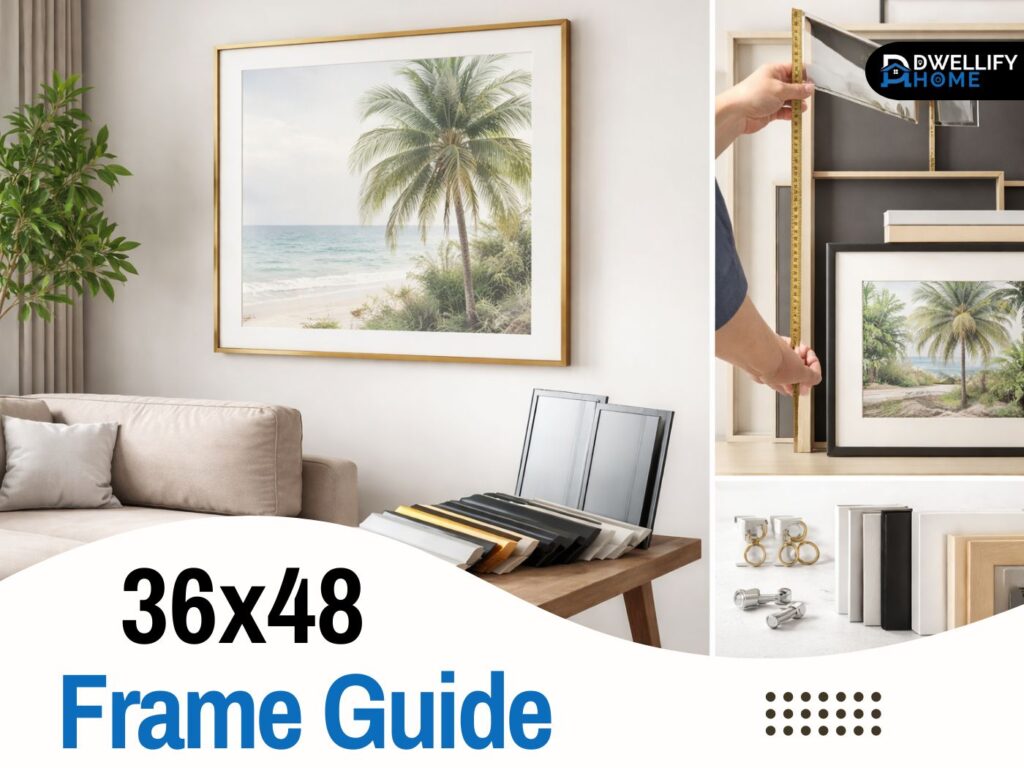
A 36×48 frame is a big, confident piece on a wall. When it’s done right, it looks intentional and balanced. When it’s done wrong, it can feel awkward, heavy, or a little off even if the art itself is great.
In my framing work, this size comes up a lot for movie posters, oversized photography, announcements, and large prints. The good news is that you don’t need fancy design skills to make it look good. You just need to understand the sizing, the frame type, the glazing, and how to hang it safely.
This guide walks you through the choices that matter, with the same advice I give clients before I ever pick up a tape measure.
Snippet-ready definition:
A 36×48 frame is an oversized frame for large posters, prints, or canvas art. The best choice depends on fit, mat opening, glazing (acrylic vs glass), backing strength, and safe wall mounting.
36×48 Frame Size Basics (Make Sure It Actually Fits)
A common mistake is assuming every “36×48” product means the exact same thing. In framing, the label usually refers to the size of the art or poster that should fit inside, but the actual viewable opening can be slightly smaller because many frames overlap the edges.
That overlap is normal, but it matters. If your poster has important text right near the border, a frame with a deeper lip can cover it. When I’m framing concert posters, I always check edge details first because those designs love to run to the corners.
Also, keep orientation in mind. You’ll see 36×48 and 48×36 used interchangeably. It’s the same size, just portrait versus landscape. Before buying, decide how it will hang on the wall and whether your hardware supports both directions.
36 x 48 frame in cm
If you’re buying outside the US or ordering prints from international shops, it helps to know the metric size. A 36 x 48 frame in cm is 91.44 x 121.92 cm. That’s useful when a listing is only in centimeters or when you’re comparing options in Europe.
One more tip from experience: if your print is slightly off, even by a few millimeters, it can ripple or bow. For large sizes, accuracy matters more than people expect.
Quick Guide Table: What to Choose (Fast Comparison)
| What you’re framing | Best frame type | Mat? | Glazing | What to watch for |
| Paper poster you’ll keep up | Standard poster frame | Optional | Acrylic | Check “viewable area” so edges don’t get covered |
| Posters you change often | Snap or quick-change frame | No | Acrylic | Needs solid wall anchors and a straight frame profile |
| Photo print for a living room | Art/print frame (sturdy) | Often yes | Acrylic or glass | Acid-free mat, rigid backing to prevent ripples |
| Stretched canvas | Floater or deep canvas frame | No | None | Confirm canvas depth so it doesn’t sit proud |
| Hallway or high-traffic area | Sturdy frame with safer front | Optional | Acrylic | Lighter weight and less break risk than glass |
Step-by-step buying checklist (simple and practical)
- Measure your art first
Make sure your poster or print is truly 36 x 48 (or note any slight variation). - Confirm the opening
Many frames overlap edges. If your poster has text near the border, check the “viewable area.” - Decide on matting
A 36×48 frame with mat often fits a smaller print inside. Always check the mat opening size. - Pick the glazing
Acrylic is lighter and safer for big frames. Glass is harder to scratch but heavier. - Look for strong backing and corners
Weak backing causes sagging. Poor corners make frames go out of square over time. - Plan safe hanging
Use two strong hanging points (D-rings preferred) and wall anchors rated for the weight. - Choose where to buy based on your goal
IKEA and Michaels can be convenient, while local frame shops help with special mat cuts or canvas depth.
Types of 36×48 Frames (Pick the Right One for Your Goal)
Not every frame is built for the same job. The right choice depends on what you’re framing and how often you plan to change it.
A standard poster frame is fine for a paper poster that will stay put. It’s usually lightweight, simple, and easy to hang. But if the frame is very thin and the backing is weak, the middle can sag over time. I’ve seen that happen most in humid homes or near kitchens.
For long-term wall art, an art frame with sturdier backing and a more solid build is worth it. It feels more stable and usually keeps the print flatter. If you’re framing a large photo print, this is the direction I’d go.
Snap frames and quick-change frames are a different category. They’re made so you can swap posters without taking the frame off the wall. I use them often in offices, cafés, and studios. They aren’t always the prettiest option for a living room, but for rotation and convenience they do the job well.
Top-load or side-load display frames are also built for quick updates. They can be useful if you want a clean look but still need to change the display occasionally.
If you’re framing canvas, that’s its own decision. A 36×48 canvas frame needs to account for depth. Many stretched canvases are deeper than paper prints, and they often look best in a floater style frame where the edge of the canvas is visible and the gap looks intentional.
Mat or No Mat? (When a Mat Makes Your Frame Look Premium)
A mat changes how the art feels on a wall. It creates breathing room, gives a cleaner border, and can make even a simple print look more finished. It also helps when the edges of the poster are a bit rough or slightly uneven.
The key is understanding what “with mat” really means. A 36×48 frame with mat often has a smaller opening cut into the mat. That means it’s designed to display a smaller print inside the larger frame. This is common with ready-made frames because it allows the manufacturer to serve more use cases with one product.
36×48 frame with mat, how it works
In real homes, mats solve a few common problems. If a poster looks too “floaty” in a large frame, a mat helps anchor it visually. If the colors in the poster are busy, a white or off-white mat can calm the whole presentation.
When picking a mat, pay attention to thickness and quality. Cheap mats can yellow over time, and thin mats can warp in humid rooms. If the artwork matters to you, choose an acid-free mat. It’s not a luxury detail, it’s basic protection.
Materials & Finishes (Looks, Weight, and Longevity)
Material affects the look, the weight, and the long-term stability. With large frames, it’s not just about style.
Wood frames feel warm and home-friendly. They tend to look good in living rooms and bedrooms because they don’t read as “commercial.” The downside is that very thin wood profiles can twist if the wood isn’t well seasoned or if the home has big humidity swings.
Aluminum and metal frames are often straighter and more consistent. That’s one reason they show up so often in display frames and snap frames. They also tend to be lighter than thick wood, which helps with mounting.
Finish is where taste comes in, but there are practical notes too. A 36×48 frame gold can look great when the room already has warm metals like brass fixtures or warm wood tones. In cooler modern rooms, gold can still work, but it usually looks better when it’s muted, not overly shiny.
Black is the safest choice for contrast and crisp edges. White can look clean, but it shows marks more easily. Natural wood tones are forgiving and tend to blend well with most spaces.
Glazing Options (Glass vs Plexiglass or Acrylic, What’s Best for 36×48?)
For a frame this size, glazing choice matters more than most people think. It affects weight, safety, glare, and clarity.
Glass is scratch-resistant and can look very clear. But at 36×48, glass gets heavy, and it can be risky in a busy hallway, near kids, or in an area where doors swing open. I’ve replaced broken glass in large frames more times than I’d like, and it’s never fun.
Acrylic glazing, often called plexiglass, is lighter and safer. That’s why it’s common in oversized frames shipped online. The trade-off is that acrylic can scratch if you clean it with the wrong cloth or use harsh sprays. A soft microfiber cloth and a gentle cleaner made for acrylic is the safer approach.
If the frame will face a window or strong lighting, consider an anti-glare option. And if the art is a poster you want to keep looking fresh, UV protection helps reduce fading. These upgrades are especially useful in bright rooms or offices with overhead lighting.
Quality Checklist (How to Avoid Warping, Sagging, and Cheap-Looking Frames)
Big frames reveal weaknesses. If the build is poor, you’ll notice it fast.
Start with the backing. A rigid backing board keeps the art flat and supports the frame. Thin backing can bow and create waves in the poster, especially in humid homes.
Then check the corners. Good corner joins keep the frame square. When corners are weak, the frame slowly shifts out of square, and you’ll see gaps or uneven alignment.
Hardware is another deal breaker. For this size, I prefer two strong hanging points, like D-rings, rather than a single sawtooth hanger. If the frame uses wire, it should be thick and properly anchored. In rentals, you can still hang safely, but you need the right anchors for drywall.
Finally, look at the frame profile. Ultra-thin frames can look sleek, but if they’re too thin for the size, they often flex. A slightly wider profile usually looks more intentional and holds up better.
Where to Buy a 36×48 Frame (Online vs Local, Best Places by Need)
Where you buy depends on your priorities. If you want quick and affordable, big-box stores can be fine. If you want specialty display features, dedicated framing retailers often have more options.
A 36 x 48 frame IKEA option can be a practical pick if you like modern styling and simple finishes. Availability varies by location, and some lines come and go, so it’s worth checking what’s actually in stock.
A 36×48 frame Michaels option can be useful when you want local pickup, frame sales, and easy returns. Craft stores also make it easier to grab accessories like foam backing, wall hooks, and picture wire if you need upgrades.
Online specialty shops are often better for snap frames, top-load frames, and frames with mat choices already prepared. If you’re ordering online, pay attention to the glazing type, the viewable area, and shipping policies for large items.
If you prefer to buy locally, searching for a 36×48 frame near me can lead you to print shops, frame shops, and even office supply stores. Local framing shops are also helpful when you need a custom depth for canvas or you want a premium mat cut to a specific print size.
Budget Picks (Cheap 36×48 Poster Frame Without Regret)
A 36×48 poster frame cheap option can work well, as long as you’re honest about the use. If it’s for a temporary poster in a low-risk room, a basic frame with acrylic can be a sensible choice.
Where cheap frames usually fail is in backing and corners. If the backing is flimsy, the poster starts to ripple. If the corners aren’t tight, the frame looks uneven. Those are the details that make a big frame look “off” from across the room.
If you’re trying to keep costs down, spend on the parts that matter most:
- Choose stronger backing, even if you add it yourself
- Pick acrylic over glass for safer handling
- Use proper anchors for the wall so the frame stays level
A quick-change snap frame can also be cost-effective over time if you plan to rotate posters often. You pay a bit more upfront, but you avoid buying multiple frames.
Canvas & Oversized Art Tips (How Pros Make Large Pieces Look Right)
Canvas changes the planning. A stretched canvas has depth, and many standard frames aren’t built to accommodate that thickness. That’s why a 36×48 canvas frame is often a floater style, where the canvas sits inside with a small gap around it.
When I install large canvas pieces, I pay attention to wall proportion first. A big canvas above a sofa should usually be centered and placed with enough breathing room above and below. If it’s too high, it feels disconnected. If it’s too low, it competes with furniture lines.
Leveling matters more at this size. Even a slight tilt looks obvious. I like using a level during installation, and I double-check by stepping back across the room. Your eyes will catch what the measuring tape doesn’t.
Styling Ideas (Make a 36×48 Frame Look Expensive in Any Room)
This part isn’t about trends, it’s about balance. A frame this large can look polished with just a few thoughtful choices.
First, let the wall breathe. If the frame is squeezed between shelves and lamps, it can feel crowded. Give it space so it reads as a focal point.
Second, match the frame finish to something already in the room. If you pick a 36×48 frame gold, it helps when there’s already warm metal in lighting, mirror frames, or hardware. If the room is cool-toned, black, white, or brushed metal often blends better.
Finally, watch glare. If you hang it opposite a window, you’ll get reflections. Sometimes the easiest improvement is changing the location by a few feet or switching to anti-glare glazing.
Quick FAQs
Is 36×48 a standard poster size?
Yes, it’s a common large format size, especially for posters, photography prints, and signage. Just confirm whether your poster is a true 36×48 or slightly smaller.
What size print fits a 36×48 frame with mat?
It depends on the mat opening. Many pre-matted frames are designed to fit smaller prints, so always check the opening size listed, not just the outer frame size.
Should I choose 48×36 or 36×48?
Same dimensions, different orientation. Choose based on how your artwork is designed to hang.
Is plexiglass better than glass for large frames?
For most homes, acrylic is safer and easier to handle at this size. Glass can look great, but it’s heavier and riskier in high-traffic areas.
Can I hang a 36×48 frame without studs?
Yes, if you use proper drywall anchors rated for the frame’s weight. Use two anchor points whenever possible to prevent swinging and tilting.
What’s the best frame type for swapping posters often?
A snap frame or a top-load style is built for quick updates without constant re-framing.
Conclusion: Final Checklist for Buying the Right 36×48 Frame
If you want a large frame to look calm and intentional on your wall, focus on fit, structure, and safe mounting. Measure the artwork, confirm the viewable area, and decide whether a mat will improve the look. Then choose a material and glazing that suit the room and the traffic level.
For most homes, I’d rather see a slightly sturdier frame with acrylic glazing and strong backing than a thin frame that looks sleek but flexes over time. And when you hang it, use two solid mounting points and anchors that match your wall type.
Once those basics are right, the rest becomes easy. The art sits flatter, the frame stays level, and the whole piece looks like it belongs there, not like it was squeezed in as an afterthought.
Disclaimer:
This guide shares general framing and installation advice based on real-world framing practice. Wall types and frame weights vary, so always follow the hardware manufacturer’s weight ratings and consult a professional installer for heavy or high-risk placements.

I’m Bilal Hassan, the founder of Dwellify Home. With 6 years of practical experience in home remodeling, interior design, and décor consulting, I help people transform their spaces with simple, effective, and affordable ideas. I specialize in offering real-world tips, step-by-step guides, and product recommendations that make home improvement easier and more enjoyable. My mission is to empower homeowners and renters to create functional, beautiful spaces—one thoughtful update at a time.