There’s something satisfying about walking into a room and immediately knowing where your eyes should land. A well-chosen feature wallpaper does exactly that. It gives the space a clear focal point, adds depth, and often makes a room feel more finished than paint alone.
I’ve used statement wallpapers in everything from compact bedrooms to busy family living rooms and small commercial spaces. The best results always come from the same basics: choosing the right wall, balancing pattern with the rest of the room, and taking lighting and surface prep seriously. This guide walks you through it step by step, without overcomplicating things.
Snippet-ready definition:
Feature wallpaper is wallpaper used on one main wall to create a focal point. People use it to add pattern, texture, and mood without covering every wall, making a room feel more designed and balanced.
Mission Statement:
At Dwellify Home, our mission is to help everyday homeowners create stylish, comfortable spaces with practical design advice you can actually use, from simple upgrades to confident room-by-room decisions.
What Is Feature Wallpaper (and Why It Works)
A feature wall is one wall you intentionally highlight to draw attention, create mood, or anchor the layout. When you use wallpaper on that wall, you get more than color, you get pattern, texture, and movement. That’s why wallpaper can add “personality” faster than almost any other finish.
Feature wallpaper works especially well when a room needs structure. Think of a long living room that feels a bit empty, a bedroom that needs a calmer headboard zone, or a hallway that feels like a plain corridor. One strong wall can make the whole space feel designed, not just decorated.
It’s also a great way to bring in a style you like without committing to four walls. If you love bold botanicals or a geometric print, one wall lets you enjoy it without overwhelming the room.
Quick Guide Table (comparison)
| Space | Best feature wall | Safer wallpaper style | One practical tip |
| Living room | Behind sofa or fireplace | Subtle geometric, texture-look | Avoid busy prints behind TVs |
| Bedroom | Behind the bed/headboard | Calm patterns, matte finishes | Keep bedding simpler if wallpaper is bold |
| Bathroom | Dry-zone wall, away from splashes | Washable/vinyl where suitable | Good ventilation matters more than pattern |
| Hallway | First wall you see | Durable, wipeable finishes | Choose mid-tone patterns to hide scuffs |
Quick bullet checklist (easy action steps)
- Choose the wall your eyes naturally land on when you enter the room
- Order samples and check them in morning and evening light
- Keep other walls quieter if the wallpaper has a strong pattern
- Prep the wall properly (smooth, clean, primed) before hanging
- Use a plumb line for the first drop and take seam alignment slowly
How to Choose the Right Wall for a Feature Wallpaper
Start with the wall that already wants attention. In most homes, there’s a natural focal point: the wall behind the sofa, the fireplace wall, the headboard wall, or the first wall you see when you walk in. When you work with what the room is already doing, the wallpaper looks intentional rather than forced.
One of my favourite simple tests is this: stand in the doorway and notice where your eyes go first. If that wall is fairly clean and not chopped up by too many doors or windows, you’ve probably found your feature wall.
Feature wallpaper can also help “zone” open-plan spaces. A dining area inside an open kitchen can feel like it’s floating. A wallpapered dining wall gives it a boundary and makes the table area feel like a proper room.
A few quick “don’ts” that save people money and frustration:
- Don’t pick a wall with lots of awkward breaks: multiple doors, deep alcoves, heavy shelving.
- Don’t choose a wall that’s already visually busy, like a gallery wall packed with frames.
- Don’t feature the wall you constantly block with tall furniture, unless the wallpaper is meant to sit above it.
Feature Wallpaper Ideas by Room
Feature wallpaper living room
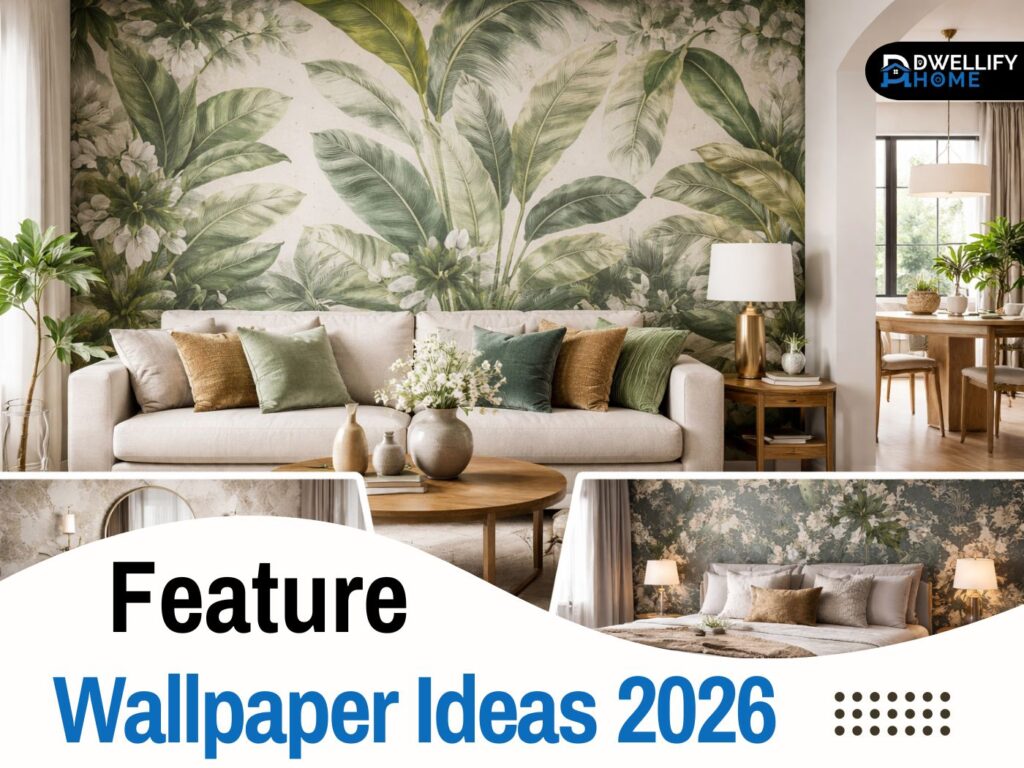
In a living room, the goal is usually to anchor the seating area. The most common choice is the wall behind the sofa, especially if your sofa is long and the wall is plain. Another strong option is the fireplace wall, because it’s already a focal point and wallpaper can make it feel more architectural.
If the TV is on the wall, be careful. A high-contrast pattern behind a TV can feel visually noisy, especially at night. In those cases, I lean toward softer textures, subtle geometrics, or a mural with a calm background so the screen doesn’t fight the wall.
A real-world example: I worked on a family living room where everything felt beige and flat. We wallpapered the sofa wall with a warm, textured linen-effect print, then repeated one colour from the wallpaper in cushions and a throw. The room didn’t need new furniture, it just needed a stronger backbone.
Practical living room tips that work in most homes:
- If you have bold wallpaper, keep the other walls quieter and let the feature wall lead.
- Pull one or two colours from the wallpaper into cushions, art, or a rug.
- If your living room gets little daylight, avoid very dark glossy prints unless you balance with warm lighting.
Feature wallpaper bedroom (including wallpaper in bedroom on one wall)
In bedrooms, the classic approach is wallpaper in bedroom on one wall, usually behind the bed. It reads like a headboard, frames the bed, and it looks good even when the room is messy, because the focal point stays clear.
For a calm bedroom, look for soft contrast, gentle pattern, and matte finishes. For a more dramatic feel, deeper tones can work beautifully, but only if the lighting is layered. One ceiling light alone rarely does dark wallpaper justice.
Here’s a common scenario I see: someone chooses a busy pattern and then adds patterned bedding, heavy curtains, and lots of small decor. The room starts to feel restless. A bedroom should feel like it’s letting you exhale. If your wallpaper has a strong pattern, keep bedding simpler and let texture do the work.
Easy bedroom wins:
- Put the feature wall behind the bed if possible, it’s the most forgiving placement.
- Choose pattern scale based on distance: small bedrooms often look better with medium-scale prints than tiny busy repeats.
- If you want colour, repeat it softly elsewhere, like a cushion or lampshade, not in five different items.
Feature wallpaper bathroom
Feature wallpaper bathroom projects can look incredible, but the practical side matters more here than in any other room. Humidity, ventilation, and where water splashes will decide whether it lasts.
If you have a powder room or a guest toilet with good ventilation, wallpaper is usually a safe choice. In a full bathroom, I treat wallpaper like a “dry-zone finish.” It can work well on a wall away from the shower or above panelling, but it’s risky in constant splash areas.
The material matters too. A good-quality vinyl wallpaper or a wallpaper with strong washability ratings is usually a smarter choice than delicate paper in a humid room. And even then, the wall prep and adhesive choice have to be right.
A simple rule I use with clients: if the wall regularly gets wet enough to wipe with a towel, wallpaper doesn’t belong there. But if it’s mainly steam and occasional splashes, and you have decent extraction, a feature wall can work.
Modern Feature Wallpaper Styles (What People Want in 2026)
Modern feature wallpaper has moved toward texture, calm colour palettes, and patterns that feel architectural. That doesn’t mean everything is minimal. It just means even bold designs tend to feel more considered.
Styles that consistently work in real homes:
- Geometric wallpaper in softer tones for a clean, modern feel
- Abstract lines or subtle repeats that add movement without shouting
- Mural wallpaper for a single wall, especially behind beds or in dining areas
- Texture looks like plaster-effect, linen-effect, or grasscloth-look alternatives
- Marble effect wallpaper when you want a polished look without the cost of stone
- Brick-effect or concrete-effect wallpaper in home offices and loft-style spaces
Feature wallpaper gold finishes are still popular, but the trick is restraint. A little metallic can make a room feel warmer and more layered, especially in lamp light. Too much gold in a small room can read harsh or dated.
If you like metallics, my practical advice is to choose a design where gold is a highlight, not the whole story. Then keep nearby finishes simple, like matte paint and natural wood.
How to Match Feature Wallpaper with Colour, Lighting, and Furniture
This is the part that makes wallpaper look expensive. Most “it looked better online” moments come from ignoring undertones and lighting.
Start by pulling one or two colours from the wallpaper and using them elsewhere. That could be a paint colour on the other walls, a rug detail, or a couple of cushions. You’re building a small colour family so the wallpaper belongs in the room.
Lighting changes wallpaper more than people expect. In north-facing rooms, colours can look cooler and flatter. Warm bulbs can bring back softness, but they can also turn crisp whites into creamy tones. That’s why samples are so important. Tape them up and look at them in the morning, afternoon, and evening.
Pattern scale is another big one. Large patterns can look amazing, but only if you’ll actually see enough of the print to understand it. Tiny, busy repeats can make small rooms feel restless. When I’m unsure, I choose a medium-scale pattern because it tends to be the easiest to live with.
A few designer rules that save time:
- If the wallpaper is bold, keep large furniture shapes simple.
- If furniture is already busy, choose a calmer wallpaper texture.
- Use trim and paint to frame the wallpaper if you want a more tailored look, especially in period-style homes.
Feature Wallpaper UK Buying Guide (Simple Checklist)
If you’re choosing feature wallpaper UK options, you’ll see a mix of traditional papers and paste-the-wall wallpapers. Paste-the-wall, usually non-woven, is often easier to hang and remove later, which makes it a popular choice for feature walls.
Before you buy, I suggest a quick checklist:
- Order samples and view them in your room lighting
- Check roll size and coverage so you don’t under-order
- Look at pattern repeat and match type, it affects waste and installation difficulty
- Confirm washability if it’s going into a busy area like a hallway or family room
- For bathrooms, only choose wallpaper suitable for humid spaces and place it in a drier zone
Budget-wise, it’s often worth spending more on the wall you’ll see most. If it’s the first wall you see when entering the room, quality shows. On a tucked-away wall, you can often choose a simpler option without losing impact.
Installation Basics (Beginner-Friendly, No Overload)
Wallpaper looks like a design decision, but it’s also a technical finish. When it fails, it usually fails at the seams, corners, or edges, and it’s nearly always because of poor prep or rushed alignment.
Start with the surface. Walls should be smooth, clean, dry, and properly primed. If the wall is dusty, flaky, or patchy, adhesive won’t bond evenly. I’ve seen beautiful wallpaper peel at the edges simply because someone skipped sanding and sealing after filling.
The key steps I always follow:
- Mark a straight plumb line for the first drop, don’t trust the corner
- Apply the correct paste for the wallpaper type
- Smooth from the centre outward to avoid bubbles
- Trim neatly at skirting and ceiling lines with a sharp blade
- Take your time on seam alignment, especially around pattern repeats
Tricky spots come up in almost every room. Sockets and switches need careful cutting and power safety. Radiators make it hard to get a clean line behind. Windows create pattern breaks that can look messy if you don’t plan the layout first. If you’re not confident, hire a professional for the first feature wall and learn from the process.
Maintenance and Longevity (Keep It Looking New)
Most wallpapers last well when they’re cleaned correctly. The mistake is scrubbing without checking the finish. Some wallpapers are wipeable, others are more delicate.
A safe approach is gentle cleaning with a soft cloth and minimal moisture. For washable or vinyl wallpaper, you can usually wipe light marks, but always test in a corner first. In high-touch areas like hallways, a more durable finish often pays off.
To prevent lifting seams, manage humidity and avoid soaking the edges during cleaning. If a seam starts to lift, fix it early with the right adhesive rather than pressing it back and hoping it stays. Small repairs are much easier than redoing a full wall.
Mistakes to Avoid (What Makes a Feature Wall Look Cheap)
Most “something feels off” rooms aren’t a wallpaper problem, they’re a planning problem.
Common mistakes I’ve seen, and how to avoid them:
- Choosing the wrong wall: pick the wall the room naturally points to, not the most convenient one
- Too many patterns: wallpaper, rugs, curtains, and bedding all competing at once
- Ignoring lighting: samples look different under warm bulbs and in low daylight
- Overdoing contrast in small rooms: a calmer background often looks more refined
- Rushing installation: the first drop sets everything, so take your time
- Using the wrong wallpaper in wet zones: bathrooms need careful placement and ventilation
If you fix these basics, your feature wall tends to look like it was done by a designer, even on a normal budget.
Quick Inspiration Sets (Fast Picks for Real Homes)
If you want a simple direction, these combinations work in a wide range of spaces:
- Modern and clean: soft geometric wallpaper with warm white paint and black accents
- Warm and cosy: textured wallpaper with oak tones, layered lamps, and neutral textiles
- Luxury touch: deep-toned wallpaper with small gold details, plus matte paint on the other walls
- Small room win: lighter background wallpaper, vertical pattern, and mirrors to bounce light
FAQ
Are feature walls still in fashion in 2025?
Yes. They’re still popular, but the look has shifted toward calmer patterns, texture, and more intentional placement instead of random “one-wall for the sake of it.”
Are feature walls outdated or trendy?
They’re trendy when they suit the room layout. If the wall choice is wrong or the pattern clashes with everything else, they can feel dated. Planning is what makes them look current.
What is the hottest wallpaper trend for 2025?
Texture-look wallpapers, soft geometrics, and mural-style feature walls are leading choices. Metallic accents are also in, but best used as a small highlight rather than all-over shine.
Where do I start wallpapering a feature wall?
Start with a straight plumb line near your chosen starting edge, not the corner. The first panel sets the whole wall, so take your time with alignment and smoothing.
Can I use feature wallpaper in a bathroom?
Often yes in a powder room or on a dry-zone wall. Avoid constant splash areas, pick a suitable washable finish, and make sure ventilation is good.
Conclusion
A feature wall should make your room feel calmer and more pulled together, not busier. The best results come from choosing a wall that already makes sense in the layout, then picking a pattern and colour that suit your lighting and furniture.
If you’re unsure, start with one clear focal wall and keep everything else simple. Order samples, view them at different times of day, and plan the placement before you hang the first drop.
Done well, feature wallpaper becomes the quiet “anchor” of the room. It’s the detail that makes the whole space feel intentional, and it keeps looking good long after the initial excitement wears off.
Disclaimer:
This guide is for general design and DIY information. Results can vary by wall condition, humidity, wallpaper type, and installation method. For electrical areas and complex installs, consider a qualified professional.

I’m Bilal Hassan, the founder of Dwellify Home. With 6 years of practical experience in home remodeling, interior design, and décor consulting, I help people transform their spaces with simple, effective, and affordable ideas. I specialize in offering real-world tips, step-by-step guides, and product recommendations that make home improvement easier and more enjoyable. My mission is to empower homeowners and renters to create functional, beautiful spaces—one thoughtful update at a time.