Getting a rug right in a lounge sounds simple until you actually try it. I’ve walked into plenty of living rooms where everything is nice, but the rug makes the space feel slightly off, like the furniture is floating or the room looks smaller than it should.
In this rug placement lounge guide, I’ll walk you through the same steps I use when I’m standing in a client’s living room with a tape measure and a clear plan. We’ll cover sizing, sofa and sectional layouts, TV setups, traffic flow, and a few fixes that help when the rug you own is not quite ideal.
Snippet-ready definition:
Rug placement lounge means positioning an area rug so it anchors your seating, supports walkways, and looks balanced with your sofa, chairs, and coffee table, without slipping or feeling too small.
Mission Statement:
Dwellify Home helps everyday homeowners make confident design decisions with practical, room-tested guidance that improves comfort, flow, and visual balance without overcomplicating the process.
The 60-Second Rug Placement Lounge Checklist (Start Here)
Before you move furniture, take one minute and decide what the rug is doing in the room. In most lounges, the rug’s main job is to connect the seating area so it feels like one intentional zone, not separate pieces scattered around.
Here’s the quick checklist I use on site:
- The rug should touch the main seating. Front legs on the rug is usually the sweet spot.
- The rug should feel centered to the seating zone, not necessarily centered to the whole room.
- Leave breathing room. A small border of visible floor around the rug looks cleaner than wall-to-wall coverage in most homes.
Also, think about safety. If the rug slides or the corners curl, it doesn’t matter how good it looks. A proper rug pad or gripper is part of good placement, not an optional extra.
Quick Guide Table: Rug Placement Lounge (Fast Decisions)
| Lounge size | Common rug size | Best placement | Quick note |
| Small | 5×7 or 6×9 | Coffee table zone + sofa front legs on rug | Keep walkways clear and avoid pushing rug to the wall |
| Medium | 8×10 | Sofa front legs on rug, chairs front legs on rug | Most flexible for everyday layouts |
| Large / open plan | 9×12+ | All main seating legs on rug | Helps define the lounge zone in open spaces |
Step-by-step (the method I use in real homes)
- Tape the rug size on the floor (painter’s tape) and walk your normal routes.
- Anchor to seating first, not the walls or the TV unit.
- Get front legs on the rug for the sofa and key chairs whenever possible.
- Stabilize the coffee table (all legs on the rug is best).
- Add a rug pad if there’s any sliding or corner lift.
Measure Your Lounge Properly (So the Rug Doesn’t Look Wrong)
Most rug problems come from guessing. When I’m helping a homeowner, I don’t start with rug patterns or color, I start with proportions. Measure the area where people actually sit and walk.
At minimum, measure your sofa width, the distance from the sofa to the coffee table, and the main walkway lines. If you have chairs, measure the full conversation circle, not just the sofa. This tells you how large the rug needs to be to hold the group together.
One practical trick that works every time is painter’s tape. Tape out the rug size on the floor, then walk through the room like you normally do. You’ll immediately notice if the taped outline blocks a walkway, feels too small under the sofa, or leaves the chairs stranded.
Rug Size Shortcuts That Work in Real Homes
Rug sizing doesn’t have to be complicated. In real lounges, you usually land in one of three categories: small, medium, or large. The goal is simple, your rug should look like it belongs to the seating area, not like a bath mat placed in the middle of the room.
A simple size guide that actually works
In a smaller lounge, a 5×7 or 6×9 can work, but it has to be placed with intention. If the rug is small, I often keep it closer to the coffee table zone, and make sure the sofa’s front legs still touch the rug so it feels anchored.
In a medium living room, an 8×10 is often the most flexible option. It usually lets you get the sofa’s front legs on the rug, gives the coffee table a stable base, and still leaves a clean border of floor around the edges. That balance is why 8×10 rug placement in living room setups is so common in professional layouts.
In large lounges or open-plan spaces, a 9×12 or larger is usually the right move. When the rug is big enough for more furniture legs to sit on it, the space feels calm and finished. It also helps define the lounge zone when the living room blends into dining or kitchen areas.
Rug Placement Lounge Ideas: The 5 Layouts That Always Look Good
When homeowners tell me, “I just want it to look normal and put together,” these are the five layouts I show them. They’re simple, and they work across most furniture styles.
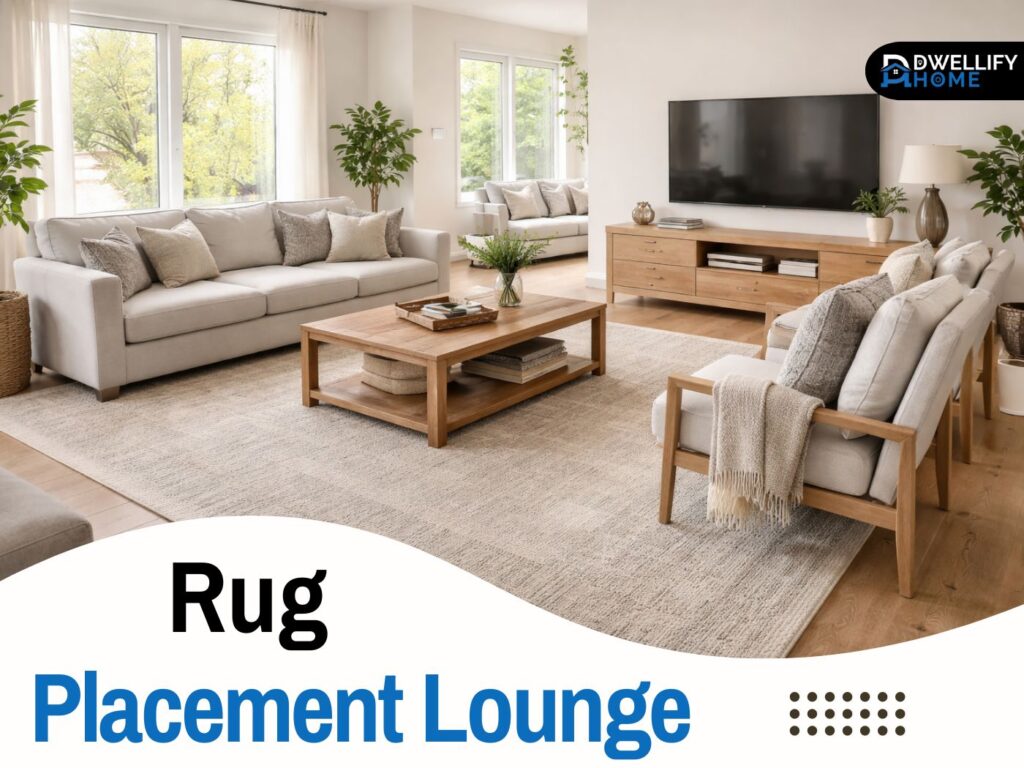
All legs on the rug is the cleanest option when the room is large enough. The entire seating group sits on the rug, and it looks cohesive from every angle. If you have space, this one makes the lounge feel like a designed set.
Front legs on the rug is what I use most often in real homes. The sofa and chairs place their front legs on the rug, while the back legs stay on the floor. It creates connection without forcing you into an oversized rug. It also tends to be the best balance for comfort and budget.
The coffee table island layout keeps furniture off the rug and centers the rug under the coffee table only. It can work in tight rooms, but you have to be careful. If the rug feels too small, the room can look disconnected. I only recommend this when walkways are tight and the rug is a deliberate accent.
A centered rug with equal borders works well in square rooms or spaces with symmetrical furniture. If the room is slightly awkward, this layout can restore visual balance. The key is centering to the seating zone, not to the walls.
Layering is a smart fix when you have a rug that’s too small but you don’t want to replace it yet. I’ve used this in family rooms where the homeowner loved a smaller patterned rug. We layered it on top of a larger, simple flatweave, and the room immediately looked grounded.
Rug Placement Under Couch (Sofa + Coffee Table Done Right)
Let’s talk about the most common question I get: rug placement under couch. The safest rule is this, your rug should extend under the sofa enough that the front legs sit comfortably on it. That’s usually the point where the room stops looking like the rug was placed as an afterthought.
A practical spacing tip is to let the rug extend beyond the sofa’s sides by a little, instead of ending exactly at the sofa arms. When the rug ends at the exact sofa width, it often looks tight. When it extends a bit past, it feels intentional and more spacious.
For the coffee table, keep it stable. Ideally, all the coffee table legs sit on the rug so it doesn’t wobble. If the rug is smaller, at least the front legs should be on. Also make sure there’s enough rug showing around the coffee table so it doesn’t look cramped.
Rug Placement Living Room With TV (Make the Media Wall Feel Connected)
A TV room can easily feel like two separate zones: the seating area and the media wall. Good rug placement living room with tv layouts connect those zones without forcing the rug to do something awkward.
I usually anchor the rug to the seating first. That means the sofa and chairs determine the rug position, not the TV stand. If you place the rug based on the TV console, you often end up with the seating floating behind it.
Should the rug go under the TV stand? Sometimes, yes. If the console is close to the seating and the rug is large enough, letting the front edge of the console sit on the rug can look clean. If the console is far away, or the rug would end up stretched too long, keep the rug under the seating zone only. The room will feel more balanced.
One real-world tip: leave a little clearance for doors, drawers, or cabinet fronts. I’ve seen rugs placed so close that TV cabinet doors catch on the rug edge. That’s the kind of small issue that makes a room feel annoying to use, even if it looks fine in a photo.
Rug Placement Living Room L-Shaped Couch (Sectional + Chaise)
Sectionals are comfortable, but they’re tricky. Rug placement living room l-shaped couch layouts can go wrong fast when the chaise side feels disconnected or the rug only covers the center, leaving the sectional edges hanging in a strange way.
Two clean layouts for sectionals
Layout A is front legs on rug. Place the rug so the sectional’s front legs sit on it, including the chaise side if possible. This layout works in most homes because it doesn’t require a huge rug, yet it still makes the seating zone feel anchored.
Layout B is all legs on rug. If your lounge is large, this is the most polished look. The sectional sits fully on the rug, and the rug becomes the foundation for the whole seating area.
Here’s the chaise detail that matters: try not to let the chaise sit fully off the rug while the rest of the sofa touches it. That creates a visual imbalance. Even a few inches of rug under the chaise edge helps the sectional feel like one piece.
Room Shape, Rug Shape and Direction (Flow Matters More Than People Think)
Most lounges are rectangles, so rectangular rugs work well. But shape can solve problems. If your seating is tight and boxy, a round rug can soften the layout and make the room feel less rigid. I’ve used round rugs in small lounges with two chairs and a loveseat, and it often makes the conversation area feel more open.
Direction matters too. I usually align the rug with the longest line in the room, often the sofa wall or the main walkway. If you rotate a rug the wrong way, the room can feel visually choppy, even if the rug is the right size.
Diagonal placement is not common, but it can help in awkward rooms where doors, walkways, and furniture don’t line up cleanly. I’ve used a slight diagonal in narrow lounges where a straight rug made the room feel like a hallway. It’s a tool, not a rule.
Common Rug Placement Mistakes (And the Quick Fix for Each)
The most common mistake is a rug that’s too small. You’ll see it when none of the seating touches the rug and it looks like a separate island. The quick fix is to pull the rug closer to the seating so at least the front legs can sit on it. If that still looks off, layering is the temporary solution that saves the room.
Another common issue is pushing the rug against the wall. That often happens when people try to make the rug look bigger. In most lounges, it works better to leave a little floor border and center the rug on the seating zone instead.
The third mistake is blocking walkways. If you have to step up and down over rug edges or the rug catches chair legs, the room won’t feel comfortable. In those cases, I’d rather size down slightly and place it correctly than force a larger rug that interferes with daily movement.
Rug Placement Lounge DIY: Stop Sliding, Curling and Corner Lift
If your rug slides, add a rug pad. This is one of those unglamorous fixes that makes a huge difference in real life. A good pad improves comfort underfoot, protects floors, and keeps the rug from creeping out of position over time.
For curled corners or ripples, check two things: humidity and furniture weight distribution. In many homes, the rug shifts slightly as furniture gets moved around or as the room temperature changes. A pad helps, and so does placing a bit more furniture weight on the rug edge where it wants to lift.
If your rug feels too small and replacement is not an option right now, layering is the DIY rescue plan. Use a larger, simple base rug and layer your smaller rug on top. It looks intentional when you keep the top rug centered and aligned to the coffee table.
Material + Maintenance Tips for High-Traffic Lounges
In lounges that get real use, material matters. Wool is durable and hides wear well, which is why many designers still like it for living room rug placement. It also tends to bounce back better under furniture legs.
For kids and pets, low-pile rugs or flatweaves are usually easier to live with. High-pile can feel cozy, but it traps crumbs and shows furniture dents more. If you’ve ever tried vacuuming a thick shag around a sectional, you know what I mean.
Maintenance is mostly about consistency. Vacuum the rug regularly, rotate it every few months if sunlight hits one side, and spot clean quickly. In homes with a TV lounge setup and frequent snacking, I often recommend a rug that can handle occasional deep cleaning without losing shape.
Quick Bonus: Rug Placement Bedroom (So You Don’t Need a Separate Guide)
Even though our focus is the lounge, I’ll give you a clean starting point for rug placement bedroom layouts because many homes share styling between spaces.
For a queen bed, the simplest approach is to place a rug under the lower two-thirds of the bed. That way, when you step out of bed, your feet land on the rug, and the room looks balanced. This naturally fits rug placement in bedroom queen setups without overcomplicating things.
If you already have a smaller rug, runners on each side of the bed can work. I use this often in narrower bedrooms where a large rug would feel crowded. The key is symmetry, keep the runners aligned and similar in size so it feels calm.
FAQs
1) How to position a rug in a lounge room?
Start by centering the rug on the seating area, not the whole room. In most lounges, place the sofa’s front legs on the rug and keep the coffee table fully on the rug for stability.
2) What is the 2/3 rule for living rooms?
It usually means the rug should cover about two-thirds of the main seating zone so the furniture feels connected. In practice, that often looks like the rug sitting under the front legs of the sofa and chairs.
3) Where should a rug be placed under a couch?
Place the rug so it runs under the front legs of the couch and extends forward to hold the coffee table area. If the rug stops before it reaches the sofa legs, the room can look disconnected.
4) What is the rule for rugs in a living room?
The simplest rule is: the rug should visually connect the seating pieces. Front legs on the rug is the most reliable approach for typical living rooms, while all legs on the rug works best in larger spaces.
5) Is it okay if the rug doesn’t go under the TV stand?
Yes. If the TV unit is far from the seating area, keep the rug anchored to the sofa and chairs instead. This usually looks cleaner than stretching the rug toward the media wall.
Conclusion
A lounge feels right when the rug supports how you live in the room. It should anchor the seating, make the walkway comfortable, and help the furniture feel like it belongs together. Most of the time, front legs on the rug with a properly sized rug is the clean, reliable choice.
If you only do one thing today, try the painter’s tape test. Outline a few rug sizes, sit down, walk the main path, and see what feels natural. Once the rug supports the layout, the rest of the room gets easier, the sofa placement makes more sense, and the space feels intentional instead of accidental.
Disclaimer
This guide shares general design advice based on real layout principles. Always measure your space, check manufacturer care guidance, and use appropriate rug pads or grippers to prevent slips and protect flooring.

I’m Bilal Hassan, the founder of Dwellify Home. With 6 years of practical experience in home remodeling, interior design, and décor consulting, I help people transform their spaces with simple, effective, and affordable ideas. I specialize in offering real-world tips, step-by-step guides, and product recommendations that make home improvement easier and more enjoyable. My mission is to empower homeowners and renters to create functional, beautiful spaces—one thoughtful update at a time.