Most foyers don’t get messy because people are careless. They get messy because the space isn’t designed for what actually happens there: shoes come off fast, hands are full, and everyone is trying to move through the doorway without bumping into something.
Over the last 10 years, I’ve set up shoe zones in tiny foyers, narrow hallways, and roomy entryways. The homes that stay tidy aren’t the ones with the fanciest furniture. They’re the ones where the storage matches the traffic flow and the daily routine. Let’s walk through it like we’re standing in your entryway together, and you’re deciding what will work for your home.
Snippet-ready definition:
Shoe storage for foyer is a practical setup near the front door that holds daily shoes neatly without blocking the walkway, using cabinets, racks, or benches to control clutter, moisture, and odor.
Mission Statement:
At Dwellify Home, our mission is to help you create a calm, functional entryway with simple storage choices that fit real routines, protect traffic flow, and keep clutter from taking over your first impression.
Start with the foyer reality check (so you don’t buy the wrong thing)
Before picking a cabinet or bench, take two minutes to look at how your foyer actually functions. This is the part most people skip, and it’s why they end up with a storage piece that looks good but creates a bottleneck.
First, count your true daily pairs. In most homes, the “active” shoes are around 2 to 4 pairs per person, plus a few extras near the door for guests. Boots change everything too. If you have winter weather, rain, or muddy seasons, you’ll want a plan for damp shoes so they don’t end up on the floor.
Next, notice the constraints that decide everything: door swing, closet doors, stairs, and the walking path. In narrow spaces, depth matters more than width. I often aim to keep the main path feeling open, because even a few centimeters can turn a calm entry into a constant shuffle.
A quick tip I use on-site is the tape test. Put painter’s tape on the floor to mark the depth of a potential storage piece. Walk through with a bag or a laundry basket. If it feels tight, it’ll feel worse on busy mornings.
Quick Guide Table (choose the right setup fast)
| Option | Best for | Pros | Watch-outs | Works best when… |
| Shoe storage cabinet | A tidy, calm-looking foyer | Hides clutter, looks like furniture, less dust on shoes | Needs airflow, damp shoes can cause odor | You want a clean look and can commit to drying wet shoes first |
| Open shoe rack | Busy homes that need speed | Quick access, good ventilation, budget-friendly | Shoes stay visible, can look messy fast | Everyone puts shoes back neatly and you keep it to daily pairs |
| Entryway shoe storage bench | Families, boots, people who need seating | Sit to remove shoes, combines storage + function | Cubbies show clutter, drawers slow things down | You want a habit-friendly station for daily routines |
| Tall shoe storage for foyer | Small foyers with limited floor space | Big capacity without taking much floor area | Must be stable, sometimes needs wall securing | You’re going vertical to protect your walkway |
| Wall-mounted storage | Tight spaces and easy cleaning | Clears the floor, easier sweeping/mopping | Weight limits, not great for tall boots | You need floor space open and have a solid wall for mounting |
| IKEA-style slim solutions | Small to medium foyers | Space-efficient, modular options, easy to style | Follow safety notes, measure depth carefully | You want slim storage and a clean, simple look |
Step-by-step: Pick the right shoe storage for your foyer
- Measure the walkway and door swing so storage doesn’t block traffic.
- Decide what lives by the door (daily shoes only) and what moves elsewhere (seasonal pairs).
- Choose your base type: cabinet for tidy, rack for speed, bench for seating, or a hybrid.
- Plan for boots and wet weather with a boot tray and a drying spot.
- Think ventilation for closed storage (air gaps, breathable liners, odor absorbers).
- Set one simple rule: daily shoes in the foyer zone, everything else in overflow storage.
Best shoe storage types for a foyer (pick your base system)
There isn’t one best setup for every home. The right choice depends on whether your foyer needs speed, hidden storage, seating, or all three.
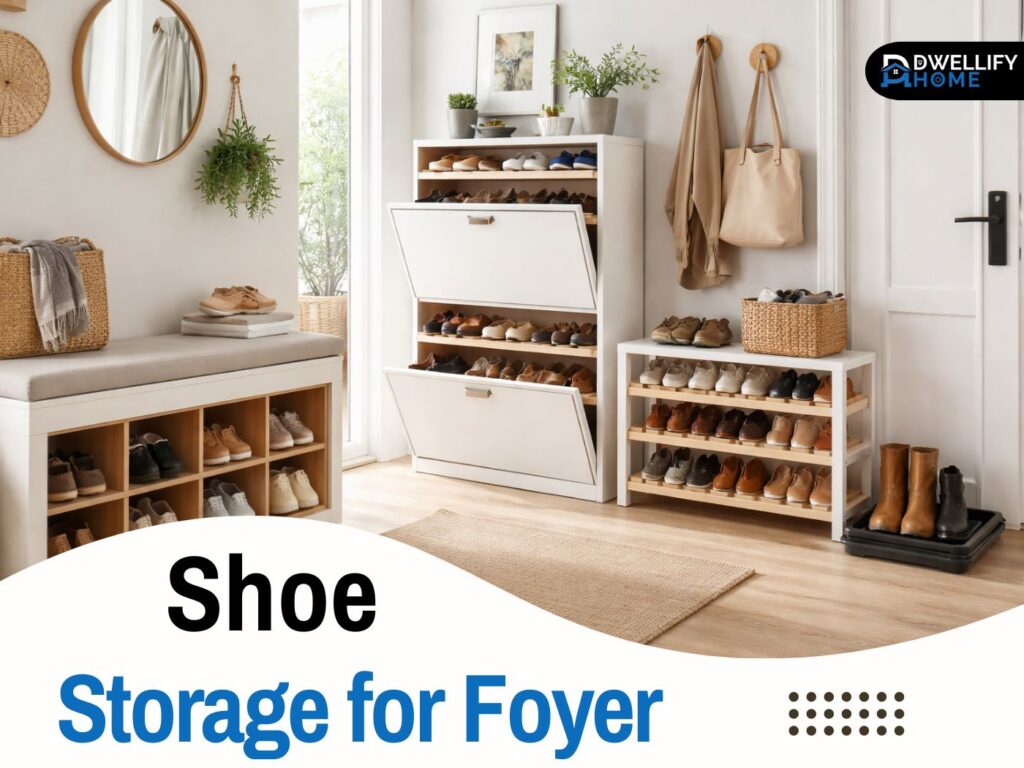
A shoe storage cabinet is usually the best choice for a tidy look. It hides visual clutter and instantly makes the entry feel calmer, especially in open-plan homes where the foyer is visible from the living room.
An open shoe rack is about fast access. It’s great when everyone takes shoes off at the door and you don’t mind seeing them. It also tends to ventilate better, which helps with odor.
An entryway shoe storage bench is the most family-friendly option I install. People sit down, shoes come off neatly, and the bench becomes the natural place to land everything.
Wall-mounted and floating solutions are useful when the floor needs to stay clear. They’re also easier to clean around, which matters in high-traffic entryways.
Baskets and drop zones are underrated. A couple of structured baskets can handle daily shoes without making the space look like a pile, especially for kids.
Small entryway shoe storage ideas that actually work in real homes
Small spaces demand a different strategy. In a tight foyer, the goal isn’t to store every shoe you own at the door. It’s to keep the daily routine smooth and the floor clear.
Go vertical before you go wider
If floor space is limited, tall shoe storage for foyer setups are often the cleanest fix. A narrow, vertical unit can hold a surprising number of pairs without swallowing your walkway. I’ve used tall cabinets in apartment foyers where the only available wall space was a slim strip near the door.
Look for adjustable shelves or compartments that can handle bulky sneakers and boots. If the unit is enclosed, ventilation matters. I’ll cover that soon, because it’s a real issue in closed storage.
Use dead space people ignore
Some of the best storage spots are the awkward ones. Behind the door can work with the right depth. Under a console table can become a tidy zone with baskets or a low rack. If your foyer is near stairs, under-stairs shoe storage can be a game-changer for overflow pairs that you still want close by.
These small entryway shoe storage ideas work best when you pair them with one simple rule: only daily shoes live here. Everything else goes to a closet or another storage zone.
Closed storage that looks tidy (shoe storage cabinet done right)
A shoe storage cabinet is usually the fastest way to make a foyer look pulled together. It’s also where people make a common mistake: choosing a cabinet based on appearance alone.
Start with capacity planning. A cabinet that holds 12 pairs sounds good until you realize it only fits slim shoes, or it forces pairs to stack awkwardly. In real homes, I plan for a mix: sneakers, flats, occasional boots, and a spot for guest shoes.
Ventilation and odor control are the difference between a cabinet you love and one you regret. Closed storage needs airflow. If the cabinet has tiny gaps or louvered sections, that helps. You can also use breathable liners, cedar inserts, or a small odor-absorbing pouch. Avoid sealing damp shoes inside. Let wet shoes dry on a tray first, then store them.
A shoe storage cabinet should also be easy to maintain. Removable trays, wipeable surfaces, and a base that doesn’t trap dust will save you time. In many homes, the cabinet top becomes a dumping ground. I always recommend keeping the top surface intentionally simple: a small catch tray and one decorative piece, nothing more.
Wooden shoe storage for foyer (warm style + long-term durability)
Wooden shoe storage for foyer spaces can look beautiful, but it needs to match your lifestyle. In homes with kids, pets, or wet weather, wood finishes take a beating near the front door.
If you want wood, choose a finish that hides scuffs and fingerprints. Matte or satin finishes tend to age better than glossy ones. I also look for a slight overhang or lip at the top edge, because it protects the front face from knocks.
Wood works well when you want the storage to feel like real furniture, not a utility unit. It pairs nicely with baskets, a mirror, and a runner. The key is scale. A wooden cabinet that’s too deep can make the foyer feel cramped, even if it looks great online.
A practical approach I often suggest is wood on the outside for style, and wipeable shelving inside for easy cleaning. It’s the best of both worlds.
Hallway shoe storage for foyer layouts (narrow, long, and high-traffic)
Some foyers are basically hallways. Long, narrow, and busy. In these spaces, hallway shoe storage for foyer setups need to be slim and predictable, so people can move without sidestepping.
Slimline units are your friend here. I usually look for shallow cabinets or racks that keep shoes tucked close to the wall. Elevating storage off the floor can help visually and practically. You can sweep and mop without moving everything, and the hallway feels less blocked.
One of my favorite approaches is a console table that works harder. Use a narrow console with structured baskets underneath, or a low shelf that holds shoes neatly. This keeps the foyer looking styled, while still serving a real purpose.
You’ll also want to decide whether your hallway can handle display storage. Open racks can look fine if the household is consistent. If shoes tend to pile up, closed storage is the safer choice.
Bench seating + shoe storage (the family-proof solution)
An entryway shoe storage bench is one of the most reliable solutions I’ve used in homes where mornings are hectic. It creates a natural behavior pattern: sit down, take shoes off, place them where they belong.
Benches come in a few types. Open cubbies are quick and breathable, but they show clutter if shoes aren’t placed neatly. Drawers hide the mess, but they slow people down. Lift-top benches can store less-used items, but I don’t love them for daily shoes, because they encourage dumping.
When choosing a bench, pay attention to seat height and comfort. Around chair height makes it easy to use, especially for older family members. If you add a cushion, make it wipeable. Entryways get dusty and damp.
For boots, a bench setup works best with one dedicated boot area. A simple tray nearby can handle wet soles, so you’re not trapping moisture inside storage.
IKEA-friendly options and IKEA hack potential without the clutter
A lot of homeowners ask about shoe storage for foyer IKEA options because IKEA pieces are often slim, practical, and easy to fit into awkward spaces. They can work very well, as long as you treat them like part of a system, not a stand-alone fix.
A shoe rack for entryway IKEA can be a smart choice when you want fast access and good airflow. It’s especially useful for daily sneakers and kids’ shoes. For a more polished look, IKEA-style slim cabinets are great for hiding visual clutter, especially in open-plan homes.
If you want an IKEA piece to look built-in, keep it simple. Swap hardware if needed, add a small basket for accessories, and style the top with restraint. Also, pay attention to stability. In many foyers, especially with kids, wall securing matters for tall or narrow units.
The best IKEA-like setups are the ones that stay consistent with your home’s routine. That’s what keeps it looking good long-term.
Shoe rack vs shoe cabinet (how to decide in 60 seconds)
If you want a quick decision, here’s the way I guide homeowners.
Choose an open rack if:
- You need speed on busy mornings
- You want better ventilation for shoes
- You’re okay seeing shoes in the entry
Choose a cabinet if:
- You want the foyer to look calm and tidy
- Your entry is visible from main rooms
- You want less dust and less visual clutter
A hybrid setup is often ideal. Keep an open zone for daily pairs, and a closed cabinet for overflow. That way, the foyer stays functional without looking messy.
The system that keeps it from getting messy again (organization rules)
Storage alone won’t solve foyer clutter if the system doesn’t match daily life. The goal is to make the tidy option the easy option.
Start with two zones. One zone is for today’s shoes, the pairs you wear all the time. The second zone is overflow storage, for less-used shoes. This is where a shoe storage cabinet shines, while a small open rack can handle daily pairs.
A seasonal swap strategy makes a big difference. When the season changes, rotate shoes. Winter boots go into the active zone in winter, and summer sandals move out. It keeps the foyer from turning into a shoe warehouse.
A simple rule I use in families is one-in, one-out. If a new pair comes into the foyer zone, an older pair goes to the closet. This keeps the system stable without constant effort.
If organization tools help you, use them lightly. A boot tray, a small divider, or a label can be enough. Too many accessories often backfire and become clutter themselves.
Expert-backed details people forget (small fixes that make a big difference)
This is the part that separates a foyer that looks tidy for a week from one that stays tidy year-round.
Moisture control is huge. A shoe tray or boot tray near the door protects floors and keeps wet shoes from spreading grime. In rainy climates, I often recommend a second mat inside the door, so water doesn’t travel deeper into the home.
Ventilation matters more than most people think. If shoes are stored damp in closed storage, odor builds fast. Let wet shoes dry on a tray, then put them away. If odor is already an issue, breathable inserts, cedar, or odor absorbers can help.
Finally, plan for cleaning. A setup that’s easy to sweep around will stay cleaner. Wall-mounted storage, raised legs, or a clear base makes this simpler. If cleaning is annoying, clutter starts creeping back.
Design details that make shoe storage look intentional, not like storage
A foyer feels welcoming when storage looks like it belongs there. That doesn’t mean you need fancy decor. It means the pieces feel considered.
Match finishes where you can. If you have a wooden shoe cabinet, echo that tone in a mirror frame or a small tray. If you use baskets, keep them consistent. Visual repetition makes the space feel calmer.
Keep the top surface under control. I recommend a small catch tray for keys, and one simple decor item. If the top becomes a dumping ground, the whole foyer starts feeling cluttered again.
Lighting and mirrors can also help a foyer feel larger and brighter. A mirror is practical for a last look before heading out, and it reflects light in narrow spaces. A small lamp or wall light can make the entry feel warmer in the evening.
Conclusion
A foyer stays clean when the shoe setup matches real life. The most useful approach is to pick a base system that fits your space and your habits, then keep the daily zone small and easy to maintain.
If your foyer is tight, go vertical with tall shoe storage for foyer needs, and keep depth slim so the walkway stays comfortable. If you want the calmest look, a shoe storage cabinet is hard to beat, especially when you plan for ventilation and moisture control. If you want the most practical family solution, an entryway shoe storage bench often becomes the natural anchor that keeps shoes off the floor.
Here’s the simple finish I leave homeowners with: set up one spot for daily shoes, one spot for overflow, and a tray for wet weather. Once that’s in place, the foyer starts feeling like an entry, not a storage problem.
Disclaimer:
This guide shares general home organization advice based on practical space-planning experience. Always measure your space, follow manufacturer instructions, and securely anchor tall furniture when recommended. For structural changes or wall mounting, consult a qualified professional if needed.

I’m Bilal Hassan, the founder of Dwellify Home. With 6 years of practical experience in home remodeling, interior design, and décor consulting, I help people transform their spaces with simple, effective, and affordable ideas. I specialize in offering real-world tips, step-by-step guides, and product recommendations that make home improvement easier and more enjoyable. My mission is to empower homeowners and renters to create functional, beautiful spaces—one thoughtful update at a time.