If you’ve ever had a cold shower on a winter morning, you already know your water heater isn’t just another appliance. It affects your comfort, your monthly bills, and even how long your plumbing system lasts.
Choosing between a tank and a tankless system isn’t just about grabbing whatever’s cheapest. It’s more like choosing the right car. The “best” option depends on how you live, how many people are in the house, and how long you plan to stay there.
As a plumber who installs and repairs both types all the time, I can tell you this: when people understand how these systems really work, they stop guessing and start making smart, confident decisions for their home.
Short intro about Tank or Tankless Water Heater:
A tank or tankless water heater comparison helps you understand whether a traditional storage tank or an on-demand tankless system fits your home’s hot-water needs, budget, energy usage, and long-term comfort.
Mission Statement:
Our mission is to help homeowners make smarter, clearer, and more confident decisions about their water heating systems by offering honest guidance, expert insights, and practical comparisons that simplify even the most technical choices.
Tank vs Tankless Water Heater – Quick Comparison at a Glance
Before we dive deep, let’s keep it simple. A traditional tank unit stores a big amount of hot water and keeps it hot all day. A tankless unit heats water only when you open a tap. Storage versus on-demand — that’s the core difference.
If you want lower upfront cost and something “standard,” a tank often wins. If you’re thinking long-term efficiency, saving space, and not worrying about running out of hot water (within reason), a tankless system usually looks more attractive.
On top of that, when people ask about pros and cons, the real answer is a trade-off: you’re balancing installation cost, monthly energy use, life expectancy, and how your family actually uses hot water.
Quick Comparison Table: Tank vs Tankless Water Heater
| Feature | Tank Water Heater | Tankless Water Heater |
| How It Works | Stores & reheats a fixed amount of water | Heats water instantly when you turn on a tap |
| Hot Water Supply | Can run out during heavy use | Continuous (as long as flow rate isn’t exceeded) |
| Upfront Cost | Lower | Higher (installation upgrades needed) |
| Energy Efficiency | Moderate; energy loss from storage | Higher; no standby heat loss |
| Lifespan | ~8–12 years | ~15–20+ years with maintenance |
| Ideal For | Tight budgets, rentals, simple replacements | Long-term homes, large families, high usage |
| Space Required | Larger unit, floor space | Wall-mounted, compact |
| Main Drawback | Can leak, limited hot water | Higher initial cost, sizing & hard-water sensitivity |
Quick Guide: How to Choose in 5 Steps
- Check your home size & usage
– Big family? Tankless often wins. - Look at your budget
– Need something quick & affordable? Tank is simpler. - Review energy costs in your area
– Higher rates = tankless pays off faster. - Consider installation complexity
– Older homes may need upgrades for tankless. - Think long-term
– Staying 10+ years? Tankless usually offers better value.
How Each Type Works (Plain-English Explanation)
How a Traditional Tank Water Heater Works
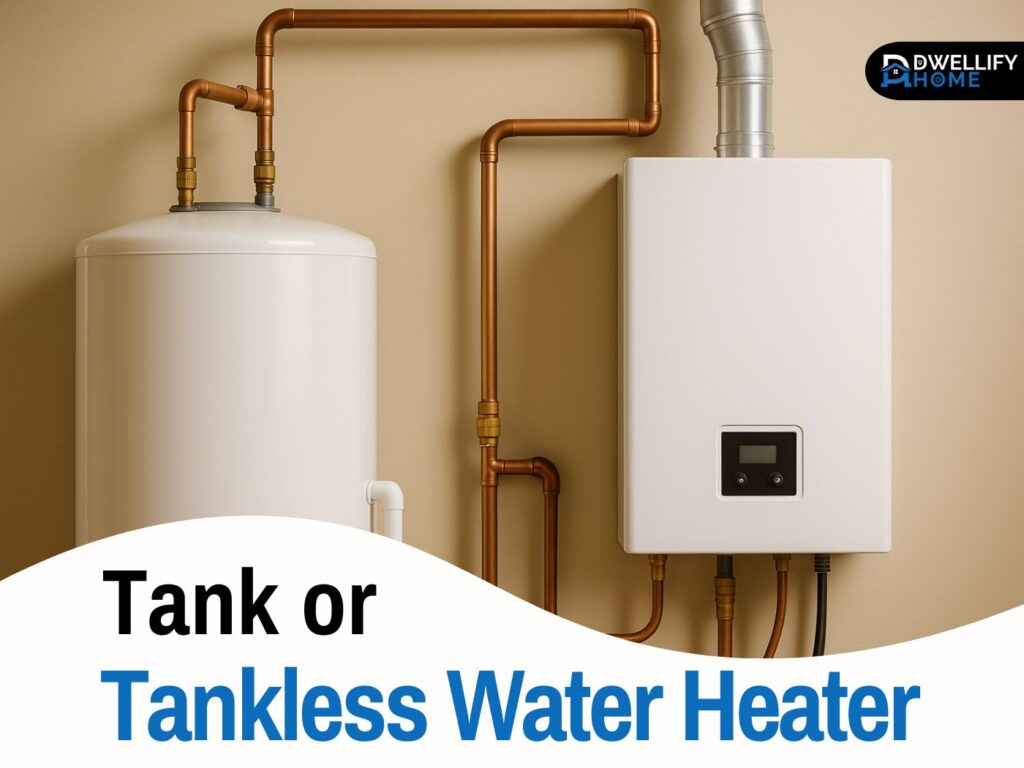
A tank heater is basically a big insulated bottle with a burner or heating element at the bottom. It fills with cold water, heats it up to the set temperature, and then just keeps it hot until someone uses it.
Every time you use hot water, cold water enters the tank and the heater kicks on again to recover the lost temperature. That’s why you’ll see specs like “50-gallon” and “first-hour rating” — they tell you how much hot water you can realistically get in busy times.
In real homes I work in, tanks are often tucked away in a basement, closet, or garage, quietly running in the background… until the day someone says, “Why is there water on the floor?” and we find a leak.
How a Tankless (On-Demand) Water Heater Works
A tankless unit doesn’t store hot water. Instead, it senses water flow and fires up a powerful burner or element as soon as you open a tap. Water passes through a heat exchanger, gets heated on the spot, and goes straight to your fixtures.
You’ll hear terms like “flow rate” and “GPM” (gallons per minute). These matter because a tankless system has a maximum amount of hot water it can produce at once. If your showers, washing machine, and dishwasher all run together, you might hit that limit.
Guess what? When sized correctly, homeowners love the idea of “endless” hot water. But if the unit is undersized or the climate is very cold, that’s when people start complaining online that their tankless doesn’t keep up.
Pros and Cons: Tank vs Tankless Water Heater Side by Side
Advantages and Drawbacks of Tank Water Heaters
Let’s start with the classic option. Traditional tanks still make sense for many homes. They’re:
- Cheaper to buy upfront
- Easier to install in most replacements
- Simple for many plumbers to work on
But there’s a flip side. Tanks keep water hot even when you’re not using it, which means energy loss. Over the years, I’ve seen plenty of tanks drive higher utility bills simply because they’re always “on guard.”
They also have a shorter life in many cases. Rust, sediment, and pressure take their toll. And when a tank fails, it often fails dramatically — think leaks, sometimes flooding nearby areas.
Advantages and Disadvantages of Tankless Water Heaters
Tankless systems shine when it comes to efficiency and space. They’re compact, hang on the wall, and only use energy when hot water is actually needed. Many homeowners see lower bills, especially in households with moderate but frequent usage.
The best part is, when they’re sized right, you won’t “run out” of hot water the way you can with a tank. Families with back-to-back showers often notice the difference immediately.
Now, about the disadvantage of tankless water heater setups:
- Higher upfront cost
- More complex installation
- Sensitivity to hard water and poor maintenance
I’ve also seen the so-called “cold-water sandwich,” where you get a brief burst of cold between hot flows. It’s not dangerous, just annoying, and usually tied to how the system and plumbing are set up.
Cost Difference Between Tankless and Tank Water Heaters
Upfront Cost: Equipment, Installation, and Required Upgrades
When people ask about the cost difference between tankless and tank water heater options, this is where they feel the biggest shock. A basic tank replacement is usually the cheaper ticket — often just a like-for-like swap.
Tankless units, on the other hand, may require:
- Upgraded gas lines or electrical circuits
- New venting
- Condensate drainage (for high-efficiency units)
So yes, the initial bill can be significantly higher for tankless. But that’s only half the story.
Long-Term Costs: Energy Bills, Repairs, and Replacement
Over time, tankless systems can save you money in energy, especially in homes that use hot water throughout the day. They’re more efficient because they’re not constantly reheating stored water.
Traditional tanks are cheaper at the start, but you may pay more in monthly bills and more frequent replacements. If you plan to stay in your home for 10–20 years and local energy prices are high, a well-chosen tankless model can balance out that higher upfront cost.
From my experience, families who think long term, not just “this year’s budget,” usually feel better about their decision.
Simple “Tankless vs Tank Water Heater Calculator” Logic
You don’t need a fancy tankless vs tank water heater calculator to get a rough idea. Think of it like this:
- Take the extra cost of installing tankless over tank
- Estimate your yearly energy savings
- Divide extra cost by yearly savings = rough “payback” period
If your payback looks like three to seven years and you plan to stay longer than that, tankless starts to look strong. If the payback is 15+ years and you might move in five, a standard tank might be more sensible.
This simple, real-world math is often more helpful than any glossy brochure.
Lifespan, Warranty, and Real-World Reliability
Tankless Water Heater vs Tank Life Expectancy
On paper, a tank might list something like 6–12 years of warranty. Tankless models often carry longer warranties on parts or heat exchangers. In the field, with proper maintenance, I regularly see good tankless water heater vs tank life expectancy differences: tankless units can outlast tanks.
That said, neglect changes everything. A tank that’s never flushed and sits in hard water can fail early. A tankless unit that’s never descaled in a hard-water area can also suffer.
So yes, tankless has the potential for longer life, but only if it’s treated well.
Common Failure Modes and What Owners Usually Experience
Tanks often fail with leaks: the steel rusts, the seams go, and suddenly you’ve got water where it shouldn’t be. I’ve seen ruined flooring and damaged belongings from a tank that quietly corroded over time.
Tankless systems fail more “electronically.” You’ll see error codes, ignition issues, or flow sensors acting up. Usually, we can service and repair these if caught early.
The key lesson? No water heater likes to be ignored. A little attention over the years keeps both types from turning into nasty surprises.
Comfort and Performance in Daily Use
Hot Water Availability for Different Household Sizes
In smaller households — say one or two people — both systems can work beautifully. A right-sized tank is enough, and a tankless may feel like a luxury.
In big families, especially with teenagers, I’ve seen tanks get overwhelmed during morning rush hour. That’s where a correctly sized tankless really shines. It can keep delivering hot water as long as the flow stays within its limits.
Here’s the thing: comfort is not just about technology; it’s about matching system capacity to how your household actually lives.
Flow Rate, “Running Out of Hot Water,” and the Cold-Water Sandwich
A tank can “run out” when the stored hot water is used up faster than it can reheat. That’s when someone shouts, “Who used all the hot water?” from the bathroom.
Tankless units don’t technically “run out,” but they can struggle if you try to pull more hot water than their rated flow. Think two showers plus a washing machine plus the dishwasher at the same time.
Some people also notice that little temperature fluctuation called the cold-water sandwich — a blip of cool water between hot cycles. It’s not dangerous, just uncomfortable, and good plumbing design can reduce it.
How Climate and Water Quality Change the Experience
In colder climates, incoming water is much colder, which means the heater (tank or tankless) has to work harder. A tankless unit that’s fine in a warm region might feel undersized when installed somewhere with icy winters.
Hard water is another big factor. It builds scale inside both tanks and tankless systems. In my hard-water customers’ homes, I always stress regular maintenance — flushing tanks and descaling tankless units. That alone can add years of life and keep performance steady.
So when you’re comparing options, don’t forget local conditions. They’re just as important as brand names.
Installation Realities Most People Don’t Hear About
Replacing an Existing Tank with Another Tank
If you’re simply swapping a tank for a similar model, the job is usually straightforward. Same type of fuel, similar size, similar location — most of the existing plumbing can stay.
In many homes, this is the least disruptive option. You’re back up and running quickly, and the upfront bill is easier to swallow, especially if the old unit failed suddenly and you weren’t planning for it.
For landlords and people who might move soon, this simple route often makes the most practical sense.
Switching from Tank to Tankless – Hidden Complexity
Switching to tankless often sounds easy: “Just hang it on the wall, right?” In reality, we may need to:
- Increase gas pipe size
- Add new venting and condensate drainage
- Upgrade wiring or breakers for electric units
Permits and local building codes also come into play. As a professional, I always check these first, because a rushed or unpermitted installation can cause safety and insurance issues later.
The good news? Once installed correctly, a tankless system is something many homeowners are very happy with. The key is doing it right, not just doing it fast.
Maintenance and Ongoing Care
Easy Maintenance Tasks for Tank Water Heaters
Tank maintenance is simple but often ignored. At minimum, I recommend:
- Flushing the tank to remove sediment
- Checking the anode rod
- Inspecting for leaks and rust
These tasks help the heater run more efficiently and delay failure. Many homeowners are surprised how much clearer the hot water runs after a good flush.
What Tankless Units Need to Stay Efficient
Tankless models like clean water and good flow. That means:
- Regular descaling in hard-water areas
- Cleaning or replacing inlet screens and filters
- Keeping vents clear and accessible
When this doesn’t happen, efficiency drops and error codes pop up. A bit of yearly attention keeps them running smoothly, which supports that better tankless water heater vs tank life expectancy you’re aiming for.
How Maintenance Affects Life Expectancy and Total Cost
I’ve seen relatively new units fail early simply because they were never maintained. On the other hand, I’ve serviced older systems still going strong because the owners stayed on top of basic care.
Think of it this way: maintenance is your smallest bill but your biggest leverage. It protects your investment, whichever system you choose, and keeps your hot water steady and predictable.
Hybrid and Advanced Setups (Tank and Tankless Together)
What It Means to Use a Tankless and Tank Water Heater in Series
Sometimes, you’ll hear about using a tankless and tank water heater in series. That simply means both units are connected so water passes from one to the other.
For example, a tankless might preheat the water that then goes into a small storage tank, or a tank might supply a specific area while tankless backs up high demand.
It’s not common in every home, but in special cases it can be very smart.
When a Hybrid System Actually Helps
Hybrid setups can help when:
- You have extremely high peak demand
- Your home has very long pipe runs
- You want instant hot water at distant fixtures
I’ve seen this work well in large homes where a single system just couldn’t keep everyone happy. The hybrid setup spreads the load and smooths out performance.
Downsides: More Cost, More Parts, More to Maintain
Of course, there’s a trade-off. Two units mean more cost upfront, more parts that can fail, and more maintenance.
For many average-sized homes, this is overkill. But when designed properly for the right situation, it can deliver hotel-style comfort in a big house.
Real Homeowner Experiences: What People Say on Reddit and Forums
Tank or Tankless Water Heater Reddit Discussions: Common Themes
If you scroll through tank or tankless water heater reddit threads, you’ll see a pattern: people who sized and installed their systems correctly are usually happy, and people who rushed the decision or went cheap on installation often regret it.
Common comments include surprise at installation costs, confusion about error codes, and relief when they finally understand how to match their system to their home.
It’s a good reminder: real-world feedback matters as much as brochures.
Noise, Delay, Sizing Mistakes, and Other Hidden Issues
People also complain about things like burner noise, fan noise, or a delay before hot water arrives. Most of these issues are manageable with better design, but if you don’t plan ahead, they become daily annoyances.
Sizing mistakes are the biggest culprit. I’ve walked into homes where a small tankless was trying to supply three bathrooms and a laundry room — no wonder they were disappointed.
Good planning up front prevents a lot of those “I wish someone had told me” moments.
What Long-Term Owners Would Choose If They Had to Start Over
When I ask long-term owners what they’d choose again, their answers are surprisingly calm. Most don’t say “never again” to either type. Instead, they say things like:
- “I’d still go tankless, but I’d get a bigger one.”
- “I’d stick with a tank, but I’d invest in a better model.”
That’s your real goal: not perfection, just a system that fits your life so well you don’t think about it much.
How to Decide: Tank or Tankless Water Heater – Which Is Better for You?
Quick Decision Checklist (Budget, Home Type, and Habits)
Here’s a simple checklist to guide you:
- How long do you plan to stay in this home?
- How many people use hot water daily?
- Do you often run multiple hot-water fixtures at once?
- Is your local water hard or soft?
- What’s your realistic budget, including installation?
Answering these honestly gets you closer than any marketing slogan.
When a Tank Water Heater Clearly Makes More Sense
A traditional tank is often the better call when:
- You’re on a tight budget
- You’re replacing a failed unit and need hot water fast
- You’re in a rental or might move in a few years
- Your hot-water demand is predictable and moderate
In these cases, a good-quality tank, properly installed, is a solid, no-drama choice.
When a Tankless Water Heater Is the Smarter Long-Term Option
A tankless system usually shines when:
- You’re planning to stay long term
- Energy prices are high and efficiency matters
- You have a larger household or high hot-water demand
- You value space savings and modern controls
This is where that “tankless vs tank water heater pros and cons” comparison usually leans in favor of tankless — especially if you’re thinking 10+ years ahead.
Quick FAQs About Tank and Tankless Water Heaters
Do tankless water heaters really save money in the long run?
They can, especially in homes with consistent usage and high energy costs. But savings depend on your habits, local rates, and maintenance.
Will I run out of hot water with tankless vs tank?
A tank can run out if you exceed its stored volume. A properly sized tankless won’t “run out,” but it can struggle if you exceed its flow capacity.
Are tankless units good for older homes?
Yes, but older gas lines, electrical panels, and venting can add cost. A professional assessment is important.
Can I switch to tankless without upgrading gas or electrical?
Sometimes, but not always. Many tankless models need more gas or power than old tanks. This is a key thing we check before quoting.
Is there a best size for a family of four?
There’s no universal answer. We look at bathroom count, appliances, and how often people overlap their showers and laundry.
What is better, a tankless or a tank water heater?
Neither is universally “better.” A tank is cheaper upfront and easier to replace, while a tankless system saves energy, lasts longer, and provides continuous hot water. The best choice depends on your home size, usage, and budget.
What is the disadvantage of a tankless water heater?
The main disadvantages are the higher upfront cost, the need for upgraded gas/electrical lines in some homes, and sensitivity to hard water. If undersized, it may struggle during heavy multi-fixture use.
How much is a tankless water heater vs tank?
A tank water heater typically costs less upfront. A tankless unit costs more because of installation upgrades, but it can save money long-term through higher efficiency and longer lifespan.
Is it worth changing to a tankless water heater?
Yes — if you plan to stay in your home long term, want lower energy bills, and like the idea of continuous hot water. For short-term stays or tight budgets, a standard tank may be the more practical choice.
How long do tank and tankless water heaters last?
Tanks usually last 8–12 years. Tankless models often last 15–20+ years with proper maintenance, making them a strong long-term investment.
Conclusion – Is a Tank or Tankless Water Heater Better for Your Home?
So, is one option “the best” for everyone? Not really. A tank is simple, familiar, and easier on the upfront budget. A tankless system is efficient, compact, and can deliver great comfort when it’s sized and installed properly.
The real win is choosing the setup that matches your home, your habits, and your plans for the next decade. If you think about how you actually use hot water — not just what’s on sale today — you’ll make a choice you won’t have to second-guess later.
At Dwellify Home, I’d always encourage you to start with your lifestyle and long-term goals. Once you’re clear on those, deciding between a traditional tank and a modern tankless water heater stops being confusing… and starts feeling like a smart upgrade for your everyday comfort.
Disclaimer:
This article is for general information only and shouldn’t replace professional advice. Home layouts, plumbing conditions, local codes, and installation needs vary. Always consult a licensed plumber or qualified technician before purchasing or installing any water heater.

I’m Bilal, the founder of Dwellify Home. With 6 years of practical experience in home remodeling, interior design, and décor consulting, I help people transform their spaces with simple, effective, and affordable ideas. I specialize in offering real-world tips, step-by-step guides, and product recommendations that make home improvement easier and more enjoyable. My mission is to empower homeowners and renters to create functional, beautiful spaces—one thoughtful update at a time.