A good Turkish mosaic lamp doesn’t just light a room, it changes how the room feels. The warm glow, the little patterns on the wall, and the way the glass softens harsh corners can make a space feel calmer in seconds.
I’ve worked with these lamps for over a decade, sourcing them from makers, inspecting them for quality, and installing them in homes and cafés. This guide walks you through what matters in real life: how they’re built, how they behave as lighting, how to avoid common buyer mistakes, and how to use them in modern interiors without turning your home into a theme set.
Snippet-ready definition:
Turkish mosaic lamps are handcrafted glass lamps made from small colored pieces set into a patterned shade. They create warm ambient light and soft wall shadows, often used as cozy accent lighting in homes and cafés.
Mission Statement:
At Dwellify Home, our mission is to help you choose décor that’s beautiful and practical, with clear guidance you can trust, so you can create a home that feels warm, lived-in, and confidently your own.
What Are Turkish Mosaic Lamps (and why they feel so special)?
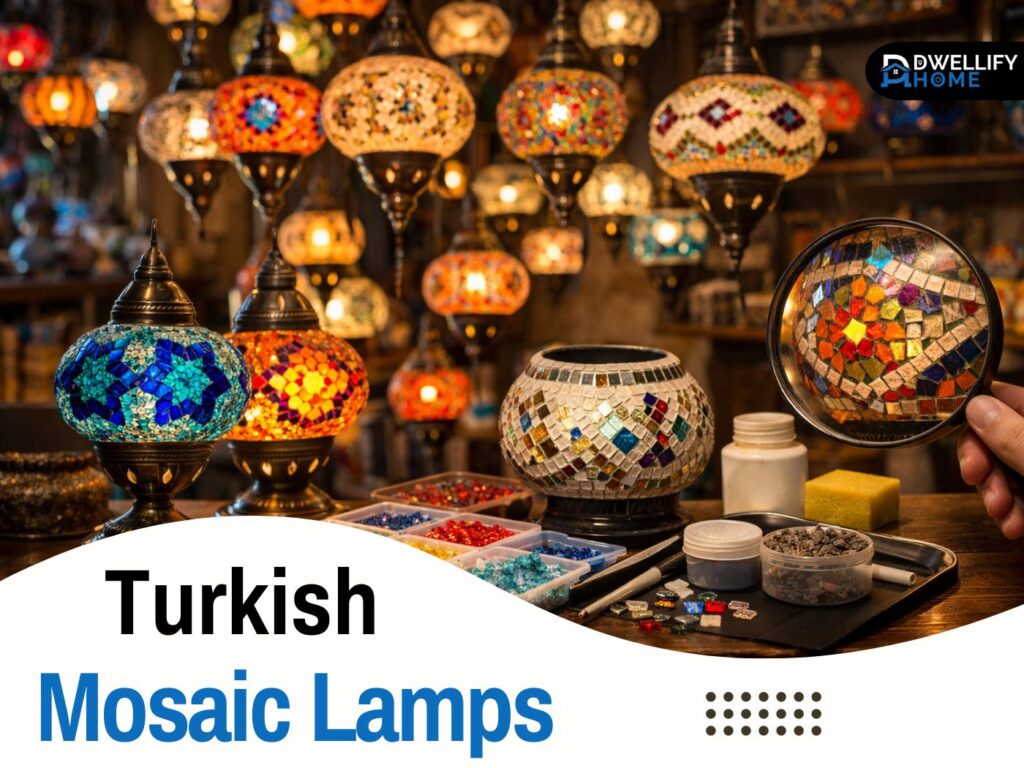
At their core, these are mosaic glass lamps built from hand-cut glass pieces set into a curved form, usually a globe or shade, supported by a metal frame. When the bulb warms up, the glass colors blend and the grout lines create a soft, patterned shadow. That shadow is a big part of the charm, and it’s also why these work best as ambient mood lighting rather than a “bright task light.”
What makes the good ones feel special is the handwork. In authentic pieces, the glass is cut in small, irregular shapes that fit together like a puzzle. You can usually see tiny variations in the cuts and spacing, and that’s a good sign. Mass-produced versions often look too perfect up close, with printed patterns or large, uniform pieces that don’t reflect light the same way.
One quick reality check I always share: these lamps are meant to be lived with. A well-made mosaic lamp can handle daily use, but it’s still glass on a curved surface. The difference is that the better ones are built to last, with stronger bonding, steadier metalwork, and safer wiring.
Quick Guide Table: Pick the Right Lamp Fast
| Type | Best for | Light behavior | What to check before buying | Good bulb choice |
| Table lamp | Bedside, console, side table | Cozy, patterned glow, mostly ambient | Stable base, neat grout, solid socket, sturdy cord | Warm LED, low heat |
| Floor lamp | Dark corners, reading chair area | Bigger presence, still ambient | Heavy base, straight stem, wobble test | Warm LED, medium brightness |
| Hanging lamp | Entryway, dining nook, corner feature | Creates a light pool and wall patterns | Ceiling height, chain quality, canopy, wiring | Warm LED, avoid high heat bulbs |
| Chandelier style | Statement space, larger rooms | Decorative, layered ambience | Strong metalwork, secure mounting points | Warm LED, multiple low watt-equivalent |
Mini tip from my installs: these lamps look brightest when the shade has some clear or lighter glass mixed in. Dense patterns feel softer and more atmospheric.
Comparison Table: Authentic vs Imitation (what I look for)
| What you notice | More likely authentic | More likely imitation |
| Pattern up close | Small variation in glass cuts, human spacing | Too perfect, uniform pieces, sometimes printed look |
| Weight and feel | Heavier base, sturdier metal | Surprisingly light, thin hardware |
| Craft details | Clean but handmade, consistent bonding | Messy adhesive, loose pieces, uneven socket |
| Seller info | Clear photos, close-ups, returns policy | One polished photo, vague details |
These quality checks align with common artisan indicators, like hand-cut glass and careful construction.
Step-by-step: How to Choose One Without Overthinking
- Decide the job
Ambient mood light, accent décor, or a statement piece. Most mosaic lamps are best as ambient light. - Match size to placement
Small lamps disappear in big rooms. If it’s an entryway or living room, going one size up often looks more balanced. - Check craftsmanship first
Look for neat bonding, stable metalwork, and a socket that doesn’t wobble. - Prioritize safe wiring and low heat
Warm LED bulbs are usually the safest choice for longevity and comfort. - Pick a color palette that fits your home
Blues feel calmer, ambers feel cozier. Dense patterns cast softer shadows.
Mosaic from Antiquity to the Present (a short, trustworthy history)
Mosaic work in this region has deep roots, stretching back through Byzantine and Ottoman eras where patterned surfaces were part of architecture, public spaces, and decorative arts. Over time, the idea moved from walls and floors into smaller, portable objects. Lamps became a natural home for mosaic because light makes color feel alive.
In the workshops I’ve visited, you still see that blend of tradition and practicality. Older patterns often lean geometric and symmetrical, while modern makers experiment with gradients, starbursts, and themed palettes. What hasn’t changed is the core logic: small pieces of colored glass create a bigger design that looks different in daylight than it does at night.
That day to night shift is one reason these lamps stay popular. In the afternoon, they read as décor. In the evening, they behave like lighting, and the room takes on a softer tone.
Craftsmanship and Materials (what you’re actually buying)
When I inspect a lamp, I start with the glass and the bonding. Good mosaic glass has depth, meaning the color isn’t just sitting on the surface. You’ll notice richer tones when you rotate the lamp under light. The bonding material should look even and clean, not cracked, chalky, or messy. If the lamp looks like it’s shedding grit or the grout is flaking, that’s a red flag.
Next is the metalwork. A stable base, a straight stem, and solid connection points matter more than people think. I’ve seen beautiful shades sitting on wobbly bases that become stressful to use, especially around kids or pets. If the lamp is hanging, look at the chain and the top cap. Thin, lightweight hardware often means corners were cut elsewhere too.
Wiring safety is the part most buyers skip, and it’s where problems show up later. If you can, check that the cord feels sturdy, the plug is properly finished, and the switch isn’t loose. With imported pieces, it’s normal for plugs to be adapted for different regions, but it should look clean and professionally done.
A simple checklist I use:
- Shade feels solid, not hollow or flimsy
- Metal joints don’t twist when lightly pressed
- Cord is thick enough to feel durable
- Switch clicks cleanly, not mushy
- Socket doesn’t wobble, and the bulb sits centered
Colors and Patterns (meaning + mood lighting)
Colors in mosaic lamps aren’t only about style, they change the mood of the light. Blue-heavy lamps usually feel calmer and cooler, even with a warm bulb. Amber, honey, and red tones push the space toward cozy. Green and teal can feel fresh, especially in kitchens or bright living rooms.
Patterns matter too. Dense patterns with smaller pieces often cast more detailed shadows and soften the bulb’s brightness. Larger pieces can throw stronger blocks of color but may feel harsher if the bulb is too bright. This is why two lamps that look similar in photos can behave very differently once they’re on.
If you want that café-style glow, go for richer colors with a medium to dense pattern, and pair it with a warm bulb. In a modern minimalist room, I often use a lamp with more white or clear glass mixed in, because it keeps the look lighter while still giving texture.
Styles and Types of Turkish Mosaic Lamps (choose the right form)
Different forms solve different problems. The mistake I see most is choosing a lamp only by looks, then realizing it doesn’t fit the space or the lighting need.
Table lamps (bedside, console, reading nook)
A Turkish mosaic table lamp is the easiest to live with. It works on a console in an entryway, a side table in a living room, or a shelf that needs warmth. On a bedside table, it’s great for winding down, but don’t expect it to replace a focused reading lamp unless the shade is larger and the bulb is chosen carefully.
For small apartments, I often recommend table lamps because they give a strong atmosphere without needing installation. They also let you move the lamp around seasonally, which is practical if you like changing your setup.
Floor lamps (corners, statement lighting, layered ambience)
Floor versions are fantastic for dark corners. In cafés, I’ve used them near seating areas where overhead lights felt too harsh. In homes, they work well beside a sofa or near an accent chair.
Just keep in mind that floor lamps can be top-heavy depending on the design. Make sure the base is heavy and stable, and place it where people won’t bump it while walking through.
Turkish mosaic lamps hanging (pendants and chandeliers)
Turkish mosaic lamps hanging over an entryway or dining corner can look incredible, but placement matters. I always check ceiling height first. A hanging lamp that sits too low becomes annoying fast, and one that sits too high loses the intimate feel.
In dining areas, aim for a gentle pool of light rather than brightness. In hallways or entryways, they work best when paired with other light sources, because a single pendant can leave corners dim.
How to choose a Turkish mosaic lamp (simple expert checklist)
Here’s the practical approach I use with clients. It keeps the choice simple and prevents regrets.
Start with purpose. If you want a relaxing glow, choose a medium shade with richer color. If you want a decorative statement that still lights the area, go slightly bigger and use lighter glass tones.
Then match the scale to the room. A tiny lamp in a large living room can disappear. A huge lamp on a small side table can feel crowded. When in doubt, pick one size up for entryways and living rooms, and one size down for shelves.
Style is about balance. In modern rooms, one mosaic lamp can act like a warm accent, especially when the rest of the décor is clean and simple. In boho or eclectic spaces, you can layer two or three, but keep the colors connected so it doesn’t feel chaotic.
Details are where quality shows. Spend a minute checking the glass alignment, the neatness of the bonding, and whether the lamp feels stable.
Finally, think about the bulb and heat. I strongly prefer LED bulbs for these lamps. They give you warmth without heat buildup, and they reduce the risk of loosening the bonding over time.
A quick, no-stress checklist:
- Choose the form: table, floor, or hanging
- Pick a size that matches the space
- Check stability and metalwork
- Confirm safe wiring and a solid socket
- Use warm LED for comfort and low heat
Authenticity and Trust
People ask me all the time how to tell an authentic lamp from an imitation. There isn’t one perfect test, but there are strong signals.
Authentic pieces usually show handwork. The glass pieces aren’t identical, and the pattern has tiny human variation. The metal often has a slightly aged finish rather than a shiny factory look. The lamp feels heavier than it looks, because the materials are denser.
Trustworthy sellers also show their work clearly. They use real photos from multiple angles, close-ups of the glass, and details about wiring and bulb type. A solid return policy matters too, because glass items can arrive damaged even when packed well.
Red flags I’ve seen in the field:
- Only one polished photo, no close-ups
- Pattern looks printed rather than glass-set
- Very light weight for its size
- Loose socket or poorly attached cord
- No support details, no clear policy
Styling Turkish Mosaic Lamps in a Modern Home (not just boho)
The trick is to treat the lamp like a warm accent, not a theme. In modern spaces, one well-placed lamp often looks better than three scattered around.
In an entryway, a mosaic table lamp on a slim console creates a welcoming tone. Pair it with a simple mirror and a small tray, and it feels intentional rather than busy.
In living rooms, I like to use one lamp near where people sit and talk. It softens the space in the evening. If you already have overhead lighting, keep the mosaic lamp as a layer, not the main source.
Bedrooms are where these lamps shine. A lamp with warmer tones and a soft LED bulb can replace harsh bedside lighting. If you read in bed, keep a separate reading light, and let the mosaic lamp handle the calming atmosphere.
For hanging lamps, keep the surroundings simple. A pendant looks best when it has room to be noticed, like above a small dining table or in a quiet corner with one chair and a plant.
Care of Your Turkish Lamp (cleaning and longevity)
Care is simple, but consistency matters. Dust builds up on the glass and the grout lines, and it dulls the glow.
For weekly care, use a soft microfiber cloth to dust the shade. If you need to wipe it, use a slightly damp cloth and dry it right away. Avoid harsh cleaners, alcohol sprays, and soaking the shade. Those can weaken bonding material over time.
For metal parts, a dry cloth is often enough. If the metal has an antique finish, don’t polish it aggressively. I’ve seen people “clean” a lamp and accidentally remove the finish that made it look authentic.
A few small habits that make a big difference:
- Use LED bulbs to reduce heat
- Don’t lift the lamp by the shade
- Keep cords tidy so the lamp doesn’t get pulled
- If moving, wrap the shade and keep it upright
DIY Options: Kits, Workshops, and Classes (when to make vs buy)
Some people want the look, others want the experience. Both are valid, and it depends on what you enjoy.
Turkish mosaic lamp DIY kit (beginner-friendly expectations)
A Turkish mosaic lamp DIY kit is a fun weekend project if you like hands-on crafts. The best kits include pre-cut glass pieces, adhesive, grout, a shade form, and clear instructions. You’ll still need patience, because placing pieces takes time, and you want them pressed evenly.
If you’ve never done mosaic work, start with a simpler pattern and a smaller shade. And plan for curing time. Rushing the drying stages is how pieces loosen later.
This is also a nice option for gifting, because the final lamp carries personal effort. Just keep expectations realistic. A DIY lamp can look beautiful, but it won’t always match the finishing quality of an artisan-built piece.
Turkish mosaic lamps class and workshop near me
A turkish mosaic lamps class is usually the fastest way to get a good result, because you have guidance and the right materials. In workshops I’ve seen, the session often begins with a short history and pattern overview, then you build step by step. You leave with a finished or nearly finished lamp.
If you like learning by doing, a turkish mosaic lamp workshop near me is worth it. You’ll also understand how the craft works, which makes you a smarter buyer later. After one class, people notice details they never saw before, like spacing, grout thickness, and how color placement affects light.
Shopping Guide (For Sale, Near Me, Vintage, and Wholesale)
When buying turkish mosaic lamps for sale, decide first whether you care most about authenticity, durability, or price. Ideally you get all three, but in reality you’ll prioritize one.
For turkish mosaic lamps near me, shopping in person can be helpful because you can feel the stability, check the cord, and see how the glass reflects light. If possible, ask to see it turned on. The glow tells you a lot.
Vintage turkish mosaic lamps can be great, but inspect them carefully. Most issues aren’t the glass, they’re the wiring and hardware. If the cord is old or brittle, plan to replace it. It’s a normal part of owning vintage lighting, and it can be done safely by a qualified electrician.
For businesses, turkish mosaic lamps wholesale makes sense for boutiques, gift shops, and interior projects. The big factor is consistency and lead time. Ask about packaging, replacement parts, and whether the supplier can maintain similar quality across batches. If you’re considering wholesale DIY kits, make sure the instructions and materials are reliable, because customer experience becomes part of your brand too.
Common Questions (FAQ)
What is the meaning of the Turkish mosaic lamp?
For many people, it represents craftsmanship, hospitality, and warm gathering spaces. Some designs also use protective motifs like the nazar, often called the evil eye, but meanings vary by maker and region.
How much are Turkish mosaic lamps?
Prices vary a lot by size, build quality, and whether it’s handmade. In Pakistan, marketplace listings often show table lamps around a few thousand to tens of thousands PKR, while artisan pieces on global marketplaces can be around $80 to $200 plus, depending on size and materials.
Why are Turkish lamps so expensive?
The cost usually comes from labor and materials. Many are made with hand-cut glass pieces and sturdy metal bases, and a single lamp can take hours or days of careful assembly, plus safer components and finishing.
How to tell if a Turkish lamp is real?
Check for handwork variation in the glass pattern, a heavier and more stable base, clean bonding, and reliable wiring. Also trust sellers who show close-up photos and offer clear returns and support.
Can I use LED bulbs in Turkish mosaic lamps?
In most cases, yes. LEDs are a smart choice because they run cooler and reduce long-term heat stress on bonding materials, while still giving a warm, cozy glow.
Conclusion
A well-made Turkish mosaic lamp brings warmth, texture, and a calmer kind of light that overhead fixtures rarely create. If you focus on craftsmanship, wiring safety, and the right bulb, you’ll end up with a piece that feels good to live with, not just nice to look at.
If you want the simplest path, choose a solid table lamp with warm LED lighting and place it where you spend your evenings. If you like hands-on projects, try a Turkish mosaic lamp DIY kit or join a turkish mosaic lamps class for guidance and a better finish. And if you’re buying vintage or going wholesale, pay extra attention to stability and electrical quality.
When the lamp fits the room and the build is right, it doesn’t just decorate the space. It becomes part of how the space feels at night.
Disclaimer
This article is for general home décor guidance. Electrical standards and wiring quality can vary by seller and region, so always follow local safety rules and consider a qualified electrician for vintage, imported, or hanging installations. Prices change by location, size, and craftsmanship level.

I’m Bilal Hassan, the founder of Dwellify Home. With 6 years of practical experience in home remodeling, interior design, and décor consulting, I help people transform their spaces with simple, effective, and affordable ideas. I specialize in offering real-world tips, step-by-step guides, and product recommendations that make home improvement easier and more enjoyable. My mission is to empower homeowners and renters to create functional, beautiful spaces—one thoughtful update at a time.