Let me tell you something most homeowners learn the hard way: a kitchen faucet isn’t “just a faucet.” It’s the most used tool in your kitchen, and when it’s wrong for your sink or your routine, it becomes annoying fast.
I’ve installed and repaired thousands of kitchen sink faucets in real homes, from tiny apartments to big family kitchens. The good news is this: once you know what to measure and what to prioritize, picking the right one becomes simple.
In this guide, I’ll walk you through what actually matters, what’s usually a waste, and how to avoid the common mistakes I see every week.
Snippet-ready definition:
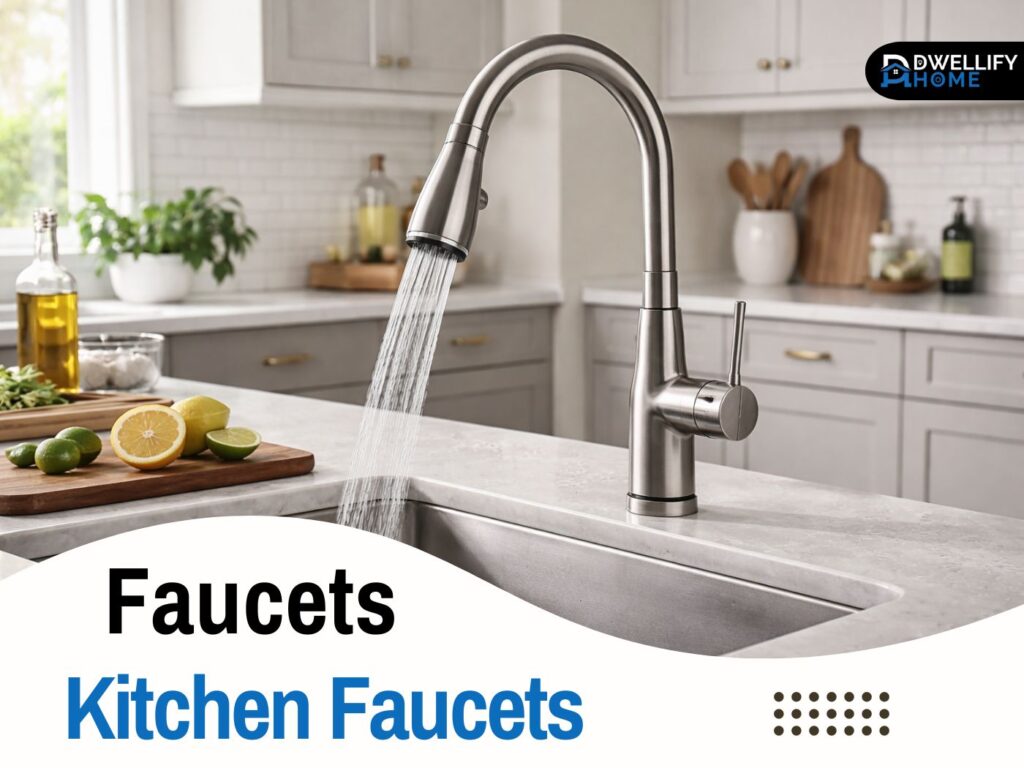
Faucets kitchen faucets are the primary fixtures used at the kitchen sink for washing, rinsing, and filling. The best one matches your sink holes, clearance, spray needs, water pressure, and finish for easy daily use.
Mission Statement:
Dwellify Home helps you choose smarter home upgrades with clear, practical guidance so you can buy once, install with confidence, and enjoy your space every day.
Quick Checklist Before You Buy (Measure First)
Here’s the thing: most “faucet regrets” start with skipping the measuring step. People fall in love with a tall pull-down model, then realize it hits the window frame or splashes all over a shallow sink.
Start with three quick checks before you look at styles and finishes. It’ll save you time and money, and it’ll keep your install smooth.
Do this 3-minute checklist:
- Count your sink holes. Most setups are 1-hole or 3-hole, but you’ll also see 2 and 4.
- Measure clearance. Check the distance to your window, cabinet, shelves, and backsplash.
- Look under the sink. Make sure the shutoff valves work and the supply lines aren’t crusty or leaking.
A small real-world example: I once replaced a faucet for a homeowner who bought a beautiful high-arc model online. The problem was their sink was shallow and narrow. Every time they ran water at medium pressure, it sprayed onto the counter. We swapped to a lower arc with a better aerator, and the mess disappeared.
Quick Guide Table (Comparison)
| Faucet type | Best for | Why people like it | Watch-outs | ||
| Pull-down sprayer | Deep or single-bowl sinks | Easy pot washing, strong rinsing | Can splash in shallow sinks | ||
| Pull-out sprayer | Small sinks, tight spaces | Compact, flexible reach | Shorter hose on some models | ||
| Side sprayer setup | 3 to 4-hole sinks | Separate sprayer, simple main spout | More parts under the sink | ||
| Touchless or touch-activated | Busy kitchens, cleaner handling | Less mess on handles | Needs power, sensor placement matters | ||
| Bridge or two-handle style | Traditional kitchens | Classic look, separate hot and cold | Takes longer to adjust temp | ||
| Pot filler | Frequent stove-top cooking | Fills pots at the stove | Needs plumbing in the wall |
Step-by-step: How to choose the right kitchen faucet (fast)
- Count sink holes (1–4) and decide if you need a deck plate to cover extras.
- Check clearance near windows, shelves, and the backsplash.
- Pick your sprayer style (pull-down, pull-out, or side sprayer).
- Match the faucet height and reach to your sink size to avoid splashing.
- Choose a finish you can live with (fingerprints and water spots matter).
- Decide DIY vs plumber based on shutoff valve condition and tight space issues.
- Stick to reliable brands and easy-to-find parts, especially for cartridges and spray heads.
Kitchen Faucet Fit and Mounting Basics (So It Actually Works With Your Sink)
A faucet can be high quality and still be wrong for your kitchen if the mounting doesn’t match. Fit comes before features.
Most kitchen sink faucet installs are straightforward, but you need to know what you’re working with. Once you do, you’ll avoid the frustrating “it almost fits” situation.
Deck-mount vs wall-mount
A deck-mount faucet sits on the sink deck or countertop. That’s what you see in most homes, and it’s usually the easiest to install and service.
A wall-mount faucet comes out of the wall above the sink. It can look clean and give you counter space, but it needs the plumbing in the wall to be set up right. In older homes, I often find wall-mount lines that weren’t installed perfectly level. That can lead to a faucet that looks slightly crooked, and trust me, you’ll notice it every day.
If you’re remodeling and love the wall-mount look, plan it early. If you’re replacing an existing faucet, deck-mount is almost always the practical route.
1-hole, 2-hole, 3-hole setups (and what extra holes are used for)
This is where a lot of confusion happens. Your sink may have multiple holes from an older setup even if your current faucet only uses one.
Here’s the simple breakdown:
- 1-hole: Usually a single-handle faucet, often with a pull-down sprayer built in.
- 2-hole: Less common in kitchens, sometimes used for certain styles or accessories.
- 3-hole: Often two-handle faucets or a single-handle faucet plus an accessory.
- 4-hole: Common when you have a side sprayer or soap dispenser.
If you have extra holes and you’re switching to a single-hole faucet, you’ll likely need a deck plate. It’s the flat plate that covers unused holes. It’s not a “cheap add-on” when it’s done right, it just makes the installation look finished.
Types of Kitchen Faucets (Choose the Style That Matches Your Routine)
This is the fun part, but I’ll keep you grounded with real kitchen logic. Your faucet type should match your sink size, how you wash dishes, and whether you cook often or mostly do quick rinses.
I’ve seen people buy a commercial-style spring faucet because it looks impressive. Then they hate it because it’s bulky and loud in a quiet kitchen. The best choice is the one you’ll enjoy using every day.
Pull-down vs pull-out (simple decision rule)
A pull-down kitchen faucet has a high arc and the sprayer pulls straight down. It’s great for deep single-bowl sinks, big pots, and busy kitchens.
A pull-out kitchen faucet usually has a lower profile and the sprayer pulls toward you. It’s a solid choice for smaller sinks, tight spaces, or when you don’t want a tall spout near a window.
My quick rule:
- If you have a deep, large sink, go pull-down.
- If you have a small sink or low clearance, go pull-out.
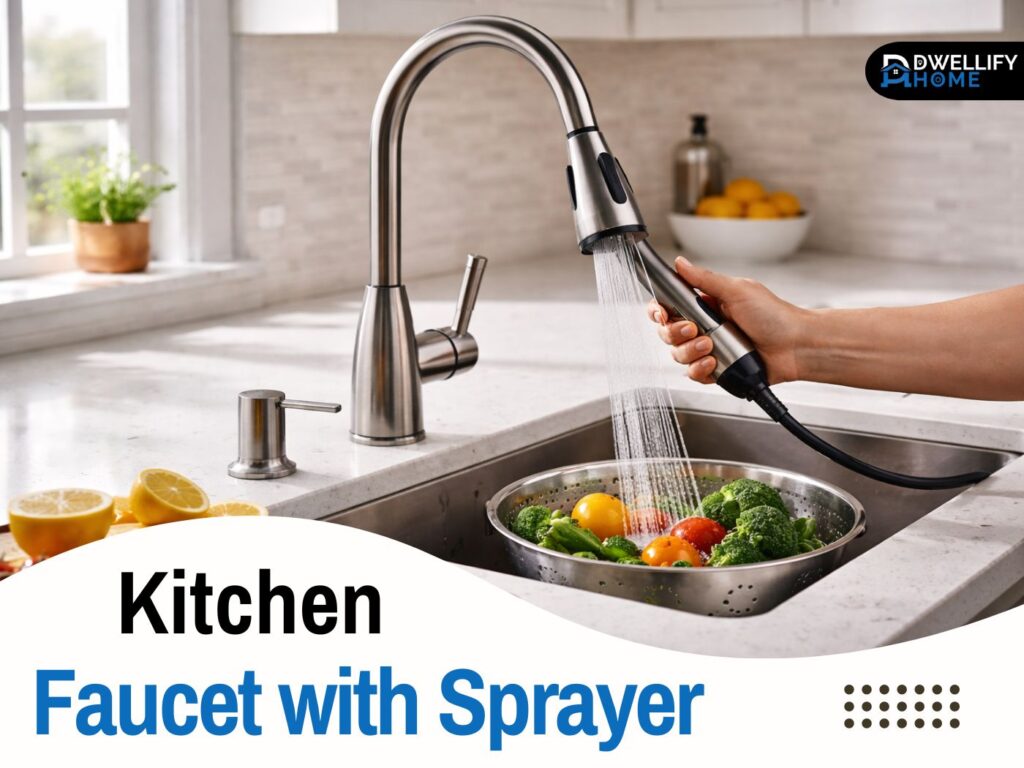
Faucets kitchen faucets with sprayer (what sprayer really means)
When people say faucets kitchen faucets with sprayer, they might mean two different things.
One option is an integrated sprayer, which is built into the faucet head. That’s what most modern pull-down and pull-out models use. It looks clean, and it’s easy to use.
The other option is a side sprayer, which sits in a separate hole next to the faucet. Side sprayers still make sense in a few situations, especially if you prefer a simpler faucet body or you already have a 4-hole sink and like that setup.
From my repair calls, the biggest sprayer issues come from cheap hoses and weak docking. A well-built sprayer head that docks firmly is worth it. It stops the droop problem that drives people crazy.
Other styles worth knowing (without overcomplicating it)
You don’t need a long list, just the few that come up in real kitchens:
- High-arc or gooseneck: More room for big items, but can splash in shallow sinks.
- Low-arc: Cleaner look, less splash risk, better for tight spaces.
- Bridge style: Classic two-handle look, great for traditional kitchens.
- Pot filler: Mounted over the stove, handy for frequent cooking.
- Bar or prep faucet: A smaller second faucet for a prep sink or coffee corner.
Handle and Control Options (Comfort Plus Daily Convenience)
The handle style seems small until you live with it. In real homes, the “best” handle is the one that feels natural with wet hands and messy moments.
I’ve also seen accessibility issues where a faucet looked great but was hard to operate for an older parent. Comfort matters.
Single-handle faucets are popular because you can control temperature and flow quickly with one hand. Two-handle setups give you a classic look and separate hot and cold control, but they take more time to adjust.
Touchless and touch-activated models are where things get interesting. When they’re good, they’re very good. When they’re cheap, they cause frustration.
The best part is touchless faucets help in the moments you don’t think about until you’re cooking. Raw chicken hands, sticky dough fingers, or a big pot blocking your reach. A good sensor faucet keeps the faucet clean and cuts down on germs around the handle.
A practical tip from my installs: if you go touchless, make sure the sensor area is positioned in a way that won’t trigger constantly from a nearby wall or sink edge. Placement and calibration matter more than people expect.
Features That Actually Matter (Not Just Marketing)
A kitchen faucet can have a long list of features, but only a few make a daily difference. I focus on the ones that reduce mess, save effort, and hold up over time.
One homeowner told me their favorite upgrade wasn’t the finish or the brand. It was simply a sprayer that didn’t droop and didn’t sputter. That’s the kind of practical win you want.
Here are the features I consider truly useful:
- Spray modes: A strong spray for rinsing and a steady stream for filling pots.
- Swivel range: A spout that swings wide is a big help for double-bowl sinks.
- Magnetic docking: Keeps the sprayer head snug so it doesn’t sag.
- Hose quality: A smoother, sturdier hose feels better and lasts longer.
Optional upgrades can be worth it if they match your lifestyle. Built-in filtration is great for people who drink a lot of tap water and want cleaner taste. Soap dispensers are handy if you want less clutter on the counter.
Smart features can be useful, but only if you already enjoy smart home stuff. Otherwise, they can feel like extra complexity.
Finishes and Colors (Looks Plus Cleaning Reality)
Finish is not just about style. It’s also about how often you want to wipe it down.
In real kitchens, shiny finishes show water spots and fingerprints more. Matte finishes hide marks better, but some require the right cleaner to keep them looking even.
Common finish choices:
- Chrome: Bright, classic, usually budget-friendly.
- Stainless or brushed nickel: A go-to for most kitchens, hides smudges well.
- Matte black: Modern, easy to match, looks clean when maintained.
- Brass or gold tones: Warm and trendy, great with certain cabinet colors.
Now let’s talk about bronze faucets kitchen faucets because people love the look. Bronze adds warmth and works beautifully with cream cabinets, wood tones, and farmhouse or traditional styles. The main tip is simple: use gentle cleaners. Harsh chemicals can dull the finish over time.
If your home has kids or you hate constantly wiping, look for fingerprint-resistant coatings. They don’t make a faucet maintenance-free, but they reduce how often you notice smudges.
Best Kitchen Faucets for Different Needs
There isn’t one “best” faucet for every kitchen. The best faucets kitchen faucets for you depend on your sink, your habits, and your tolerance for cleaning.
Here are the most common “best for” situations I see during consults and installs:
- Best for large or farmhouse sinks: High-arc pull-down with a solid sprayer and strong docking.
- Best for small kitchens: Compact pull-out or a lower arc faucet to reduce splash.
- Best for heavy daily cooking: Durable build, strong spray, easy swivel.
- Best for easy cleaning: Brushed finishes, simpler shapes, fewer crevices.
- Best for accessibility: Single-handle or touchless options that are easy to operate.
A quick real-life scenario: a family with three kids switched from a two-handle faucet to a single-handle model with a pull-down sprayer. They told me dishwashing got easier, and the sink area stayed cleaner because the sprayer made quick rinses effortless.
Brand Guide (Kohler vs Delta vs Moen) How to Choose Without Guessing
People often ask me, “Which brand should I trust?” I get it. A faucet is something you don’t want to replace again in a year.
Here’s my honest take: most major brands have good models and weaker models. What matters is the specific design, the valve quality, and how easy it is to get replacement parts.
When I compare brands for homeowners, I focus on:
- Warranty clarity and parts availability
- Build feel and long-term reliability
- Ease of installation and service
- Sprayer and docking quality
Kohler faucets kitchen faucets tend to offer strong design variety. I’ve installed many Kohler models in both modern and traditional kitchens, and homeowners usually love the look and feel when they choose the right configuration.
Delta faucets kitchen faucets often stand out when people want practical features. I’ve seen Delta models that handle daily use very well, especially in busy households where the faucet gets used constantly.
Now Moen. If you’re considering a moen kitchen sink faucet or a moen kitchen faucet with sprayer, you’ll find lots of options that focus on comfort and everyday convenience. I’ve had plenty of service calls where parts were easy to source, which matters more than people think when something needs a quick fix.
My simple brand advice: pick the brand you can get support for locally, and choose a model with proven build quality rather than the fanciest feature list.
Water Flow and Performance (Pressure, GPM, and Real Results)
If you’ve ever used a faucet that felt weak, you already know performance matters.
Flow rate is often measured in GPM, gallons per minute. Many modern faucets are designed to balance water efficiency with usability, but not all do it well. A faucet can be technically efficient yet feel frustrating if the spray pattern is poor.
If your home has low water pressure, don’t panic. You just need to pick wisely:
- Choose a faucet with a well-designed aerator and strong spray modes.
- Avoid overly long, restrictive hoses on very cheap models.
- Make sure your shutoff valves are fully open and not partially clogged.
One tip I use in troubleshooting: if the flow is weak only on the hot side, the issue might be the shutoff valve or supply line, not the faucet itself. That’s why I always tell people to inspect under-sink plumbing during a replacement.
Installation Guide (DIY vs Plumber) Plus Common Mistakes
A kitchen faucet swap is one of the most doable home upgrades, but it can also become a headache if the old plumbing is stubborn.
If you’re comfortable working in a tight space under the sink, DIY is possible. If you see corrosion, seized nuts, or old shutoff valves that haven’t moved in years, calling a plumber is a smart move.
Simple installation overview
Here’s a clean, realistic overview:
- Turn off hot and cold shutoff valves.
- Disconnect supply lines and remove the old faucet.
- Clean the mounting surface and install the new faucet.
- Reconnect supply lines, then slowly turn water back on.
- Check for leaks and test the sprayer and handle.
A small but important habit: after the first test, place a dry paper towel under each connection. Check again after 30 minutes. Tiny leaks show up clearly that way.
Supply lines and connections (small detail, big impact)
Old supply lines can look fine but fail after you disturb them. If your lines are stiff, cracked, or heavily corroded, replace them while you’re there.
Braided stainless lines are common and reliable when sized correctly. The key is not over-tightening connections. Snug is good. Cranking it down can damage seals.
When I get a call for a “new faucet leak,” it’s often one of these:
- A washer seated wrong
- A connection slightly cross-threaded
- Old shutoff valves that don’t seal well anymore
If you spot any of that, don’t ignore it. A small drip can become cabinet damage quickly.
Maintenance and Troubleshooting (Make It Last for Years)
Most faucet problems are preventable with simple care.
For daily cleaning, use a soft cloth and mild soap. Avoid abrasive pads. They scratch finishes and trap grime, especially around the handle base and sprayer head.
If you live in a hard water area, you’ll deal with mineral buildup. A safe approach is to remove the aerator and soak it briefly in a gentle descaling solution, then rinse well. If you don’t want to remove parts, wrap a damp cloth around the end of the spout with a bit of vinegar solution, then wipe clean. Just don’t leave harsh solutions sitting on the finish too long.
Common issues I see, and what they usually mean:
- Weak spray: clogged aerator or spray head screen.
- Dripping spout: worn cartridge or valve.
- Leaking base: loose mounting or failing gasket.
- Drooping sprayer: weak docking or worn hose guide.
If your faucet is more than a decade old and you’re constantly patching it, replacing often makes more sense than repeated repairs.
Kitchen Faucets vs Bathroom Faucets (Don’t Mix Them Up)
I’ve seen this mistake happen in budget remodels: someone buys a bathroom faucet for a kitchen because it “looks similar.” Then they wonder why it feels awkward and doesn’t reach the center of the sink.
Kitchen faucets are built for heavier daily work. They usually have more reach, more height options, and sprayer setups that bathroom faucets don’t offer.
A quick checklist to avoid mixing them up:
- Kitchen faucet needs enough reach to hit the center of the sink.
- Sprayer options are common in kitchens and rare in bathrooms.
- Kitchen use demands better durability and easier cleaning.
So yes, the phrase bathroom faucets kitchen faucets comes up, but the practical truth is they’re designed for different jobs.
FAQs
1) Pull-down vs pull-out: which is better?
Pull-down is great for deep sinks and big cookware. Pull-out is better for small sinks or low clearance. If your sink is shallow, pull-out often reduces splashing.
2) Do I need a deck plate?
If your sink has 3 holes and you’re installing a 1-hole faucet, you’ll usually need a deck plate to cover the extra holes and make it look finished.
3) What’s the easiest finish to maintain?
Brushed nickel or stainless-style finishes hide water spots and fingerprints well. Matte black can look clean too, but it needs gentle cleaning to stay even.
4) Can I install a kitchen faucet myself?
Yes, if your shutoff valves work, the mounting hardware isn’t seized, and you’re comfortable working under the sink. If valves are old or corroded, a plumber can prevent leaks and broken fittings.
5) What flow rate should I look for?
A balanced flow should feel strong enough to rinse and fill without being splashy. If your home has low pressure, prioritize a faucet known for good spray performance and a quality aerator.
Conclusion
If you remember just one thing, make it this: the right kitchen faucet is the one that fits your sink, matches your routine, and stays easy to live with.
Start with measurements and hole count. Pick a type that makes sense for your space, like pull-down for deep sinks or pull-out for tight kitchens. Prioritize real features like good spray modes, solid docking, and a finish you won’t hate cleaning.
Then choose a trusted model from a brand with easy-to-find parts, whether that’s Kohler, Delta, or Moen. Finally, install it carefully, check for leaks twice, and keep up with simple cleaning so it stays smooth for years.
Once you get the right setup, you’ll feel it every single day. And honestly, that’s what a good kitchen upgrade should do.
Disclaimer:
This content is for general informational purposes only. Plumbing conditions vary by home. For safety and proper installation, consult a qualified professional if you’re unsure or if shutoff valves, supply lines, or fittings appear damaged or corroded.

I’m Bilal, the founder of Dwellify Home. With 6 years of practical experience in home remodeling, interior design, and décor consulting, I help people transform their spaces with simple, effective, and affordable ideas. I specialize in offering real-world tips, step-by-step guides, and product recommendations that make home improvement easier and more enjoyable. My mission is to empower homeowners and renters to create functional, beautiful spaces—one thoughtful update at a time.