
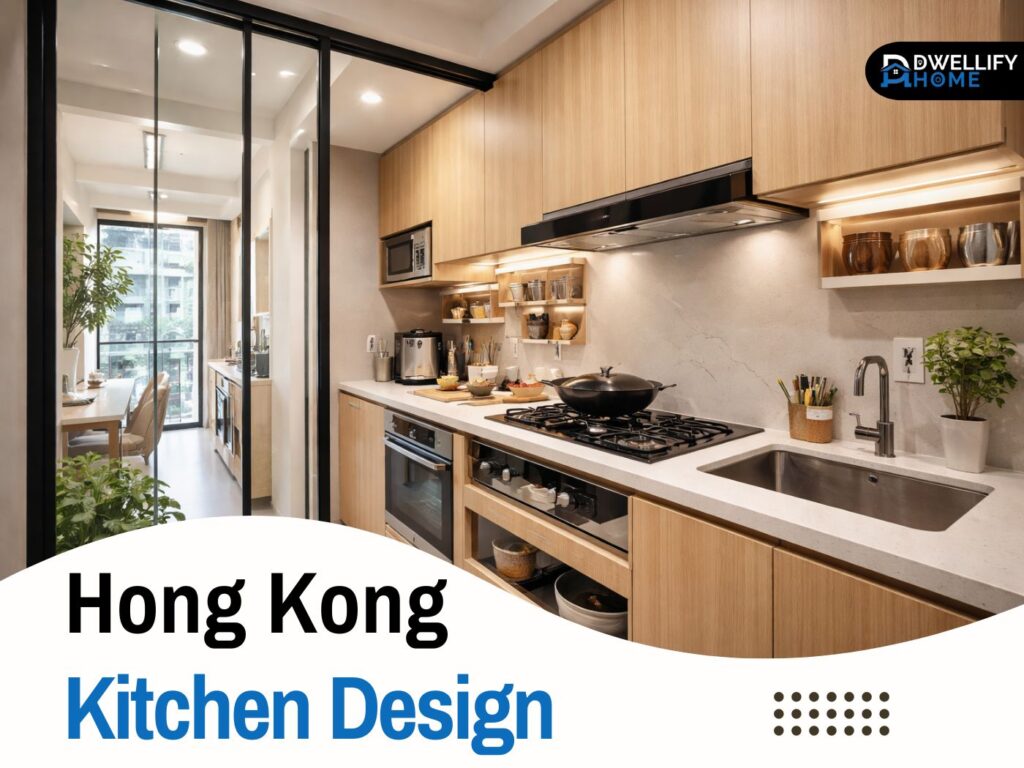
A hong kong kitchen isn’t just a style. It’s a set of smart decisions built for small urban apartments where space is tight, cooking is real, and storage needs to work hard every day.
I’ve designed plenty of compact kitchens in dense cities, and Hong Kong homes taught me something fast: you can’t rely on pretty ideas alone. You need a layout that flows, ventilation that actually handles oil fumes, and storage that keeps counters clear even on busy weeknights.
Let’s walk through what works in real homes, step by step, without overcomplicating it.
Snippet-ready definition:
A Hong Kong kitchen is a compact, highly practical kitchen style designed for small apartments, focused on efficient layouts, strong ventilation for oil fumes, and smart storage that keeps counters clear and cleaning easy.
Mission Statement:
At Dwellify Home, our mission is to share practical, experience based home design guidance that helps you plan small spaces with confidence, especially kitchens that need to handle real daily cooking without feeling cramped.
What Makes a “Hong Kong Kitchen” Different?
Most Hong Kong apartment kitchens are small, sometimes surprisingly small. The footprint might be just enough for one person to move comfortably, and that changes how you plan everything from cabinet depth to where you put your chopping board.
On top of that, cooking habits matter. Many households cook with high heat, stir-fry often, and use aromatics that cling to fabrics. That’s why you’ll see a big focus on odor control, easy-clean finishes, and smart separation between the cooking zone and the living area.
The best part is, these kitchens can feel neat and calm even when they’re compact. The secret is not squeezing in more stuff, but choosing what earns its space.
Quick Guide Table (comparison you can use inside the article)
| Kitchen type | Best for | Main advantage | Main drawback | Common HK solution |
| Open kitchen | Light cooking, social homes | Feels bigger, more light | Smells and grease can travel | Strong range hood plus tidy storage |
| Semi open kitchen | Most daily HK cooking styles | Light + separation balance | Needs good door or glass design | Glass partition or sliding glass doors |
| Closed kitchen | Heavy stir fry, deep fry | Best odor and grease control | Can feel smaller if poorly lit | Borrow light with glass panels |
Mini rule of thumb:
- Light cooking most days: open or semi open
- Regular stir fry: semi open is usually the sweet spot
- Heavy frying: closed or very well sealed semi open
Optional step-by-step mini guide (super clean)
- Decide how you cook (light vs high heat)
- Pick open, semi open, or closed
- Plan ventilation early (hood coverage, duct route, easy cleaning)
- Choose a layout that supports prep cook wash flow
- Build storage in zones so countertops stay clear
- Pick easy clean backsplash and practical cabinet finishes
- Add task lighting under cabinets
Know Your Cooking Style First (This Decides Everything)
Here’s the thing: I’ve seen beautiful open kitchens fail because the cooking style didn’t match the design. If you love quick steaming and light pan cooking, you can get away with more openness. If you do deep-frying or daily wok cooking, you’ll need stronger fume control and better containment.
Before you think about colors or cabinet handles, answer a few simple questions:
- Do you stir-fry or deep-fry often?
- Do you cook once a day, or multiple times?
- Do smells bother you, or are you used to them?
- Do you want people to chat with you while you cook?
One practical tip I use with clients is the prep to cook to wash flow. If those three zones sit naturally within arm’s reach, the kitchen feels bigger than it is. If you have to zig-zag around, even a slightly larger kitchen feels tiring.
Open vs Closed Kitchen in Hong Kong (Which One Should You Choose?)
Why open kitchens are popular in Hong Kong apartments
Open kitchens became popular because they bring light and visual space into a small home. When you remove a wall, the kitchen stops feeling like a box. It also helps the living area feel more connected, which matters when the dining table is only a few steps away.
I’ve designed open kitchen Hong Kong layouts that feel airy, especially when you keep the cabinetry clean-lined and use reflective surfaces in small amounts. The room looks bigger, and you’re not cut off from family while you cook.
Still, openness only feels good if the smells and grease stay under control. Without that, the sofa and curtains start paying the price.
When a closed kitchen is the smarter choice
If your cooking is heavy on frying, browning, or spicy stir-fry, a closed kitchen is often the calmer choice. It gives you a physical barrier that stops oil fumes from drifting into the living area.
In my experience, people who cook daily at high heat usually feel happier long-term with a closed layout or a semi-open solution. It’s not about being old-fashioned. It’s about maintenance, comfort, and keeping the rest of the home fresh.
A closed kitchen can still feel bright. The trick is to borrow light using glass, smart lighting, and clean finishes so it doesn’t feel like a cave.
The Semi-Open Hong Kong Kitchen (Most Practical Option for Many Homes)
If there’s one layout idea I keep coming back to, it’s the semi-open kitchen design. It’s the middle ground that fits real life in small apartments.
A semi-open kitchen usually means a glass partition kitchen, a sliding glass door kitchen, or a half wall with a glass panel above. You get separation for fumes, but you keep the sense of openness and light.
Guess what, this is also one of the easiest ways to make a small kitchen feel less cramped. When you use glass, your eye still travels. The space feels connected, but the kitchen stays containable when you’re cooking.
A simple way to choose:
- Light cooking most days, open or semi-open can work.
- Regular stir-fry and strong aromas, semi-open is usually the safest bet.
- Deep-fry often, closed or very well-sealed semi-open plus strong ventilation.
Ventilation and Oil-Fume Control (The Make-or-Break Feature)
Range hood priorities in small kitchens
In a compact Hong Kong apartment kitchen, the range hood isn’t optional. It’s the workhorse. And no, the fanciest-looking hood isn’t always the best choice.
What I look for first is coverage. The hood needs to sit over the cooking area properly, not just hover there like decoration. Next is airflow strength. Brands measure this in different ways, but the practical test is simple: can it pull steam and smoke quickly, especially during high-heat cooking?
Also, pay attention to ducting. If the duct path is too long or has too many bends, performance drops. I’ve seen great hoods underperform because the installation wasn’t planned well.
Extra odor-control tips that actually help
On top of that, a few habits and design tweaks make a big difference:
- Use a hood that’s easy to clean so you actually maintain it.
- Keep the cooktop close to the hood’s sweet spot, not pushed too far forward.
- Add a small gap under the door or a planned airflow path so the hood can pull air effectively.
- Wipe grease daily on the backsplash and nearby surfaces, it stops odor buildup.
This isn’t glamorous advice, but it’s what keeps a small home feeling fresh.
Best Layouts for a Small Hong Kong Kitchen
Layout matters more than style in tight spaces. I’ve watched people fall in love with a trendy look, then hate the kitchen because the workflow is awkward.
A good layout reduces steps and keeps the messy parts contained. It also gives you a logical place for everything, which is how small kitchens stay tidy.
U-shaped kitchen layout (compact and efficient)
A U-shaped kitchen layout is one of my favorites when space allows. It wraps the work zones around you, so you’re not walking back and forth.
It’s especially strong for households that cook often, because you can keep prep space on one side, the cooktop in the middle, and washing on the other side. The kitchen feels like a cockpit, everything within reach.
The common mistake is making the walkway too tight. You need enough clearance so doors and drawers don’t collide, and so you can move comfortably.
Galley or corridor kitchen layout (simple workflow)
A galley kitchen layout, also called a corridor kitchen, is common in many Hong Kong apartment kitchen plans. It’s efficient because it keeps everything in a straight line.
The key is to maintain a clean prep to cook to wash sequence. If the sink is too far from the cooktop, or the fridge blocks the prep zone, the kitchen feels frustrating.
When I design a galley, I try to keep counters clear by building storage into the walls and focusing on drawers rather than deep cabinets that become messy caves.
Storage That Solves the Real Problem (Without Making It Look Crowded)
Storage is the number one daily pain point in small kitchen ideas Hong Kong projects. The goal isn’t maximum cabinets. The goal is storage that’s easy to use.
Vertical storage helps, especially ceiling-height cabinets. You can keep daily items at eye level, and store less-used items up high. That way, your main shelves stay practical.
Drawer strategy matters too. Deep drawers can hold pots and pans neatly, and pull-outs make it easier to reach items without digging.
I also like to create simple zones. Nothing fancy, just clear logic:
- Daily-use zone for plates, cups, and basics
- Cooking tools zone near the cooktop
- Pantry zone for dry goods and snacks
When zones are right, the countertop stays clear. And that’s what makes a compact kitchen feel calm.
Work Surfaces and Materials for Real Cooking (Easy-Clean Wins)
In kitchens built for high-heat cooking, materials need to survive heat, moisture, and grease. I always recommend choosing finishes that wipe clean without babying them.
For countertops, durability and maintenance come first. You want something that can handle hot pans, sharp tools, and frequent cleaning. The same goes for the backsplash. An easy-clean backsplash with fewer grout lines saves you time every week.
Cabinet finishes matter more than people think. Matte can look nice, but some matte finishes hold onto fingerprints. Gloss can reflect light, but it may show smudges. I often choose a balanced satin finish for a practical middle ground.
The best part is, practical materials can still look modern and stylish. You just need to pick with real life in mind.
Lighting and Visual Space Tricks Used in Hong Kong Kitchens
Lighting can make a small kitchen feel either cramped or surprisingly open. I always design lighting in layers.
First, task lighting. Under-cabinet lights brighten your prep area and reduce shadows. Then, general lighting that fills the room evenly. If you only have one ceiling light, corners tend to feel dark.
Visual space tricks help too, but keep them subtle:
- A bit of reflective surface to bounce light
- Glass elements that let light travel
- Lighter wall tones for an airy feel
Glass blocks or a glass panel above a half wall can be a great solution in a semi-open setup. You get separation without losing brightness.
Appliances and Fixtures That Fit Small HK Kitchens (Space-Smart Picks)
In compact kitchens, appliance size and placement can make or break the workflow. I’ve seen clients buy a huge fridge, then lose their prep space and wonder why cooking feels stressful.
Go for compact kitchen appliances where it makes sense, especially if you don’t need full-size everything. Built-in appliances can look clean and save space, but only if the layout supports them.
Sinks and faucets matter too. A well-placed sink reduces splashing and keeps cleanup contained. For faucets, a simple pull-down sprayer can be genuinely helpful in tight spaces, especially if you wash large pans or wok accessories.
A small tip I share often: don’t crowd the cooktop. Leave breathing room on at least one side for a landing zone, so you’re not placing hot pans on random spots.
The Hong Kong Kitchen Look (Minimal, Functional, and Culture-Inspired)
A lot of people love the Hong Kong kitchen design look because it feels minimal and efficient. Clean lines, practical storage, and a layout that doesn’t waste space.
You can add subtle culture-inspired touches without turning it into a themed room. For example, tile choices that nod to classic patterns, or a warm neutral color palette that feels grounded.
Function should still lead. If you have a wok-friendly setup, a strong hood, and storage that supports your daily routine, the kitchen will feel right. Style becomes the finishing touch, not the main event.
Renovation Reality Check in Hong Kong (Safety, Rules, and Approvals)
Renovation in dense apartment buildings comes with real constraints. Depending on the building, there may be rules about what walls can be changed, what ventilation routes are allowed, and what approvals you need.
I always advise planning early for safety and compliance. Fire safety considerations, proper electrical planning, and ventilation routing should be decided before cabinets are finalized.
Common mistakes I’ve seen:
- Changing layouts without checking building restrictions
- Ignoring ventilation duct paths until too late
- Choosing materials that don’t handle humidity and grease well
A little planning here prevents expensive fixes later.
Real-World Examples: What Hong Kong Homeowners Copy Most Often
One popular setup I’ve used many times is a semi-open kitchen with sliding glass doors. The doors stay open during light cooking, then close during heavy stir-fry. It keeps the home feeling open, but protects the living space when it matters.
Another common pattern is building storage up to the ceiling and using a mix of drawers and pull-outs. This keeps daily items accessible and reduces countertop clutter.
I’ve also seen homeowners fall in love with a clean galley layout paired with strong under-cabinet lighting. Even if the kitchen is narrow, it feels bright, organized, and easy to cook in.
These ideas work because they solve daily problems, not because they look trendy in photos.
Common Hong Kong Kitchen Mistakes (And How to Avoid Them)
The biggest mistake is underestimating ventilation. If you cook with high heat, weak odor control becomes a daily frustration.
Another mistake is choosing an open kitchen when your cooking style needs separation. It can look great, but maintenance becomes constant.
Other common issues:
- No clear prep zone, so counters stay messy
- Oversized appliances that block movement
- Hard-to-clean finishes that show grease quickly
- Poor lighting that makes the kitchen feel cramped
Fixing these doesn’t require luxury upgrades. It requires thoughtful planning.
Quick Planning Checklist (Before You Spend Money)
Here’s a simple checklist I use with clients:
- Decide your cooking style and how often you cook
- Choose open, closed, or semi-open based on fumes and lifestyle
- Plan ventilation early, including duct route and cleaning access
- Pick a layout that supports prep, cooking, and washing flow
- Design storage zones so counters stay clear
- Choose easy-clean materials for backsplash and cabinets
- Plan layered lighting for prep areas and general brightness
- Confirm renovation approvals and safety planning
Keep it simple. Clarity beats complexity every time.
FAQs
1) Who is the owner of Hong’s Kitchen?
Hong’s Kitchen is a Chinese QSR brand from Jubilant FoodWorks Limited, the company that operates several major food brands in the region.
2) What does Hong Kong style mean on a Chinese menu?
It usually points to Hong Kong influenced dishes, often linked to cha chaan teng style cafes, known for affordable fusion of Cantonese tastes with Western style items and drinks like Hong Kong milk tea.
3) What was Bruce Lee’s favorite restaurant?
A widely cited favorite spot of Bruce Lee in Seattle is Tai Tung restaurant, a long running Chinese restaurant in the Chinatown International District.
4) Why is Din Tai Fung so famous?
Din Tai Fung is known for its soup dumplings and a strong reputation for consistency, careful technique, and hospitality, backed by large global expansion and media coverage around its kitchen standards.
5) Is a semi open kitchen better than an open kitchen for oily cooking?
Often, yes. A semi open kitchen uses glass partitions or sliding doors to reduce cooking fumes spreading while still keeping the home brighter and more open feeling.
Conclusion
A hong kong kitchen works best when it’s built around real life. Not a showroom version of life, but the daily routine of chopping, frying, washing, and putting things away in a small space.
If you remember one thing, let it be this: start with how you cook, then choose the right openness level, then invest in ventilation and smart storage. Once those are solid, the rest becomes much easier.
And honestly, that’s the beauty of Hong Kong-style design. It respects the reality of compact living, and it proves that even small kitchens can feel efficient, calm, and surprisingly enjoyable to use.
Disclaimer:
This article is for general home design education. Building rules, ventilation requirements, and renovation approvals vary by building and location, so confirm details with qualified professionals before starting work.

I’m Bilal, the founder of Dwellify Home. With 6 years of practical experience in home remodeling, interior design, and décor consulting, I help people transform their spaces with simple, effective, and affordable ideas. I specialize in offering real-world tips, step-by-step guides, and product recommendations that make home improvement easier and more enjoyable. My mission is to empower homeowners and renters to create functional, beautiful spaces—one thoughtful update at a time.