Most kitchen renovations get planned down to the last tile, but cabinet hardware gets chosen in ten minutes at the end. I’ve seen it happen on more projects than I can count. Someone spends months deciding on countertop stone and cabinet paint, then grabs the first knob that looks decent online. Three months later, they’re asking how to swap everything out.
The good news is this decision doesn’t need to be rushed or stressful. Once you understand what actually drives it — style, finish, and fit — the rest falls into place fairly quickly.
Snippet-Ready Definition
Kitchen cabinet knobs are single-point hardware fixtures used to open cabinet doors. They influence both the look and daily usability of a kitchen, and choosing the right style, finish, and size ensures a result that holds up over time.
Mission Statement
At Dwellify Home, we help homeowners make practical, well-informed décor decisions — without the overwhelm. Every guide we publish is built around real decision-making, not trends for the sake of trends.
Knobs vs. Pulls — What’s the Difference and Does It Matter?
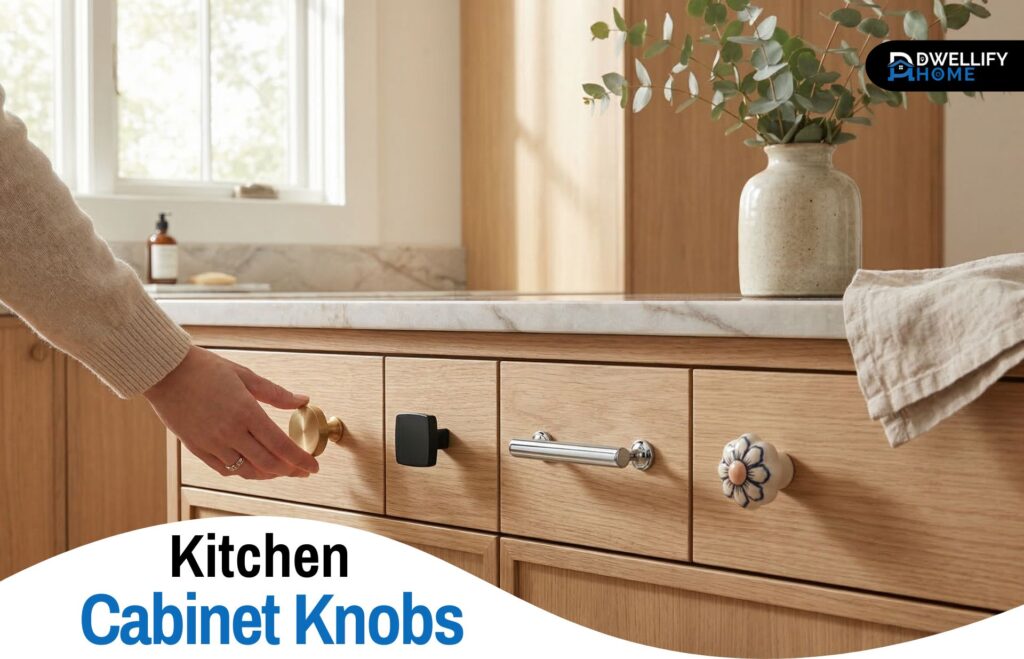
A knob has one screw and one grip point. A pull has two mounting points and a bar or bridge shape. Both open cabinets — the difference is in feel, leverage, and visual weight.
Why Most Kitchens Use Both
The standard approach is knobs on cabinet doors and pulls on drawers. Drawers need leverage because you’re pulling weight outward. A single-point knob on a heavy drawer feels awkward in daily use. A pull distributes that grip across a wider span and just works better. Cabinet doors, on the other hand, swing open easily with minimal effort, so a knob handles the job well.
The Simple Rule Most Designers Follow
Keep the finish the same across both. A round knob and a bar pull can look intentional together as long as they’re in the same finish. The moment finishes start mixing without purpose, the hardware starts looking like it was assembled from different projects.
Quick Comparison: Knobs vs. Pulls at a Glance
| Feature | Knobs | Pulls |
| Mounting Points | 1 screw | 2 screws |
| Best For | Cabinet doors | Drawers |
| Grip Type | Single-point | Bar or bridge |
| Visual Weight | Minimal | More prominent |
| Ease of Use | Simple | Better leverage |
| Style Range | Wide | Wide |
Key Practical Benefits of Choosing the Right Cabinet Knobs
- Instantly updates the look of existing cabinetry without full replacement
- Coordinates the kitchen’s hardware palette across doors and drawers
- Improves daily usability when size and grip style match household needs
- A durable finish reduces maintenance and holds up to daily kitchen use
- Correct placement prevents awkward reach and reduces wear on the door edge
The Main Types of Kitchen Cabinet Knobs
Round Knobs — The Versatile Classic
Round knobs suit almost every kitchen style. They’re comfortable to grip, widely available, and come in every finish. If you’re ever genuinely unsure, a well-chosen round knob in the right finish is a safe and honest choice.
Square and Geometric Knobs — Clean and Contemporary
Square knobs complement flat-panel, modern cabinetry well. The hard angles mirror the geometry of the cabinets themselves. One honest note: they’re slightly less comfortable to grab repeatedly through the day compared to a rounded profile.
T-Knobs — A Functional Middle Ground
T-knobs have a short bar shape with a wider grip than a standard round knob. They work particularly well on doors where a round knob feels too minimal but a full pull would look heavy. They offer better grip without changing the visual balance much.
Ceramic and Porcelain Knobs — Charm with Character
Ceramic knobs work well in farmhouse, cottage, and country kitchens. Hand-painted versions add warmth and individuality that no metal finish can replicate. They’re not indestructible though — ceramic chips if knocked repeatedly, so consider placement before you commit.
Ornate and Decorative Knobs — When Detail Is the Point
Decorative knobs with raised detailing, scrollwork, or antique shapes belong in traditional kitchens where the hardware is part of the design language. They look deliberate in the right setting. In a minimal or modern kitchen, they create visual noise.
Knobs with Backplates — Decorative Detail or Practical Solution?
Backplates frame the knob and give the hardware a more layered, finished look. They’re also one of the most practical tools in a renovation context. If you’re replacing old hardware and the existing holes are slightly off or in an awkward position, a backplate covers the problem cleanly without any patching or redrilling. It’s a detail that earns its place on both fronts.
How to Match Cabinet Knob Style to Your Kitchen
Traditional and Classic Kitchens
Antique brass, oil-rubbed bronze, or polished nickel in a round or slightly ornate shape feel natural here. The hardware can carry some detail — it fits the overall design.
Modern and Flat-Panel Kitchens
Keep it simple. Square or cylindrical knobs in matte black or brushed nickel work with the clean geometry of modern cabinetry without distracting from it.
Shaker-Style Kitchens
Shaker cabinetry is versatile. Brushed nickel, matte black, and brass all read well against it. A simple round or slightly tapered knob stays true to the utilitarian character of the style.
Farmhouse and Cottage Kitchens
Ceramic knobs, cup pulls, and bin-style hardware feel authentic here. Black iron and aged brass finishes add warmth without looking decorative for decoration’s sake.
Transitional Kitchens — When You’re Mixing Eras
Transitional kitchens blend elements from different periods. Unlacquered brass and brushed nickel are the two finishes that sit most comfortably in this in-between space — warm enough to feel traditional, clean enough to feel current.
Choosing the Right Finish — What to Know Before You Decide
Brushed Nickel and Stainless Steel — The Reliable Staples
These are consistently the most used residential finishes, and for practical reasons. They’re durable, coordinate with most appliances, and hide fingerprints well — which genuinely matters in a kitchen.
Matte Black — Bold, Modern, and Very Forgiving
Matte black is one of the most low-maintenance finishes in daily kitchen use. It doesn’t show water spots or smudges the way polished finishes do. It works particularly well against white, grey, sage, and navy cabinetry.
Brass and Gold Tones — Warmth Done Right
Brass used to feel dated. Now it’s used thoughtfully and the results speak for themselves. Unlacquered brass develops a natural patina that many people prefer over time. Satin brass stays more consistent in appearance with less upkeep. Avoid thin-plated brass from budget suppliers — it chips and discolors within a year of daily use.
Chrome — When You Want Clean and Bright
Polished chrome looks sharp in contemporary kitchens but requires more maintenance than any other finish. Every fingerprint and water mark shows. In a kitchen with heavy daily use, that adds up.
Bronze and Antique Finishes — Built-in Character
Oil-rubbed bronze and similar aged finishes have a visual depth that flat finishes don’t. They look better as they age slightly, which makes them a low-effort long-term choice for traditional spaces.
How to Match Your Knob Finish to Your Cabinet Color
Warm cabinet colors — cream, wood, olive, navy — pair well with brass, bronze, and matte black. Cooler tones — white, grey, light blue — work well with brushed nickel, chrome, and matte black. Matte black is the one finish that genuinely bridges both ends of the color spectrum.
Which Finishes Hold Up Best in a Working Kitchen
Brushed and matte finishes consistently outperform polished ones for daily upkeep. Solid brass and stainless are the most durable base materials overall. Avoid thinly plated hardware for anything that sees heavy use — the finish wears away at the contact points within a year or two.
Getting the Size and Placement Right
Standard Knob Sizes and What They Work With
Most cabinet knobs measure between 1 inch and 1.5 inches in diameter. Smaller knobs under an inch can look sparse on larger cabinet faces. Anything above 1.5 inches starts to dominate smaller cabinets.
The Proportion Rule — A Simple Way to Get It Right
Larger doors need proportionally larger knobs. A small knob on a wide, tall cabinet door looks like it was placed there as an afterthought. Match the visual weight of the hardware to the size of the cabinet face and the balance takes care of itself.
Upper Cabinets vs. Lower Cabinets — Does Size Change?
It doesn’t have to, but slightly smaller knobs on upper doors and larger hardware on lower drawers and doors can reflect the natural scale difference between the two areas. It reads as considered rather than accidental.
One Knob or Two on Wider Drawers?
On a drawer wider than roughly 24 inches, a single centered knob can feel unbalanced — both visually and in use. Two knobs spaced evenly or a longer pull handle the scale better on both counts.
Where to Place Knobs on Cabinet Doors
Upper cabinet doors: bottom corner, opposite the hinge. Lower cabinet doors: top corner, opposite the hinge. This positions the knob where the hand naturally reaches and aligns with how the door swings.
Drawer Placement — Centered or Offset?
For most drawers, centering the knob horizontally and vertically is the cleanest approach. On a very tall drawer, placing it slightly above center feels more natural to reach from a standing position.
Framed vs. Frameless Cabinets — Placement Isn’t the Same
On framed cabinets, knobs typically sit on the face frame rail. On frameless European-style cabinets, they go directly on the door panel. The visual result looks different, so don’t carry measurements from one type over to the other without checking.
A Tip Before You Drill
Use a small piece of painter’s tape to mark the proposed screw position before committing. Hold the knob against it and step back. Live with it for a day. It takes almost no time and it’s the most reliable way to confirm placement before the drill comes out.
Mixing Knobs and Pulls — How to Do It Without It Looking Messy
Do Kitchen Cabinet Knobs and Handles Need to Match Exactly?
They don’t need to be identical, but they do need to feel related. The most reliable method is choosing from the same hardware collection or at least the same finish family. Related shapes in a single finish almost always look deliberate.
Mixing Shapes Within One Finish
A round knob and a straight bar pull in matching brushed nickel read as an intentional pairing. The shape difference adds visual variation; the consistent finish provides the cohesion. Most professional kitchen designers work this way as a default.
Mixing Finishes — What Works and What Doesn’t
Two complementary finishes can work — brass and matte black is a pairing that holds up well when it’s applied consistently. Three or more finishes in one kitchen almost always look unplanned. A useful check: if both finishes appear elsewhere in the kitchen — in the faucet, light fixtures, or appliances — the hardware feels like part of a considered palette rather than a mismatch.
Practical Things to Sort Out Before You Buy
Measure Your Existing Holes First
Before ordering anything, check where your current holes sit. Standard knobs use a single-screw bore, but the position relative to the door edge can vary between cabinet manufacturers. Ordering 40 knobs before confirming this is a genuinely common and avoidable mistake.
Replacing Old Knobs Without Redrilling — What to Check
If the existing holes are off-center or in an awkward spot, a backplate covers the issue without any filling or repainting. Alternatively, a knob with a wider base can conceal an old hole cleanly. Filling and redrilling is always possible, but it adds time and finish-matching work that’s easy to skip with the right hardware selection.
Accessibility and Ease of Use — Who in Your Home Opens These Cabinets?
Small round knobs can be genuinely difficult to grip for people with reduced hand strength. Elderly family members, young children, and anyone with arthritis will find a D-ring pull or T-knob much easier to use. It’s a detail that gets overlooked on most projects and makes a real difference in the right household.
Order More Than You Think You Need
Finishes get discontinued. Hardware gets nicked during installation. A few extra knobs ordered upfront means you won’t spend months tracking down an exact match later.
Test With Samples Before Committing
Most hardware suppliers sell single units. Order one or two of your shortlisted choices and hold them against your actual cabinet doors in your kitchen’s natural light. Monitor finishes look different in photography than they do in a real kitchen, and screen calibration varies too much to trust completely.
Common Mistakes People Make When Choosing Cabinet Knobs
The most frequent one: buying based on a product photo without considering scale. A knob that looks proportionate in a styled shoot may look undersized on your actual cabinet faces. Always check dimensions against the size of your specific cabinet doors and drawers.
The second: choosing hardware at the tail end of a project when the budget is nearly spent. Cabinet hardware makes a visible impact, and it deserves a deliberate allocation — not whatever’s left.
The third: prioritizing appearance over grip. A knob that looks good in photos but is uncomfortable to use, or catches on clothing because of sharp edges, will become a daily irritation quickly.
What’s Worth Knowing About Current Trends
Matte black and unlacquered brass continue to dominate renovated kitchens. Fluted and ribbed knob profiles have appeared more consistently over the past two years. Integrated, handle-free cabinet designs with push-to-open mechanisms are also growing in modern kitchens — though they require precision installation to stay reliable over time.
Trends are worth knowing for context, not for direction. A finish or style that genuinely suits your kitchen and holds up to your household’s daily use doesn’t need external validation to be the right choice.
FAQs
Q: What is the latest trend in cabinet knobs?
Matte black and unlacquered brass remain the most consistently chosen finishes in renovated kitchens. Fluted and ribbed knob profiles have grown more popular over the past two years, and integrated handle-free designs with push-to-open mechanisms continue to appear in modern kitchen builds.
Q: What is the 1/3 rule for cabinet pulls?
The 1/3 rule suggests that a pull’s length should be roughly one-third the total height or width of the cabinet door or drawer front it’s placed on. It’s a proportional guideline — not a strict rule — but it helps avoid hardware that looks too small or too dominant relative to the cabinet face.
Q: Is it better to put knobs or pulls on cabinets?
Neither is universally better. The practical approach most designers use is knobs on cabinet doors and pulls on drawers. Doors open with minimal effort and a single knob handles that well. Drawers need more grip and leverage, which a pull provides more comfortably. Using both also adds visual variety without looking inconsistent, as long as the finish stays consistent.
Q: What is the best size knob for kitchen cabinets?
For most kitchen cabinets, a knob between 1 inch and 1.5 inches in diameter works well. Smaller knobs under 1 inch can look sparse on larger doors. The more reliable approach is to match the knob size proportionally to the cabinet face — larger doors need larger hardware, and smaller upper cabinets can carry something slightly more modest.
The Right Kitchen Cabinet Knobs Come Down to Three Things
Style, finish, and fit. Get those three aligned with your kitchen and your actual daily habits, and the decision largely makes itself.
The style should suit the character of your cabinetry. The finish should coordinate with what’s already in the space and hold up to how your kitchen gets used. The fit — size, placement, and grip — should feel comfortable and proportionate every time someone reaches for a door.
Kitchen cabinet knobs are a modest investment relative to everything else in a kitchen project. But you’ll interact with them dozens of times every single day. Giving them a proper hour of thought, and testing a sample before you commit, is time that always pays off.
Disclaimer
The information provided on Dwellify Home is for general guidance purposes only. Product availability, sizing standards, and design recommendations may vary by region and supplier. Always verify specifications with your chosen hardware supplier before purchasing or installing.

I’m Bilal, the founder of Dwellify Home. With 6 years of practical experience in home remodeling, interior design, and décor consulting, I help people transform their spaces with simple, effective, and affordable ideas. I specialize in offering real-world tips, step-by-step guides, and product recommendations that make home improvement easier and more enjoyable. My mission is to empower homeowners and renters to create functional, beautiful spaces—one thoughtful update at a time.