Metal kitchens get a reaction. Some people walk into one and immediately feel that quiet confidence a well-built space gives you. Others hesitate — they’re not sure if it’ll feel too cold, too industrial, or just too different from what they’re used to.
After working with dozens of kitchen renovation projects over the years, I’ve seen both responses, and I understand both. What I’ve also seen is that the people who make the wrong call with metal cabinets usually do so because they didn’t have the full picture before deciding.
This guide gives you that picture.
Snippet-Ready Definition
Metal kitchen cabinets are cabinetry made from steel or aluminum instead of wood. Homeowners choose them for their durability, hygienic surfaces, and long lifespan — particularly in modern, industrial, or high-use kitchen environments.
About Dwellify Home
At Dwellify Home, we help homeowners make practical, well-informed decisions about their living spaces — without the noise. Every guide we publish is built on real research, honest evaluation, and the kind of straightforward advice that actually helps you move forward.
What Are Metal Kitchen Cabinets?
Metal kitchen cabinets are cabinet boxes and door fronts made from sheet metal — most commonly steel or aluminum — instead of the wood, plywood, or MDF used in traditional cabinetry. They’re fabricated through cutting, bending, and welding, then finished with paint, powder coating, or left with a natural brushed or polished surface.
They’ve been used in commercial kitchens for decades because they hold up under serious conditions. The residential market is a different story — here, the choice is more about balancing durability with design, and getting that balance right takes some thought.
Quick Comparison: Metal vs. Wood Kitchen Cabinets
| Factor | Metal Cabinets | Wood Cabinets |
| Durability | Very high | Moderate to high |
| Moisture resistance | Excellent | Poor to moderate |
| Design flexibility | Limited | Very high |
| Maintenance | Low (right finish) | Moderate |
| Cost (mid-range) | Higher upfront | More affordable |
| Lifespan | 30–50+ years | 10–20 years |
| Repairability | Difficult | Easier |
| Eco-friendliness | Fully recyclable | Depends on source |
Key Benefits at a Glance
- Resistant to moisture, warping, and heat
- Non-porous surface — hygienic and easy to clean
- Long lifespan with minimal upkeep
- Available in powder-coated colors beyond standard silver
- Fully recyclable at end of life
- Fire-resistant construction
A Brief History: From Post-War Kitchens to Modern Homes
Metal cabinets were actually the standard in American homes during the 1940s and 1950s. Brands like St. Charles, Youngstown, and Geneva were household names, and a steel kitchen was considered modern, hygienic, and aspirational. Then wood took over through the 1960s and beyond, and metal got pushed into garages and utility rooms.
What’s happening now is a deliberate return — driven partly by the industrial design trend and partly by homeowners who simply want something that lasts. Vintage metal kitchen cabinets have also developed a loyal following among people restoring mid-century homes or hunting for that retro character that flat-pack wood cabinets can’t replicate.
The Main Types of Metal Used in Kitchen Cabinets
Not all metal cabinets are the same material, and the differences matter more than most guides acknowledge.
Stainless steel is the most widely used option. It’s corrosion-resistant, non-porous, and holds up extremely well over time. Stainless steel kitchen cabinets are the standard in professional kitchens for a reason — they’re built to take punishment.
Aluminum is lighter and naturally rust-proof, which makes it a reasonable choice in humid environments. It dents more easily than steel but costs less and is easier to handle during installation.
Powder-coated steel is probably the most versatile option for residential use. A powder coat finish gives you the strength of steel with a wide color range — matte black, white, olive, navy — and it hides fingerprints far better than bare metal.
Galvanized steel shows up occasionally in industrial-style designs. It has a raw, utilitarian look that some people love. It’s durable, but it’s not for everyone aesthetically.
The Real Advantages of Metal Kitchen Cabinets
The durability argument is the most straightforward. A well-made steel cabinet, properly sealed, will outlast most wood alternatives by a significant margin. Wood swells, warps, and reacts to moisture over time — metal doesn’t.
Beyond longevity, metal surfaces are genuinely hygienic. They don’t absorb bacteria the way wood can, they don’t off-gas formaldehyde like some composite materials, and they’re easy to wipe down thoroughly. For anyone who cooks seriously, that matters.
Metal cabinets are also fire-resistant, which isn’t something people think about often but is worth knowing. And at the end of their long life, steel and aluminum are fully recyclable — a real environmental advantage over cabinets headed for a landfill.
The Drawbacks You Should Know Before Deciding
The biggest practical downside is dents. Unlike wood, which can be sanded and refinished, a dented metal cabinet panel is much harder to restore. In a busy household with kids or heavy kitchen traffic, this is a legitimate concern worth weighing honestly.
Fingerprints and smudges are a daily reality with certain finishes — especially polished or high-gloss stainless steel. If you have the kind of household where cabinet doors get grabbed constantly, a brushed or matte finish will save you a lot of frustration.
Noise is something a lot of buyers don’t anticipate. Metal cabinet doors can be louder to open and close than wood, particularly with lower-quality hinges. Soft-close hardware fixes this almost completely, but it adds to the cost.
And there’s the design factor. Metal cabinets work beautifully in modern, industrial, and minimalist kitchens. In a traditional or farmhouse-style home, they can feel out of place unless paired very thoughtfully with other materials.
Metal Cabinets vs. Wood Cabinets: A Straight Comparison
On pure durability, metal wins. On design flexibility and warmth, wood wins. On hygiene, metal wins. On repairability after damage, wood wins. On cost for mid-range options, wood is generally more affordable.
Where metal starts to make stronger financial sense is in long-term value. A quality set of steel cabinets installed correctly can last 30 to 50 years with minimal upkeep. Most wood cabinets in the mid-range price bracket start showing wear in 10 to 15 years. For a forever kitchen, metal is worth the higher entry cost.
Metal Kitchen Cabinet Styles Worth Considering
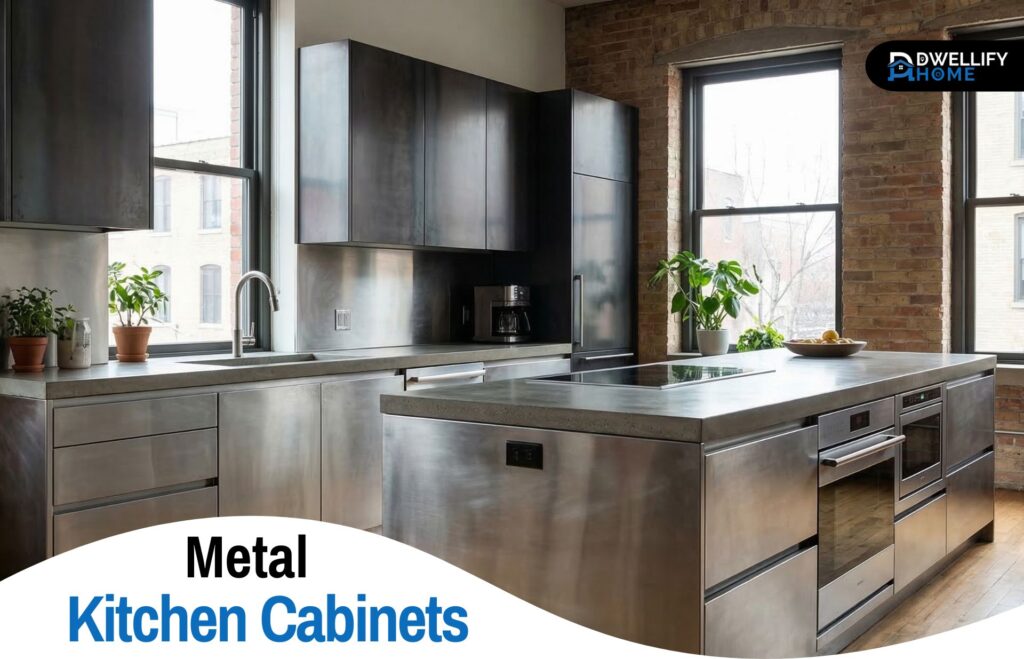
The industrial look is the most common entry point — raw edges, exposed hardware, flat-panel doors in brushed steel or matte black. It works particularly well in open-plan spaces with concrete floors or exposed ceilings.
Modern minimalist kitchens pair well with powder-coated metal in neutral tones. The surface stays uniform, clean, and completely flat, which suits handle-less or push-to-open designs.
Vintage metal kitchen cabinets bring a completely different energy — softer curves, pastel or two-tone finishes, and chrome hardware. This style fits mid-century restorations or anyone who wants personality over clinical precision.
Mixed-material kitchens — metal upper cabinets with wood lowers — are increasingly popular because they balance the industrial feel with warmth. Black metal cabinets paired with walnut wood surfaces, for example, is a combination that photographs and lives well.
Finishes That Change the Entire Look (and Maintenance Level)
The finish isn’t just aesthetic — it’s practical. Brushed finishes hide fingerprints and minor scratches far better than polished ones. Matte powder-coated finishes are the easiest to maintain in a family kitchen. High-gloss finishes look striking but demand more consistent cleaning.
Powder-coated surfaces are also more forgiving for color choices — you’re not limited to silver or gray. The coating bonds directly to the steel, provides a hard shell against chips, and is repairable in small areas if it chips.
One thing worth knowing: cheaper powder-coat finishes can peel or fade over time, especially near heat sources. Always ask about the coating thickness and curing process before buying.
How to Pair Metal Cabinets With Other Kitchen Materials
The most common worry I hear is that a metal kitchen will feel cold or sterile. That almost never happens when the materials around it are chosen well.
Wood countertops or open wood shelving bring warmth to metal cabinet fronts immediately. Stone and quartz surfaces — particularly warm-toned ones like cream quartzite or veined marble — complement brushed steel without competing with it.
Metal kitchen cabinets with a sink in stainless steel create a cohesive, professional look. It reads intentional, not mismatched. Exposed brick walls work well with industrial-style metal cabinets if the kitchen layout allows for it.
What Do Metal Kitchen Cabinets Actually Cost?
Stock metal cabinets — typically imported, standard sizes — run roughly $150 to $400 per linear foot installed. Semi-custom options sit in the $400 to $700 range. Full custom fabrication, where cabinets are built to your exact specifications, can push past $1,000 per linear foot.
Gauge thickness affects both cost and quality. 16-gauge steel is thicker and more rigid — it’s commercial grade. 18-gauge is the standard for quality residential use. 22-gauge is thinner and found in budget options; it dents more easily and flexes more during installation.
Where to Buy Metal Kitchen Cabinets
Specialty cabinetry fabricators are the best option for custom work — they’ll measure, build, and finish to your specs. For indoor metal kitchen cabinets in residential settings, look for suppliers who specify residential-grade finishes rather than commercial-only coatings, which can be harder to maintain in a home environment.
IKEA’s metal-adjacent options — particularly in their SEKTION and METOD lines — offer a practical middle ground for budget-conscious buyers. They’re not solid steel throughout, but the steel finishes and durable doors offer some of that aesthetic without the full cost.
For vintage metal kitchen cabinets, online marketplaces and architectural salvage stores are the best hunting grounds. Check condition carefully — look at the weld seams, hinge points, and interior coating. Surface rust on exterior panels is manageable; structural corrosion is not.
Vintage Metal Kitchen Cabinets: What to Know Before Going Retro
Buying vintage metal cabinets is not the same as buying new ones, and treating it that way leads to regret. The first thing to assess is the interior coating. Old cabinets sometimes have lead-based paint inside — test before you restore or install them in a food-contact environment.
The most collectible vintage brands — St. Charles, Youngstown, Geneva — are identifiable by their embossed logos and characteristic handle shapes. Parts and replacement hardware are available through specialty suppliers, which makes restoration more practical than most people assume.
What makes these cabinets worth the effort is the build quality. Many were made with thicker gauge steel than what you’ll find in budget modern options. Restored properly, they’re genuinely built to last another 50 years.
How to Care for Metal Kitchen Cabinets the Right Way
Stainless steel cabinets clean best with a microfiber cloth and a small amount of dish soap in warm water — always wipe in the direction of the grain. Avoid abrasive scrubbers and bleach-based cleaners, which can scratch the surface or break down the finish over time.
For powder-coated surfaces, mild soap and water is all you need. Avoid solvent-based cleaners — they can lift the coating if used repeatedly.
Install soft-close hinges from the start. The noise issue that comes up with metal cabinets is almost entirely a hardware problem, not a material problem. Quality hinges with built-in dampers make a significant difference in daily use.
If a powder-coated surface chips, small touch-up kits are available in matching colors. Catching it early prevents rust from forming underneath.
Are Metal Kitchen Cabinets the Right Choice for Your Home?
They’re genuinely worth it for certain households — and genuinely not the right call for others. Here’s an honest breakdown:
Metal cabinets tend to work best for people who cook frequently and want a hygienic, durable surface that doesn’t need replacing every decade. They suit modern, industrial, or minimalist design sensibilities. They’re a solid long-term investment if you’re renovating a home you plan to stay in.
They’re a harder sell for traditional or rustic interiors where the look simply doesn’t fit. In households with very young children who treat cabinets roughly, the denting risk is real. And if the budget is tight, the upfront cost is a legitimate barrier — there are better-value wood options in the mid-range that will serve most people well.
The mistake I see most often is people choosing metal for the look alone without thinking through how they actually use their kitchen. The look fades in importance. Daily function doesn’t.
FAQs
Are metal cabinets better than wood cabinets?
It depends on how you use your kitchen. Metal cabinets outperform wood in durability, moisture resistance, and hygiene — making them a strong long-term investment. Wood offers more design flexibility and is easier to repair after damage. For high-use kitchens or modern aesthetics, metal is the stronger choice. For traditional interiors or tighter budgets, quality wood still makes sense.
Are metal cabinets fireproof?
Not completely fireproof, but significantly more fire-resistant than wood. Steel and aluminum don’t ignite or contribute to the spread of fire the way wood does. In a kitchen fire scenario, metal cabinets are far less likely to fuel the situation — which is one reason they’ve been the standard in commercial kitchens for decades.
Are steel cabinets better than aluminum cabinets?
Steel is stronger, more rigid, and generally more durable under heavy use. Aluminum is lighter, naturally rust-proof, and better suited to very humid environments. For most residential kitchens, powder-coated steel is the better all-round choice. Aluminum makes more sense in coastal homes or spaces with consistently high moisture levels.
Are metal kitchen cabinets in style?
Yes — and not just as a passing trend. The industrial and modern minimalist design directions that have dominated residential interiors for several years both lean heavily on metal cabinetry. Powder-coated options in black, white, and neutral tones have broadened the appeal well beyond purely industrial spaces. Vintage metal cabinets from mid-century brands have also developed a genuine collector following.
What finish is easiest to maintain on metal kitchen cabinets?
Matte or brushed powder-coated finishes are the easiest to live with day to day. They hide fingerprints, minor scuffs, and cleaning streaks far better than polished or high-gloss finishes. If you have a busy household, avoid high-gloss stainless steel on door fronts — it shows everything.
Conclusion
Metal kitchen cabinets are a serious option for the right buyer — not a trend, not a novelty. When they’re chosen for the right reasons and installed with quality materials and hardware, they deliver a level of durability and hygiene that wood cabinets simply don’t match.
The key is going in with clear expectations. Know your finish, know your gauge, know how your household actually lives in the kitchen. Get those things right, and a metal kitchen won’t just look good on day one — it’ll still be performing well 25 years from now.
That’s the kind of investment worth making.
Disclaimer
The information on Dwellify Home is intended for general guidance only. Costs, product availability, and specifications vary by region and supplier. Always consult a qualified contractor or cabinetry professional before making final renovation decisions.

I’m Bilal, the founder of Dwellify Home. With 6 years of practical experience in home remodeling, interior design, and décor consulting, I help people transform their spaces with simple, effective, and affordable ideas. I specialize in offering real-world tips, step-by-step guides, and product recommendations that make home improvement easier and more enjoyable. My mission is to empower homeowners and renters to create functional, beautiful spaces—one thoughtful update at a time.