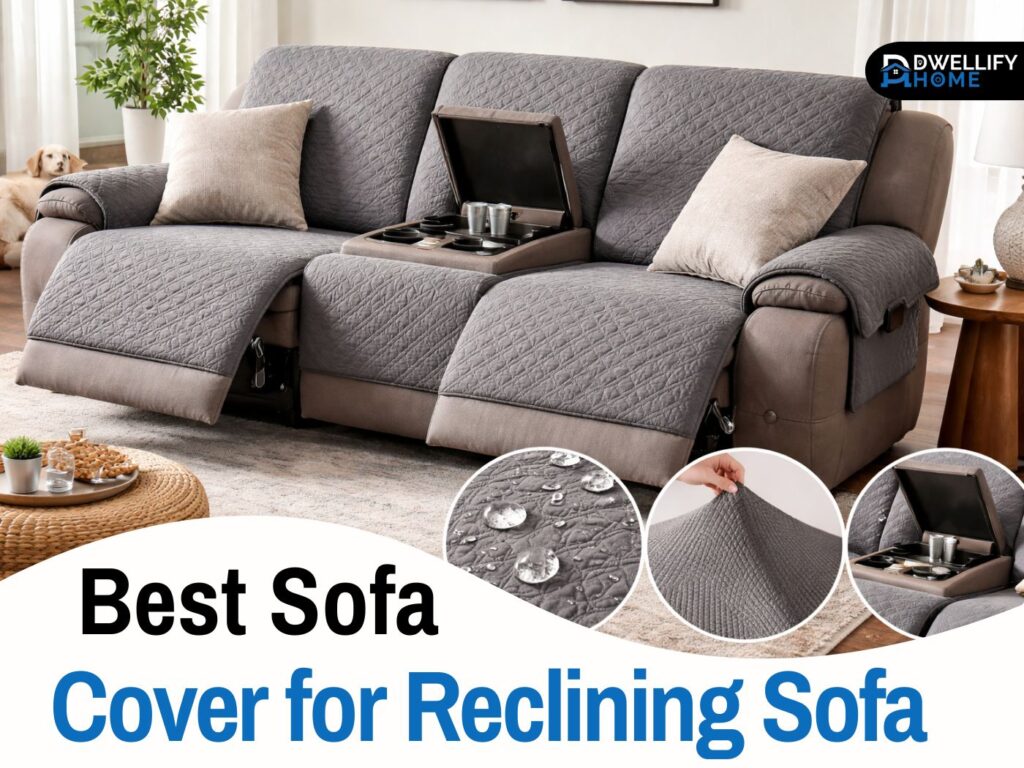
A reclining sofa is one of the hardest pieces to cover neatly. It isn’t just the shape, it’s the movement. Footrests slide out, backs tilt, and some models have consoles, cup holders, or power buttons that you still need to reach.
After fitting and tailoring covers for recliners for over a decade, I’ve learned one thing. The best-looking setup is the one that respects the mechanism. If a cover pulls tight over the footrest joint or bunches near the seat hinge, it won’t last, and it’ll feel annoying every time you recline.
This guide walks you through fit, fabrics, measuring, installation, and the common mistakes that make covers slip or block movement. You’ll be able to choose something that protects your sofa and still lets it recline smoothly.
Snippet-ready definition:
A sofa cover for reclining sofa models is a protective fitted or multi-piece cover made to handle moving footrests and backrests. People use it to prevent stains, wear, and pet hair while keeping recline functions usable.
Mission Statement:
At Dwellify Home, our mission is to make everyday home upgrades feel simple and practical, with clear advice that helps you choose better-fitting, longer-lasting solutions that look good and work in real life.
Quick fit check (avoid the #1 reason people return covers)
Most cover problems come down to fit. Not style, not color. Fit. Recliners need room to move, but not so much fabric that it balloons or slides around.
A good cover should sit smooth when the sofa is closed, and still allow the footrest to extend without dragging the whole cover forward. That balance starts with three quick measurements.
The 3 measurements that matter most for recliners
First, measure the full width from outside arm to outside arm. That tells you whether you’re in a 2-seater or a 3-seater range, and it helps you avoid covers that are simply too narrow.
Second, measure the seat width per sitting area if the recliner has separate seats. On many 3-seater recliners, only two seats recline and the middle seat is fixed. That changes how a cover should be cut and where straps should sit.
Third, measure the reclined length with the footrest fully extended. This one gets skipped constantly. If the cover is too short front-to-back, it’ll tug, creep, and eventually tear around the footrest seam.
Quick Guide Table (comparison)
| Your Situation | Best Cover Type | Best Fabric Choice | Key Feature to Look For |
| Daily reclining, want a neat look | Multi-piece or split-seat set | Stretch blend or jacquard | Under-seat straps + deep tuck points |
| Kids, frequent spills | Fitted or multi-piece | Waterproof layered fabric | Waterproof backing + washable |
| Pets (hair, claws) | Multi-piece or thick fitted | Microfiber or textured weave | Durable fabric + easy wash |
| Leather recliner (slips easily) | Fitted with strong anchoring | Microfiber or grippy stretch | Anti-slip backing + strong elastic |
| Console or cup holders | Console-specific design | Stretch blend or microfiber | Console panel and stitched openings |
Mini step-by-step: Measure a reclining sofa correctly
- Width (arm to arm): measure the full outside width.
- Seat width per section: measure each seat if seats recline separately.
- Reclined length: extend the footrest fully and measure front to back.
- Check special features: note console, cup holders, and power controls so they stay accessible.
Types of recliner sofa covers (choose the right style for your exact sofa)
Recliners come in a few common layouts. The cover type that works best depends on whether your sofa reclines as one piece, reclines seat-by-seat, or has built-in features like a console.
When I’m helping a homeowner pick a cover, I start by matching the cover style to the motion points. If the cover style fights the motion, it will always look messy, no matter how expensive it is.
One-piece stretch slipcovers can work well on simple reclining sofas where the arms and back have a clean shape and the footrest doesn’t pull too far forward. They’re usually the easiest option and they give a tidy look fast.
Multi-piece covers, like split seat designs or panel-style sets, usually fit reclining sofas better. Each seat section can move more freely, and the cover doesn’t have to stretch across hinges and gaps.
Throw-style protectors are another option. They’re quick and great for pets, but they shift more when the sofa is used daily. I usually suggest these for casual protection rather than a tailored look.
If you have a sofa cover for reclining sofa with console, look for a design made for consoles. You want a separate console panel or a shaped middle section so the lid can open and the storage stays usable.
For recliner couch covers with cup holders, pay attention to how the openings are made. Some have stitched openings, others rely on stretch. Stitched openings hold shape better, especially if you actually use the holders often.
Best fabric sofa cover for reclining sofa (comfort, grip, durability)
Fabric choice is not just about feel. It’s also about grip and how the cover behaves when the sofa moves. Two covers can look similar online, but one will slide all day and the other will stay put.
I also think about the home itself. A quiet living room with adults needs a different fabric than a family room with kids, snacks, and pets climbing up and down.
Stretch sofa cover for reclining sofa (spandex blends)
Stretch blends are often the easiest route to a clean fit. They hug the shape, smooth out quickly, and handle daily reclining without looking baggy.
A good stretch cover should bounce back after you stand up. If it feels thin and loose out of the box, it’ll relax even more after a few washes.
Microfiber
Microfiber is a solid choice when you want a soft feel and good stain resistance. It tends to grip better than slick fabrics, which helps on leather or smooth upholstery.
It’s also forgiving on high-use sofas. Minor wrinkles and paw marks don’t show as much compared to flat cotton-like weaves.
Jacquard and textured weaves
Textured fabrics like jacquard are great when you want a more finished look. The pattern helps hide wear, and it can make the cover look closer to real upholstery.
These covers often feel thicker too, which helps them drape nicer and resist shifting.
Velvet and plush fabrics
Velvet covers can look warm and feel comfortable, especially in colder months. The downside is that velvet shows pressure marks and lint more easily.
If you go velvet, I suggest choosing a snug fit with strong elastic edges. Loose velvet slides and bunches faster than most people expect.
Waterproof vs water-resistant (what those labels really mean)
This part needs clarity because the words get used loosely. Water-resistant usually means the fabric can handle a small spill for a short time. Waterproof usually means there’s a barrier layer that blocks liquids from reaching the sofa.
That barrier layer is helpful in a busy home, but it can make the cover feel warmer and less breathable. I’ve had clients love waterproof covers in winter, then switch to a lighter option for summer.
If your main goal is protection from frequent spills or accidents, recliner sofa covers 3 seater waterproof options can make sense, especially in family rooms. Just check that the waterproof layer doesn’t make the fabric stiff around hinges and footrests.
A practical tip from real jobs. If a cover is waterproof but doesn’t fit well, it will still fail. Liquid finds gaps at the seams and edges. Fit matters just as much as fabric.
2-seater vs 3-seater recliner sofa covers (how sizing actually works)
Sizing labels can be confusing. A “2-seater” might mean a loveseat, or it might mean two reclining seats with a middle console. A “3-seater” might have two recliners plus a fixed center seat.
Recliner sofa covers 2 seater designs often struggle at the center gap. If the seats sit apart slightly, the cover can sag into the space and look sloppy. Multi-piece designs help here because each seat section is handled separately.
For recliner sofa covers 3 seater, the biggest issue is usually the arm-to-arm width and where the straps land underneath. On wide models, straps end up pulling at odd angles, which causes the cover to creep forward.
Here’s what I do in practice. I choose the size based on full width, then confirm the reclined length, then check whether the sofa has two or three moving footrests. That tells me whether I need a split design instead of a single-body cover.
Special designs: console recliners and cup-holder recliners (details most articles skip)
Console recliners are convenient, but they require more planning. If the cover blocks the console lid or tightens around the hinges, the whole sofa feels awkward.
Sofa cover for reclining sofa with console
Look for a design with a dedicated console section, not just a straight piece stretched across the middle. A proper console cover usually has a separate panel or a shaped section that keeps the lid accessible.
Also check that the cover doesn’t cover charging ports or power buttons. On power recliners, I often recommend covers with clear seams and flexible edges around the control area so you can reach controls without tugging.
Recliner couch covers with cup holders
Cup holders are usually placed where fabric wants to bunch. If the cover has stitched openings, it stays neater and doesn’t stretch out as quickly.
If the cover relies on stretch only, it can work, but choose a thicker stretch fabric and avoid oversized sizing. Oversized plus cup holders equals constant shifting.
How to install a sofa cover on a reclining sofa (clean look in minutes)
Installation is where a lot of people lose patience. The trick is to start with alignment, not tucking. If you tuck first and align later, you’ll redo it.
Start with the sofa in the closed position. Lay the cover out, find the front and back tags if there are any, and drape it evenly from the center outward.
Next, align the seams with the sofa’s natural lines. Get the arm seams sitting where the arms start, and the back seam sitting at the top edge. Only after the seams look right should you begin deep tucking.
When you tuck, push fabric into the seat creases and along the arm gaps. Foam tuck sticks help a lot here. Then attach straps under the seats, but don’t over-tighten. Over-tight straps can pull the cover into the recliner joints.
Finally, test the recline. Extend the footrest slowly and watch where the fabric pulls. If it catches, loosen that area slightly and retuck deeper behind the seat.
How to keep a recliner sofa cover from slipping (pro fixes that work)
Slipping happens because recliners move. The cover shifts forward when you push back, and it shifts again when the footrest extends. You can reduce this a lot with the right setup.
First, choose covers with elastic hems and under-seat straps. Those two features do more than any pattern or thickness. Anti-slip backing can help, especially on leather, but it isn’t a substitute for fit.
Second, use foam tuck sticks in the seat crease and along the back crease. They create friction and keep fabric anchored. I’ve installed covers where foam sticks alone fixed 80 percent of the slipping.
If you still get movement at the arms, small furniture-safe grip strips can help. Use them sparingly and test in a hidden area first, especially if your sofa is leather or delicate fabric.
Choosing the best sofa cover for reclining sofa (match it to your household)
There isn’t one best cover for everyone. The right choice depends on what your sofa goes through every day.
For pets, I lean toward microfiber or textured fabrics that don’t trap hair deeply and can handle claws better. A washable cover matters more than a fancy weave. If pets lounge on the arms, look for thicker arm panels or add arm protectors.
For kids, stain resistance and easy washing are key. Water-resistant fabric works for light spills, but if you deal with frequent messes, a waterproof layer is worth considering.
For leather recliners, focus on grip. Smooth leather makes many covers slide. Look for elastic edges, strong straps, and a fabric that isn’t overly slick.
If you recline daily, choose a cover that respects motion. Split designs, panel sets, and high-stretch blends tend to hold up better because they move with the seats instead of fighting them.
Style and setup tips (make it look like it belongs, not temporary)
A cover should look intentional, not like something tossed on five minutes ago. Small choices make a big difference.
If your room is calm and neutral, a textured cover like jacquard can add interest without loud patterns. If your room already has strong textures, a simple solid microfiber or velvet can feel cleaner.
To avoid a wrinkled look, smooth the cover from the center outward after every install, then do a final tuck. I tell clients to spend two extra minutes on the first setup, because a well-tucked cover stays neat for weeks.
If you’re torn between a tailored multi-piece look and a casual throw, think about daily use. A throw is easy to remove and wash, but it will shift more. A fitted cover takes longer to install, but it looks better when the sofa is used often.
Care and cleaning (keep the fit and elastic from wearing out)
Covers fail early mostly because of washing and drying. Heat breaks down elastic and makes stretch fabrics relax.
Wash in cool to warm water and skip harsh cycles unless you truly need them. Use a mild detergent, and avoid heavy fabric softener on stretch blends because it can reduce grip.
Air drying is safest, but I know it’s not always practical. If you use a dryer, choose low heat and pull the cover out while it’s slightly damp. Then put it back on the sofa and smooth it into shape. It helps the cover keep its fit.
If your sofa has high-contact zones, like the main seat and armrest, rotate the cover sections if possible. Even a small rotation evens out wear over time.
FAQs
1) Can you put a couch cover on a reclining couch?
Yes, but it needs to allow movement. Choose a stretch or multi-piece cover that won’t pull tight over the footrest hinges or block the recline path.
2) Can you get sofa covers for recliners?
Yes. You’ll find loveseat and recliner sofa covers in stretch, panel-style, and waterproof options, including designs for consoles and cup holders.
3) How to dress a recliner sofa?
Start with a fitted cover that matches the recliner layout, then add coordinated pillows and a throw on the non-moving backrest area. Avoid bulky layers that catch when reclining.
4) What is a reclining couch called?
Common names include reclining sofa, recliner couch, motion sofa, and reclining loveseat (for 2-seaters). Power versions are often called power recliners or power motion sofas.
5) What’s the best way to stop a recliner cover from slipping?
Use the right size, tuck deeply into seat creases, and rely on elastic hems + under-seat straps. Foam tuck sticks help keep fabric anchored where it shifts most.
Conclusion
A sofa cover for reclining sofa models only works well when it respects the way the sofa moves. Measure the width, seat sections, and the fully reclined length, then pick a cover style that matches your layout, especially if you have a console or cup holders.
From there, fabric choice is about real life. Stretch blends for a snug fit, microfiber for daily durability, textured weaves for a more finished look, and waterproof options when spills are part of the routine.
If you remember one practical rule, it’s this. A cover that fits well and stays clear of the recliner joints will look better, feel better, and last longer. Once you get that part right, everything else becomes easy to maintain.
Disclaimer:
This article shares general upholstery and fit guidance based on real-world experience. Always check your recliner’s manual and cover manufacturer instructions, especially for power recliners, consoles, and delicate upholstery materials.

I’m Bilal Hassan, the founder of Dwellify Home. With 6 years of practical experience in home remodeling, interior design, and décor consulting, I help people transform their spaces with simple, effective, and affordable ideas. I specialize in offering real-world tips, step-by-step guides, and product recommendations that make home improvement easier and more enjoyable. My mission is to empower homeowners and renters to create functional, beautiful spaces—one thoughtful update at a time.