
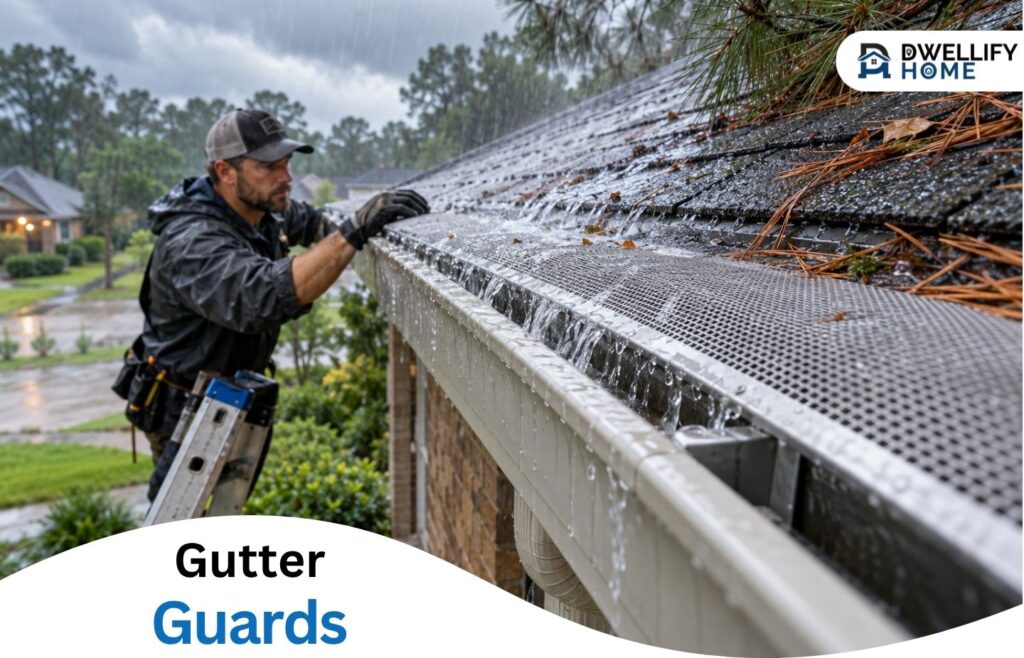
One week of spring storms dropped enough rain on my street to turn two yards into ponds. Both houses had newer gutters. Both had guards. Only one stayed dry, and the difference had nothing to do with looks and everything to do with how the system handled a full month of pine needles and shingle grit. If you live anywhere near the Gulf, that is the only test that matters. Guards that pass a single downpour and then clog by May are just expensive decoration.
You want water leaving your roof fast, debris staying out, and a setup you do not have to climb a ladder to fix twice a season. Austin, Katy, and Pearland all feel the same pattern: months of dry, then a week that empties the sky. A guard system has to handle both without warping, sagging, or letting a mat of seeds slide into the downspout. That is where most of the disappointment I hear about comes from. When neighbors ask who did the work on the house that stayed dry, the answer almost always leads back to expert gutter guard installation in Houston, and there is a plain reason for that.
Installation quality decides more than the product label. A guard that sits perfectly level on a bench in a warehouse will pool water on a real roofline if the hangers are spaced too far apart or the panel does not follow the pitch. Water has to want to move. The moment it hesitates at a seam, grit settles, and now you own a shallow planter tray instead of a drainage system. So the first question is never which brand. It is who is measuring the roof.
Why Houston breaks the guards that work in drier cities
Houston rain does not fall politely. The National Weather Service, run through NOAA, tracks the Gulf Coast as one of the wettest regions in the country, with storms that deliver a month of rain in an afternoon. That intensity matters because a guard’s real job is not catching leaves. It is keeping a high volume of water moving across its surface while the surface is buried under debris.
Then there is the other half of the problem: what grows here. According to the U.S. Department of Agriculture, warm, humid zones support dense tree canopies that shed pollen, seed pods, and needles in long overlapping cycles. A pine in your neighbor’s yard does not care about your maintenance schedule. It will fill a shallow guard, and a shallow guard is what most big box kits sell.
Materials fail differently here too. Steel rusts faster near the coast, and cheap plastic turns brittle under UV long before it wears out mechanically. Seamless aluminum handles the humidity without complaint. Copper will outlast everything, including your roof, and looks better every year it ages. I would pick aluminum in almost every case, because the money you save on copper buys you a much better installation, and installation is the part that actually fails.
The Grit Test: a quick check before you sign anything
I use a simple filter when a homeowner asks me to weigh in on a quote. Call it the Grit Test. It scores any guard system on three things that decide whether you will be happy next October: how it handles fine debris, how it handles flat rooflines and shallow pitch, and how easily you or a contractor can get back inside the channel if the first two go wrong. Any system that fails one of those three gets a no from me, no matter what it costs.
| Guard type | Fine debris (pollen, grit) | Heavy rain flow | Serviceable later
|
| Snap in mesh panels | Clogs in fine debris | Good at first | Difficult to reseat |
| Foam inserts | Worst in this category | Slows on high volume | Replace, not clean |
| Bottle brush strips | Catches everything | Beehive scenario | Pull and toss |
| Reverse curve and micro mesh | Strong on grit | Strong if pitched right | Removable sections |
The failure I see most often is foam. It looks tidy on installation day and turns into a wet sponge within a season or two, especially under pine. Bottle brush is the opposite extreme, a bristly tube that collects seed pods like a lint roller collects sweater fuzz. Neither one is malicious. They just were not designed for a climate that rains this hard this often.
What the installation day should actually look like
Ask any homeowner who has been through this what they remember, and it is almost never the panels. It is whether the crew checked the rest of the system before covering it up. Guards over failing gutters just hide the problem, and hidden water goes straight into your fascia and foundation. Walking the perimeter during a storm and watching where water lands tells you more than any brochure. Check your grading against the runoff basics covered by the Environmental Protection Agency and you will spot pooling fast.
Here is the sequence a competent crew follows, and you should see all of it or ask why not:
- Rinse the gutters before any guard goes on, and confirm the downspouts drain at full speed.
- Repair or replace sagging hangers and reseal failed seams first.
- Panel sections on your driveway, following the actual pitch of each roofline rather than a template.
- Never two in the same place, or you will need to pull that section for the rest of its life.
Installation is fast, usually a single day for a standard Houston home. Larger houses with multiple rooflines take longer, and that is a good sign, not a bad one. Speed is not the goal. Water control is. A team that rushes the pitch check is a team that will hand you a pooled gutter by the first real storm.
A maintenance rhythm that takes twenty minutes
Guards reduce cleaning, they do not erase it. Twice a year, spring and late fall, walk the perimeter after a hard rain and look for water sheeting over the front edge instead of running to the downspout. Look at the ground below the downspout outlet. If you see a fan of grit or staining on the concrete, debris is getting through somewhere.
Anything you cannot see from the ground, leave alone. The single biggest source of damaged gutters I run into is a homeowner on a ladder pulling at a panel to check underneath it. Those clips are not meant to be cycled twice a year. If water is pooling near your foundation after a storm, that is your signal, and it is a call, not a DIY ladder project. Standing water against a slab is how small drainage issues turn into foundation quotes, and you do not want that bill in August.
Keep the roof clear too. A healthy canopy is a tradeoff, and the tree that shades your living room in July is also the tree feeding your gutter every April. Managing that tension is the whole game in this climate.
What I would do on my own house
Reverse curve or micro mesh panels, seamless aluminum, installed by a crew that measures pitch and fixes the gutter before covering it. I would skip anything sold as an all in one kit, because the failures I see are almost never random. They follow a pattern: too shallow for fine debris, too flexible to hold a line, or too permanent to open later. Fix the flow problem first, then decide what to cover it with, and you will not be redoing this next spring.
So what is your gutter actually doing during the next downpour? Go stand outside with an umbrella and watch. The answer will tell you more than any quote sitting in your inbox.
Disclosure: We may receive compensation from selected affiliate or sponsored links included in our articles. Any commissions earned help support Dwellifyhome.com and do not come at an additional cost to our readers.