
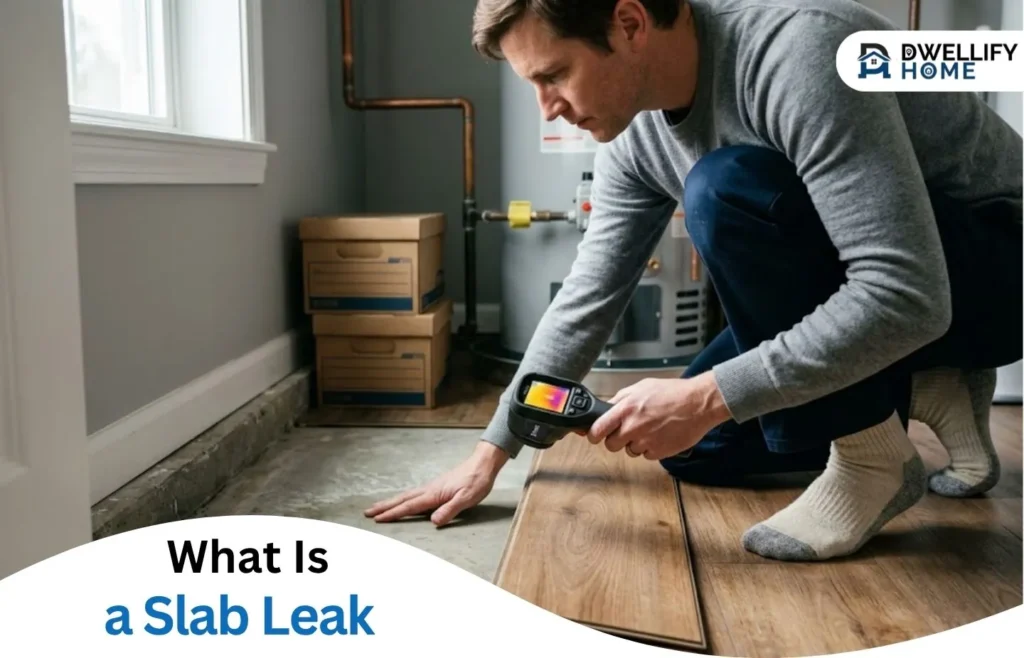
Your floor gives nothing away. That is the problem.
If your home sits on a concrete foundation, some of your water lines probably run underneath it. When one of those lines fails, there is no dripping ceiling and no puddle under the sink. There is just a slow loss you cannot see, sometimes for a year or more.
Most people find out when the water bill jumps or a patch of floor turns warm. Here is how to spot one earlier than that.
What Is a Slab Leak and Why It Hides So Well
A slab leak is a break or pinhole in the plumbing that runs beneath your home’s concrete foundation. It can happen on a hot water line or a cold one, and it can start from corrosion, abrasion, ground movement, or a pipe that was laid against a rock during construction.
The concrete creates the real difficulty. Water escaping under a slab takes the path of least resistance, so it often travels sideways through the gravel bed before surfacing anywhere. By the time you see evidence, the actual break may be fifteen feet away.
Early Signs of a Slab Leak Inside the House
Most of the early warnings are things people notice and then explain away. A slab leak usually shows up in one of these ways before anything dramatic happens.
The sound test
Pick a quiet moment at night. Turn off every faucet and appliance, then put your ear near the floor in a few rooms.
A faint hiss or rushing sound with nothing running ranks among the clearest signs you will get. If you hear it, note where it is loudest.
The warm floor test
Walk barefoot across the house. A hot water line leaking under the slab warms the concrete above it, and the difference is usually obvious.
Look for a spot that stays warm when nothing else does. Pets often find these first and start sleeping there.
Outside Signs of a Slab Leak
Not every sign is indoors. A slab leak frequently surfaces around the perimeter of the house, so walk the exterior too.
Check for damp soil along the foundation when it has not rained. Look for a crack in the driveway or patio that appeared recently and keeps getting wider. Grass or weeds growing noticeably faster in one strip near the house is another common tell.
Inside, watch for floors that feel uneven, tile that has started to lift at the grout line, or baseboards that are cupping.
How to Confirm a Slab Leak With Your Water Meter
The meter test is free and it takes an afternoon. Confirming a slab leak this way will not tell you where the break is, but it will tell you whether you have one.
Turn off every fixture and appliance that uses water. Write down the meter reading. Then leave it alone for three hours and do not use water at all.
Read it again. If the number changed, water is escaping somewhere in the system. Next, shut off the irrigation valve and repeat, which rules the sprinklers in or out.
What Causes a Slab Leak
Pipe material matters a lot here. Older copper lines corrode from the outside in when the surrounding soil turns chemically aggressive, and that causes more of the slab leak calls we take than anything else.
Abrasion is the second. A line that nobody sleeved properly rubs against concrete or gravel every time hot water expands it, and after a decade or two it wears through.
Then there is ground movement. Expansive clay soils swell and shrink with moisture, and that shifting puts stress on rigid pipe. Poor installation accounts for much of the rest.
How a Slab Leak Is Located Without Breaking the Floor
This is where I will say something that may save you money. You should never let anyone open your floor to go looking for a slab leak.
I spent 13 years in pool and water systems work before founding LeakLab, and the reason I started it was this exact problem. The trade treated leak location as guesswork, and homeowners paid for that guessing with jackhammers.
A proper diagnosis happens in order. First we confirm the loss, so nobody tests for a leak that does not exist. Then we isolate each line and pressure-test it separately, which narrows the problem to a specific run. Electronic listening equipment then pinpoints the escape point through the concrete. Dye testing verifies it last.
Done properly, professional leak detection ends with one marked spot on your floor and a written report. The repair crew opens a small square, not a trench.
What to Do the Day You Suspect a Slab Leak
Act in this order and you will limit what a slab leak costs you.
Shut off the main water supply if the loss is significant. Run the meter test to confirm. Photograph everything, including wet areas, cracks and the meter readings, because your insurer will want documentation.
Then call your insurance company before the repair, not after. Dwelling coverage often pays for slab damage caused by a sudden pipe failure, but it usually will not pay to repair the pipe itself. Knowing which part your policy pays for changes how you approach the job.
Frequently Asked Questions
How much does it cost to repair a slab leak?
Repair averages around $2,300 nationally, though it varies widely with access and the extent of the damage. Detection typically runs $150 to $600.
Does homeowners insurance cover a slab leak?
Sometimes. Coverage usually applies when a sudden covered event caused it. Insurers generally exclude foundation settling, wear and tear, root pressure and faulty construction, and most policies will not pay to fix the broken pipe itself.
Can a slab leak cause foundation damage?
Yes, and that is the real risk. Water under a foundation erodes the soil supporting it, which leads to settling and cracking. The longer it runs, the more expensive the outcome.
How long can a slab leak go unnoticed?
Months, and often more than a year. Slow leaks under concrete produce no visible water, which is why the warm floor and the water bill are usually the first clues.
Will my water bill definitely go up?
Usually, though a very small leak may hide inside normal seasonal variation. Compare the same month year over year rather than month to month.
Is a slab leak an emergency?
Treat it as urgent rather than an emergency. You have days, not minutes. But every week it runs adds to the soil erosion and the repair bill, so do not sit on it.
A few links in this article may be affiliate or sponsored links. If you buy something through an eligible link, Dwellifyhome.com may earn a small commission. This does not increase your purchase price and helps support our website.



